
Best AI Courses Online for Sales, Service, and L&D Teams

Sales, service, and L&D teams are being asked to “use AI” without always getting the training to do it safely, confidently, and in a way that actually moves revenue and customer outcomes. The good news is that AI courses online have improved quickly, and you no longer need a computer science background to learn what matters for frontline performance.
This guide focuses on the online AI learning options that fit revenue enablement and customer-facing work: building AI literacy, using generative AI tools responsibly, and translating knowledge into better conversations through practice.
What “AI training” should look like for sales, service, and L&D
If you search for AI courses online, you will find a lot of machine learning and coding content. That is useful for technical roles, but most sales and service teams need something different.
For customer-facing teams, strong AI training typically covers:
- AI literacy for business: what AI can and cannot do, where it helps, and where it fails
- Generative AI practical skills: prompts, workflows, summarization, analysis, and content drafting
- Customer data and governance: privacy, security, policy, and what should never go into a public model
- Role-specific use cases: prospecting research, call prep, objection handling, case summarization, knowledge base drafting
- Proof you can use it: practice, feedback, and measurable improvement (not just a completion certificate)
A simple way to think about it is: knowledge + behavior change. Courses handle the knowledge part well, and teams often still need a way to practice the behaviors repeatedly.
How to choose the best AI courses online for your team
The best course is the one your team completes, applies in the real world, and can be measured against performance outcomes.
Here are the evaluation criteria to use when comparing AI courses online.
| What to evaluate | What “good” looks like for sales/service/L&D | Red flags |
|---|---|---|
| Role relevance | Use cases for discovery, objection handling, customer support, coaching, content creation, QA | Purely technical content, little business application |
| Time to value | Learners can apply within a week (prompts, templates, checklists, workflows) | Long theory-only modules with no practice |
| Practice and feedback | Exercises, quizzes, scenario work, or assignments with feedback | Passive videos only |
| Governance coverage | Covers data privacy, security basics, and safe usage guidelines | Encourages uploading sensitive data into public tools |
| Measurement | Clear learning outcomes, skill checks, progress tracking | Completion-only metrics |
| Accessibility | Plain language, minimal prerequisites, mobile friendly | Requires coding background for basic objectives |
Match course format to how your teams actually learn
Sales and service teams often learn best in short, applied bursts. L&D teams may want deeper frameworks they can roll out internally.
Use this quick mapping:
| Team | Best-fit online AI training format | Why it works |
|---|---|---|
| Sales | Short modules plus practice scenarios | Reinforces talk tracks, objection handling, and confidence |
| Customer service / support | Microlearning plus workflow labs | Improves summarization, de-escalation, and consistency |
| L&D / enablement | Program-based learning plus internal rollout assets | Helps standardize training, policy, and measurement |
Best AI courses online (by goal) for sales, service, and L&D
Below is a practical shortlist organized by what teams usually need. Rather than claiming one “best” provider for everyone, this section helps you pick a track based on outcomes.
1) AI fundamentals for non-technical teams
These are ideal if your organization needs a shared baseline: definitions, risks, realistic capabilities, and “how to think” about AI at work.
Strong options to consider
- DeepLearning.AI (AI literacy and business-friendly courses): Great for explaining concepts in plain language and aligning teams on what AI is good for. Start at DeepLearning.AI.
- Coursera (broad catalog across business and tech): Useful when you want a structured pathway for mixed audiences (frontline, managers, operations). Explore options at Coursera.
- edX (university and enterprise-oriented programs): Helpful for organizations that want more formal learning experiences. Browse at edX.
Who this is best for: teams that feel behind, leaders rolling out AI policies, and L&D building a common language across departments.
2) Generative AI and prompting for productivity (sales and service workflows)
Most frontline value comes from applying generative AI to repetitive work: call prep, follow-up emails, meeting notes, knowledge base drafts, and internal summaries.
Strong options to consider
- Microsoft Learn (Copilot and AI productivity training): Useful if your organization runs on Microsoft 365 and wants practical guidance and adoption support. Start at Microsoft Learn.
- LinkedIn Learning (business-focused GenAI courses): Good for bite-sized training that fits busy schedules and supports manager-led rollouts. Browse LinkedIn Learning.
- Google Cloud Skills Boost (GenAI learning paths): Helpful if your organization is in the Google ecosystem and wants a structured path. Explore Google Cloud Skills Boost.
What “good” learners can do after: write prompts that produce consistent outputs, build reusable templates, and apply AI to their daily workflow without exposing sensitive data.
3) AI for customer experience and support operations
Service leaders often need AI training that covers consistency, compliance, and quality. That includes how AI can support agents (summaries, suggested replies), how to avoid hallucinations, and how to design workflows that protect customers.
Strong options to consider
- Vendor academies and enablement hubs (especially if you run major CRM/help desk platforms): These can be excellent because they connect AI features directly to workflows your agents already use.
- Cloud provider training (Microsoft, Google, AWS) when your CX tooling is tied to those ecosystems.
A useful benchmark here is guidance from the NIST AI Risk Management Framework, which is widely referenced for responsible AI practices. Even non-technical teams benefit from the core ideas: risk, governance, transparency, and monitoring.
Who this is best for: support leaders, QA, CX ops, and team leads who coach performance.
4) AI for L&D and enablement (designing training that sticks)
L&D teams are often tasked with:
- Creating internal AI guidelines and training programs
- Upskilling managers to coach AI usage
- Measuring adoption and behavior change
For L&D, the “best AI course online” is often the one that includes implementation assets: assessments, practice activities, and a rollout plan.
Strong options to consider
- LinkedIn Learning for practical change management and “AI at work” content that managers will finish.
- Coursera and edX when you need more structured programs and deeper content for L&D professionals.
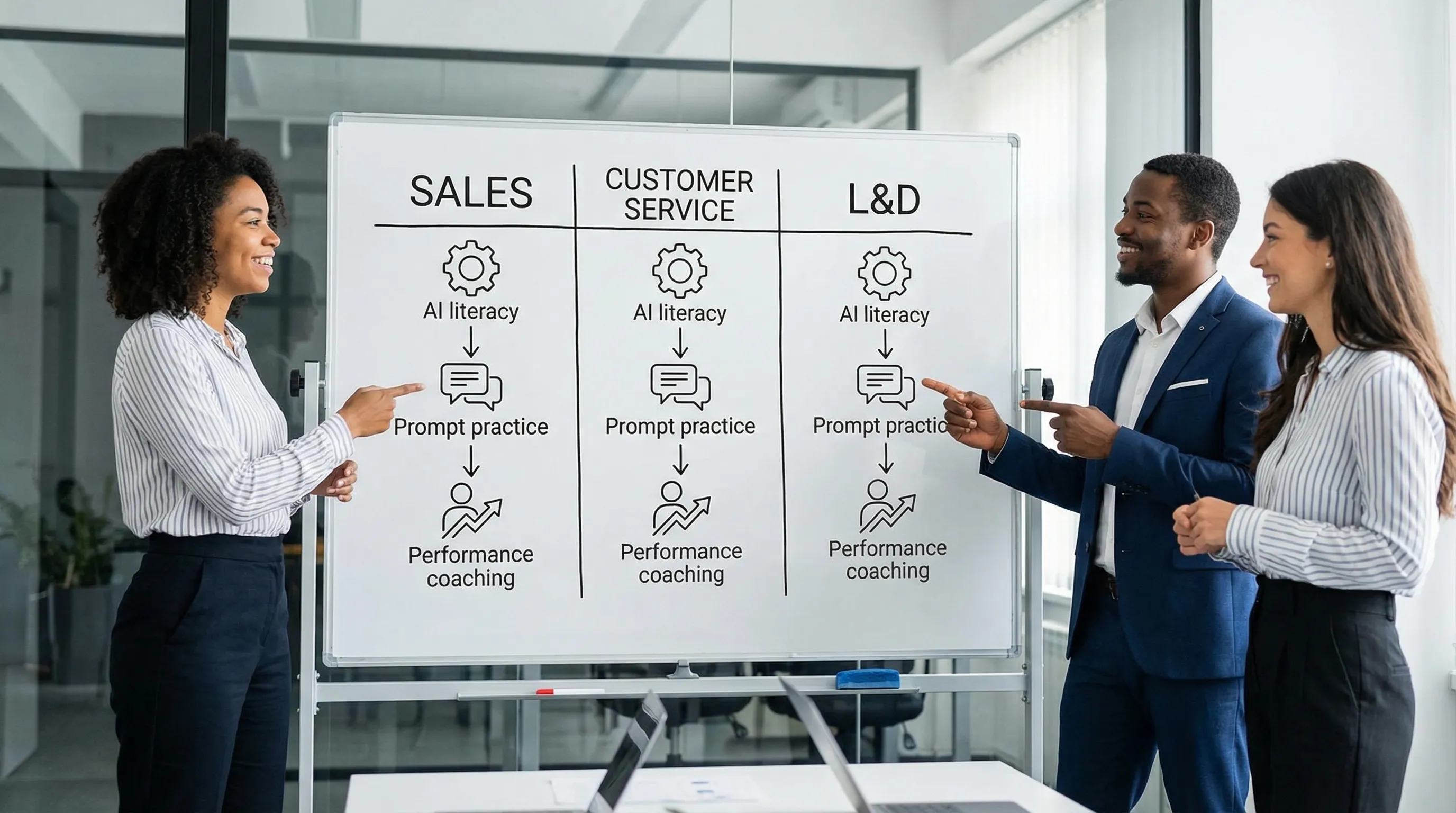
When you want to connect learning to behavior, look for content that emphasizes practice and coaching loops, not only content consumption.
5) Sales and service performance requires practice, not just courses
Courses can teach concepts, but sales and service performance changes when people practice realistic conversations repeatedly, get feedback, and improve.
That is where AI roleplay becomes a strong complement to AI courses online.
With Scenario IQ, teams can train through AI-driven, personalised scenario-based roleplay to build confidence and improve communication. Based on the product information provided, Scenario IQ focuses on:
- AI-powered roleplay simulations tailored to your environment
- Real-time feedback and adaptive guidance during practice
- Progress tracking analytics and performance dashboards to measure improvement
- Team-focused learning with customizable skill levels
- Enterprise-grade security to support organizational rollouts
For sales teams, this can translate into more consistent discovery, stronger objection handling, and better talk track execution. For service teams, it can mean more effective de-escalation, clearer explanations, and better consistency across shifts.
A practical learning path you can roll out in 30 days
If you are building an enablement plan, you will typically get better adoption with a clear sequence.
| Week | Focus | Outcome |
|---|---|---|
| 1 | AI fundamentals and policy basics | Shared language and safe usage standards |
| 2 | Generative AI workflows (role-specific) | Prompts and templates that save time |
| 3 | Quality and risk (hallucinations, verification, tone) | Higher accuracy and better customer experiences |
| 4 | Practice and coaching loop (roleplays, feedback, tracking) | Behavior change and measurable improvement |
This approach is intentionally simple. Teams first learn what AI is, then how to use it, then how to avoid common failures, and finally how to perform better with it.
Common mistakes when selecting AI courses online
Buying “AI training” that is really just tool demos
Tool training is useful, but it can become outdated quickly. Your team also needs durable skills: prompt patterns, verification habits, and communication best practices.
Ignoring measurement
If you cannot measure improvement, it becomes a compliance exercise. Look for ways to track:
- Completion and knowledge checks
- Skill progression over time
- Performance indicators that matter (conversion, handle time, CSAT, QA scores)
Skipping practice
Sales and service are performance disciplines. Without practice, confidence stays low and new habits do not form.
Frequently Asked Questions
What are the best AI courses online for sales teams? The best AI courses online for sales teams teach practical generative AI workflows (research, call prep, follow-ups), safe usage, and include practice. Many teams use platforms like Coursera, LinkedIn Learning, and Microsoft Learn, then reinforce with roleplay.
Do customer service teams need different AI training than sales teams? Yes. Service teams typically need more training on accuracy, tone, compliance, and de-escalation. Sales teams usually focus more on personalization, objection handling, and pipeline productivity.
How long does it take to get value from AI courses online? With the right course and a clear rollout plan, teams can apply useful workflows in days. Measurable performance change usually requires ongoing practice, coaching, and tracking over several weeks.
Should we teach prompting or AI fundamentals first? Start with fundamentals if your team lacks a shared baseline or you need policy alignment. Otherwise, you can teach prompting early, but include governance and verification habits immediately.
How do we turn AI training into behavior change? Pair AI courses online with repeated practice, feedback, and measurement. Scenario-based roleplay, coaching loops, and progress analytics are common ways to make training stick.
Build confident, customer-ready performance with Scenario IQ
AI courses online can give your teams the knowledge and workflows to work faster. If you want that learning to show up in real customer conversations, add consistent practice.
Scenario IQ delivers AI-driven roleplay simulations with real-time feedback and progress tracking so your sales, service, and L&D teams can build confidence, handle objections, and improve performance over time.
Explore Scenario IQ at scenarioiq.ai.