

Customer service is moving faster than any playbook most teams inherited. Customers expect instant answers, personalized help, and a smooth handoff when things get complicated. At the same time, service leaders are being asked to do more with less, often while rolling out new AI tools.
That is why “artificial intelligence and customer service” is not really a question of replacement. The highest performing service organizations use AI to remove friction and amplify great agents, while keeping humans in charge of the moments that require judgment, empathy, and trust.
This article breaks down where AI genuinely excels, where humans still win (and will for the foreseeable future), and how to design a practical operating model and training approach that makes the partnership work.
What AI is good at in customer service (when implemented well)
AI adds the most value when the job is high-volume, pattern-based, or requires fast retrieval across messy information.
Speed and consistency at scale
AI can deliver immediate responses 24/7, without queues. That matters for:
- Order status and delivery updates
- Password resets and account access flows
- Simple policy questions (returns, cancellations, warranties)
- Basic troubleshooting that follows a stable decision tree
When customer needs are predictable, AI can reduce handle time and free up humans for higher-value conversations.
Finding answers inside complex knowledge bases
Many service teams struggle with knowledge sprawl: outdated docs, multiple tools, and tribal knowledge trapped in senior agents’ heads. Modern AI can help retrieve relevant information quickly and suggest drafts, especially when paired with curated knowledge.
A useful mental model is: AI searches and summarizes, humans verify and decide.
Behind-the-scenes assistance for agents
Some of the best customer service AI wins are invisible to customers:
- Conversation summaries and after-call notes
- Suggested next best actions based on policy and context
- Automated QA signals (for example, missed steps or risky language)
- Pattern detection across thousands of tickets (emerging product issues)
These uses can improve speed without turning the customer experience into “bot vs human.”
Predictive routing and workload balancing
AI can classify intent, detect urgency, and route cases to the right team faster. That can reduce transfers, shorten resolution times, and protect specialized teams from being overwhelmed by misrouted work.
Where humans win in customer service (and why it matters)
Even with strong automation, customers still want humans when:
- The issue is novel, ambiguous, or emotionally charged
- They need an exception, a compromise, or a judgment call
- They are evaluating trust (especially for high-stakes purchases)
- They feel stuck in a loop and want ownership
Humans win because service is not only information delivery. It is relationship management under constraints.
Empathy, de-escalation, and trust-building
When a customer is angry, scared, or embarrassed, the first job is emotional alignment. Humans can:
- Read between the lines and adapt tone dynamically
- Make customers feel heard without sounding scripted
- De-escalate tension with authentic accountability
AI can assist with suggested language, but customers often detect “template empathy.” The agent’s credibility is what restores trust.
Judgment in edge cases and policy tradeoffs
Real service work is full of exceptions: partial refunds, goodwill credits, shipping replacements, warranty gray areas, and multi-step investigations.
Humans are better at balancing:
- Policy vs long-term customer value
- Risk vs customer fairness
- Speed vs accuracy
Owning complex outcomes across systems
Customers do not care about your org chart. They care that someone is accountable.
When an issue spans billing, product, logistics, and security, humans win by:
- Orchestrating across teams
- Explaining what is happening in plain language
- Setting expectations and following up
Revenue-protecting service conversations
Service is often a retention and expansion moment. Humans outperform when:
- The customer is considering cancellation
- Objections require discovery and negotiation
- The solution is not a single “best answer,” but a tailored recommendation
AI can provide talking points, but humans close the loop with credibility and rapport.
A practical model: automate, augment, escalate
Instead of asking “Should we use AI?”, service leaders get better results by designing where AI fits in the customer journey.
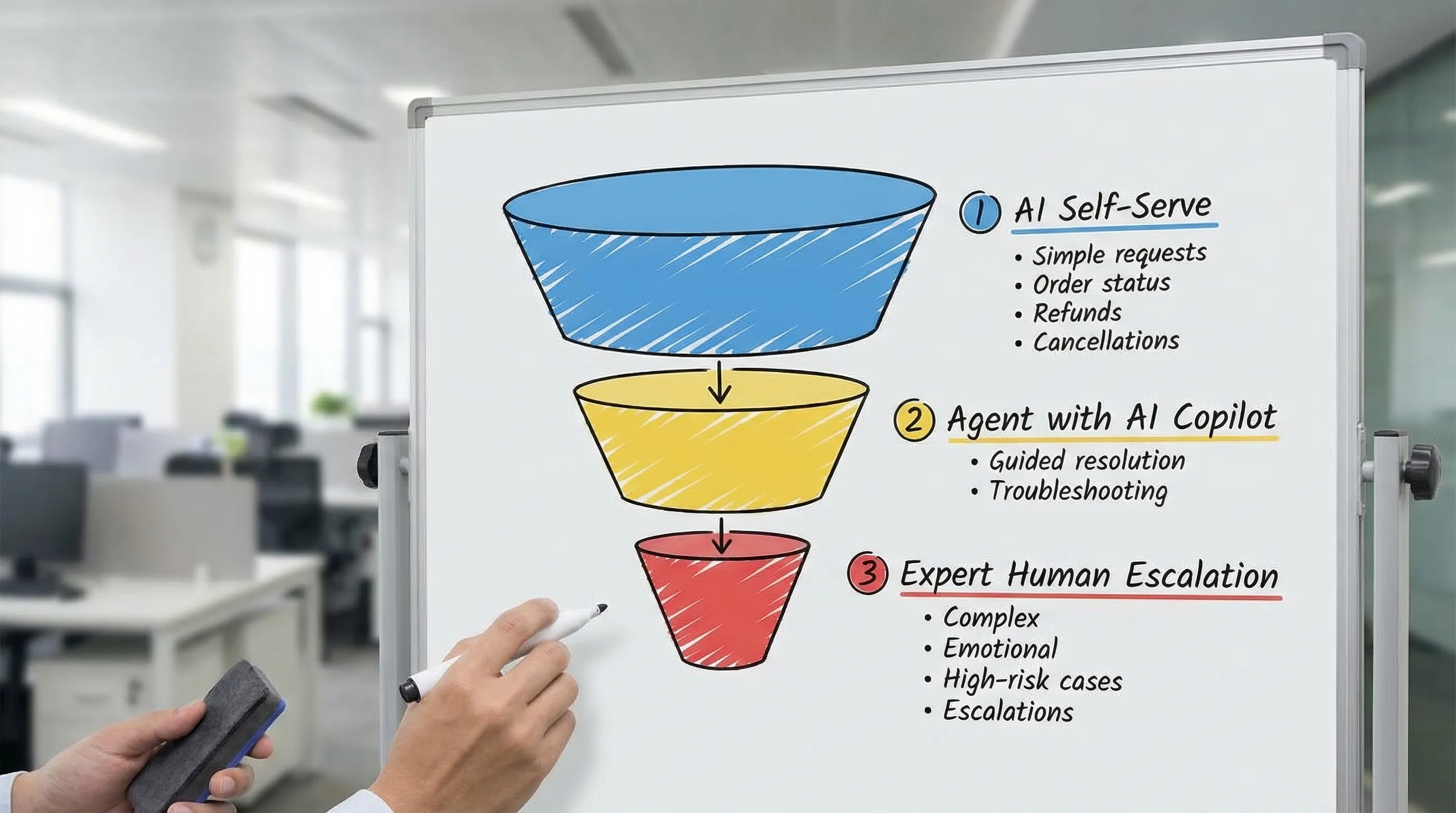
Layer 1: AI self-serve (low risk, high volume)
Use AI for repetitive tasks with clear success criteria. Keep the exit ramp obvious:
- “Talk to an agent” should be easy to find
- Customers should not have to repeat context when they escalate
Layer 2: Human agents with AI copilot (most interactions)
This is the sweet spot for many teams. AI supports agents with:
- Fast knowledge retrieval
- Draft responses the agent can refine
- Checklists for compliance steps
- Summaries and disposition suggestions
The key is governance: the agent remains accountable for what is sent.
Layer 3: Human experts (high stakes)
Route complex or sensitive cases to senior agents early. Examples include:
- Fraud and security concerns
- Safety issues
- VIP or enterprise accounts
- Legal or compliance-sensitive scenarios
AI can still help with summarizing and documentation, but it should not drive decisions.
How to decide what should be AI-led vs human-led
A simple way to evaluate a workflow is to score it on four dimensions:
- Emotional intensity: will the customer be anxious, angry, or vulnerable?
- Business risk: can the interaction create regulatory, reputational, or financial exposure?
- Ambiguity: does resolution require investigation and judgment?
- Reversibility: if the outcome is wrong, is it easy to fix?
Use AI-led experiences when emotional intensity and risk are low, ambiguity is low, and outcomes are reversible.
Here is a quick reference table to guide decisions.
| Service moment | AI can lead when… | Humans should lead when… | Common failure mode to prevent |
|---|---|---|---|
| FAQs and policy questions | Policy is stable and clearly documented | Policy has exceptions or depends on account context | Confident but wrong answers |
| Order status, appointment updates | Data is reliable and real-time | Data is delayed, missing, or disputed | Bot loops with no escalation |
| Troubleshooting | Steps are known and measurable | Symptoms are unclear, intermittent, or safety-related | Overlong scripts that frustrate customers |
| Refunds and credits | Rules are strict and bounded | Customer needs a judgment call or retention save | Inconsistent goodwill decisions |
| Cancellations | Simple plans with clear terms | Objections, negotiation, or high-value accounts | Robotic responses that increase churn |
| Complaints and escalations | Low severity and easily reversible | High emotion, brand risk, or regulatory exposure | Tone mismatch and lack of ownership |
The hidden challenge: AI changes the agent job
When AI enters service workflows, the agent’s job shifts from “know everything” to:
- Validate information quickly
- Apply judgment and policy tradeoffs
- Communicate with empathy and clarity
- Use AI suggestions without sounding automated
Teams that skip training often see new problems:
- Agents over-trust AI drafts and send inaccuracies
- Tone becomes generic, hurting CSAT
- Compliance language is missed because agents move faster
This is where scenario-based practice matters.
What to train for in an AI-enabled service team
Service training is most effective when it mirrors real conversations and pressure. Focus on skills like:
- Escalation control: when to move from AI self-serve to human ownership
- Verification habits: how to fact-check AI suggestions against source-of-truth systems
- De-escalation language: reflective listening, clear accountability, expectation setting
- Objection handling: cancellation saves, policy pushback, pricing complaints
- Brand voice: sounding human, consistent, and confident, not templated
- Risk awareness: privacy, security, and compliance-safe phrasing
AI roleplay tools can accelerate this because they allow repeated practice without needing a manager to act as the customer.
How Scenario IQ supports human excellence (with AI roleplay)
Scenario IQ is designed for AI-driven, personalized scenario-based training that improves communication, confidence, and performance across teams.
Based on the platform capabilities provided, Scenario IQ can help service organizations by enabling:
- AI-powered roleplay simulations to practice realistic customer conversations
- Personalized training scenarios aligned to your workflows and customer situations
- Real-time feedback to reinforce better phrasing, structure, and decision-making
- Progress tracking analytics and performance dashboards to see improvement over time
- Adaptive guidance and customizable skill levels so beginners and advanced reps both improve
The practical advantage is repetition and consistency: teams can practice high-stakes moments (angry customers, cancellation calls, policy exceptions) until the right responses become natural.
To explore the platform, visit Scenario IQ.
Metrics that keep AI and humans aligned
If you only measure speed, AI will win and the experience may lose. Balanced scorecards work better.
| Metric | What it tells you | How AI can help | What to watch |
|---|---|---|---|
| First Contact Resolution (FCR) | Were issues solved without repeat contacts? | Better routing, better knowledge retrieval | AI answers that “close” tickets but do not solve |
| CSAT | Perceived experience quality | Faster responses, better consistency | Templated tone can reduce trust |
| Time to Resolution | End-to-end speed | Summaries, routing, reduced admin | Speed that sacrifices accuracy |
| Transfer rate | How often customers get bounced | Intent classification and routing | Over-confident routing that mislabels complex issues |
| Reopen rate | Quality of resolution | Better agent guidance | Hidden defect when AI encourages premature closure |
| Compliance adherence | Risk management | Automated checklists and QA flags | Agents skipping verification steps |
| Agent confidence (survey) | Readiness and retention signal | Training and coaching recommendations | Burnout if AI increases monitoring without support |
A strong practice is to review a sample of AI-assisted interactions weekly for accuracy, tone, and compliance, not just operational metrics.
Risk and governance: where teams get burned
AI can raise customer experience and productivity, but only with clear guardrails.
Hallucinations and overconfidence
Generative AI can produce plausible but incorrect statements. Mitigations include:
- Limit AI responses to approved knowledge sources
- Require citations or links inside internal agent tools
- Train agents to verify before sending
For risk frameworks, the NIST AI Risk Management Framework is a widely referenced starting point.
Privacy and data handling
Service conversations can include sensitive personal data. Make sure your AI deployment aligns with your security and compliance posture, including access controls and retention rules.
Bias and uneven experiences
Routing, prioritization, and tone recommendations can create inconsistent treatment across customer segments. Monitor outcomes and audit decision rules.
Over-automation that damages loyalty
A common failure is using AI to block agent access. Customers remember friction more than efficiency. A simple principle helps:
Automate convenience, not accountability.
A rollout approach that protects experience
Start with a journey map and a shortlist of high-impact moments
Pick a handful of workflows where AI can reduce friction without raising risk, then define what “good” looks like in measurable terms.
Pilot with training, not just tooling
Before broad rollout, equip agents to work with AI effectively. Scenario-based roleplay is ideal for practicing:
- When to trust AI suggestions
- How to correct tone and personalize
- How to handle escalations and exceptions
Scale with continuous coaching loops
As products, policies, and customer expectations change, your training has to keep up. Use analytics to identify where reps struggle most (for example, cancellations, billing disputes, angry callers) and deploy targeted practice scenarios.
Frequently Asked Questions
Will artificial intelligence replace customer service agents? In most organizations, AI reduces repetitive work and supports agents, but humans remain essential for complex, emotional, high-risk, and relationship-driven interactions.
What are the best use cases for AI in customer service? High-volume, low-risk tasks like FAQs, order updates, basic troubleshooting, routing, and agent assist features such as summarization and knowledge retrieval.
Where do humans outperform AI in customer service? Empathy, de-escalation, judgment in edge cases, cross-team ownership, and retention conversations where trust and negotiation matter.
How do you prevent AI from giving incorrect answers to customers? Constrain AI to approved knowledge sources, keep a clear escalation path to humans, and train agents to verify AI suggestions before sending.
What skills should agents learn for AI-enabled customer support? Verification habits, clear writing, brand voice control, de-escalation, objection handling, and knowing when to escalate to expert support.
How can AI roleplay training improve customer service performance? It enables realistic practice at scale, consistent coaching, and targeted repetition for difficult scenarios, helping agents build confidence and better communication habits.
Build a service team where humans win, supported by AI
AI can handle speed, search, and scale. Humans win the moments that define loyalty: the apology that feels real, the judgment call that feels fair, and the ownership that makes a customer exhale.
If you want your team to thrive in an AI-enabled service environment, practice matters as much as tooling. Scenario IQ provides AI-powered roleplay simulations, personalized scenarios, and real-time feedback to help agents build confidence and handle objections and escalations more effectively.
Learn more at Scenario IQ.