

Most sales and service teams “know the talk track” until they are on a live call, the customer interrupts, the tone shifts, and a simple question turns into an objection spiral. Traditional training helps, but it is often inconsistent: shadowing depends on who is available, roleplays depend on who is willing, and coaching usually happens after the fact.
AI voice chat for training real customer conversations solves a different problem than generic e-learning. It gives your team a safe place to practice realistic spoken dialogue, build muscle memory for objections, and get immediate, repeatable feedback, without waiting for the next call or the next manager 1:1.
Why voice practice is different from chat or scripts
Voice conversations add pressure and complexity that slides and text drills do not capture:
- Tone and pacing: sounding confident, curious, or calm matters as much as the words.
- Interruptions and overlap: real customers do not wait for your full pitch.
- Silence and thinking time: long pauses can feel like uncertainty.
- Emotional cues: frustration, skepticism, urgency, confusion.
- Call control: knowing when to ask, when to summarize, and when to close.
If your team is expected to perform on calls, they need practice that feels like calls.
What “AI voice chat training” actually is
AI voice chat training is a voice-based roleplay simulation where a learner speaks naturally and the AI responds like a customer, prospect, or stakeholder. Under the hood, most systems combine:
- Speech-to-text (to understand the learner)
- A conversational AI model (to generate an in-character response)
- Text-to-speech (to respond out loud)
- A scoring and coaching layer (to evaluate what happened and guide improvement)
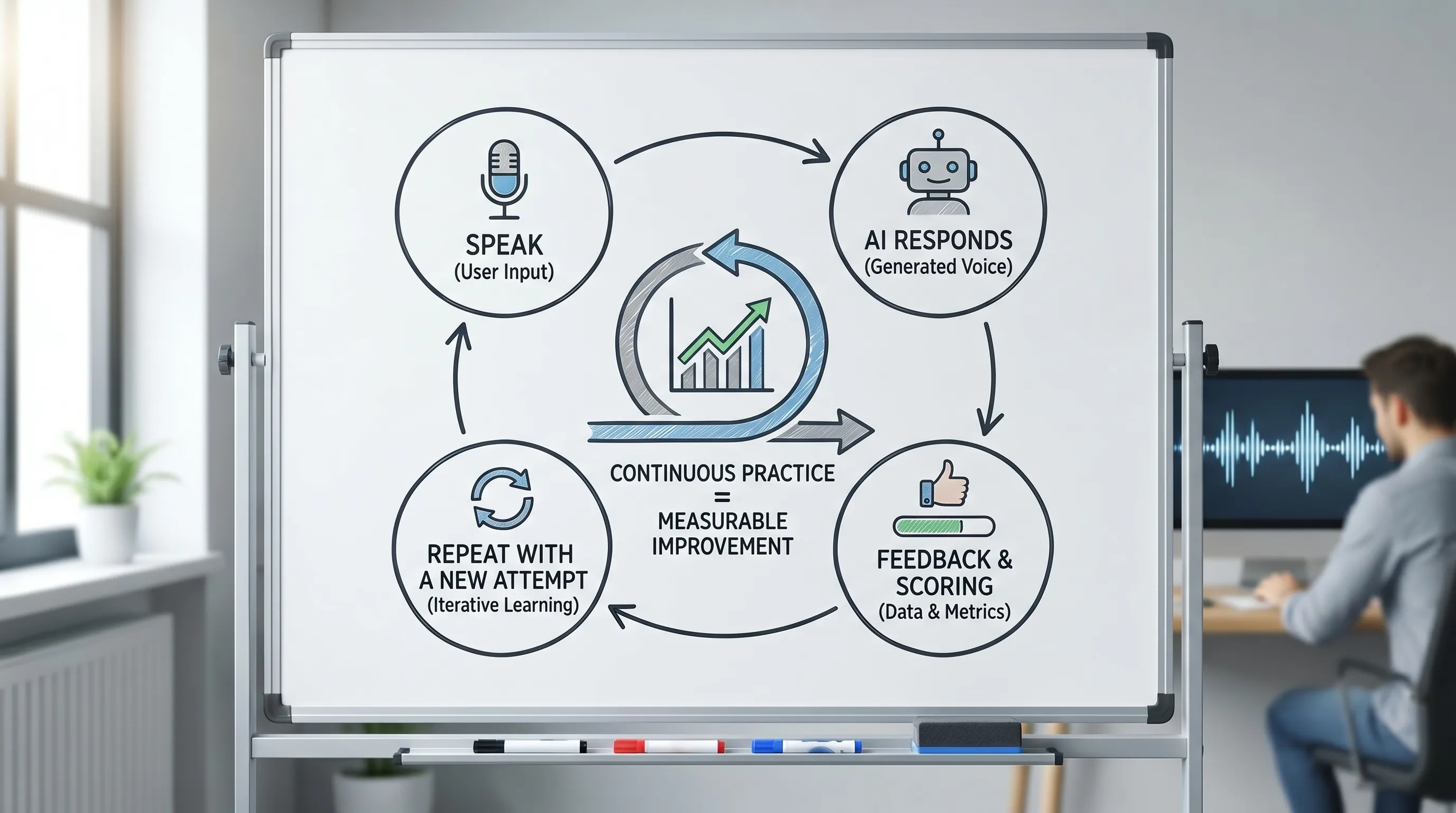
The training value comes from repetition and feedback. You can run the same scenario multiple times, change difficulty, switch persona types, and focus on specific skills (discovery, objection handling, de-escalation, upsell, empathy, policy adherence).
Where AI voice chat fits in a modern training program
AI voice chat is most effective when it supports (not replaces) human coaching and real call exposure.
Onboarding that gets to “first competent call” faster
New hires often struggle with the transition from product knowledge to conversation control. Voice simulations help them practice:
- Opening and agenda-setting
- Asking confident discovery questions
- Explaining value clearly (without jargon)
- Handling the first wave of common objections
Ongoing practice for experienced reps
Even strong reps drift into habits. AI voice chat makes it easy to keep skills sharp with short, high-frequency practice, especially for:
- New product launches
- Competitive positioning updates
- Handling pricing pressure
- Support policy changes
Customer service de-escalation and empathy training
Service teams can rehearse difficult situations repeatedly, including:
- Billing disputes
- Shipping delays
- “I want to cancel” conversations
- Angry or anxious customers
Because the training is simulated, learners can safely make mistakes, then immediately replay with better tactics.
Designing training that sounds like your customers (not a generic bot)
The quality of outcomes depends heavily on scenario design. The goal is not to “trap” reps, it is to recreate the moments that actually decide wins, renewals, and CSAT.
Start with the moments that matter
Pick scenarios where talk tracks often break down:
- The first pricing objection
- “We are evaluating competitors”
- “Send me something and I will review”
- “We had a bad experience before”
- “Your policy says X”
Then define what “good” sounds like. For example, in a pricing objection, do you want reps to:
- Acknowledge and validate
- Re-anchor to outcomes
- Ask a clarifying question about budget or buying process
- Offer packaging options (if applicable)
Build realistic personas
A strong voice scenario includes:
- The customer’s job role and context
- A believable reason they are talking to you today
- Their current emotional state (rushed, skeptical, curious)
- A few details they reveal only if asked
This is where AI voice chat shines: learners can practice how to ask, not just what to say.
Calibrate difficulty by skill level
Many teams accidentally make training too hard too soon. If a new hire’s first simulation is a hostile, rapid-fire procurement call, you create anxiety instead of skill.
A better progression is:
- Early: cooperative customer, clear needs, fewer interruptions
- Mid: unclear needs, mild skepticism, multiple objections
- Advanced: interruptions, competitive comparisons, policy constraints, tight timelines
What great feedback looks like (and what to avoid)
The biggest difference between “cool demo” and “real training tool” is the coaching layer.
Helpful feedback is:
- Immediate: right after the interaction, while it is fresh
- Specific: tied to moments in the conversation
- Behavioral: what to do differently next time
- Repeatable: suggests a redo with a clear focus
Unhelpful feedback is vague (“be more confident”), overly generic, or disconnected from your team’s real standards.
Platforms like Scenario IQ are built around this training loop, using AI-powered roleplay simulations with personalized scenarios, real-time feedback, adaptive guidance, and progress tracking analytics so learners can improve with each attempt rather than guessing what changed.
How to evaluate an AI voice chat training platform
If you are comparing options, focus on whether the platform supports your real operational needs, not just whether the voice sounds human.
Key questions to ask
- Can you tailor scenarios to your products, policies, and customer profiles?
- Does it support different skill levels and coaching standards across roles?
- Is feedback actionable (and consistent across sessions)?
- Can managers track progress across individuals and teams?
- What does it do with recordings and transcripts (privacy, retention, access)?
If you want a broader perspective on evaluating software categories and vendors, browsing independent roundups and reviews can help you build a shortlist. A useful starting point is this library of online tool guides, which covers a wide range of tool comparisons and tutorials.
Metrics that prove training is working
AI roleplay is easiest to justify when you connect practice data to business outcomes. The most practical approach is to combine leading indicators (skill behaviors) with lagging indicators (performance results).
| Metric | What to measure in AI voice chat | Why it matters |
|---|---|---|
| Objection handling quality | Acknowledge, clarify, reframe, confirm next step | Predicts win rate and call confidence |
| Discovery depth | Number and quality of open questions, summaries, next-step alignment | Drives fit, reduces churn, improves solutions |
| Talk-to-listen balance (directional) | Does the learner ask, pause, and confirm, or monologue? | Correlates with trust and conversion |
| Policy adherence (service) | Correct steps, correct language, correct boundaries | Reduces escalations and compliance risk |
| Time to competency | Sessions to reach a target score or rubric | Helps onboarding forecasting |
| Coaching efficiency | Fewer manager reviews needed for the same improvement | Frees managers for higher-leverage coaching |
A good program sets a baseline, runs a pilot, and uses analytics to identify which behaviors changed, then checks whether those changes show up in conversion rate, retention, first contact resolution, or quality assurance scores.
Common pitfalls (and how to avoid them)
Mistake: treating AI practice like a one-time certification
One roleplay per quarter will not change behavior. The advantage of AI voice chat is low-friction repetition.
A practical cadence is short sessions (5 to 10 minutes) multiple times per week, paired with targeted coaching.
Mistake: optimizing for “perfect scripts” instead of real conversations
Customers do not follow scripts. Train for adaptable communication:
- Ask better questions
- Confirm understanding
- Handle interruptions
- Recover when you lose the thread
Mistake: ignoring privacy and compliance requirements
Voice data can contain personal data, payment references, or sensitive details. Ensure you have clarity on:
- Consent and disclosure (where required)
- Data retention rules
- Access controls for managers and admins
- How transcripts are stored and protected
Scenario IQ highlights enterprise-grade security as part of its platform positioning, which matters if you are deploying training at scale.
Mistake: not involving your best reps and QA leaders
Your best people know what “great” sounds like in your market. Pull them into scenario design and scorecard definitions so the AI training matches reality.
A simple rollout plan for AI voice chat training
The fastest path to value is a focused pilot with high-impact scenarios.
Step 1: pick 3 scenarios tied to revenue or risk
Examples:
- Sales: pricing objection, competitor comparison, next-step close
- Service: cancellation save, billing dispute, escalation prevention
Step 2: define a scorecard your team recognizes
Use the same behaviors your managers coach today. Keep it simple at first (clarity, discovery, empathy, objection handling, next step).
Step 3: run a 2 to 4 week pilot and measure change
Track improvement in the leading indicators inside training, then compare with business outcomes for the pilot cohort where possible.
Step 4: expand scenario coverage and personalize
Once you have proof, add role-based paths, adjust difficulty, and use analytics to identify skill gaps by team, region, or tenure.

Why Scenario IQ is a strong fit for voice-based conversation training
If your goal is to make training feel like the conversations that decide outcomes, you need three things: realistic practice, tight feedback loops, and visibility into progress.
Scenario IQ is designed for scenario-based training with:
- AI-powered roleplay simulations
- Personalized training scenarios
- Real-time feedback and adaptive guidance
- Progress tracking analytics and team-focused learning
- Customizable skill levels and performance dashboards
That combination is what turns voice practice into a measurable, coachable system, rather than a novelty.
Frequently Asked Questions
What is AI voice chat training? AI voice chat training uses voice-based roleplay simulations where employees speak naturally to an AI “customer,” receive immediate feedback, and repeat scenarios to improve.
Is AI voice chat only for sales teams? No. It is effective for customer service, call centers, account management, and any role where outcomes depend on spoken conversations.
How do you make AI roleplays sound like real customers? Start with real call patterns: common objections, emotional states, and the details customers reveal only when asked. Then calibrate difficulty by skill level.
How should we measure ROI from voice training? Combine leading indicators (objection handling quality, discovery depth, policy adherence) with lagging indicators (conversion rate, retention, CSAT, QA scores).
Can AI voice chat replace human coaching? It works best as a multiplier for coaching, giving reps more practice between manager sessions and providing consistent feedback that managers can build on.
Train real conversations, not just theory
If you want your team to sound confident on live calls, they need a place to practice real customer conversations at scale.
Explore how Scenario IQ can help your sales and service teams improve with AI roleplay simulations, real-time feedback, and analytics: Scenario IQ.