

Most training fails for the same reason most New Year’s resolutions fail: people understand the idea, but they do not build the habit. In sales and customer service, that gap shows up as shaky objection handling, inconsistent messaging, and slow ramp times. The fix is not “more content.” It is a repeatable learning loop that forces realistic practice, delivers specific feedback, and makes improvement measurable.
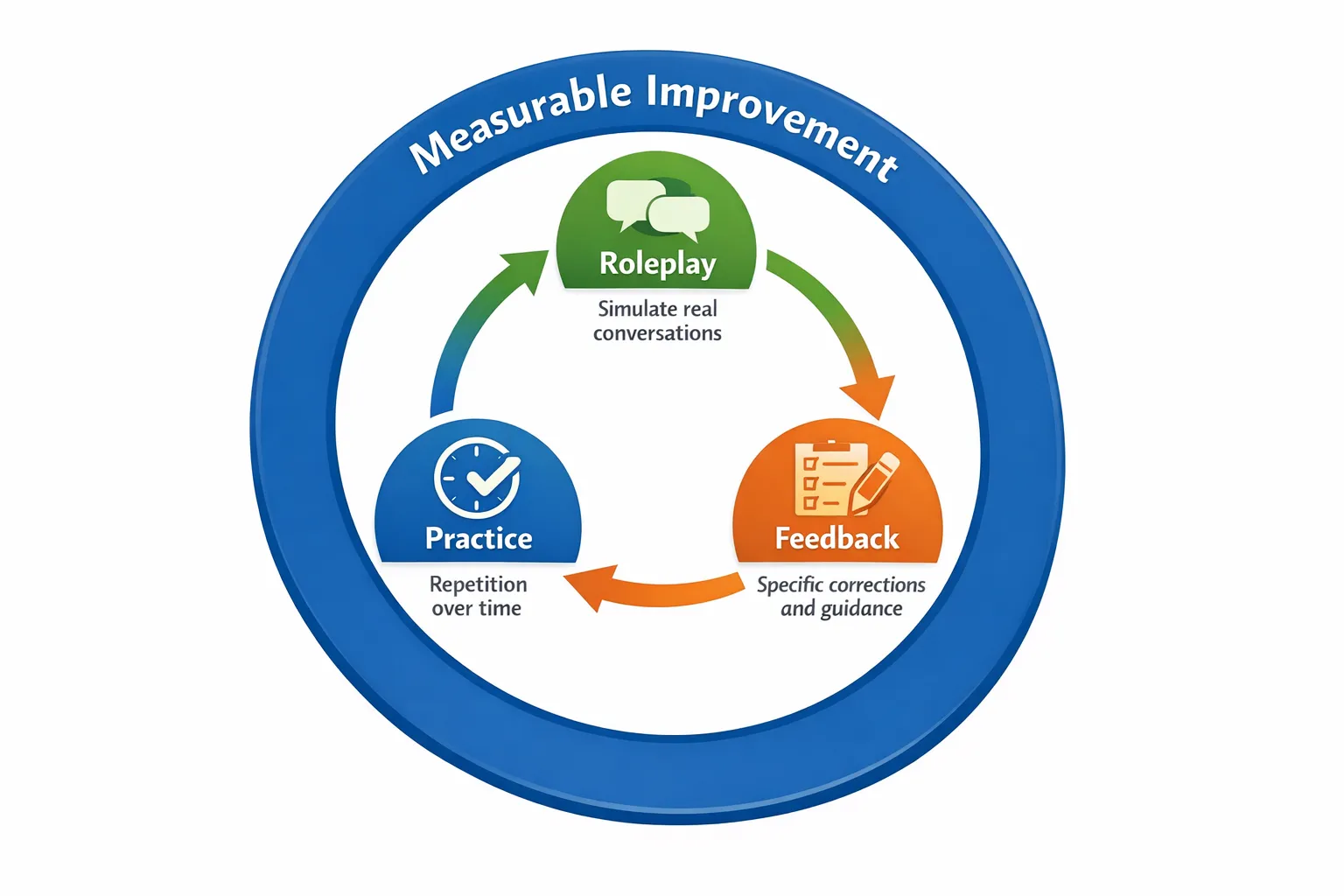
That is exactly where AI training shines when it is built around three fundamentals: roleplay, feedback, and practice.
Why traditional training doesn’t stick (even when it’s “good”)
Teams forget training quickly when it is built like an event instead of a system. A kickoff workshop, a slide deck, or a one-time certification can feel productive, but it often fails to create durable behavior change.
Common reasons:
- Low retrieval: Learners recognize information in a deck, but cannot recall it under pressure. Research on the “testing effect” shows that retrieving knowledge (not rereading it) improves long-term retention. See the classic review by Roediger and Karpicke.
- Not enough realistic reps: People do not build conversational skill by watching examples alone. They build it through repeated, effortful attempts with correction.
- Feedback arrives too late: If feedback comes days later (or never), the learner repeats the same mistakes.
- Practice is not spaced: Memory strengthens when practice is distributed over time, not crammed. Spacing is one of the most consistently supported findings in learning science. A helpful overview is in Cepeda et al. (2006).
The result is predictable: performance returns to baseline when the next tough call, negotiation, or escalation hits.
The “Roleplay, Feedback, Practice” loop (and why it works)
If you want AI training that sticks, start by copying what great coaches do manually and then scale it.
Roleplay: simulate the moments that actually matter
Roleplay works because it forces context-dependent performance: you must choose words, tone, and sequence in real time. This creates “desirable difficulty,” a term associated with better long-term learning when tasks are challenging in the right way (see an overview of this idea from AFT’s summary of learning science).
In sales and service, the highest leverage roleplays are rarely generic. They are specific:
- A prospect pushes back on price after you’ve built value.
- A customer threatens to churn because they feel ignored.
- A caller is angry, interrupting, and demanding a manager.
- A buyer compares you directly to a competitor.
The goal is not perfect scripts. The goal is pattern recognition and repeatable response structure under realistic pressure.
Feedback: make corrections immediate and actionable
Practice without feedback is just repetition. Feedback turns repetition into improvement.
High-quality feedback is:
- Specific (what you did, where it happened)
- Behavioral (what to say or do next time)
- Prioritized (one to three changes, not a laundry list)
- Aligned to a rubric (what “good” looks like for your org)
This is where AI can change the economics. Instead of waiting for a manager to review a call (and only catching a small sample), AI training can deliver feedback on every rep’s practice attempt, consistently, and on-demand.
Practice: build skill through short, frequent reps
“Training that sticks” looks less like a quarterly workshop and more like a gym routine. Short sessions, repeated often, beat occasional marathons.
A practical cadence for many teams is:
- 5 to 10 minutes per day of scenario practice
- 1 weekly focus skill (for example: discovery depth, de-escalation, negotiation)
- Monthly calibration with managers (review patterns, update scenarios)
Over time, this creates automaticity: the rep does not freeze when the customer says something unexpected.
Where AI roleplay training outperforms traditional coaching
AI does not replace great managers or enablement teams. It removes bottlenecks that prevent consistent practice and feedback.
Here are the advantages that matter most in the real world:
1) Infinite reps without burning out your top performers
Top reps and managers are often the best coaches, and the busiest. AI roleplay makes it possible for each learner to get far more repetitions without needing a second human on every session.
2) Consistency across teams, shifts, and geographies
Human coaching varies. Some reps get great feedback, others get almost none. AI scenarios and rubrics help standardize what “good” looks like so new hires, remote teams, and multi-site organizations develop the same baseline competencies.
3) Personalization at scale
The best coaching adapts to the learner. AI training can adjust difficulty, focus areas, and guidance based on performance, keeping practice challenging but achievable.
4) Faster time to proficiency
When learners can practice the exact conversations they struggle with (and do it repeatedly with immediate feedback), ramp time typically improves because fewer “first time” mistakes happen on live customers.
What “AI training that sticks” looks like in practice
The strongest programs treat AI as part of a system, not a novelty tool. A simple, effective model is:
Step 1: Choose the few behaviors that drive outcomes
Start with a small set of skills tied to business metrics. For example:
- Sales: objection handling, discovery quality, next-step commitment
- Service: empathy statements, troubleshooting flow, de-escalation
- Account management: renewal conversations, risk identification, value reinforcement
If everything is a priority, nothing is.
Step 2: Build scenarios from real conversations
Use what your team actually hears:
- Top objections from CRM notes
- Churn reasons from tickets
- Call recordings (and the moments where deals stall)
- Compliance or policy language that must be used correctly
The more authentic the scenarios, the more transferable the skill.
Step 3: Define a scoring rubric people can understand
A rubric turns “good call” into observable actions. Even a simple rubric can be powerful.
| Skill area | What strong looks like | What weak looks like |
|---|---|---|
| Discovery | Asks targeted questions, confirms impact, summarizes | Jumps to pitching, assumes needs |
| Objection handling | Acknowledges, explores root cause, reframes value, confirms | Argues, discounts too early, rushes |
| Service de-escalation | Names emotion, sets clear next step, maintains calm tone | Deflects blame, escalates tone, vague promises |
| Closing / next step | Mutual action plan, time-bound commitment | “Let me know,” no clear next step |
This keeps feedback aligned with the behaviors you want repeated.
Step 4: Make practice unavoidable (and easy)
Adoption is rarely a motivation problem. It is a workflow problem.
Make training “default” by:
- Keeping sessions short
- Assigning a weekly focus scenario
- Using team reporting to spot who needs support
- Recognizing improvement, not just top scores
Measuring whether it’s actually working
If you cannot measure it, you will not sustain it. The key is to connect practice signals to business outcomes over time.
Track two categories of metrics:
Learning metrics (leading indicators)
These show whether practice is building capability.
- Scenario completion rate
- Score trends by skill area
- Common failure patterns (for example: weak discovery summaries)
- Progression in difficulty level
Business metrics (lagging indicators)
These show whether capability changes results.
- Sales: conversion rate, average deal cycle length, discount rate, win rate by segment
- Service: CSAT, first-contact resolution, escalation rate, handle time (with quality controls)
- Retention: churn rate, renewal rate, expansion attach
The best programs review learning metrics weekly, and business metrics monthly or quarterly.
Common pitfalls (and how to avoid them)
AI training only “sticks” when the implementation is sound.
Pitfall: treating AI roleplay like a one-time rollout
Fix: run it like a habit program. Weekly themes, regular reinforcement, visible leadership support.
Pitfall: generic scenarios that feel fake
Fix: use real customer language. Include the awkward parts, interruptions, emotion, and pushback.
Pitfall: feedback overload
Fix: prioritize. Focus on one or two changes per session that the learner can apply immediately.
Pitfall: no manager involvement
Fix: managers do not need to coach every rep every day, but they should review patterns, reinforce standards, and celebrate progress.
How Scenario IQ fits into the loop
Scenario IQ is designed around the core mechanics that make training stick: AI-powered roleplay simulations, personalised training scenarios, and real-time feedback that helps learners improve in the moment. For teams, it supports progress tracking analytics and performance metric dashboards so leaders can see where skills are improving and where coaching is still needed. It also emphasizes team-focused learning, adaptive feedback and guidance, and enterprise-grade security, which matters when training touches customer scenarios and internal processes.
If your current enablement approach relies heavily on occasional workshops or a small amount of call coaching, AI roleplay can add the missing volume of reps that skill-building requires.
Frequently Asked Questions
Does AI roleplay training replace managers or human coaching? No. AI is best used to scale practice and provide consistent baseline feedback. Managers still set standards, coach nuance, and connect training to real pipeline and customer outcomes.
What types of teams benefit most from AI training roleplay? Sales, customer support, success, and any customer-facing team that must perform in high-pressure conversations benefit because roleplay targets real-time communication, not just knowledge.
How often should reps practice for training to “stick”? Short, frequent sessions work best for most teams. Many programs succeed with 5 to 10 minutes per day or a few sessions per week, plus periodic manager calibration.
What should we measure to prove ROI? Combine learning metrics (scenario completion, score improvement by skill) with business metrics (conversion rate, discounting, CSAT, escalations, churn). Look for trend alignment over several weeks to months.
Build a training loop your team actually uses
If you want roleplay-based AI training that sticks, focus on the loop: realistic scenarios, immediate feedback, and frequent practice that fits into the workday.
Explore how Scenario IQ can help your team practice the conversations that decide revenue and retention, improve confidence through real-time feedback, and track progress with actionable analytics.