

Building skills with AI training online is easier than ever, but “having access” is not the same as “getting better.” Most sales and service teams do not fail because they lack information. They fail because practice is inconsistent, feedback is delayed, and the next real customer interaction arrives before a new habit sticks.
A 30-day skill habit solves that. Not because 30 days is a magic number, but because it is long enough to create momentum, reduce friction, and turn practice into something your calendar expects.
First, a quick reality check about “30-day habits”
You have probably heard that it takes 21 or 30 days to build a habit. Research suggests habit formation varies widely by person and behavior. One widely cited study found the average time to reach automaticity (doing a behavior with little conscious effort) was 66 days, with a broad range depending on complexity and context (Lally et al., 2009).
So why do 30 days anyway?
- It is long enough to prove the routine works (or reveal why it does not).
- It creates a measurable “season” of practice you can review and iterate.
- It reduces the stakes compared to “this is my new life forever.”
Think of 30 days as your habit “on-ramp.”
What a 30-day skill habit needs (and what it does not)
A sustainable skill habit is less about motivation and more about design. The goal is to make daily practice:
- Small enough to do on bad days
- Specific enough to measure
- Realistic enough to repeat
- Relevant enough to care about
A skill habit does not need:
- Long training sessions
- Perfect content
- A big kickoff meeting
- Willpower-based routines
Step 1: Pick one skill, not a job description
“Get better at sales” is not a habit. A habit has a clear behavior and a clear outcome.
Choose one skill that shows up daily in your work. Examples for revenue and customer-facing teams:
- Opening a call with a tight agenda and customer value
- Asking better discovery questions
- Handling a specific objection (price, timing, competitor, internal approval)
- De-escalation and empathy statements
- Upsell or cross-sell transitions
- Clear next-step closing language
If you are leading a team, align the skill to a real business outcome for the month (conversion rate, show rate, average handle time, CSAT, renewal rate). You are not promising the metric will move in 30 days, but you are ensuring practice is connected to reality.
Step 2: Define the “minimum viable session” (10 minutes)
The fastest way to break a habit is to make it too big.
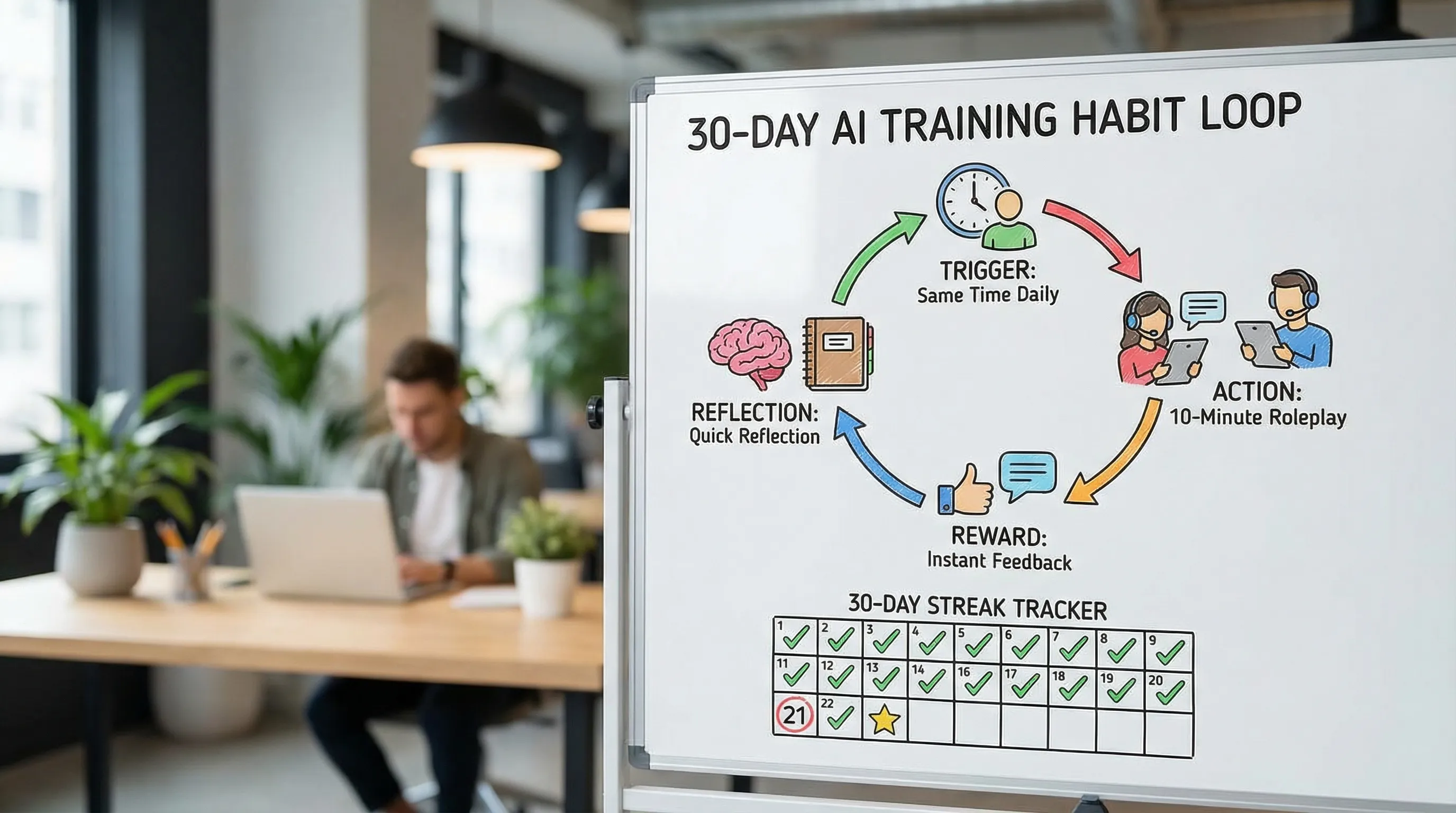
A strong default for AI training online is a 10-minute daily session:
- 6 to 8 minutes of practice (roleplay or scenario)
- 2 minutes of feedback review
- 1 to 2 minutes of reflection and one micro-commitment
If you regularly do more, great. But your habit should be built to survive busy days.
Step 3: Use a trigger that already happens
Habits stick when they attach to an existing routine. Pick a trigger that happens almost every workday.
Good triggers:
- First coffee at your desk
- Right after your first internal standup
- Immediately after lunch
- The first 10 minutes after you open your CRM
Avoid triggers that rely on “when I have time.” That time rarely arrives.
Step 4: Make feedback immediate (this is where AI shines)
Traditional coaching has a timing problem:
- The rep performs.
- The manager maybe observes later.
- Feedback arrives after the moment is gone.
AI training online can compress that loop. Scenario-based simulations with real-time feedback let learners iterate quickly: try a phrasing, see the impact, adjust, repeat.
This matters because skill is built through deliberate practice, not passive learning. Deliberate practice requires clear goals, immediate feedback, and repeated attempts.
Step 5: Decide how you will measure “done”
Your habit needs a binary definition: either you did it, or you did not.
Use completion-based scoring first. Quality comes second.
Examples of “done”:
- Completed 1 AI roleplay scenario
- Reached feedback summary screen
- Logged one takeaway sentence
Then add one performance metric to track weekly, not daily:
- Objection handling score (or rubric rating)
- Discovery coverage (number of key questions asked)
- Talk-to-listen ratio (if available)
- Customer sentiment markers (empathy, clarity, resolution)
If your AI platform includes progress analytics and dashboards, use them as the single source of truth for trend tracking.
The 30-day plan: build consistency first, then level up
Below is a practical structure you can run solo or across a team. It is designed to reduce drop-off, while still improving real conversations.
Weekly themes
- Week 1 (Days 1 to 7): Make it easy, build the streak
- Week 2 (Days 8 to 14): Add friction in the right places (harder scenarios)
- Week 3 (Days 15 to 21): Generalize to more contexts (more customer types)
- Week 4 (Days 22 to 30): Pressure test and lock in the routine
A simple daily format (repeat for 30 days)
- Practice: 1 scenario
- Feedback: review 1 to 3 key points
- Fix: repeat the same scenario once with one improvement
- Note: write one sentence: “Next time I will…”
30-day habit calendar (what to focus on)
| Days | Goal | Scenario focus | What “good” looks like |
|---|---|---|---|
| 1 to 3 | Start the streak | Easy mode, friendly customer | You complete sessions without resistance |
| 4 to 7 | Stabilize the routine | Same scenario repeated | Your opening and structure get smoother |
| 8 to 10 | Add one constraint | Customer is rushed or skeptical | You stay concise and calm |
| 11 to 14 | Add objections | Price, timing, competitor | You acknowledge, clarify, and respond cleanly |
| 15 to 17 | Expand context | New industry or persona | You adapt without losing structure |
| 18 to 21 | Handle emotion | Frustrated, anxious, confused | You show empathy and regain control |
| 22 to 24 | Increase difficulty | Longer scenario, less guidance | You maintain clarity under pressure |
| 25 to 27 | Speed and precision | Short scenarios, tight time box | You get to value fast, avoid rambling |
| 28 to 30 | Pressure test | Mixed scenarios, surprise turns | You perform consistently across situations |
This approach works well with AI roleplay tools that offer adaptive guidance, real-time feedback, customizable skill levels, and analytics for progress tracking.
How to make AI training online feel “real” (so it transfers to calls)
One risk with any practice environment is that learners treat it like a game. You want practice to transfer to real work.
Use these three transfer boosters:
Use your actual words
Do not roleplay with “training language.” Use phrases you would say to a prospect or customer. If something sounds unnatural, rewrite it until it is yours.
Practice the hardest 30 seconds
Most outcomes swing on small moments:
- the first 30 seconds (trust, agenda, relevance)
- the objection moment (emotional control)
- the close (clear next step)
Your AI sessions should repeatedly hit those moments.
Keep a “one-liner library”
Create a living doc with your best-performing lines:
- one opening line
- one empathy line
- one clarifying question
- one value line
- one close
Update it weekly based on feedback.
If you manage a team: run this as a 30-day sprint
AI training online becomes much more effective when it is supported by lightweight team rituals.
The manager’s job is consistency, not supervision
Your role is to protect the habit and normalize practice.
A simple cadence:
- Monday: announce the weekly focus (one skill)
- Midweek: share one “best line” from the team
- Friday: 15-minute review of trends (not individual shame)
If your platform provides team-focused learning and performance dashboards, use them to spot patterns: where the team improves, where it stalls, and which scenarios correlate with better real outcomes.
Keep coaching human, keep practice AI-driven
AI can deliver repetition and immediate feedback at scale. Human leaders are best for:
- context (why this matters)
- deal and account specifics
- confidence building
- reinforcing good judgment and ethics
Common failure points (and how to fix them)
“We missed a day, so we stopped.”
Solution: adopt a rule: never miss twice. If you miss today, tomorrow is non-negotiable.
“People do the sessions but do not improve.”
Solution: require one repeat attempt. Improvement often happens on the second run, when learners apply feedback immediately.
“It feels disconnected from real conversations.”
Solution: align scenarios to current pipeline or recent tickets. Rotate customer personas your team actually serves.
“We tried too many skills.”
Solution: one skill per month, one focus per week. Depth beats breadth.
How Scenario IQ fits a 30-day skill habit
Scenario IQ is designed for scenario-based skill building with AI-powered roleplay simulations, personalized training scenarios, real-time feedback, and progress tracking analytics. That combination is exactly what a 30-day habit needs:
- daily reps without scheduling overhead
- immediate feedback so learners can adjust on the spot
- analytics to show progress over time and across a team
- adaptable difficulty as confidence grows
If you are building a habit across sales and service, also look for enterprise-ready elements (like security and team management) so the program can scale beyond a pilot.
Frequently Asked Questions
Is AI training online effective for sales and customer service? Yes, when it includes realistic scenarios, repeated practice, and immediate feedback. The biggest advantage is consistency: teams can practice daily without waiting for live coaching time.
How long should daily AI training sessions be? For habit building, 10 minutes is a strong baseline. Short sessions reduce friction and increase consistency, which is what drives long-term improvement.
What skill should I focus on first in a 30-day plan? Start with a high-frequency skill that impacts outcomes quickly, such as opening structure, discovery questions, or one common objection you hear weekly.
What if I miss a day in my 30-day habit? Do not restart the entire plan. Use a “never miss twice” rule and resume the next day. Consistency over time matters more than a perfect streak.
How do I prove ROI from AI training online? Track completion first, then monitor one or two business-linked indicators over time (conversion rate, show rate, CSAT, renewals). Use trendlines and compare to a baseline period.
Build your 30-day skill habit with Scenario IQ
If you want AI training online that makes daily practice easy, measurable, and relevant to real conversations, Scenario IQ can help you run a 30-day skill sprint without adding scheduling chaos.
Explore Scenario IQ to see how AI roleplay simulations, real-time feedback, and progress analytics can support a habit your team will actually keep.