
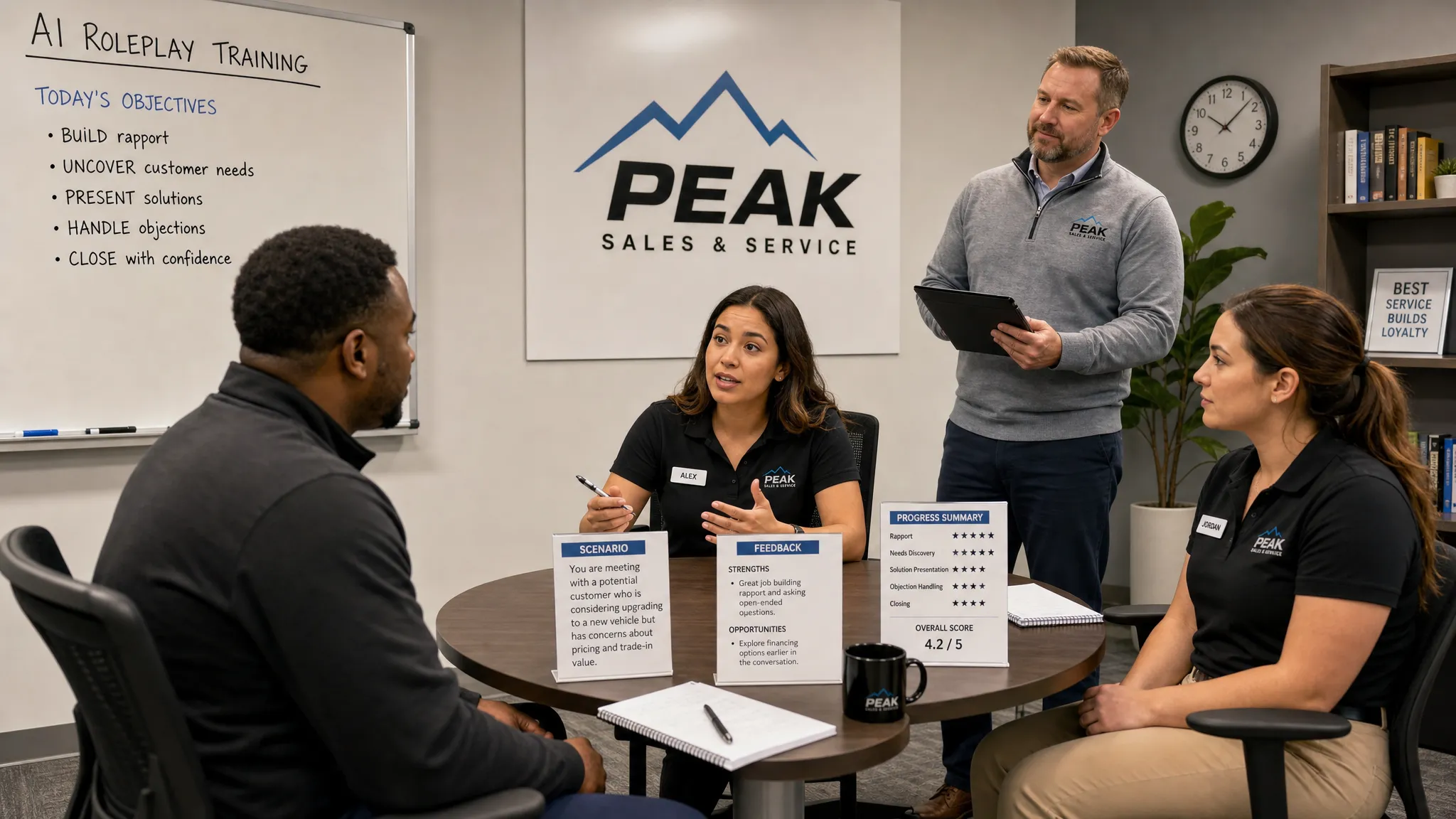
Rep readiness is not created by one kickoff session, a product deck, or a quiz. It is created when reps repeatedly practice the conversations that decide revenue: discovery, objections, pricing pressure, competitive traps, renewals, escalations, and emotionally charged service moments.
For sales and service leaders, the challenge is scale. Top managers can coach a handful of reps deeply, but most teams need consistent practice and feedback every week. That is where the right AI strategies can change the operating model. AI is not just a faster content generator. Used well, it becomes a practice environment, feedback engine, and readiness measurement layer that helps every rep build confidence before a customer is on the line.
The goal is not to replace human coaching. The goal is to make coaching more specific, timely, and measurable so managers can spend less time guessing and more time developing the behaviors that move deals and customer outcomes.
The Readiness Problem AI Is Best Suited to Solve
Most organizations already have enablement content. They have playbooks, product pages, battlecards, recorded calls, onboarding sessions, and manager check-ins. Yet reps still freeze when a prospect says the price is too high, rush discovery when a buyer gives vague answers, or over-explain features when they should be diagnosing business impact.
That gap exists because knowing and performing are different skills. Rep readiness is the ability to apply knowledge in a live conversation under pressure. It requires recall, judgment, tone, listening, and decision-making. Those capabilities improve through practice, feedback, repetition, and coaching.
AI is especially useful because it can deliver three things traditional coaching struggles to scale:
- Realistic repetition: Reps can practice tough conversations repeatedly without waiting for a manager or risking a live deal.
- Immediate feedback: AI can identify missed discovery questions, weak objection handling, filler language, poor structure, or lack of next steps as soon as the simulation ends.
- Readiness visibility: Leaders can see patterns across teams, territories, roles, and skill levels rather than relying only on anecdotal manager observations.
This matters because generative AI is moving beyond experimentation into workflow design. McKinsey research on generative AI estimates that sales and marketing are among the business functions with major potential value from AI. In coaching, that value comes when AI is connected to real moments reps face, not when it is treated as another generic training tool.
Start With Conversation Moments, Not Training Modules
The best AI strategies for readiness begin with a practical question: Which conversations do reps need to handle better?
A module might be called product positioning or objection handling. A real conversation moment sounds more specific: a CFO challenges ROI late in the deal, a buyer says they are happy with a competitor, a customer threatens to cancel after a service issue, or a prospect asks for a discount before value is established.
AI training becomes more effective when scenarios are built around these concrete moments. They give reps a realistic context, an objective, a persona, and a likely emotional tone. They also make feedback more precise because the expected behavior is clear.
| Conversation moment | Readiness signal to observe | AI practice application |
|---|---|---|
| First discovery call with a senior buyer | Rep asks business impact questions and confirms pain | Simulate executive discovery with limited buyer patience |
| Pricing objection before value is clear | Rep reframes around outcomes before discussing concessions | Practice price pressure with multiple buyer pushbacks |
| Competitive displacement | Rep differentiates without attacking the competitor | Roleplay a buyer who is loyal to an incumbent vendor |
| Renewal risk or escalation | Rep acknowledges frustration and moves toward resolution | Simulate an upset customer with incomplete information |
| Late-stage buying committee concern | Rep maps stakeholders and clarifies decision criteria | Practice multi-stakeholder questions and next steps |
Once these moments are defined, AI can help teams practice the skills that actually show up in pipeline and customer conversations.
1. Use AI Roleplay to Create a Safe Practice Environment
Roleplay has always been one of the strongest coaching methods, but many teams underuse it because it can feel awkward, time-consuming, or inconsistent. AI-powered roleplay changes the format. Reps can practice privately, repeat the same scenario, adjust the difficulty level, and receive structured feedback immediately.
This is particularly valuable for new hires, reps entering a new market, and experienced reps preparing for unfamiliar buyer personas. A new account executive might practice discovery with a skeptical operations leader. A customer support rep might practice de-escalating a frustrated customer. A sales development rep might practice opening a cold call without sounding robotic.
The best simulations do not reward memorized scripts. They reward behaviors such as listening, probing, summarizing, clarifying impact, handling resistance, and securing a next step. This is where AI strategies outperform static enablement. Instead of asking whether a rep read the playbook, the organization can see whether the rep can use the playbook in a realistic interaction.

2. Personalize Scenarios by Role, Segment, and Skill Level
Generic coaching creates generic performance. A senior enterprise rep, a new SDR, and a frontline service agent do not need the same practice environment. They need scenarios that reflect their job, their customers, and their current skill gaps.
AI makes personalization more practical. Training scenarios can be tailored by persona, industry, deal stage, product knowledge level, objection type, or communication style. A rep who struggles with discovery can receive scenarios that force deeper questioning. A rep who over-discounts can practice value reframing. A rep who sounds too technical can practice translating features into business outcomes.
Personalized training also helps managers avoid one-size-fits-all coaching. Instead of telling every rep to improve objection handling, leaders can identify whether the real issue is confidence, product fluency, executive presence, poor qualification, or weak next-step control.
A simple readiness model can include three levels:
| Skill level | What the rep can do | Best AI scenario type |
|---|---|---|
| Foundational | Uses the basic talk track but needs structure | Guided roleplay with prompts and simpler objections |
| Proficient | Handles common objections and asks relevant questions | Adaptive roleplay with realistic buyer resistance |
| Advanced | Navigates ambiguity, emotion, and executive pressure | High-stakes simulations with complex stakeholder dynamics |
This approach turns AI from a content tool into a targeted coaching system.
3. Give Real-Time Feedback Against a Shared Rubric
AI feedback is only useful if reps trust it and managers know how to interpret it. That starts with a shared rubric. Without one, feedback can feel subjective, inconsistent, or overly focused on surface-level language.
A strong coaching rubric should define the behaviors that matter. For example, a discovery rubric might evaluate whether the rep opened with context, asked layered questions, connected pain to business impact, confirmed understanding, and set a clear next step. An objection-handling rubric might evaluate whether the rep acknowledged the concern, diagnosed the reason behind it, reframed value, and checked for alignment.
Real-time feedback gives reps a faster improvement loop. Instead of waiting until the next pipeline review or one-on-one, they can practice, receive feedback, repeat the scenario, and compare results. Managers can then focus their live coaching time on the behaviors that remain stuck.
| Coaching category | Observable behavior | Example feedback prompt |
|---|---|---|
| Discovery depth | Rep asks follow-up questions beyond the first answer | What business impact is behind that problem? |
| Value articulation | Rep connects product or service value to the buyer's goal | Tie the feature back to cost, risk, revenue, or time. |
| Objection handling | Rep acknowledges and explores before responding | Ask what is driving the concern before defending the offer. |
| Conversation control | Rep summarizes and confirms next steps | End with ownership, timeline, and mutual action. |
| Empathy and tone | Rep responds to emotion without becoming defensive | Acknowledge the concern before moving to resolution. |
The key is to keep feedback actionable. Reps should leave a simulation knowing what to do differently in the next attempt, not simply whether they passed.
4. Use Readiness Analytics to Prioritize Coaching
Managers often know which reps are missing quota, but they may not know which behaviors are causing the miss. Readiness analytics can help connect coaching to specific skills before performance issues show up in the forecast.
Progress tracking and performance dashboards make coaching more proactive. If a team is consistently weak in pricing conversations, enablement can adjust training. If new hires are strong on product knowledge but weak on discovery, onboarding can change. If one region struggles with competitive displacement, sales leadership can create targeted simulations before the next quarter.
The most useful metrics combine practice activity, skill quality, and business outcomes. Activity alone is not enough. A rep who completes ten simulations but repeats the same mistakes is not ready. A rep who improves across scenarios and applies the behavior in live calls is moving toward readiness.
| Metric | What it tells you | Coaching action |
|---|---|---|
| Scenario completion rate | Whether reps are practicing consistently | Remove friction and set practice expectations |
| Skill score by scenario type | Which conversation moments are strong or weak | Assign targeted practice and manager coaching |
| Improvement over repeated attempts | Whether feedback is changing behavior | Reinforce what improved and isolate what remains |
| Time to readiness for new hires | How quickly reps reach proficiency | Adjust onboarding sequence and ramp support |
| Manager follow-up rate | Whether coaching is happening after practice | Help managers prioritize one-on-ones |
| Win, conversion, retention, or CSAT trends | Whether readiness connects to outcomes | Compare skill gains with business results |
This creates a more balanced view of performance. Leaders can see not only what happened in the field, but how prepared reps were before they got there.
5. Reinforce Skills With Micropractice and Daily Tips
Most training fades when reinforcement is weak. A kickoff session may inspire reps for a day, but conversation habits are built through frequent, focused repetition.
AI can support this by delivering small practice prompts and daily actionable tips tied to a rep's current goals. A rep preparing for a renewal call might receive a short reminder to acknowledge risk before proposing next steps. A sales rep working on executive presence might practice a two-minute value summary. A service agent might rehearse a calm escalation response before a busy shift.
This kind of reinforcement works best when it is specific and easy to act on. Instead of broad advice such as be more consultative, a stronger tip might be: ask one impact question before you introduce a solution. Instead of saying handle objections better, the prompt might be: acknowledge the concern, ask what is driving it, and only then respond.
Small repetitions reduce the pressure of formal training. They also make learning part of the daily workflow rather than a separate event.
6. Help Managers Coach With Better Signals
AI should not remove managers from the coaching process. It should give them better information so they can coach more effectively.
A manager who has ten reps and limited time cannot observe every practice conversation. AI can help surface where attention is needed: which reps are improving, which scenarios are being avoided, which objections are causing difficulty, and which behaviors are consistent across the team. That allows managers to spend less time diagnosing from scratch and more time coaching the highest-impact skill.
This also improves coaching consistency. In many organizations, the quality of coaching depends heavily on the manager. Some managers are excellent at roleplay and feedback. Others focus mostly on pipeline inspection. AI-supported readiness programs create a shared coaching language, while still leaving room for manager judgment and context.
The best manager workflow is simple: review readiness signals, select one coaching priority, practice one scenario with the rep, agree on one behavior to improve, and check progress the following week.
7. Turn Frontline Insights Into Better Scenarios
Training should evolve as buyer and customer conversations change. AI strategies become more valuable when they help teams convert frontline patterns into practice.
For example, if reps are hearing a new competitor claim, that objection can become a roleplay scenario. If service agents are seeing a surge in a specific escalation, that moment can become a de-escalation simulation. If sales calls reveal that buyers are confused about ROI, enablement can build a scenario around business case development.
This creates a feedback loop between the field and training. Instead of updating enablement once or twice a year, teams can refresh scenarios as customer needs, competitor messaging, product positioning, and market conditions change.
A practical workflow looks like this: collect recurring objections, identify the conversation behavior required, create or update a scenario, assign targeted practice, review readiness analytics, and refine the coaching rubric. The loop is simple, but it keeps training relevant.
8. Build Trust, Privacy, and Governance Into AI Coaching
AI coaching touches performance data, communications, and sometimes sensitive customer context. Trust is essential. Reps need to know how AI feedback will be used, managers need to understand its limits, and leaders need governance around data access and quality.
The NIST AI Risk Management Framework is a useful reference for responsible AI programs because it emphasizes trustworthy characteristics such as validity, reliability, security, privacy, transparency, and fairness. For sales and service training, those principles translate into practical decisions: define what data is used, limit unnecessary exposure, review AI feedback for accuracy, and ensure the system supports coaching rather than surveillance.
Good governance also means keeping humans accountable. AI can identify patterns and recommend practice, but managers should still provide context, judgment, and encouragement. Reps should be able to understand why they received a score or suggestion. Leaders should monitor whether the program improves confidence and customer outcomes, not just whether it produces more data.
For organizations evaluating AI readiness platforms, enterprise-grade security, role-based access, and clear data handling practices should be part of the buying conversation.
A 90-Day Rollout Plan for AI-Enabled Rep Readiness
AI coaching works best when it starts with a focused use case. Trying to transform every training motion at once usually slows adoption. A 90-day rollout gives teams enough time to build momentum, prove value, and refine the process.
| Timeline | Focus | What to do |
|---|---|---|
| Days 1 to 30 | Define readiness | Select 3 to 5 high-impact conversation moments, create scoring rubrics, and choose a pilot group |
| Days 31 to 60 | Practice and measure | Launch AI roleplay simulations, review feedback quality, and coach managers on how to use readiness signals |
| Days 61 to 90 | Optimize and expand | Compare skill improvement with team outcomes, refine scenarios, and expand to additional roles or regions |
During the first month, resist the urge to build too many scenarios. Choose moments that clearly connect to revenue, retention, or customer satisfaction. For a sales team, that might be discovery, pricing, and competitive objections. For a service team, it might be escalation, empathy, and policy explanation.
During the second month, focus on adoption. Reps need to see that AI practice helps them prepare, not that it is another compliance task. Managers should model the behavior by reviewing practice data and using it in one-on-ones.
During the third month, connect readiness data to business trends. The goal is not perfect attribution. The goal is to see whether better practice and feedback are moving the right indicators, such as ramp time, call quality, conversion, win rate, retention, or customer satisfaction.
Common Mistakes to Avoid
AI can improve coaching, but only when it is implemented with discipline. The most common mistakes come from treating AI as a shortcut instead of a system for better practice.
- Automating vague coaching: If the rubric is unclear, AI feedback will not create consistent behavior change.
- Measuring only activity: Completion rates matter, but skill improvement and outcome alignment matter more.
- Making practice feel punitive: Reps should experience AI roleplay as a safe place to improve before live conversations.
- Ignoring manager enablement: Managers need training on how to interpret readiness data and coach from it.
- Using generic scenarios too long: Scenarios should evolve as buyer objections, customer needs, and market conditions change.
- Skipping governance: Privacy, access controls, and responsible use policies should be addressed before scale.
The strongest programs keep the human purpose clear. AI provides more practice, faster feedback, and better visibility. Managers provide context, motivation, accountability, and coaching judgment.
Where Scenario IQ Fits
Scenario IQ is designed for organizations that want to improve sales and service performance through AI-driven, scenario-based training. Teams can use AI-powered roleplay simulations, personalized training scenarios, real-time feedback, adaptive guidance, progress tracking analytics, and performance metric dashboards to build confidence before reps face high-stakes customer conversations.
Because Scenario IQ supports team-focused learning, customizable skill levels, daily actionable tips, and enterprise-grade security, it can help leaders create a readiness system that is both practical for reps and measurable for managers. The value is not simply more training content. It is a repeatable way to help people practice the conversations that influence revenue, retention, and customer trust.
Frequently Asked Questions
What are the best AI strategies for improving rep readiness? The strongest AI strategies include roleplay simulations, personalized scenarios, real-time feedback, readiness analytics, manager coaching signals, micropractice, and scenario updates based on frontline insights.
How does AI improve sales coaching? AI improves sales coaching by giving reps more opportunities to practice, providing immediate feedback, and helping managers identify specific skills that need attention. It makes coaching more consistent and data-informed.
Will AI replace sales managers? No. AI can support coaching by surfacing patterns and feedback, but managers still provide context, judgment, motivation, and accountability. The best programs use AI to make managers more effective.
What readiness metrics should leaders track? Leaders should track scenario completion, skill scores, improvement over time, time to readiness, manager follow-up, and business outcomes such as conversion, win rate, retention, or customer satisfaction.
Can service teams use AI roleplay too? Yes. Service teams can use AI roleplay to practice de-escalation, empathy, policy explanations, complex troubleshooting, renewal conversations, and other customer moments that require confidence and judgment.
Make Coaching Scalable Without Making It Generic
Rep readiness improves when practice becomes realistic, feedback becomes immediate, and coaching becomes specific. AI gives sales and service leaders a way to build those habits at scale, but the strategy has to start with the conversations that matter most.
If your team is ready to move from one-off training to measurable scenario-based practice, explore Scenario IQ. Use AI roleplay, personalized scenarios, real-time feedback, and readiness analytics to help every rep prepare for the conversations that close deals and strengthen customer relationships.