

Building effective roleplay training is not just an LLM prompt problem. The best systems feel like realistic customer conversations, adapt to each learner, provide coaching-quality feedback, and give leaders trustworthy performance signals. That requires disciplined AI software development, including conversation design, evaluation pipelines, analytics, security, and continuous improvement.
This guide breaks down the key components you need to build (or evaluate) an AI roleplay training product for sales and service teams, with an emphasis on what actually makes simulations credible and coaching actionable.
What “roleplay training” software must deliver (beyond chat)
Roleplay training sits in a tricky middle ground: it needs the open-ended realism of conversation, but also the structure and measurability of training. In practice, teams expect four outcomes:
- Behavior change: Learners practice handling objections, building trust, and closing.
- Consistency: Scoring and feedback should be repeatable enough to compare progress over time.
- Personalization: Coaching and scenario difficulty should adapt to role, skill level, and goals.
- Operational readiness: Managers need analytics, and IT needs compliance, security, and integrations.
That combination is why “AI roleplay” is a systems problem with multiple components working together.
Reference architecture: the core layers of an AI roleplay training system
Most roleplay platforms converge on a layered architecture. If you are scoping AI software development work, these layers map cleanly to teams and backlogs.
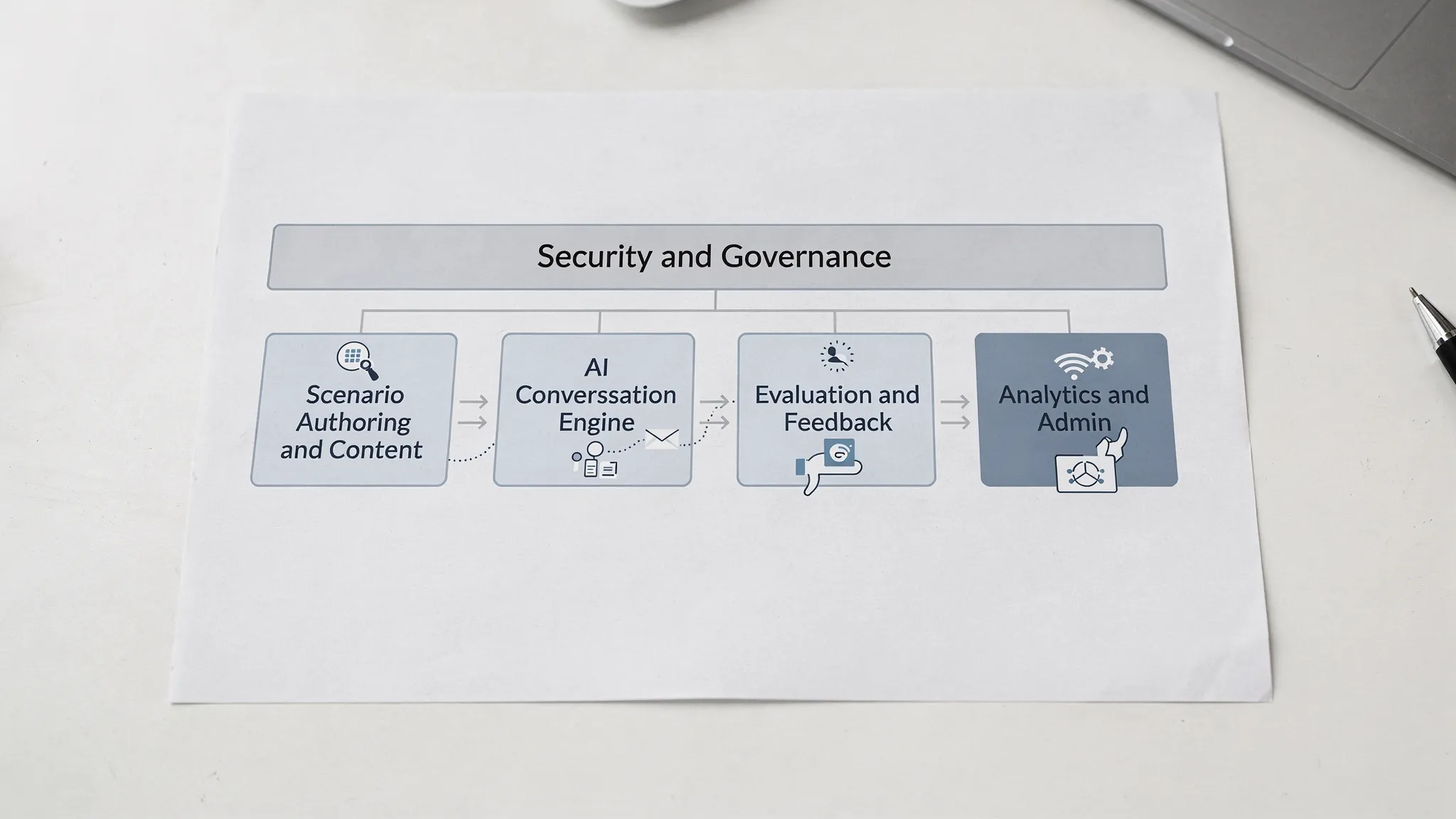
1) Scenario authoring and content management
Great roleplays start with clear training intent. Your system needs a way to define scenarios that are structured enough to evaluate, but flexible enough to feel real.
Key elements to support:
- Role definition: learner role, customer persona, relationship context, channel (phone, chat, in-person).
- Objectives: what “good” looks like (for example, confirm needs, propose fit, ask for the next step).
- Constraints: policies, pricing boundaries, regulated language, escalation rules.
- Difficulty controls: novice to expert variants, time pressure, emotional tone.
Implementation detail that matters: store scenarios as versioned objects (not just text blobs). Treat them like product assets with review workflows, audit history, and rollback.
2) AI conversation engine (LLM orchestration)
This is the runtime layer that turns a scenario into an interactive simulation.
Key components:
- Prompt and policy framework: system instructions, persona and style constraints, and “do not do” boundaries.
- Retrieval (RAG) for realism: access to approved product knowledge, policies, and talk tracks so the AI is grounded in what your organization actually sells and supports.
- State management: conversation memory, goals already achieved, unresolved objections, learner behaviors observed.
- Tooling hooks: optional functions like scoring triggers, hint generation, or knowledge lookup.
Engineering tip: prioritize determinism where it matters. For example, keep scenario goals and rubric items as explicit structured fields the model can reference, and track them in state rather than hoping they emerge from free-form chat.
3) Evaluation and scoring (the “truth layer”)
If roleplay is training, you need measurement that users trust.
Most successful systems separate:
- Conversation generation (the simulated customer)
- Evaluation (judging learner performance)
This reduces the risk that a single model both “acts” and “grades” in ways that hide errors.
Evaluation usually includes:
- Rubric-based scoring: explicit criteria (for example, discovery questions, objection handling, clarity, next-step commitment).
- Evidence extraction: highlighting learner quotes that justify each score.
- Calibration controls: thresholds, weightings, and reviewer feedback loops.
When you can, design scoring so it is explainable. A manager should be able to answer, “Why did the score drop?” without reading the whole transcript.
4) Feedback generation that feels like coaching
Feedback is where many products feel generic. Coaching-quality feedback is typically:
- Specific: references exact phrases and moments.
- Actionable: gives a better alternative and explains why.
- Prioritized: focuses on the one or two moves that would improve outcomes most.
- Level-appropriate: novice learners need structure, advanced learners need nuance.
A practical pattern is “micro-coaching” plus “next rep suggestions”:
- What you did well
- The highest-impact improvement
- A rewrite or example line
- A short drill for the next attempt
Platforms like Scenario IQ position this as AI-driven, personalized scenario-based training with real-time feedback and adaptive guidance, which is exactly the direction teams need for repeatable practice.
5) Analytics and progress tracking
Training leaders need visibility, not just transcripts.
Your analytics layer should support:
- Learner progress over time (per skill, per scenario type)
- Team and cohort views (compare regions, roles, tenure bands)
- Behavioral insights (common missed steps, top objections, weak moments)
- Operational dashboards (usage, completion, time-to-proficiency)
Be careful with metric design. If you score too many things, you dilute focus. If you score too few, you miss coaching opportunities.
Key components checklist (with build notes)
The table below summarizes what typically matters most in AI software development for roleplay training.
| Component | Why it matters | Practical build notes |
|---|---|---|
| Scenario schema and versioning | Enables consistent training and auditing | Use structured fields, version control, review workflows |
| Grounded knowledge (RAG) | Prevents hallucinations about products/policies | Index only approved content, log citations and retrieval |
| Conversation state | Keeps roleplays coherent and goal-driven | Track goals, objections, and learner actions as state |
| Evaluation rubric and evidence | Builds trust in scores and coaching | Require quotes or timestamps as justification |
| Adaptive difficulty | Keeps practice in the “stretch zone” | Increase objection intensity and complexity as scores improve |
| Real-time feedback | Accelerates learning during the rep | Provide hints sparingly, keep them optional |
| Analytics dashboards | Makes training measurable for leaders | Separate individual coaching from org-level trends |
| Security and governance | Required for enterprise adoption | Role-based access, encryption, audit logs, data retention |
Safety, compliance, and governance (non-negotiable for enterprise)
Because roleplays often include customer details, pricing conversations, and internal policies, governance should be designed in from day one.
Focus areas:
Data protection and access controls
- Role-based access (learner, coach, admin)
- Encryption in transit and at rest
- Clear data retention policies for transcripts and audio (if applicable)
If you are building for regulated environments, align controls to recognized frameworks. The NIST AI Risk Management Framework is a useful reference for documenting risks and mitigations.
Model and prompt safety
Roleplay systems should be resilient to prompt injection and policy evasion. Common mitigations include:
- Separating system instructions from user-visible content
- Sanitizing inputs used for retrieval
- Using allowlists for tools and knowledge sources
- Logging and red-teaming scenarios that attempt to bypass boundaries
Human oversight
Even strong evaluation pipelines benefit from supervision:
- Manager review for high-stakes assessments
- Content review for new scenario templates
- Feedback loops when the AI scoring disagrees with a coach
Personalization: where AI actually adds compounding value
Personalization is not just calling someone by name. In roleplay training, personalization means the system changes what it serves and how it coaches.
High-impact personalization inputs include:
- Role (SDR vs AE vs support)
- Industry and customer segment
- Common objections encountered in the field
- Skill level and recent performance
- Target competency model (your sales methodology or service standards)
If you operate training alongside professional credentialing, it can also be useful to pair roleplay practice with structured exam prep. For example, technical enablement teams sometimes use resources like IT certification practice tests to validate foundational knowledge, then use roleplay simulations to apply it in real conversations.
Integration points that reduce friction and increase adoption
Roleplay platforms succeed when they fit into existing workflows.
Common integration needs:
- Identity providers (SSO)
- Learning systems (LMS) for assignments and completion tracking
- CRM context (optional) to align scenarios to pipeline realities
- Collaboration tools for coaching handoffs
Avoid overbuilding early. Start with the integrations that remove login friction and make reporting easier for leaders.
Testing and evaluation: how to know your roleplay AI is improving
You should test two things continuously: conversation quality and scoring quality.
Conversation quality signals
- Persona consistency (the customer does not “break character”)
- Realism (uses plausible constraints, objections, and context)
- Goal progression (conversation advances toward outcomes)
- Safety compliance (stays within policy boundaries)
Scoring quality signals
- Inter-rater agreement (AI vs coach alignment on rubrics)
- Stability (same performance yields similar scores)
- Actionability (feedback leads to improvement on the next attempt)
Log what matters. Without evaluation data, teams end up iterating on “vibes,” which is slow and risky.
Frequently Asked Questions
What is AI software development for roleplay training? AI software development for roleplay training is the process of building scenario-based simulations powered by AI, plus the scoring, feedback, analytics, and security needed to make practice measurable and reliable.
What are the most important components of an AI roleplay platform? The essentials are scenario authoring, an AI conversation engine, a separate evaluation and scoring layer, coaching-quality feedback generation, progress analytics, and strong security and governance.
How do you prevent hallucinations in roleplay simulations? Ground the AI in approved knowledge (often via retrieval), constrain outputs with policies and state, and avoid letting the same model both invent facts and grade performance without checks.
Should scoring be real-time or after the roleplay? Both can work. Real-time feedback is best for optional hints and quick corrections, while post-roleplay scoring is better for comprehensive evaluation and coaching summaries.
Put these components into practice with Scenario IQ
If you want AI roleplay training that is designed for real-world performance improvement, not just scripted chat, explore Scenario IQ. It provides AI-driven, personalized scenario-based training with adaptive simulations, real-time feedback, and progress tracking analytics so teams can build confidence, handle objections, and improve outcomes.
Learn more at Scenario IQ.