

Choosing among AI software development companies is not like hiring a typical dev shop. The hardest problems rarely live in the UI or the API, they live in messy data, unclear success metrics, fragile model behavior in production, and governance gaps that surface only after launch.
This guide gives you practical, buyer-ready questions to vet real expertise, spot red flags early, and compare proposals fairly, whether you are building an internal AI assistant, automating back-office workflows, or shipping an AI feature in a customer-facing product.
Start with clarity: what outcome are you buying?
Before vendor calls, align internally on three things. Without them, even a strong partner will struggle.
1) The business decision you want to improve. “Use AI” is not an outcome. “Reduce handle time by 15% without hurting CSAT” is.
2) The operational boundary. Where will AI be allowed to act, and where must it only recommend? This single decision influences risk, architecture, and testing depth.
3) The success measurement plan. Define what “good” looks like and how you will measure it in production (not just in a demo).
If you do only one preparation step, write a one-page brief with: use case, users, data sources, constraints (privacy, latency, budget), and acceptance criteria.
Questions that quickly separate specialists from generalists
A credible AI partner should welcome hard questions and answer with specifics, tradeoffs, and examples. If you hear vague promises, heavy buzzwords, or “we’ll figure it out later,” treat that as a risk signal.
1) Discovery and problem framing
Ask: How do you translate our business goal into an AI approach, and when would you recommend not using AI?
Strong answers include a structured discovery phase, baseline metrics, and explicit “non-AI” alternatives (rules, search, workflow redesign). Weak answers push straight to model selection.
Ask: What is your process for defining acceptance criteria and evaluation metrics?
Look for clarity on offline metrics (accuracy, precision/recall, retrieval quality) and online metrics (conversion, time saved, quality scores), plus a plan to prevent metric gaming.
2) Data readiness and ownership
Most AI projects succeed or fail here.
Ask: What data do you need from us, and what will you do if the data is incomplete or inconsistent?
A strong partner will talk about data profiling, labeling strategy (if needed), missingness, and bias risks. Be wary of “just give us exports” without a data quality plan.
Ask: Who owns the data pipeline and documentation after go-live?
You want a clear handoff model, documentation, and the ability for your team to operate the system without permanent vendor dependency.
3) Model strategy (buy, fine-tune, RAG, or custom)
Ask: For this use case, would you use an off-the-shelf model, retrieval-augmented generation (RAG), fine-tuning, or a custom model, and why?
Good answers explain tradeoffs in cost, latency, safety, maintainability, and data requirements. They also mention that many enterprise use cases are best served with strong retrieval and guardrails rather than heavy training.
Ask: How do you handle hallucinations and incorrect outputs?
Look for concrete controls (retrieval grounding, citations, confidence thresholds, refusal behavior, human-in-the-loop review) instead of “our model is very accurate.”
For risk vocabulary and controls, it is reasonable to align with frameworks like the NIST AI Risk Management Framework.
4) Evaluation: how you will prove it works
Ask: Show an example evaluation report from a past project (with sensitive details removed).
You are looking for evidence of discipline: test sets, failure analysis, edge cases, and iteration logs.
Ask: How do you evaluate with real users before full rollout?
Strong partners describe pilots, phased rollout, A/B testing when applicable, and a plan for collecting structured feedback.
5) Engineering quality and MLOps (production reality)
Demos are easy. Production is the differentiator.
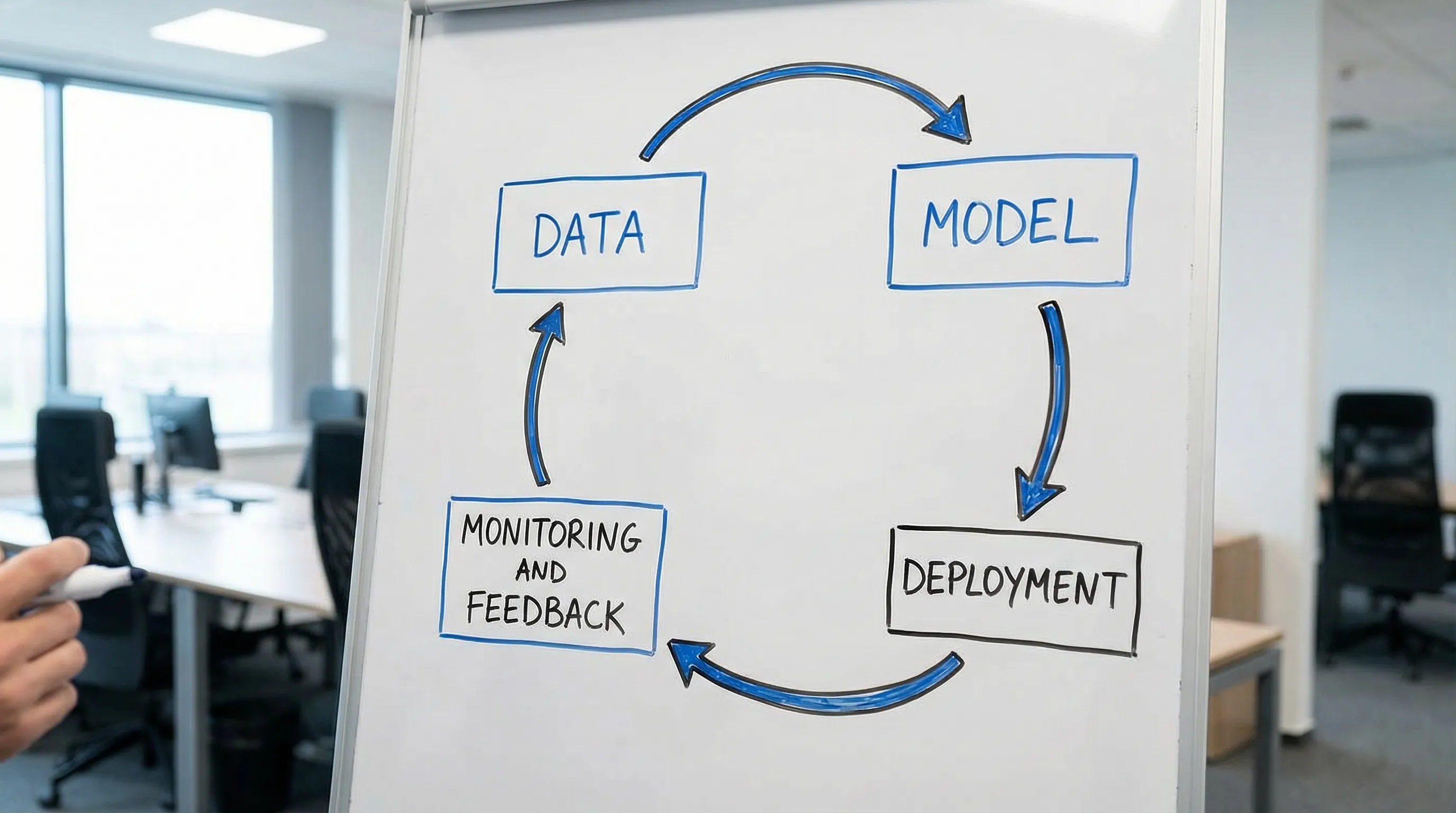
Ask: What is your deployment approach and how do you monitor model performance after launch?
Look for monitoring beyond uptime: drift detection, quality sampling, guardrail metrics, latency/cost tracking, and rollback plans.
Ask: How do you version prompts, models, and datasets?
If the vendor cannot explain reproducibility, you risk “it changed and nobody knows why.”
Ask: What is your incident response plan for AI failures?
A mature answer includes severity levels, on-call responsibilities, and playbooks for unsafe output, data leakage risk, and degraded quality.
For teams building LLM-enabled apps, it is also worth sanity-checking against the OWASP Top 10 for LLM Applications.
6) Security, privacy, and compliance
Ask: Where will our data be stored and processed, and will any of it be used to train third-party models?
You want explicit answers, not assumptions. Insist on clarity around retention, training usage, and administrative access.
Ask: What security standards do you align to (for example, ISO 27001 or SOC 2), and can you share a recent summary report or controls mapping?
They may not be certified, but they should be able to explain controls, encryption, access management, and secure SDLC practices.
Ask: How do you handle PII, data minimization, and deletion requests?
Even if you are not regulated, you want “privacy by design” habits.
7) Responsible AI and governance
Ask: How do you identify and mitigate bias, and how do you document limitations?
Strong partners can explain bias testing relevant to your domain and how they communicate limitations to end users.
Ask: Who is accountable for model behavior, and what governance artifacts do you produce?
Depending on your industry, you may need documentation like model cards, data source inventories, and risk assessments.
8) Team capability and communication
Ask: Who will actually be on our project team, and what are their last 2 to 3 similar implementations?
Request role clarity (ML engineer, data engineer, product, security) and ask what “similar” means (same domain, same scale, same risk profile).
Ask: How do you keep stakeholders aligned, and how do you handle scope changes?
Look for crisp rituals (weekly demos, decision logs) and transparent change control.
A practical vetting scorecard (use this to compare vendors)
Use a consistent rubric so the best storyteller does not automatically win.
| Category | What to ask | What strong evidence looks like | Common red flags |
|---|---|---|---|
| Problem framing | “How do you define success and acceptance criteria?” | Clear metrics, baselines, non-AI alternatives | Jumps straight to model choice |
| Data readiness | “What data do you need and how will you assess it?” | Data profiling plan, labeling strategy, ownership clarity | “Just send a dump,” no data QA |
| Model strategy | “Why RAG vs fine-tune vs custom?” | Tradeoffs, constraints, safety plan | One-size-fits-all approach |
| Evaluation | “Show an evaluation report.” | Test sets, error analysis, user pilot plan | Only demos, no measurable eval |
| MLOps | “How do you monitor and roll back?” | Drift/quality monitoring, versioning, incident playbooks | No monitoring beyond uptime |
| Security & privacy | “Will our data train any model?” | Explicit retention/training stance, access controls | Vague answers, unclear data flows |
| Governance | “What governance artifacts do you produce?” | Risk assessment approach, documentation | “Not needed,” hand-waving |
| Delivery | “What is the delivery plan and milestones?” | Phased rollout, clear dependencies, change control | Big-bang launch, fuzzy timeline |
Request these deliverables before you sign
Instead of buying promises, buy proof. Ask each vendor to provide a lightweight package (with confidential parts redacted if needed):
- A sample project plan with milestones, dependencies, and what you must provide
- A sample evaluation approach (metrics, test set strategy, pilot plan)
- A security overview (data flow diagram, retention policy, access controls)
- A description of the production monitoring plan (quality, drift, cost, latency)
- A named project team, including who is accountable for MLOps and security sign-off
If a vendor is unwilling to share any examples, that does not automatically mean they are weak, but it does raise the risk that their process is not mature.

A fast way to run a high-signal vendor call
A 30 to 45 minute call can be enough to surface depth if you structure it well. Keep it focused on how they think, not what they sell.
- Ask them to restate your problem, users, and constraints in their own words
- Ask for 2 possible solution approaches and why they would pick one
- Ask how they would evaluate success before launch and after launch
- Ask what typically goes wrong in projects like yours, and how they mitigate it
- Ask for one concrete example of a similar deployment and what they would do differently now
You are listening for specificity, tradeoffs, and operational realism.
Don’t forget enablement: your team must be able to use what you build
Even a great AI system can fail if front-line teams do not trust it, do not understand it, or do not know how to respond when it is uncertain.
Plan enablement as part of delivery:
- How users will learn the new workflow
- How feedback will be captured and turned into improvements
- What “safe use” looks like in ambiguous cases
- How supervisors will coach to consistent quality
This is especially important for sales and service use cases, where adoption and behavior change determine ROI.
Frequently Asked Questions
What should I look for when comparing AI software development companies? Look for proof of production experience: data readiness process, evaluation discipline, MLOps monitoring, security posture, and clear ownership after go-live.
How can I tell if a vendor is overselling AI? Warning signs include vague claims, no discussion of data quality, no evaluation plan beyond demos, and no clear monitoring or rollback strategy.
Should we build a custom model or use an existing one? Many business use cases work best with existing models plus strong retrieval (RAG), guardrails, and evaluation. Custom training can help, but it increases cost and operational burden.
What security questions matter most for AI projects? Ask where data is stored and processed, whether it will train any third-party model, retention policies, access controls, and how incidents are handled.
Build the skills to vet vendors, handle objections, and drive adoption with Scenario IQ
Vendor selection is partly technical, but it is also a communication test. Your leaders need to ask sharper questions, your stakeholders need to align on constraints, and your front-line teams need to adopt new AI-assisted workflows confidently.
Scenario IQ helps organizations practice these moments with AI-powered roleplay simulations, personalised scenarios, and real-time feedback, plus progress tracking analytics to see where teams improve over time. If you want to turn the questions in this guide into repeatable conversations across procurement, product, sales, and service, explore Scenario IQ.