
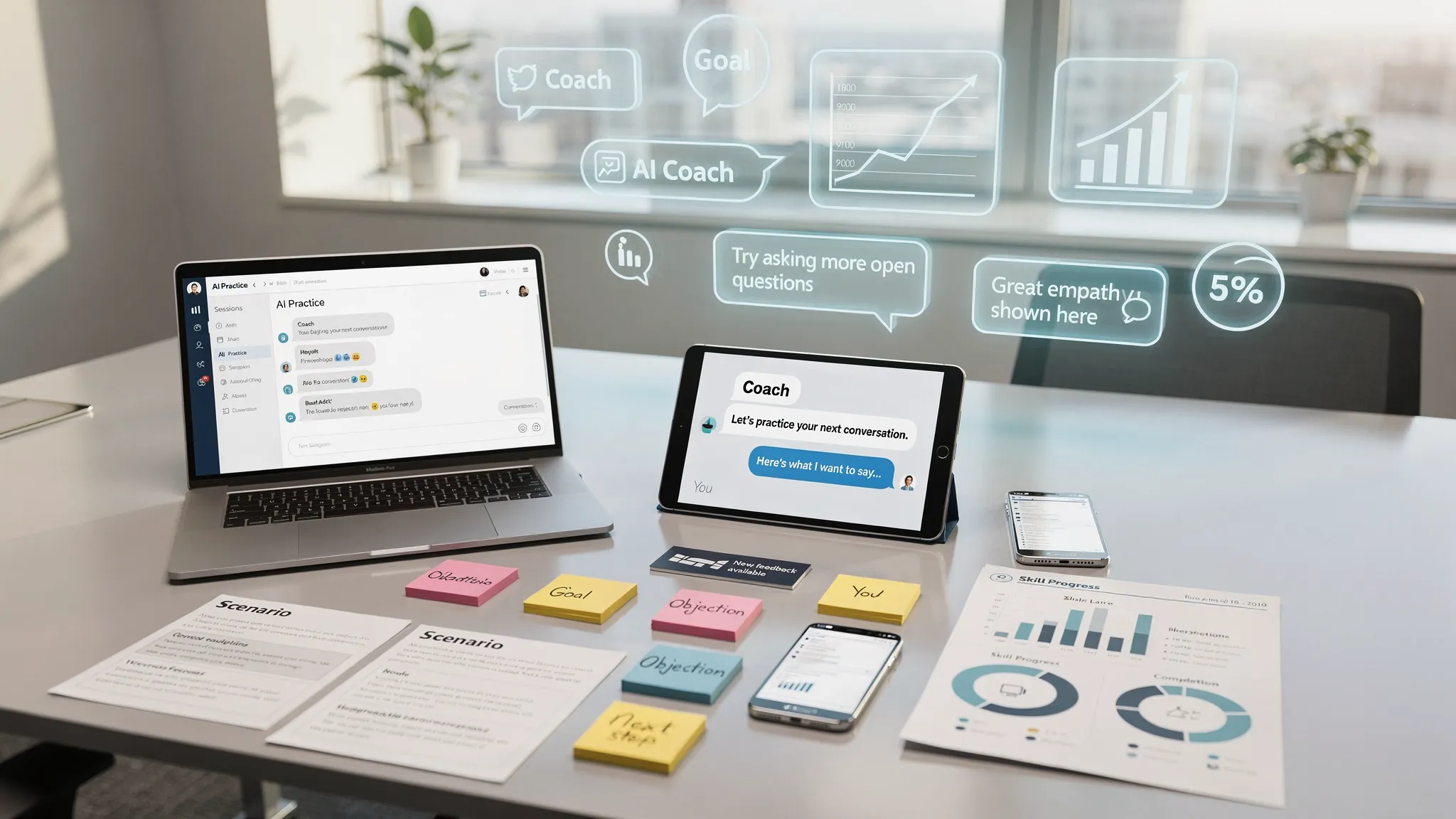
AI has moved from a helpful side tool to a daily teammate for sales and service teams. By 2026, the best reps will not simply know how to use an AI chat box. They will know how to turn AI into better preparation, sharper conversations, faster follow-up, and more trustworthy customer experiences.
That shift matters because customer-facing work is still deeply human. Buyers want relevance. Customers want speed and empathy. Leaders want consistent performance across the team. AI can support all of that, but only when reps build the right habits around it.
The practical AI skills every sales and service rep needs in 2026 are not coding skills. They are communication, judgment, data discipline, and repeatable practice skills, strengthened by AI.
Why AI skills are now frontline skills
AI adoption is already mainstream in knowledge work. Microsoft and LinkedIn’s 2024 Work Trend Index reported that 75% of global knowledge workers were using AI at work. For sales and service teams, that means AI is no longer a future initiative owned only by operations or IT. It is becoming part of how reps prepare, respond, learn, and improve.
The opportunity is clear. AI can summarize customer history, simulate objections, draft follow-ups, identify patterns, and help managers coach at scale. The risk is just as real. Poorly trained reps may overtrust AI outputs, send generic messages, mishandle sensitive customer data, or use automation in ways that make customers feel less heard.
In 2026, the competitive advantage will belong to teams that train reps to use AI with skill, not just access.
The 2026 AI skills every rep should build
The table below summarizes the core skill set. Each skill applies differently across sales and service, but the underlying capability is the same: use AI to improve human performance without giving up human responsibility.
| AI skill | What it means in practice | Why it matters in 2026 |
|---|---|---|
| AI-assisted research | Using approved data and AI tools to prepare for accounts, customers, and conversations | Reps can enter conversations with better context and less manual prep |
| Prompting and instruction writing | Giving AI clear context, goals, constraints, and output formats | Better prompts produce more useful, accurate, and actionable outputs |
| Data judgment | Checking AI responses against CRM records, policies, and customer facts | Prevents hallucinations, outdated guidance, and poor recommendations |
| Personalization | Turning AI suggestions into relevant, human messages | Helps reps avoid generic outreach and scripted support responses |
| AI roleplay practice | Rehearsing realistic sales and service scenarios with adaptive feedback | Builds confidence before reps face high-stakes customer moments |
| Conversation analysis | Learning from call, chat, and email patterns to improve future performance | Makes coaching more specific and measurable |
| Workflow orchestration | Moving from AI output to CRM updates, follow-ups, and next actions | Keeps productivity gains from getting lost between tools |
| Responsible AI use | Protecting customer data and applying company policy when using AI | Builds trust and reduces operational risk |

1. AI-assisted research and customer context building
The first AI skill every rep needs is the ability to prepare faster without becoming shallow. AI can help summarize account notes, past support interactions, industry context, renewal history, buying signals, and common pain points. But preparation still requires judgment.
A sales rep might use AI to turn CRM notes into a pre-call brief that highlights likely business priorities, open risks, previous objections, and suggested discovery questions. A service rep might use AI to summarize a customer’s recent tickets, sentiment, product usage context, and unresolved issues before responding.
The key is to train reps to ask AI for context, not conclusions. A strong rep does not ask, What should I sell this customer? A stronger prompt is closer to: Based on the approved CRM notes and previous conversation summary, identify the customer’s stated goals, open concerns, and three discovery questions I should ask before recommending next steps.
That distinction matters. AI should help reps arrive prepared, but reps should still listen, validate, and adapt in the live conversation.
2. Prompting that produces usable outputs
Prompting is one of the most practical AI skills because it directly affects output quality. Reps do not need to become prompt engineers, but they do need a repeatable way to instruct AI.
A useful prompt usually includes five elements: role, context, objective, constraints, and format. If one of those is missing, the output often becomes too broad, too generic, or too risky to use.
| Prompt element | Rep-friendly question | Example |
|---|---|---|
| Role | What should the AI act as? | Act as a sales coach reviewing my discovery plan |
| Context | What information should it consider? | Use these CRM notes and the prospect’s stated priorities |
| Objective | What outcome do I need? | Help me prepare for a 30-minute renewal call |
| Constraints | What rules should it follow? | Do not invent facts or make claims not supported by the notes |
| Format | How should the answer be structured? | Give me a brief, risks, questions, and recommended next steps |
The best reps also learn how to iterate. They ask AI to make a message more concise, adjust tone, identify weak assumptions, or provide alternative responses for different customer emotions. This turns AI from a one-shot answer machine into a thinking partner.
3. Data judgment and verification
AI can sound confident even when it is wrong. That makes verification a core frontline skill.
Sales and service reps should know how to separate AI-generated suggestions from verified facts. If an AI tool summarizes a customer issue, the rep should still confirm it against the ticket history. If AI drafts a competitive comparison, the rep should check it against approved messaging. If AI suggests a policy response, the rep should verify that the policy is current.
This is especially important for teams working with regulated industries, enterprise buyers, sensitive customer data, or complex product terms. The NIST AI Risk Management Framework emphasizes trustworthy AI characteristics such as validity, reliability, safety, security, accountability, and transparency. Those principles are not just for technical teams. They should shape how customer-facing teams use AI every day.
A simple rule helps: AI can accelerate the first draft, but the rep owns the final answer.
4. AI roleplay and realistic conversation practice
Knowing what to say is not the same as being able to say it under pressure. This is why AI roleplay is becoming a critical skill-building method for sales and service teams.
In sales, reps need to practice discovery, pricing pressure, competitive objections, procurement pushback, stalled deals, and executive-level conversations. In service, reps need to practice frustrated customers, vague complaints, escalation requests, technical confusion, and policy-sensitive conversations.
AI roleplay helps because it makes practice repeatable. Instead of waiting for a manager to roleplay every scenario manually, reps can rehearse against adaptive simulations, receive feedback, and try again. The skill is not just using the tool. The skill is learning how to practice deliberately.
Strong reps approach AI roleplay with specific goals. They might focus on asking better follow-up questions, reducing filler language, acknowledging emotion before solving, or closing with a clear next step. Over time, this turns practice into measurable improvement rather than a one-time training event.
5. Personalization without sounding automated
AI can help reps personalize faster, but it can also create messages that feel artificial. In 2026, customers will be even more sensitive to generic AI-written outreach and robotic support replies. Reps need to know how to humanize AI outputs.
For sales teams, personalization means connecting outreach to a real business trigger, role-specific priority, or previous conversation. It does not mean inserting a prospect’s company name into a generic template. For service teams, personalization means acknowledging the customer’s actual issue, history, and emotional state before offering a resolution.
Before sending an AI-assisted message, reps should ask:
- Is this based on verified customer context?
- Does it sound like something I would actually say?
- Does it clearly help the customer move forward?
- Is any claim too broad, too confident, or unsupported?
This skill protects both performance and brand trust. AI can draft the structure, but the rep should add the relevance.
6. Objection handling and conflict navigation
Objection handling is one of the highest-value areas for AI training because it requires speed, empathy, and judgment at the same time.
Sales reps need to handle objections like price, timing, priority, risk, implementation effort, competitor preference, and internal alignment. Service reps need to handle concerns like unmet expectations, repeated issues, billing frustration, product confusion, and requests outside policy.
AI can help reps prepare responses, but the real skill is choosing the right response for the moment. A customer saying the price is too high may be expressing budget limits, unclear value, lack of urgency, or fear of making the wrong decision. A customer demanding escalation may need a manager, but they may also need acknowledgement and a clear path to resolution.
Great reps use AI to practice options, then rely on listening to choose the right path. The goal is not to memorize scripts. The goal is to build conversational range.
7. Service triage and escalation judgment
For service reps, one of the most important AI skills is knowing when AI assistance is enough and when a human escalation is needed. AI can suggest knowledge base answers, summarize customer history, and recommend next steps. But the rep still needs to read urgency, emotion, complexity, and risk.
A service rep should be trained to identify moments when escalation is appropriate, such as repeated unresolved issues, potential legal or compliance concerns, safety-related problems, high-value customer risk, or strong emotional distress. AI can help organize the handoff by summarizing the issue, customer history, attempted fixes, and requested outcome.
This makes escalation more efficient and more respectful. Customers should not have to repeat themselves just because a case moved from one channel or person to another.
8. CRM and knowledge base hygiene
AI depends on the quality of the information it can access. If CRM notes are incomplete, outdated, or inconsistent, AI-assisted coaching and recommendations become less reliable. The same is true for knowledge base articles, call dispositions, ticket categories, and objection tracking.
That means data hygiene is no longer just an operations task. It is an AI skill for every rep.
Sales reps should log customer priorities, stakeholders, objections, next steps, and deal risks in a consistent format. Service reps should capture issue type, resolution path, sentiment, root cause, and follow-up needs. Managers should make this easy by defining the fields that matter most and removing unnecessary admin work where possible.
When reps understand that better inputs lead to better AI support, CRM discipline becomes less of a chore and more of a performance advantage.
9. Responsible AI, privacy, and customer trust
Trust is a skill. In customer-facing roles, reps need clear rules for what information can be entered into AI tools, what must stay inside approved systems, and how AI-assisted content should be reviewed before use.
At a minimum, reps should know how to avoid pasting sensitive customer data into unapproved tools, how to follow company policy on AI-generated communication, and how to avoid making claims that AI cannot verify. They should also understand that customers may have questions about how their information is used.
Responsible AI training should not be buried in a legal policy that reps read once. It should be built into everyday scenarios. For example, a rep can practice responding when a customer asks whether an answer was generated by AI, or when a suggested response includes information that may not be appropriate to share.
10. Continuous self-coaching with AI feedback
The final skill is the ability to use AI feedback to improve week by week. This is where AI can change the rhythm of learning.
Traditional training often happens during onboarding, quarterly enablement sessions, or after performance issues appear. AI makes it possible to create a more continuous loop: practice, feedback, adjustment, and measurement.
Reps should learn how to review feedback without becoming defensive. Managers should help them focus on one or two skills at a time, such as discovery depth, empathy statements, closing clarity, or policy accuracy. This keeps improvement practical and prevents AI feedback from becoming overwhelming.
The most effective teams will not treat AI training as a one-time rollout. They will treat it as a weekly performance habit.
How managers can build AI skills without overwhelming the team
Sales and service leaders do not need to introduce every AI workflow at once. In fact, trying to do too much too quickly often creates tool fatigue. A better approach is to connect AI skills to the conversations reps already have.
| Training phase | Focus | Example activity | Success signal |
|---|---|---|---|
| Weeks 1 to 2 | Baseline readiness | Run roleplay assessments for common sales or service scenarios | Managers can see skill gaps by rep, team, and scenario |
| Weeks 3 to 4 | Prompting and preparation | Train reps to create customer briefs using approved data | Reps show better call prep and fewer generic messages |
| Weeks 5 to 8 | Conversation practice | Use AI roleplay for objections, escalations, and discovery | Reps improve confidence and consistency in difficult moments |
| Weeks 9 to 12 | Feedback and reinforcement | Review analytics, coach targeted skills, and assign practice scenarios | Coaching becomes more specific and performance trends improve |
The most important step is to define what good looks like. AI skills should be tied to observable behaviors, not vague enthusiasm. For example, a rep is not AI-ready because they say they use AI. They are AI-ready when they can prepare with AI, verify outputs, personalize appropriately, practice tough moments, protect customer data, and act on feedback.
A quick AI readiness checklist for sales and service reps
Use this checklist to identify where your team is strong and where training should focus next.
- Reps can use AI to prepare for customer conversations using approved data.
- Reps know how to write prompts with clear context, goals, constraints, and formats.
- Reps verify AI outputs before using them with customers.
- Reps can adapt AI-generated messages so they sound human and relevant.
- Reps practice objections, escalations, and difficult conversations through roleplay.
- Reps understand what customer information can and cannot be used with AI tools.
- Reps consistently log customer context so AI-assisted coaching becomes more accurate.
- Managers can track progress by skill, scenario, and team performance trend.
If several of these are missing, the issue is not just tool adoption. It is readiness. And readiness can be trained.
Frequently Asked Questions
What are AI skills for sales and service reps? AI skills are the practical abilities reps need to use AI effectively in customer-facing work. They include prompting, research, data verification, personalization, roleplay practice, responsible AI use, and applying feedback to improve performance.
Do sales and service reps need to learn coding to use AI well? No. Most reps do not need coding skills. They need communication skills, judgment, process discipline, and the ability to use AI tools safely and effectively within their daily workflows.
How can managers train AI skills across a team? Managers can start with scenario-based practice, define clear skill rubrics, use AI roleplay for common conversations, review performance analytics, and reinforce one or two behaviors at a time through coaching.
Why is AI roleplay useful for sales and service training? AI roleplay gives reps a safe way to practice realistic conversations before they happen with actual customers. It helps build confidence, improve objection handling, strengthen empathy, and make coaching more consistent.
What is the biggest risk when reps use AI? The biggest risk is overtrusting AI outputs. Reps must verify facts, follow data privacy rules, use approved sources, and take responsibility for the final customer response.
Build AI-ready reps with Scenario IQ
AI skills become valuable when reps can practice them in realistic situations, receive feedback, and improve over time. That is where scenario-based training matters.
Scenario IQ helps sales and service teams build confidence through AI-powered roleplay simulations, personalized training scenarios, real-time feedback, adaptive guidance, progress tracking analytics, and team-focused learning. Instead of relying only on static training materials, leaders can help reps rehearse the conversations that actually affect revenue, retention, and customer trust.
If your team is preparing for 2026, start by training the moments that matter most: the tough objection, the frustrated customer, the unclear next step, and the conversation where confidence makes the difference.