
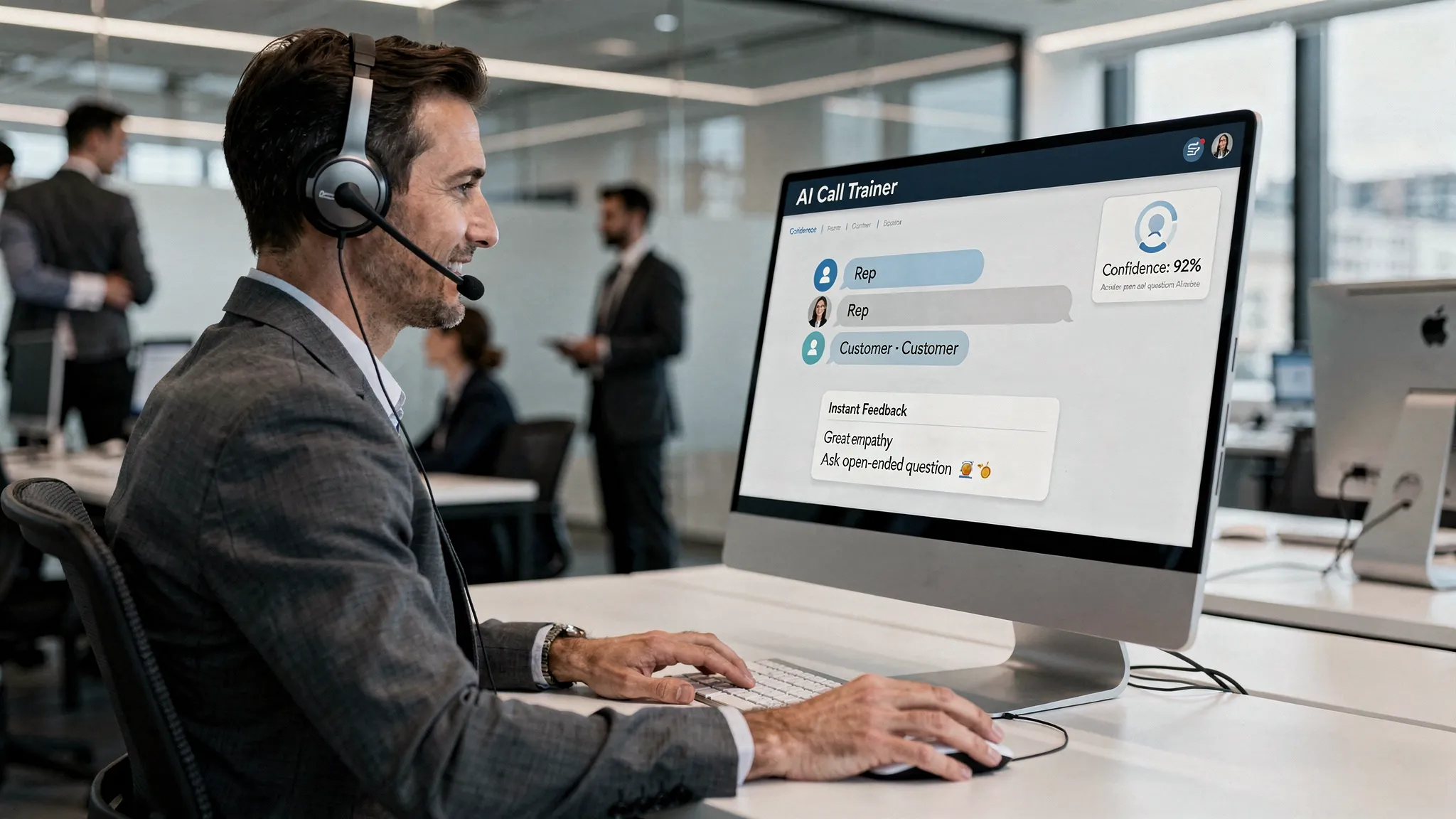
The hardest part of a sales or service call is rarely the script. It is the moment a real customer asks an unexpected question, challenges pricing, compares you to a competitor, or gets frustrated before the conversation has even started.
That is why confidence matters. A confident rep does not simply sound more polished. They listen better, recover faster, ask stronger follow-up questions, and stay present when the call becomes unpredictable. The challenge for sales enablement, customer service, and revenue leaders is simple: how do you build that confidence before the stakes are real?
AI simulations are becoming one of the most practical answers. Instead of waiting for reps to learn through trial and error on live calls, teams can now rehearse realistic conversations in a safe environment, receive feedback immediately, and improve before speaking with customers.
Why live-call confidence is a performance issue
Confidence is often treated as a personality trait. In high-performing teams, it is treated as a readiness outcome.
A rep who has practiced common objections, difficult customer emotions, and call flow transitions is more likely to stay composed. A rep who has only reviewed slides or watched training videos may understand the theory, but still freeze when a prospect says, “We already use a competitor,” or “Your price is too high.”
This gap between knowledge and performance is common. Traditional training often focuses on information transfer, while live calls demand real-time communication. The rep has to process tone, context, objections, product fit, and next steps all at once.
That is where simulation-based practice changes the learning experience. It turns passive training into active rehearsal.

What AI simulations do differently
Roleplay has existed in sales and service training for decades. The problem is that traditional roleplay is often inconsistent. It depends on manager availability, peer comfort, and whether the scenario feels realistic enough to take seriously.
AI simulations solve many of those constraints by giving every rep a repeatable, personalized practice environment. Instead of scheduling a manager for every coaching moment, reps can practice on demand. Instead of rehearsing one generic scenario, they can work through different buyer personas, objection types, service issues, and skill levels.
The real advantage is not just convenience. It is feedback speed.
When reps receive feedback immediately after a simulated conversation, they can connect the guidance to the moment it happened. They can see where they interrupted, missed a buying signal, skipped discovery, over-explained, or failed to confirm next steps. That short feedback loop is what helps confidence grow quickly.
Research on skill development consistently supports the value of practice, feedback, and repetition. The National Research Council’s work on adult learning highlights the importance of active learning, feedback, and transferring knowledge into real-world performance. For sales and service teams, AI roleplay makes those principles easier to apply at scale.
The confidence gap before live calls
Most teams do not lose deals or disappoint customers because reps know nothing. They struggle because reps are underprepared for the specific moments that create pressure.
Common confidence gaps include:
- Opening a call with clarity and control
- Asking discovery questions without sounding scripted
- Handling pricing pressure without discounting too early
- Responding to competitor comparisons
- De-escalating frustrated customers
- Explaining value in the customer’s language
- Recovering after an unclear or awkward answer
- Moving from conversation to next step without sounding pushy
These are not purely knowledge problems. They are communication problems under pressure. That makes them ideal for scenario-based training.
A rep may understand the approved messaging, but still struggle to deliver it naturally. They may know the objection-handling framework, but forget it when challenged. AI simulations create a bridge between “I know what to say” and “I can say it clearly when it matters.”
How AI simulations build confidence before customer conversations
Confidence grows when reps experience progress. AI simulations create that progress through controlled challenge, repetition, and measurable improvement.
They make practice feel realistic
The more realistic the scenario, the more useful the practice. A generic script about a fictional customer does not prepare reps for the nuance of real conversations. Strong AI simulations can reflect actual call types, customer goals, objections, and communication styles.
For example, a new account executive might practice a discovery call with a skeptical operations leader. A customer support agent might practice calming an angry customer after a delayed resolution. A sales development rep might rehearse a cold call where the prospect is distracted and short on time.
Realism matters because confidence does not come from memorizing perfect lines. It comes from learning how to adapt.
They reduce the fear of failure
Live calls create pressure because mistakes can affect revenue, customer satisfaction, and brand trust. In a simulation, reps can make mistakes safely. They can stumble through an objection, try a different response, and learn without risking a real opportunity.
This is especially valuable for new hires, career switchers, and reps entering a new market or product line. Instead of relying on shadowing alone, they can actively practice before taking ownership of conversations.
They provide immediate feedback
Delayed feedback is less effective because the rep may not remember exactly what happened. AI simulations can provide real-time or near-real-time feedback while the conversation is still fresh.
Feedback can help reps understand both what they said and how they handled the interaction. Did they ask enough questions? Did they acknowledge the customer’s concern? Did they jump to a pitch too early? Did they close with a clear next step?
Scenario IQ, for example, supports AI-powered roleplay simulations, personalized training scenarios, real-time feedback, adaptive guidance, and progress tracking analytics. Those capabilities help teams move from subjective coaching to more consistent skill development.
They support repetition without manager bottlenecks
Managers are essential to coaching, but they cannot be present for every practice session. AI simulations give reps more opportunities to rehearse between coaching conversations.
This does not replace managers. It makes manager time more valuable. Instead of spending every coaching session recreating basic scenarios, managers can review patterns, focus on higher-level development, and coach the moments that matter most.
They personalize difficulty
Confidence is built when practice is challenging but achievable. If scenarios are too easy, reps do not grow. If they are too hard, reps may disengage.
Adaptive simulations can adjust based on skill level, role, or performance. A new rep may start with basic discovery flow, while an experienced rep may practice complex multi-stakeholder objections or tense renewal conversations.
This personalization is critical because teams are rarely uniform. A single training session cannot meet everyone where they are. AI simulations can.
Where AI simulations fit in the sales and service training workflow
AI simulations work best when they are not treated as a one-time training event. They should be part of an ongoing readiness system.
| Training moment | How AI simulations help | Example use case |
|---|---|---|
| New hire onboarding | Build call confidence before reps speak with customers | Practice discovery, qualification, and support intake calls |
| Product launches | Help teams explain new value propositions clearly | Rehearse positioning and FAQs for a new feature or offer |
| Objection handling | Prepare reps for common resistance patterns | Practice pricing, timing, competitor, and authority objections |
| Customer service coaching | Improve empathy, de-escalation, and resolution clarity | Simulate frustrated customers or complex support issues |
| Manager coaching | Give leaders performance data to guide coaching | Review recurring gaps across reps, teams, or scenarios |
| Certification | Validate readiness before live conversations | Require reps to complete scenario benchmarks before call ownership |
The biggest shift is from event-based enablement to continuous readiness. Instead of asking, “Did the rep attend training?” leaders can ask, “Can the rep handle the conversation?”
Practical scenarios worth simulating before live calls
Not every scenario needs to be complex. The best starting point is to identify the conversations where confidence most affects outcomes.
For sales teams, that may include discovery, cold outreach, demo setup, pricing conversations, procurement pushback, and renewal risk. For service teams, it may include complaints, escalations, unclear requests, policy explanations, and emotionally charged interactions.
A useful scenario should include context, customer motivation, likely objections, desired behaviors, and success criteria. Without those elements, practice can become too vague.
For example, “practice objection handling” is broad. A stronger simulation prompt would be: “The prospect believes the current vendor is good enough and does not want to spend time evaluating another solution. The rep must uncover the cost of staying the same, avoid attacking the competitor, and earn agreement on a short follow-up.”
That level of specificity helps reps practice judgment, not just wording.
What leaders should measure
Confidence can feel intangible, but readiness can be measured. The key is to track behaviors that show whether reps are improving.
Useful metrics include:
- Scenario completion rates
- Improvement over repeated attempts
- Objection-handling performance
- Talk-to-listen balance indicators
- Use of discovery questions
- Clarity of next steps
- Manager review outcomes
- Readiness by team, role, or skill level
Scenario IQ includes progress tracking analytics and performance metric dashboards, which can help leaders see where individuals and teams are improving. That matters because the goal is not just to give reps more practice. The goal is to connect practice to better customer conversations.
Leaders should also compare simulation insights with business outcomes over time. For example, if reps improve in pricing objection simulations, teams can monitor whether discounting behavior, deal progression, or manager call reviews change as well. The connection will not always be one-to-one, but it can reveal whether training is moving in the right direction.
How to introduce AI simulations without overwhelming the team
The easiest mistake is trying to simulate every conversation at once. Start with the highest-impact call moments.
Choose one team, one skill, and one measurable outcome. For example, a revenue leader might begin with discovery calls for new account executives. A customer service leader might begin with de-escalation for frontline agents. A sales enablement leader might begin with pricing objections before a new product launch.
Then make practice short, consistent, and relevant. A 10-minute simulation repeated several times per week can be more effective than a long quarterly workshop that reps quickly forget.
To drive adoption, position AI simulations as a performance advantage, not a surveillance tool. Reps should understand that the purpose is to help them gain confidence before the customer conversation, not to punish imperfect practice. Analytics should support coaching and readiness, not create fear.
Best practices for better AI simulation results
AI simulations are most effective when they are designed around real business conversations. The technology matters, but the training strategy matters just as much.
Start with actual call patterns. Review common objections, lost deal notes, support escalations, manager feedback, and customer questions. Use those insights to build scenarios that mirror the conversations your team already faces.
Keep the scoring focused. If a rep receives feedback on 15 things at once, they may not know what to improve first. Focus each scenario on a few priority behaviors, such as opening structure, discovery depth, empathy, objection handling, or closing clarity.
Create a progression. Begin with foundational scenarios, then increase complexity. This mirrors how confidence grows in real life. Reps need early wins, followed by harder challenges that stretch their skills.
Finally, involve managers. AI feedback is powerful, but human coaching adds context, judgment, and encouragement. Managers can use simulation analytics to identify patterns, then coach more precisely.
Why confidence before the call improves the customer experience
Customers can feel when a rep is unsure. They can also feel when a rep is prepared, calm, and focused on helping.
Confidence affects more than tone. It changes the quality of the conversation. A prepared rep is less likely to rush into a pitch, more likely to ask thoughtful questions, and better equipped to handle objections without becoming defensive. In service environments, confident agents are more likely to acknowledge frustration, explain next steps clearly, and keep the interaction moving toward resolution.
This is why AI simulations are not just an enablement tool. They can support revenue growth, customer satisfaction, and employee development at the same time. When people feel prepared, they perform better. When they perform better, customers notice.
Frequently Asked Questions
What are AI simulations in sales and service training? AI simulations are interactive practice environments that let reps rehearse realistic customer conversations. They can be used for sales calls, support interactions, objection handling, onboarding, and other communication-heavy scenarios.
How do AI simulations build confidence before live calls? They give reps a safe place to practice difficult conversations, make mistakes, receive feedback, and try again. This repeated practice helps reps feel more prepared when similar moments happen with real customers.
Can AI simulations replace manager coaching? No. AI simulations are best used to support manager coaching, not replace it. They give reps more practice opportunities and give managers better insight into where coaching is needed.
Which teams benefit most from AI roleplay training? Sales, customer service, customer success, account management, and any team that relies on high-quality conversations can benefit. The strongest use cases are roles where communication quality directly affects revenue, retention, or customer experience.
How often should reps practice with AI simulations? Short, frequent practice is usually better than occasional long sessions. Many teams benefit from using simulations during onboarding, before major campaigns, after product updates, and as part of weekly coaching routines.
Build live-call confidence with Scenario IQ
AI simulations help teams move from hoping reps are ready to knowing where they stand before live conversations happen.
Scenario IQ provides AI-driven, personalized scenario-based training designed to improve team performance, communication, and confidence. With AI-powered roleplay simulations, real-time feedback, adaptive guidance, daily actionable tips, customizable skill levels, and progress tracking analytics, teams can practice the conversations that matter most before they happen with real customers.
If your team needs to handle objections better, improve service conversations, or build confidence before live calls, explore Scenario IQ and see how AI roleplay training can support stronger performance across your organization.