

Most “AI sales stacks” fail for a simple reason: they are built for leadership dashboards, not for a rep’s daily rhythm. Reps adopt tools that help them book meetings, run better calls, follow up faster, and move deals forward with less effort. Everything else becomes shelfware.
An AI sales system is not one tool. It is a connected set of workflows where AI reliably helps with specific jobs, inside the systems reps already use (CRM, email, calendar, calling, chat, knowledge base). This guide shows how to design that system so it becomes part of the workday, not another tab.
What “AI sales systems” actually means (and what it does not)
An AI sales system is a repeatable operating model for selling, supported by AI across:
- Data (clean inputs, consistent fields, trustworthy activity capture)
- Workflow (where reps execute: CRM, inbox, dialer, support console)
- Decision support (what to do next, what to say, which deals need help)
- Skill development (practice, coaching, reinforcement that sticks)
- Governance (security, permissions, compliance, and quality control)
It is not:
- A single “AI copilot” added on top of messy CRM data
- A pile of point solutions with overlapping features
- A content generator that creates more noise than signal
If you want daily usage, design for rep time-to-value: the system should save time or increase win probability within the first week.
The rep adoption test: 5 questions your stack must pass
Before you choose tools, pressure-test the stack with these adoption questions:
1) Does it remove work reps already hate?
Think call notes, follow-ups, CRM hygiene, meeting prep, and first-draft outreach. If AI only adds “new best practices,” adoption will be slow.
2) Does it live where work happens?
Reps live in inbox, calendar, dialer, and CRM. If your AI requires copying context into a separate app, usage drops.
3) Does it use trusted data?
AI is only as good as the underlying CRM fields, product knowledge, and call transcripts. When reps see wrong account details or generic suggestions, they stop relying on it.
4) Does it help them sound better, not more automated?
AI that produces robotic scripts can hurt conversion. The goal is better conversations (objection handling, discovery depth, concise follow-ups) not “more output.”
5) Is it measurable without becoming surveillance?
You need adoption and performance signals (activity quality, skill progression, pipeline movement), but reps will resist systems that feel purely punitive.
The everyday AI sales loop (what you are building)
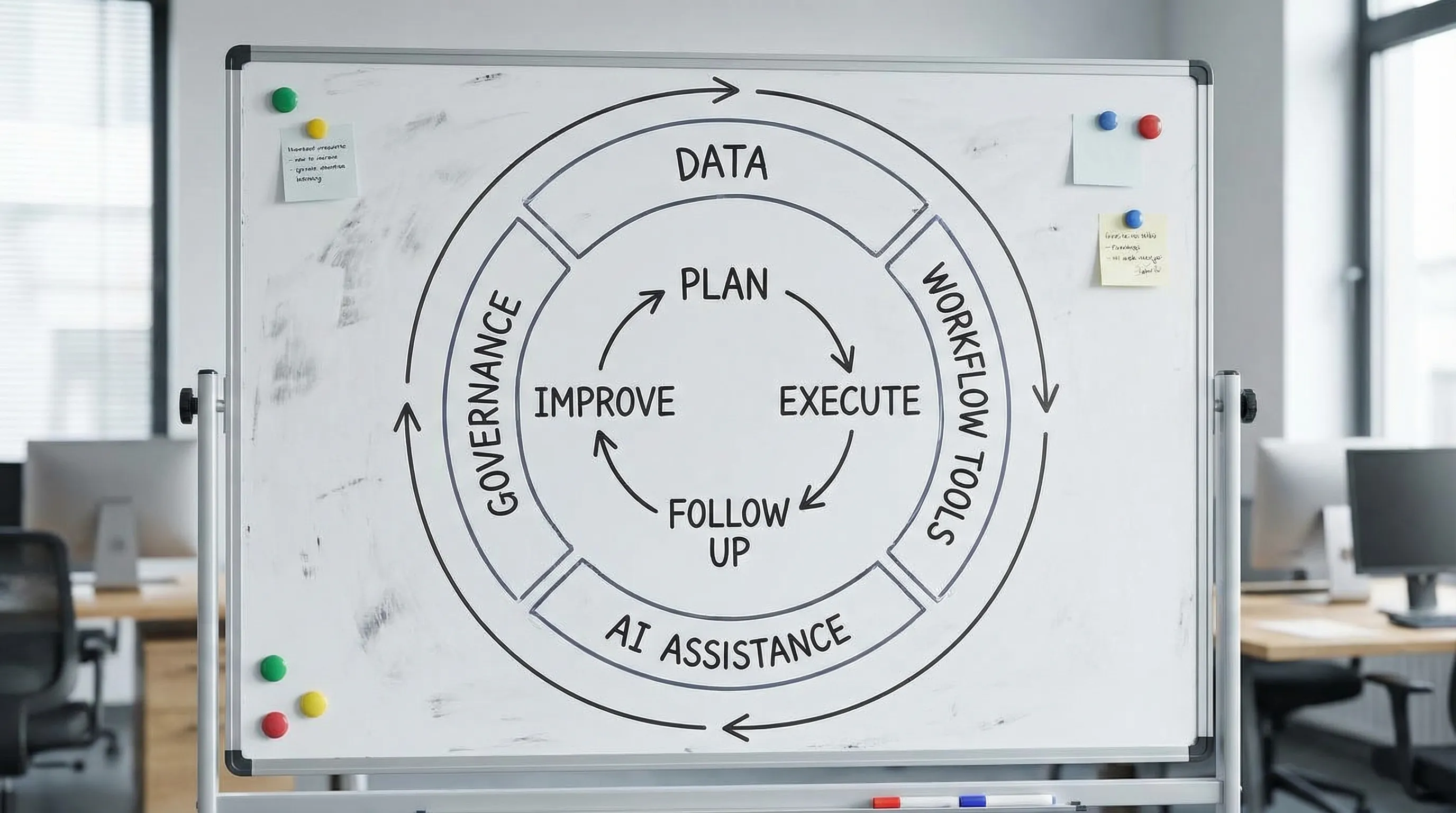
A practical AI sales system supports a repeating daily loop:
- Plan: prioritize accounts, prep for meetings
- Execute: run calls, handle objections, capture outcomes
- Follow up: emails, tasks, next steps, multi-threading
- Improve: coaching, practice, reinforcement, feedback
If your stack does not strengthen each part of this loop, it will not be used every day.
The 6 layers of an AI sales system stack (with what to standardize)
You can assemble this in different ways depending on your size and motion, but the layers stay consistent.
Layer 1: The system of record (CRM) and data standards
Your CRM is still the source of truth. AI can reduce manual entry, but it cannot fix missing definitions.
Standardize:
- Lead, contact, account, and opportunity definitions
- Required fields at each stage (and what “complete” means)
- A single set of pipeline stages and exit criteria
- Activity capture rules (what gets logged, where, and by whom)
If you have inconsistent stages or free-text everything, your AI outputs will be inconsistent too.
Layer 2: Communication and engagement surfaces
This is where reps spend time: email, calendar, phone, video conferencing, chat.
Your goal is to embed AI into these surfaces so reps can:
- Generate first drafts that match your messaging
- Summarize calls and extract next steps
- Produce follow-ups with correct context
- Create tasks without breaking flow
Layer 3: Conversation intelligence and call workflow
Call recordings and transcripts become a high-value data stream when they are searchable, tagged, and tied to deals.
What to look for at the system level:
- Automatic summaries aligned to your sales methodology
- Objection and competitor mention capture
- Coachable moments that map to skills
- Easy push of outcomes back to CRM (without rep rework)
Layer 4: Enablement, coaching, and skill practice (where most stacks are weak)
AI systems often focus on content and analytics, but behavior change comes from practice.
This is where scenario-based training fits naturally. Tools like Scenario IQ provide AI roleplay simulations that let reps practice discovery, objection handling, and service recovery in realistic scenarios, with real-time feedback and progress tracking. That closes the loop between “we saw the problem in calls” and “we fixed the skill that caused it.”
The best implementations tie practice to reality:
- A rep loses deals on pricing pushback, they get a targeted scenario that week
- A new hire struggles with discovery depth, they practice the same ICP scenario daily
- A service team sees escalation patterns, they roleplay de-escalation and policy explanations
Layer 5: Knowledge and content that AI can safely use
If AI drafts an email that contradicts policy, pricing, or legal guidance, adoption and trust collapse.
Treat knowledge like product infrastructure:
- One approved source for positioning, pricing guardrails, security answers, and competitive notes
- Clear “do not say” rules and compliance disclaimers
- A lightweight review cadence so content stays current
Layer 6: Governance, security, and risk controls
If you sell into regulated industries, governance is a feature, not paperwork.
Use recognized guidance for your risk posture. The NIST AI Risk Management Framework is a useful, practical reference for structuring AI risks (accuracy, privacy, transparency, and accountability) in a way security teams understand.
A practical blueprint: build an AI sales system in 30 to 60 days
This is a rollout pattern that prioritizes adoption and compounding value.
Step 1: Start with 3 daily rep jobs (not 30 “AI use cases”)
Pick jobs where reps feel pain and the outcome is measurable:
- Meeting prep that reduces ramp time and improves discovery
- Call recap plus next steps pushed into CRM
- Follow-up drafts that improve speed-to-response and consistency
If you begin with “AI account insights” but your data is messy, you will disappoint everyone.
Step 2: Choose your “anchor” workflow (usually CRM plus inbox)
Your AI sales system should have a clear center of gravity. For most teams, that is:
- CRM for pipeline and process
- Inbox and calendar for daily execution
Design integrations and prompts so reps do not re-enter context.
Step 3: Define quality bars (what “good” looks like)
Avoid vague success criteria like “more productivity.” Define observable standards:
- What a good call summary includes
- What a good follow-up email must contain (next step, date, value recap)
- What fields must be populated for a stage change
This is where AI shines: it can coach consistency if you define the standard.
Step 4: Add skill practice that targets your real objections
Once AI is capturing objections and patterns from calls, use that data to drive practice.
Scenario-based roleplay lets you turn patterns into improvement loops, for example:
- “Procurement is asking for a discount” scenario at intermediate difficulty
- “Switching from competitor X” scenario for advanced reps
- “Angry customer escalation” scenario for service teams
With Scenario IQ, this can be delivered as personalised, adaptive simulations with real-time feedback and analytics, making it easier to run reinforcement without pulling managers into constant 1:1 roleplays.
Step 5: Launch with champions, then scale with proof
Adoption spreads when reps see peers win.
- Pilot with one team (5 to 15 reps)
- Publish 2 to 3 wins: time saved, faster follow-up, improved conversion on a key objection
- Roll out to the next segment with the same playbook
What to measure (so the system improves instead of just reporting)
You need a balanced scorecard that reflects both usage and outcomes.
| Measurement area | What to track | Why it matters |
|---|---|---|
| Adoption | Weekly active users per role, usage by workflow (prep, recap, follow-up) | Shows if the system is actually “daily” |
| Speed | Time-to-follow-up after meetings, time spent on admin | Indicates immediate rep value |
| Quality | Call summary completeness, next-step clarity, CRM hygiene at stage change | Connects AI to execution quality |
| Capability | Skill progression by scenario type, coaching completion | Proves behavior change, not just activity |
| Revenue signals | Stage conversion, win rate in targeted segments, cycle length | Validates business impact |
A key point: measure outcomes at the initiative level (for example “pricing objection handling”) rather than attributing revenue to a single tool.
Common failure modes (and how to avoid them)
“We bought AI, but reps do not trust it”
This is usually a data and knowledge problem. Fix the inputs:
- Tighten CRM definitions and required fields
- Create one approved knowledge source for AI drafting
- Limit AI to areas where correctness can be verified (summaries, checklists, structured templates)
“AI emails sound generic, so reps stop using them”
Make personalization systematic, not magical.
- Define 2 to 3 tone options aligned to your brand
- Require AI drafts to include a specific customer context field (industry, trigger, current tool, goal)
- Train reps to treat AI as a first draft, not a final answer
“Managers get dashboards, reps get extra steps”
If reps do more work so leadership can see more charts, adoption dies.
Design the system so rep actions automatically generate the reporting artifact, for example call recap produces next steps, which populates CRM, which creates forecast signals.
“We automated the wrong parts of the process”
AI should amplify high-value selling time. Do not rush to automate what needs judgment (deal strategy, pricing exceptions) until you have reliable guardrails.
Recommended stack patterns by company stage
You do not need an enterprise stack to build an AI sales system, but you do need coherence.
Small teams (early stage)
Focus on fewer tools with strong workflow fit:
- CRM as the core
- AI support for call recap and follow-up
- Lightweight scenario practice for objection handling and discovery
Goal: reduce admin and improve consistency.
Mid-market teams (multiple segments, faster hiring)
Add structure and reinforcement:
- Conversation intelligence plus coaching workflows
- Role-based scenario paths (SDR, AE, AM, service)
- Progress analytics that help managers coach without micromanaging
Goal: shorten ramp time and standardize execution.
Enterprise and regulated teams
Prioritize governance and integration:
- Clear data retention and permissions
- Central knowledge management and approvals
- Security reviews and vendor risk management
- Strong analytics, but tied to rep value
Goal: scale safely while keeping daily usability.
Where Scenario IQ fits in an AI sales system
Most AI stacks get better at analyzing sales, but they struggle to change what reps do on the next call. That is exactly where training and practice belongs.
Scenario IQ is a natural fit for the “Improve” part of the daily loop:
- AI-powered roleplay simulations for sales and service conversations
- Personalised scenarios and adjustable skill levels for different roles
- Real-time feedback and adaptive guidance
- Progress tracking analytics and performance dashboards
- Team-focused learning with enterprise-grade security
If your goal is a stack reps use every day, connect practice to reality: use call patterns and frontline challenges to trigger short, targeted roleplays that build confidence and improve objection handling.
A final checklist: the simplest version that can work
If you want a clean starting point, aim for:
- One CRM process your team actually follows
- AI assistance embedded in inbox and call workflow
- A controlled knowledge base for safe messaging
- A reinforcement engine (roleplay and coaching) that targets real objections
- A small set of metrics that prove rep value and business impact
That combination is what turns “AI tooling” into AI sales systems that earn daily usage.