

Buyers are cautious, committees are larger, and every deal feels like a maze. That is exactly why revenue teams are turning to AI sales strategies that remove friction, increase seller confidence, and create more consistent outcomes. If your goals are faster cycle times and higher win rates, the playbook below shows what to implement first, how to measure impact, and how to make the change stick.
Why Sales Cycles Slow Down, and Where AI Can Help
Long cycles rarely come from one issue. The common pattern is a handful of small delays that compound across stages:
- Weak qualification that lets low probability deals hang around
- Generic discovery that fails to uncover urgency or business impact
- Slow or shallow objection handling that triggers more meetings
- Proposals that do not map to decision criteria, leading to stalls
- Inconsistent coaching, so the team repeats the same mistakes
AI helps by doing two things very well. It reduces manual work that causes delays, and it uplevels skills through deliberate practice, so reps execute under pressure when it matters.
McKinsey research shows generative AI can unlock significant value in sales and marketing functions. The fastest gains come when AI improves day to day execution rather than adding yet another tool that reps rarely use.
The AI Practice Loop That Shortens Cycles
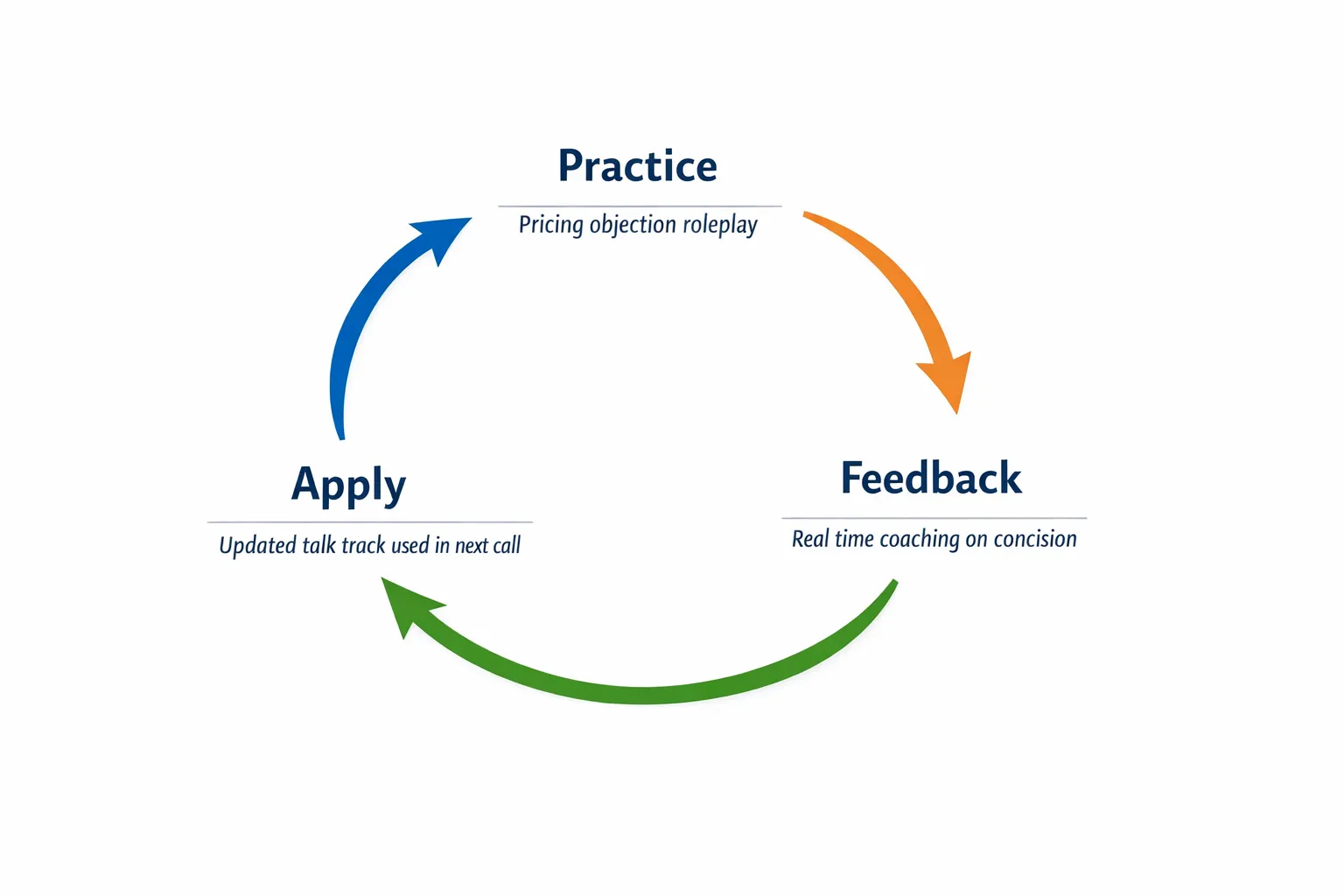
The most reliable way to move deals faster is to close the gap between what reps know and what they do live with customers. The AI practice loop makes that practical at team scale:
1) Practice high impact moments in realistic simulations, repeatedly.
2) Get real time feedback on clarity, objection handling, and next steps.
3) Apply the improved talk tracks and habits in active deals.
Platforms like Scenario IQ operationalize this loop with AI powered roleplay simulations, personalized training scenarios, adaptive feedback, daily tips, and performance dashboards. The result is less time stuck between stages and fewer expensive do overs.
Seven AI Sales Strategies That Cut Time to Close and Lift Win Rates
1) Turn Objections into a Strength with AI Roleplay
If objections consistently add an extra meeting, your cycle grows by weeks. Use AI simulations to rehearse the top five objections by segment, then vary tone, pushback level, and stakeholder profile until responses are crisp.
How to implement this week: - Build scenarios for price, timing, competitor comparison, security risk, and status quo. - Require reps to practice each objection at least three times with increasing difficulty. - Use real time feedback to tighten answers, remove filler, and land value clearly.
What to measure: stage conversion from demo to proposal, the rate of one call objection resolution.
Where Scenario IQ helps: AI powered roleplay simulations, adaptive feedback and guidance, customizable skill levels for beginner to expert.
2) Upgrade Discovery to Create Urgency
Deals stall when discovery surfaces surface level pain, not impact. AI can score discovery calls for depth and structure, then guide reps to ask better follow ups, quantify impact, and confirm decision criteria.
How to implement this week: - Define three discovery frameworks by use case or industry. - Create simulations that force reps to earn specifics, for example cost of manual process, risk of inaction, timeline drivers. - Coach reps to summarize agreed value in one sentence before moving on.
What to measure: conversion from first meeting to technical validation, percentage of opportunities with quantified business impact in notes.
Where Scenario IQ helps: personalized training scenarios with real time feedback on clarity, relevance, and next step alignment.
3) Train Multi Threading, Do Not Just Tell Reps to Do It
Most pursuits involve multiple stakeholders. Practice the outreach and meeting dynamics for economic buyers, technical evaluators, and end users so reps do not rely on a single champion.
How to implement this week: - Build three versions of the same account, each with a different persona goal and objection. - Require reps to run a simulated meeting that includes two stakeholders with competing priorities. - Score on whether the rep aligned on mutual next steps that satisfy both.
What to measure: number of stakeholders engaged by stage, late stage deal loss due to single threaded risk.
Where Scenario IQ helps: team focused learning and progress tracking analytics that show who improves and where they stall.
4) Shorten Legal and Security Reviews with Better Upfront Handling
Late stage friction often traces back to early uncertainty. Train reps to set expectations, provide clear documentation, and preempt security concerns.
How to implement this week: - Create a scenario where the buyer raises security and data questions mid call. - Require reps to confirm requirements, explain next steps, and follow up with the exact document list. - Track whether follow ups are complete and sent within 24 hours.
What to measure: days in contracting, percentage of deals that slip due to security or legal surprises.
Where Scenario IQ helps: daily actionable tips that remind reps to preempt risks, plus performance metric dashboards that spotlight slow stages.
5) Make Qualification a Team Sport
Disqualifying faster is one of the most direct ways to shrink the cycle. Use AI scenarios to practice respectful disqualification that keeps the door open while freeing time for high probability deals.
How to implement this week: - Write two scenarios where budget or timing is not viable, and coach reps to exit professionally. - Calibrate what a qualified next step looks like for your ICP, then train to that standard.
What to measure: average days in stage one, ratio of qualified to total pipeline, forecast accuracy by stage.
Where Scenario IQ helps: customizable skill levels and real time feedback so new reps learn the standard quickly.
6) Negotiate on Outcomes, Not Discounts
If pricing drags on, win rates drop. Train reps to anchor on business outcomes, to trade, and to protect value.
How to implement this week: - Simulate a negotiation where the buyer asks for a discount without business justification. - Coach reps to restate agreed value, propose a give and get, and confirm timing.
What to measure: discount rate variance by rep, days from proposal to close.
Where Scenario IQ helps: adaptive simulations that increase difficulty, teaching composure and clarity under pressure.
7) Coach at Scale with Data You Can Trust
Managers cannot join every call. Use AI to deliver consistent, on demand coaching, then review dashboards to target live 1 to 1 sessions where they matter most.
How to implement this week: - Standardize rubrics for discovery, demo, and closing. - Let AI deliver immediate feedback so reps fix issues before the next call. - Managers review team dashboards weekly to spot coaching themes.
What to measure: ramp time for new reps, improvement in rubric scores, correlation between scores and stage conversion.
Where Scenario IQ helps: performance metric dashboards, team focused learning, and progress tracking analytics.
What Good Looks Like: Strategy to KPI Mapping
| Bottleneck | AI strategy | Outcome to expect | KPI to track |
|---|---|---|---|
| Stalled early stage opportunities | Discovery and qualification simulations | Faster yes or no decisions | Days in stage one, qualified rate |
| Repeated objections dragging to extra calls | Objection roleplay with real time feedback | More first call resolutions | Demo to proposal conversion |
| Single threaded risks | Multi persona simulations | Broader stakeholder alignment | Stakeholders per opportunity |
| Late stage security surprises | Preemptive security scenarios and checklists | Fewer slips near quarter end | Days in contracting |
| Inconsistent coaching | AI coaching and dashboards | More consistent execution across team | Win rate variance by rep |
A 90 Day Rollout Plan That De Risks Change
Week 1 to 2, Baseline and focus areas - Pull historical metrics for cycle time by stage, win rate by segment, and discount rate by rep. - Identify the three moments that most often add extra meetings, for example weak discovery, price pushback, or legal reviews. - Define simple rubrics, for example discovery quality scored on pain depth, quantified impact, and next step clarity.
Week 3 to 6, Pilot and proof - Onboard a pod of 6 to 10 reps into AI roleplay for the chosen scenarios. - Require 10 to 15 minutes of practice per day. Keep it light and consistent. - Managers review dashboards weekly, then run short targeted coaching sessions based on the data.
Week 7 to 10, Scale and automate - Expand to the full team. Add multi persona and negotiation scenarios. - Turn on daily tips that reinforce the behaviors you are training. - Publish a shared playbook with the best talk tracks discovered in the pilot.
Week 11 to 13, Measure and tune - Compare pre and post metrics on cycle time, stage conversion, and win rate. - Keep what worked, adjust scenarios that did not move the needle. - Tie results to enablement OKRs and share wins with leadership.
Governance, Security, and Change Management
Adopting AI in sales works best with a few guardrails:
- Start with internal practice data, not sensitive customer content, during early rollout.
- Use enterprise grade security to protect training data and user performance records.
- Document the coaching rubrics so the team understands how scores map to expectations.
- Inspect for bias in scenarios and example talk tracks, update regularly based on customer feedback.
Scenario IQ is built for organizations that care about security, with enterprise grade protections, team administration, and analytics that respect privacy while enabling performance improvement.
Sample Scenarios You Can Use Today
Use these templates to create fast wins. Adjust the wording to fit your product, ICP, and persona language.
-
Pricing pushback, CFO persona: "Your price is 20 percent higher than our current vendor. Why should we switch now?" Success criteria, anchor on the quantified impact you uncovered earlier, propose a give and get tied to outcomes, confirm the next step.
-
Status quo risk, operations leader: "We can revisit this next quarter, this is not urgent." Success criteria, connect delay to measurable risk or cost, then co create a lightweight next step with a clear owner and date.
-
Competitive comparison, technical buyer: "Vendor X has this feature, you do not." Success criteria, reposition on business outcomes and differentiation, suggest a focused validation to test what matters most.
-
Multi persona alignment, champion plus skeptical stakeholder: The champion wants speed, the skeptic worries about integration. Success criteria, acknowledge both goals, propose a joint success metric, and schedule a short technical validation to de risk.

How Scenario IQ Fits Into Your AI Sales Strategy
Scenario IQ focuses on the execution layer, where small improvements compound into faster cycles and higher win rates.
- AI powered roleplay simulations, practice the high impact moments that usually add extra meetings.
- Personalized training scenarios, mirror your ICP, segment, and coaching standards.
- Real time feedback and adaptive guidance, tighten talk tracks and reduce filler.
- Team focused learning, daily actionable tips, and customizable skill levels that keep practice relevant.
- Progress tracking analytics and performance dashboards, see what is working, who needs help, and where to coach.
- Enterprise grade security, suitable for organizations of any size.
If you already use AI in your CRM or call recording platform, Scenario IQ complements that stack. Use your deal data to choose the right scenarios, then use training outcomes to raise the floor across the team.
Pro Tips to Sustain Momentum
- Keep practice short and daily. Ten minutes of targeted reps beats an hour once a month.
- Publish the scorecard. When everyone sees the same rubric, coaching feels fair and clear.
- Celebrate call clips where a new behavior landed well. Turn wins into team standards.
- Rotate scenarios monthly to reflect seasonality, new products, or a changing competitive field.
The Bottom Line
Shorter cycles and higher win rates come from consistent fundamentals performed under pressure. AI makes those fundamentals easier to teach, easier to measure, and easier to scale. Start with the moments that create the most delays, train them with realistic AI roleplay, reinforce the behaviors with daily tips, and measure results with clear dashboards.
Ready to turn this into a 90 day win for your team, including faster time to close and more consistent outcomes, Explore how Scenario IQ can help at scenarioiq.ai.
References and further reading: - McKinsey, The economic potential of generative AI, value in sales and marketing, 2023, linked above. - Salesforce, State of Sales, 5th Edition, research on sales execution and enablement, https://www.salesforce.com/resources/research-reports/state-of-sales/