

AI has moved from nice-to-have to revenue-critical in sales organizations. In 2025, teams use AI sales software to prepare for conversations, prioritize pipelines, coach at scale, and turn every customer interaction into a data point for improvement. This guide breaks down the features that matter, the use cases that consistently produce lift, and a simple way to model ROI so you can build a credible business case.
What is AI sales software?
AI sales software is a category of tools that apply machine learning and generative AI to help sellers and service reps perform better. It spans several subcategories:
- Sales readiness and enablement, including AI roleplay, coaching, and skills development
- Conversation intelligence and call summarization
- Forecasting and pipeline risk signals
- Prospecting and sequencing assistance
- Battlecard and objection guidance during live calls
- Post-sale service coaching and cross-sell prompts
If you are responsible for quota, onboarding, or customer experience, you are not buying algorithms, you are buying measurable changes in win rate, ramp time, deal size, and cycle length.
Essential features to look for, and why they matter
Use this feature-to-outcome map when shortlisting vendors.
| Feature | What it does | Why it matters | Example metrics |
|---|---|---|---|
| AI-powered roleplay simulations | Lets reps practice calls in realistic scenarios with an AI buyer | Increases confidence before live conversations | Time to first productive call, pass rates on scenario checkoffs |
| Personalized training scenarios | Adapts to role, industry, and product lines | Reduces generic training, improves relevance | Scenario completion rate by persona, skill progression |
| Real-time feedback | Immediate guidance on tone, structure, and content | Builds correct habits faster | Coaching score improvement, filler word reduction |
| Progress tracking analytics | Surfaces skill gaps at rep and team levels | Focuses coaching where it pays off | Skill heatmaps, manager coaching coverage |
| Team-focused learning | Shared libraries, consistent playbooks, collaboration | Scales what top performers do | Content adoption, playbook usage |
| Adaptive feedback and guidance | Raises difficulty as skills improve | Maintains engagement, prevents plateauing | Difficulty progression, retention |
| Daily actionable tips | Bite-size nudges tied to active deals or skills | Keeps learning continuous, not event-based | Daily active learners, tip-to-outcome correlation |
| Performance metric dashboards | Links training activity to pipeline and revenue KPIs | Proves impact to the business | Win rate lift after certification, ramp time trend |
| Enterprise-grade security | Protects customer and employee data | Enables deployment in regulated environments | SSO usage, compliance attestations |
For a broad look at where AI creates value in commercial functions, see McKinsey’s analysis of generative AI’s economic potential in marketing and sales, which highlights outsized value in content generation, customer interaction, and sales support tasks. Read the research.
Sales and service use cases that work in 2025
Prospecting that earns replies
- Draft first-touch emails and call openers, then practice delivery in an AI roleplay before hitting send or dialing.
- Calibrate message-market fit by testing variations against realistic buyer personas.
Discovery that uncovers business impact
- Simulate discovery with an AI executive who pushes back, goes silent, or changes direction.
- Get instant feedback on question depth, listening, and recap quality.
Objection handling without scripts that sound robotic
- Practice the top 10 objections you see in your pipeline, with adaptive scenarios that escalate if you deflect.
- Measure how often reps arrive at a mutually agreed next step.
Negotiation and closing with confidence
- Run high-stakes price, legal, or procurement scenarios where the AI counterpart enforces deadlines and constraints.
- Coach on framing value, managing concessions, and closing language.
Manager coaching that scales beyond calendar constraints
- Replace sporadic ride-alongs with consistent scenario pass-offs and targeted feedback.
- Use analytics to spot who needs help, in what skill, and by when.
Service conversations that protect NPS and revenue
- Train agents on de-escalation, empathy, and cross-sell in realistic customer service situations.
- Track compliance and quality benchmarks before agents touch live queues.

How to calculate ROI for AI sales software
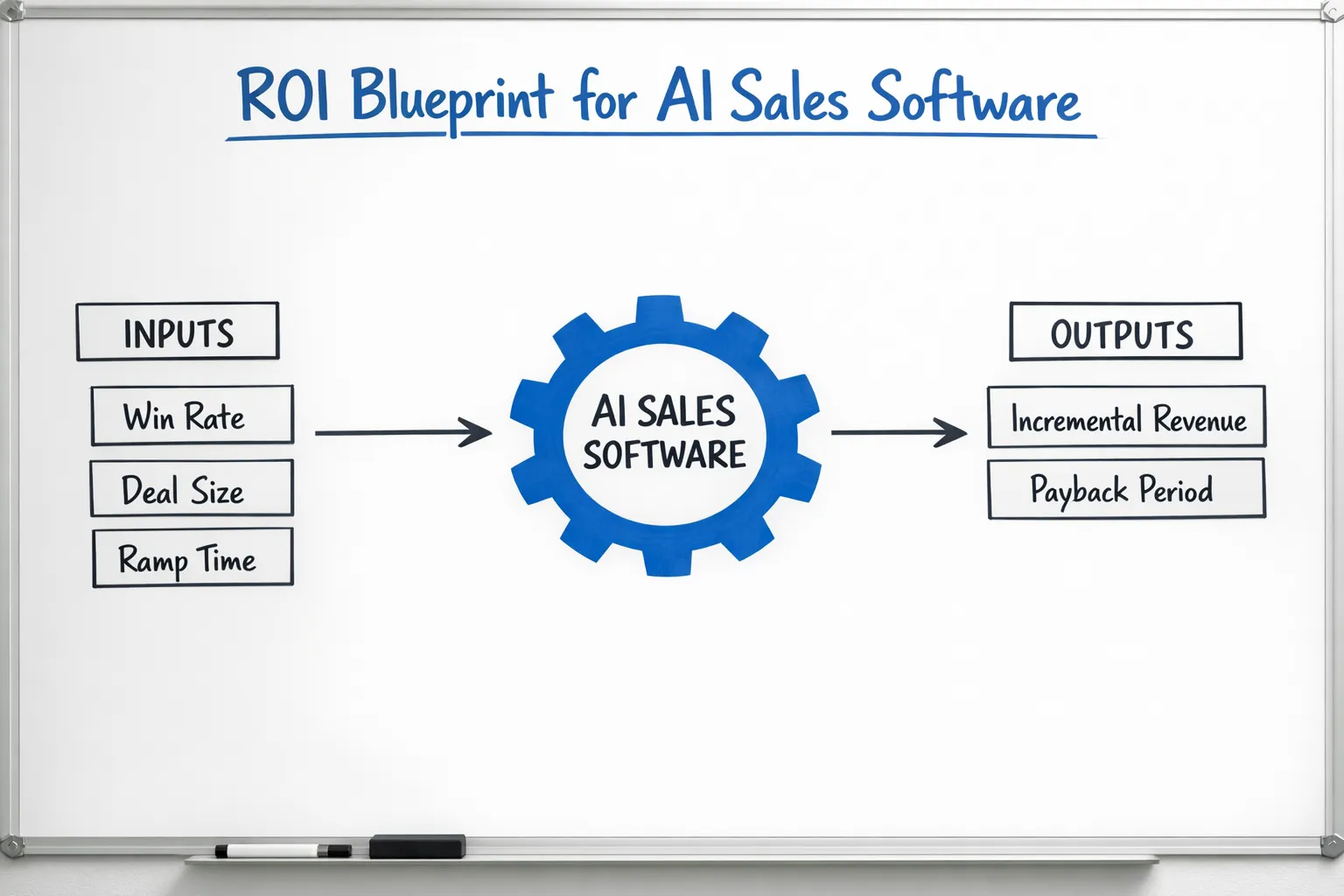
An ROI model should connect features to outcomes that finance cares about. The most common revenue levers are:
- Higher win rate on qualified opportunities
- Larger average deal size through better discovery and negotiation
- Shorter sales cycle time
- Faster rep ramp to quota
- Lower training and coaching cost per rep
- Reduced voluntary attrition from better enablement and confidence
A simple formula
ROI = (Annual incremental gross profit from improvements − Annual cost of software and program) divided by Annual cost of software and program.
Incremental gross profit typically includes contributions from win rate lift, cycle time reduction, and ramp acceleration. Work with conservative assumptions and align with finance on gross margin.
Illustrative example
Assume a 25-person sales team with the following baseline and conservative improvements after adopting AI roleplay and coaching analytics. This example is for modeling purposes only, not a guarantee of results.
| Input | Baseline | Conservative change | Notes |
|---|---|---|---|
| Qualified opportunities per quarter | 500 | No change | Volume held constant |
| Win rate | 22% | 24% | 2 percentage point lift |
| Average deal size | 20,000 dollars | No change | Keep conservative |
| Gross margin | 70% | No change | Applied to revenue |
| Sales cycle length | 90 days | 85 days | 5 days faster |
| New hire ramp to 80% quota | 6 months | 5 months | 1 month faster |
| Annual software and program cost | — | 150,000 dollars | Licenses and enablement |
Estimated impact, annualized:
- Win rate lift, 500 opportunities times 4 quarters equals 2,000 opportunities, additional 2 percent points times 2,000 equals 40 more wins times 20,000 dollars equals 800,000 dollars revenue, times 70 percent margin equals 560,000 dollars gross profit.
- Cycle time improvement, typically improves capacity and forecast accuracy. To stay conservative, exclude direct dollar impact in year one.
- Ramp acceleration, 10 hires per year times 1 month saved equals roughly 0.083 years per rep, assume 1,000,000 dollars annual quota per rep equals 83,000 dollars additional bookings, times 70 percent margin equals 58,100 dollars gross profit.
Total estimated gross profit impact equals 618,100 dollars. Program cost equals 150,000 dollars. ROI equals (618,100 minus 150,000) divided by 150,000 equals 3.12x.
Your finance team will want sensitivity ranges. Model low, expected, and high cases, then design a pilot to test assumptions.
Run a credible 90-day pilot
Define success upfront
Pick two or three measurable outcomes, for example objection-handling pass rate, time to first meeting booked, and win rate on stage-qualified deals. Set baseline from the previous two quarters.
Isolate variables
Select comparable teams or territories. Provide the pilot group with AI training and coaching analytics while the control group keeps the current process. Keep quotas and territories stable.
Instrument everything
Track activity in the platform, scenario completion, coaching coverage, and on-the-job outcomes. Agree with RevOps on how to attribute impact and how to handle seasonality.
Review and decide
At day 90, compare pilot to control on the chosen outcomes, and build your scale-up plan if the signal is strong.
Implementation best practices
- Start with the moments that matter, objection handling, discovery, and negotiation drive most near-term impact.
- Codify what good looks like, write scenario rubrics that mirror your playbooks, then let AI adapt difficulty over time.
- Coach managers first, adoption rises when managers know how to assign scenarios and interpret analytics.
- Honor data security requirements early, involve IT to validate enterprise-grade security and SSO.
- Plan reinforcement, daily actionable tips keep learning continuous and prevent skill decay.
Avoid these common pitfalls
- Deploying AI without content, a tool without high quality scenarios becomes shelfware.
- Chasing vanity metrics, hours trained does not equal revenue impact, tie training to win rate, cycle time, and ramp.
- Over-automating conversations, AI should prepare people to be more human, not script robots.
- Ignoring the website experience, if you rely on inbound, your first five minutes of buyer experience affect conversion and sales pipeline. If this is a bottleneck for your SaaS motion, consider a focused consultation to fix your first five minutes.
Where Scenario IQ fits in the AI sales stack
Scenario IQ focuses on the human side of revenue performance, the moment when a rep or agent must run a great conversation. The platform provides AI-powered roleplay simulations, personalized scenarios, real-time feedback, progress tracking analytics, team-focused learning, adaptive guidance, daily actionable tips, customizable skill levels, performance metric dashboards, and enterprise-grade security.
Teams use Scenario IQ to build confidence, sharpen messaging, and create consistent coaching habits that translate into higher win rates and faster ramp. If you are assembling your AI sales software stack, combine automation that saves time with training that upgrades skills, then measure the result in your pipeline.
Learn more at Scenario IQ.
Frequently Asked Questions
How is AI sales software different from a CRM? A CRM is a system of record for account and pipeline data. AI sales software is a system of action, it helps reps prepare, execute, and improve conversations, and it ties learning and guidance to revenue outcomes.
Will AI replace sales reps? AI accelerates preparation, coaching, and follow-up. It does not replace trust, business acumen, or relationship building. The winning pattern in 2025 is human plus AI, not human versus AI.
What metrics should I use in a pilot? Start with win rate on qualified opportunities, time to first meeting, time to key certifications, and ramp to productivity. Add revenue-weighted quality metrics like discovery depth and next-step clarity.
How fast can we see ROI? Teams often see leading indicators within 30 to 60 days, such as higher scenario pass rates and stronger call outcomes. Hard revenue measures, like win rate lift, typically show up in 1 to 2 sales cycles.
What about data privacy and security? Validate enterprise-grade security, SSO, data retention controls, and content permissions. Limit sensitive customer data in training content and use anonymized examples when possible.
How do we keep the content fresh? Use adaptive scenarios and update prompts based on win-loss analysis, product launches, and seasonality. Daily actionable tips help reinforce new behaviors without large content overhauls.
Ready to turn practice into performance?
If your team is evaluating AI sales software, include a solution that upgrades conversation skills, not just activity volume. Scenario IQ delivers AI roleplay training, real-time feedback, and analytics that help sales and service teams close the performance gap. Explore how it fits your stack at Scenario IQ.