

Sales teams are adopting AI faster than their customers are getting comfortable with it. That gap creates a common fear: “If we use AI on sales calls, we’ll sound scripted, slow to react, and vaguely fake.”
The good news is that AI sales calls do not have to feel robotic. In fact, the best results tend to come from AI that behaves like a great manager sitting beside you, offering small, timely nudges, not like a puppet master writing your lines.
This guide breaks down what “real-time coaching” actually means, why AI can make reps sound unnatural, and how to design coaching that keeps conversations human while improving consistency, confidence, and outcomes.
What “real-time coaching” means (and what it should not mean)
When people say “AI sales calls,” they often mix three different capabilities:
- Pre-call preparation: AI helps you research the account, plan questions, and rehearse a call plan.
- In-call coaching: AI listens and suggests next best actions, questions, or reminders in the moment.
- Post-call coaching: AI summarizes, tags moments (objections, competitor mentions), and recommends what to improve next time.
Real-time coaching is the middle category, and it is the most delicate.
The north star: augment, do not replace
If in-call AI is trying to “drive” the conversation, it usually creates robotic delivery. Great in-call AI coaching should:
- Keep the rep in control
- Be brief and context-aware
- Reinforce a repeatable sales approach
- Help the rep stay present, not distracted
In other words, it should behave more like a discreet prompt and less like a script.
Why AI coaching makes reps sound robotic
Most “robotic AI” problems are not model problems, they are design problems. The AI is being asked to do the wrong job, or it is being fed rules that force unnatural behavior.
Common failure modes:
- Over-scripted talk tracks: Word-for-word lines make reps sound like they are reading, because they are.
- Too many nudges: If the rep is reacting to constant pop-ups, they stop listening deeply.
- Coaching the wrong layer: Telling someone what to say is weaker than coaching what to accomplish.
- Generic objections handling: If the AI suggests “I understand your concern” for every objection, customers pick up the pattern.
- Mis-timed interventions: Interrupting when the buyer is emotionally engaged (frustrated, excited, skeptical) can cause awkward pivots.
- Confidence mismatch: The AI might recommend a bold close when the rep has not earned that right in the conversation.
The fix is to make AI coaching more like an expert mental checklist, delivered at the right moment.
A human-first framework for AI sales calls
If you want real-time coaching that feels natural, design around intent rather than exact wording.
Principle 1: Coach outcomes, not sentences
Replace “Say this” with “Achieve this.”
- Sentence-level coaching is brittle.
- Outcome-level coaching adapts to the rep’s voice and the buyer’s tone.
A good outcome-level prompt sounds like:
- “Clarify the impact before you propose a fix.”
- “Ask for an example so you do not solve the wrong problem.”
- “Confirm decision process and timeline.”
Principle 2: Keep prompts short enough to remember
On a live call, working memory is limited. If the AI suggests a paragraph, the rep will either:
- sound like they are reading, or
- ignore it
Great prompts are often a single line.
Principle 3: Encourage curiosity and listening
Robotic calls happen when reps chase a sequence. Human calls happen when reps follow meaning.
Design prompts that push curiosity:
- “What changed that made this urgent now?”
- “What happens if you do nothing for 90 days?”
- “Who else feels the pain day-to-day?”
Principle 4: Use “talk tracks,” not scripts
A talk track is a flexible structure with room for personality. A script is a memorized performance.
Here is a practical way to encode talk tracks into coaching prompts:
| Moment in call | Robotic coaching (avoid) | Human coaching (use) |
|---|---|---|
| Opening | “Say: Thanks for your time today…” | “Set agenda in one sentence, then ask for their top priority.” |
| Discovery | “Ask: What are your goals this quarter?” | “Ask a specific, situational question tied to their context.” |
| Objection | “Say: I understand your concern.” | “Label the objection type (risk, budget, authority), then ask one clarifier.” |
| Close | “Say: Are you ready to move forward?” | “Confirm outcomes, confirm next step owner, confirm date.” |
Principle 5: Make the rep’s voice the default
If your coaching system is built around “perfect phrasing,” it will flatten individuality. The goal is not to make everyone sound the same. The goal is to make everyone consistently effective.
Designing real-time coaching cues that actually work
In-call coaching is easiest to implement when you limit it to a handful of cue types. Here are five that consistently improve performance without breaking natural conversation flow.
| Cue type | What it does | Example cue | Risk to watch |
|---|---|---|---|
| Focus cue | Keeps the rep on the right objective | “Stay in discovery, do not pitch yet.” | Can feel controlling if overused |
| Question cue | Suggests a next question | “Ask for a recent example.” | Generic questions become repetitive |
| Objection cue | Helps classify and respond | “Is this budget, priority, or trust?” | Misclassification can derail |
| Process cue | Protects next steps | “Confirm decision process and timeline.” | Can feel transactional if too early |
| Language cue | Removes weak wording | “Replace ‘maybe’ with a clear option.” | Can sound unnatural if forced |
How to keep nudges from becoming noise
Set guardrails for when coaching shows up:
- Time-based limits: For example, no more than one nudge every few minutes.
- Conversation-based triggers: Only nudge when the buyer asks a question, raises an objection, or mentions a competitor.
- Rep-controlled modes: Let reps toggle “quiet mode” for delicate moments.
The biggest win is not more AI output, it is better timing.
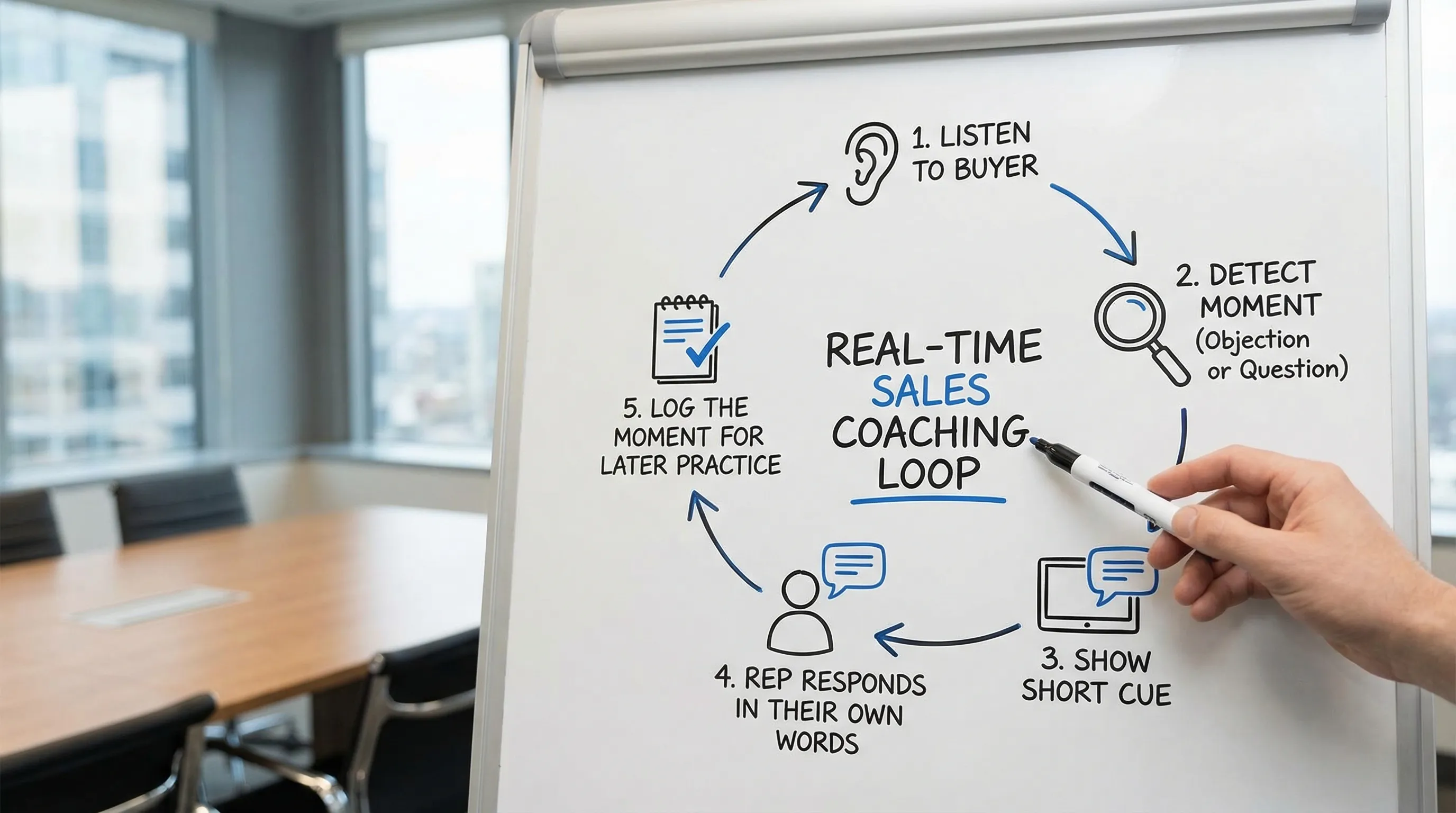
The best way to avoid robotic calls: train off-call, then coach lightly in-call
The uncomfortable truth is that real-time coaching cannot compensate for missing fundamentals. If a rep does not know how to run discovery, handle tension, or ask crisp follow-ups, in-call prompts will feel like life support.
That is why high-performing teams pair in-call assistance with scenario-based practice.
Why scenario practice transfers better than memorization
In learning science, timely feedback is one of the strongest accelerators of improvement, especially when it is specific and actionable. A widely cited research synthesis, “The Power of Feedback”, highlights that feedback is most useful when it helps someone close the gap between current and desired performance.
Sales is no different. Reps improve fastest when they can:
- practice realistic scenarios
- get immediate feedback on what they did, not who they are
- repeat with increasing difficulty
Where Scenario IQ fits
Scenario IQ is built around this exact idea: AI-powered roleplay simulations that let reps practice sales and service conversations in realistic scenarios, with real-time feedback, adaptive guidance, and progress tracking analytics.
Used correctly, that kind of training does two things:
- It builds automaticity, so reps do not need to “think in scripts” on live calls.
- It standardizes skills (objection handling, discovery depth, clarity, confidence) without standardizing personalities.
If your goal is more natural AI sales calls, the fastest path is often:
- practice with AI roleplays until the motions feel natural
- use in-call coaching as a light safety net, not a crutch
You can explore the platform here: Scenario IQ.
What to measure so “better calls” is not just a feeling
Robotic delivery often shows up when teams measure the wrong things. If the scoreboard only tracks activity (dials, meetings), coaching systems tend to optimize for checklists. If the scoreboard tracks behaviors and outcomes together, you can coach for quality.
A practical measurement set:
| Metric category | What to track | Why it matters |
|---|---|---|
| Buyer engagement | Talk-to-listen ratio (directional), question depth, interruptions | Predicts whether discovery is real |
| Discovery quality | Presence of pain, impact, stakeholders, timeline | Prevents premature pitching |
| Objection handling | Time to acknowledge, clarifying question rate, resolution rate | Reduces defensiveness |
| Next-step clarity | Named owner, dated next step, recap quality | Protects pipeline integrity |
| Outcomes | Stage conversion, win rate, sales cycle length | Validates that coaching works |
Avoid pretending any single metric is “the truth.” Use a small set, review trends, then inspect a few call moments to find causes.
How to roll out AI coaching without killing trust
Even great AI coaching fails if reps think it is surveillance or if customers feel tricked.
1) Be explicit about consent and compliance
Call recording and live assistance can trigger legal, contractual, and policy requirements depending on where you sell. Align with your legal and security teams on:
- what is recorded and stored
- who can access it
- retention policies
- customer disclosure language
If you are building training that includes real call data, keep it anonymized and permissioned.
2) Start with a narrow use case
Pick one motion and one skill, for example:
- inbound demo calls: discovery depth
- renewals: de-escalation and value reinforcement
- outbound: opening and problem framing
A narrow rollout makes it easier to tune prompts and earn rep buy-in.
3) Design “in-call” coaching to be skimmable
If the rep has to read, it is already too long.
Good coaching UI patterns (regardless of tool):
- one-line cue
- optional expansion if the rep clicks
- a clear “why this cue” label
4) Create a feedback loop with reps
The reps are your reality check. Ask them:
- Which prompts felt helpful?
- Which prompts felt generic?
- When did the AI interrupt at the worst time?
- What cues would a top rep give in that moment?
Then refine.
Common “robotic” moments and what to coach instead
Below are three moments where teams often accidentally create unnatural calls, plus better coaching targets.
Moment: The rep jumps to pitch too early
Instead of coaching: “Use this opening pitch.”
Coach: “Name the problem you are solving in their words, then ask for confirmation.”
Why it works: It forces relevance, and it keeps language native to the buyer’s world.
Moment: The rep gets a budget objection and goes defensive
Instead of coaching: “Overcome budget objection with value statement.”
Coach: “Clarify budget objection type: affordability, prioritization, or proof.”
Why it works: Budget objections are rarely just about dollars.
Moment: The rep closes awkwardly
Instead of coaching: “Ask for the close.”
Coach: “Summarize outcomes, propose one next step, ask if they would change anything.”
Why it works: It is collaborative, and it reduces pressure.
The hidden dependency: your data and systems
Real-time coaching improves the conversation, but revenue impact comes from what happens after the call: clean handoffs, accurate forecasting, fast follow-up, and fewer operational bottlenecks.
Mid-market teams often struggle here because sales tools, support tools, and ERP data do not agree. If you are trying to connect coaching insights to real business outcomes (like renewals, expansion, margin, or delivery capacity), it can help to bring in specialists who live at the intersection of AI and business systems.
For organizations running NetSuite or planning deeper automation, AI and NetSuite consulting for mid-market teams can be a practical way to reduce system disconnects, so performance insights actually translate into execution.
A simple operating model that keeps calls human
If you want a clean way to deploy AI sales calls coaching without the “robot voice” effect, use this operating model:
- Before calls: reps practice the highest-risk moments in realistic scenarios (openings, pricing pushback, stakeholder mapping).
- During calls: the AI only provides short, outcome-based cues at high-signal moments.
- After calls: reps get 1 to 2 prioritized improvements and a targeted practice assignment.
This creates a compounding effect: fewer prompts are needed over time because reps build genuine skill.
If you want AI training that strengthens real conversations (not scripts), Scenario IQ’s AI roleplay simulations and real-time feedback are designed for exactly that, helping teams build confidence and consistency while still sounding like themselves.