

AI has made it tempting to put large chunks of the sales cycle on autopilot. Yet the fastest growing teams in 2025 are not the ones who automate everything, they are the ones who automate selectively, protect customer trust, and upskill their reps to use AI as leverage. This article shows you exactly what to automate, what to augment with AI, and what to keep human, plus how to roll it out with practical guardrails and metrics.
A simple test for AI sales automation decisions
Use this four-part test before you switch anything on:
- Repeatability and volume, is the task high volume and pattern based?
- Data quality and access, do you have clean, reliable data the system can use?
- Risk and reversibility, what is the legal, brand, or revenue risk, and how easy is it to undo mistakes?
- Empathy and trust load, does this moment require human judgment, nuance, and relationship building?
If a task is high on the first two and low on the last two, automate. If it is mixed, augment the human with AI. If it is high empathy or high risk, keep it human led.
What to automate now
These activities maximize time savings without sacrificing relationships, when implemented with clear guardrails.
CRM hygiene and admin
- Automatic logging of emails and calls, meeting notes, next steps, and follow up tasks.
- Data enrichment from reputable sources to fill firmographic and technographic fields.
- De-duplication and automated contact merging.
Guardrails, audit logs for all changes, required field validation, and weekly data quality reports.
Lead management
- Lead-to-account matching and round-robin assignment aligned to territories and capacity.
- Predictive lead and opportunity scoring that triggers playbooks.
Guardrails, cap automated routing to defined ICP ranges, and require rep acceptance for edge cases.
Scheduling and micro-coordination
- Meeting scheduling links with rules for time zones, buffers, and account ownership.
- Automated reminders and reschedule workflows across email or SMS when opted in.
Guardrails, make the human easy to reach, include clear opt out, and respect quiet hours.
Outreach for low-risk segments
- Sequenced emails for inbound hand-raisers, trials, and self-serve segments.
- AI assisted personalization that inserts context from the CRM and website behavior.
Guardrails, daily send caps per domain, unsubscribe links, domain health monitoring, and human review for higher value targets.
Conversation intelligence and summarization
- Call recording, transcription, and AI summaries with action items and CRM field updates.
- Topic, sentiment, and competitor mention detection to trigger coaching.
Guardrails, customer consent notices, secure storage, and redaction of sensitive data.
Pipeline and forecast hygiene
- Automated nudges to update close dates, stage, and next steps when signals change.
- Risk flags for no recent activity, single-threaded deals, or missing stakeholders.
Guardrails, make suggestions non-blocking and explainable so reps can overrule with context.
What to augment, not fully automate
These tasks benefit from AI as a copilot, while the rep remains the decision maker.
Discovery preparation and call planning
Have AI synthesize research from CRM notes, website behavior, and recent news, then propose a discovery plan and questions. The rep tailors the plan and owns the conversation.
Proposal and email drafting
Use AI to draft proposals, ROI outlines, and follow ups from call summaries and templates. The rep edits tone, validates numbers, and adds account nuances before sending.
Objection handling and roleplay
AI can simulate realistic objections and provide feedback so reps practice messaging before the live call. This improves live performance without automating the actual customer moment.
Forecasting
Let AI aggregate signals and suggest forecast ranges. Leaders maintain the final call, since context and judgment still matter.
What not to automate
Some moments are too sensitive or strategic to outsource to a machine.
- High stakes negotiations, pricing strategy, and custom commercial terms.
- Executive outreach to strategic accounts and relationship building.
- Contract redlines, compliance disclosures, and regulatory attestations.
- Qualification gates that define opportunity strategy in complex sales.
AI can prepare materials and surface risks, but the human must lead the interaction and the decision.
A quick reference table, automate vs augment vs human led
| Sales activity | Recommended mode | Why it qualifies | Guardrail or KPI |
|---|---|---|---|
| CRM data entry, notes, tasks | Automate | High volume, repeatable | Data accuracy score, audit log |
| Lead enrichment and routing | Automate | Structured data, clear rules | Match accuracy, SLA to first touch |
| Meeting scheduling and reminders | Automate | Low risk logistics | Opt out rate, no-show rate |
| Low ACV nurture sequences | Automate | Pattern based messaging | Domain health, spam complaint rate |
| Call transcription and summaries | Automate | Speeds coaching and follow up | Consent rate, PII redaction errors |
| Discovery prep and talk tracks | Augment | Research heavy, human delivery | Prep time saved, call outcome quality |
| Proposal and follow up drafts | Augment | AI drafts, rep validates | Time to send, error rate in details |
| Forecast suggestions | Augment | Signal aggregation | Variance to actuals, explainability |
| Late stage pricing and negotiation | Human led | High risk, empathy required | Win rate, margin integrity |
| Contract terms and compliance | Human led | Legal exposure | Cycle time with legal, error rate |
Data, privacy, and governance
AI needs structure, security, and oversight to work in sales.
- Map your data sources, CRM, marketing automation, support, finance, product analytics. Remove stale and conflicting fields before you deploy.
- Secure customer data with role based access, encryption, and retention rules. Redact PII in prompts and outputs, and log all AI actions for audit.
- Establish a model and prompt library for consistent outputs. Document what data each workflow can and cannot touch.
- Start with bounded pilots, define success criteria, and expand only when guardrails hold.
Regional admin, when automation meets the real world
Sales leaders often face document heavy processes that slow deals, immigration, licensing, and entity setup. Use AI to auto populate forms, validate fields, and route tasks to the right owners. When a regulated or government step is involved, pair automation with approved experts so your reps do not become process clerks. For example, if you operate in the UAE, a government transaction and typing center in Dubai can streamline visa and business setup paperwork end to end. See this option at a government transaction and typing center in Dubai to reduce manual back and forth while staying compliant.
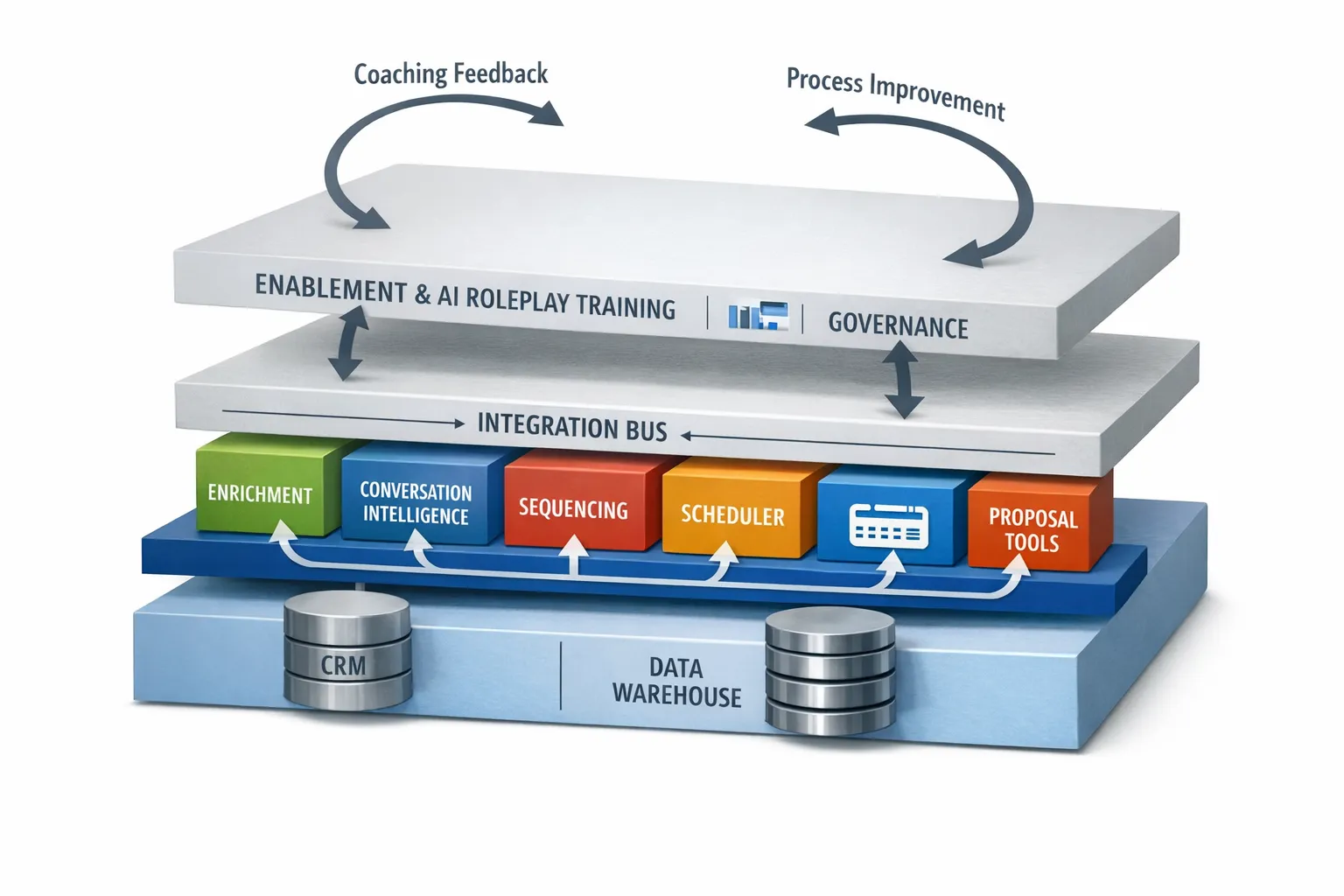
Design your AI sales automation stack
Aim for a small, well integrated stack rather than overlapping tools.
- System of record, your CRM remains the source of truth.
- System of engagement, sequencing, meeting scheduler, chat, and calling in one or two tools.
- Intelligence and content, enrichment, conversation intelligence, proposal automation.
- Governance, permissions, audit, data quality, and security monitoring.
- Enablement and training, continuous reinforcement so reps learn to use AI effectively.
Change management, how to roll out automation without breaking trust
- Communicate the objective clearly, to save time and improve customer experience, not to replace people.
- Pilot with a small team and a narrow workflow, then iterate on prompts, guardrails, and routing rules.
- Set opt out and escalation paths for reps and customers. Humans should always be able to step in.
- Pair every automated workflow with training so reps know how to use the time they win back.
Where Scenario IQ fits in
Automation removes busywork, but conversion still hinges on the human moments, discovery, objection handling, multi threading, and negotiation. Scenario IQ helps teams get those moments right with AI driven, scenario based practice that is safe, scalable, and measurable.
- AI powered roleplay simulations let reps practice realistic calls and chats.
- Personalized training scenarios adapt to your industry and skill levels.
- Real time feedback and daily actionable tips reinforce better behavior.
- Progress tracking analytics and performance metric dashboards show what is working.
- Team focused learning with enterprise grade security supports companies of any size.
Use automation to create more high quality conversations, then use Scenario IQ to make those conversations count.
Metrics that matter for AI sales automation
Track a balanced scorecard that blends efficiency and effectiveness. Measure before you deploy, during the pilot, and after scale up.
| Metric | What it tells you | Direction | Early warning sign |
|---|---|---|---|
| Manual CRM time per rep | Admin burden | Down | Reps reverting to spreadsheets |
| First response time | Speed to lead | Down | SLA breaches for key segments |
| Meeting acceptance rate | Outreach quality | Up | Drop in acceptance after template change |
| Reply rate and positive sentiment | Messaging resonance | Up | Spam complaints, domain health warnings |
| Stage progression velocity | Deal momentum | Up | Stalled deals after automation change |
| Forecast variance | Predictability | Down | Black box model suggestions with poor explanations |
| Win rate and margin | Real outcomes | Up | Discounts spike after automation tweaks |
Frequently Asked Questions
Is AI sales automation the same as sales enablement? Automation executes or accelerates tasks. Enablement builds skills, content, and processes so reps perform better. They work together, but they are not the same.
How do I avoid damaging my domain reputation with automated outreach? Start with low volumes, authenticate email correctly, include clear opt outs, segment carefully, and monitor bounce and complaint rates. Add human review for higher value accounts.
What should small teams automate first? Start with CRM hygiene, scheduling, and call summaries. These deliver quick wins with minimal risk and free hours every week.
Can AI handle complex enterprise proposals? AI can draft and organize content, but humans should tailor value hypotheses, pricing structures, and legal language. Treat AI as a first draft assistant.
How do I keep data safe when using AI in sales? Redact sensitive data, restrict model access with roles and logging, store transcripts and outputs securely, and choose vendors with enterprise grade security.
How do I know if a workflow should be automated or augmented? Apply the four part test, repeatability, data quality, risk and reversibility, and empathy and trust load. If it is high repetition and low risk, automate. If it is mixed, augment. If it is high empathy or risk, keep it human led.
Put this playbook into practice
If you want reps who can handle objections, tailor discovery, and close with confidence while automation clears their admin queue, train them with practical, simulated practice. See how AI roleplay and real time feedback work in Scenario IQ at Scenario IQ.