

Enablement platforms do not fail because teams “don’t like training.” They fail because adoption is inconvenient, generic, hard to measure, or disconnected from the moments where reps and agents actually need help.
That is why AI SaaS for enablement is getting attention in 2026. Not because “AI” is a buzzword, but because the right AI capabilities can reduce friction, personalize practice, and make coaching measurable. The result is higher usage, faster skill lift, and a clearer line of sight from enablement activity to performance.
This guide breaks down the features that most reliably drive adoption in sales and service enablement software, plus what to look for during evaluation and rollout.
What “adoption” really means in enablement (and how to measure it)
Adoption is not a login. Adoption is sustained, behavior-changing usage across reps, managers, and onboarding cohorts.
If you only measure “active users,” you can miss the real story: reps might open the tool once to satisfy a manager, then never return. Strong enablement adoption shows up as repeated practice, improving performance signals, and manager involvement.
Here are practical adoption metrics to track from week 1.
| Adoption metric | What it tells you | A strong sign looks like |
|---|---|---|
| Weekly active learners | Ongoing habit formation | Consistent or rising WAU after week 3 |
| Median time to first value | How fast a user gets a win | First completed practice within the first session |
| Practice frequency per user | Whether skills are reinforced | Multiple short sessions per week, not one long binge |
| Manager participation | Coaching leverage (multiplies impact) | Managers reviewing, assigning, or coaching weekly |
| Scenario completion rate | Content relevance and usability | Most learners finish the practice they start |
| Re-engagement after feedback | Whether feedback feels useful | Learners repeat scenarios to improve scores |
A helpful mindset: adoption is a product problem before it is a people problem. The best platforms make the right behavior the easiest behavior.
Why enablement SaaS adoption stalls (even with great content)
Enablement leaders commonly run into the same adoption blockers:
- Training feels generic, so reps do not see immediate relevance to their deals, objections, or call types.
- Practice is missing, so learners consume content passively and forget it quickly.
- Feedback arrives too late, so there is no tight learning loop.
- Managers are not equipped, so coaching remains inconsistent and subjective.
- Impact is hard to prove, so enablement loses budget or executive support.
The features below directly address these blockers.
AI SaaS for enablement: features that drive adoption
1) AI roleplay simulations that feel like real conversations
The fastest way to make enablement “stick” is to make it feel like the job.
AI-powered roleplay simulations give reps and agents a safe environment to practice discovery, objection handling, empathy, de-escalation, and closing. When simulations reflect real customer behaviors (tone shifts, hesitations, pushback), learners are more likely to return because it is immediately useful.
What to look for:
- Scenarios that mirror real calls, chats, or in-person conversations
- The ability to practice high-risk moments (pricing pushback, escalation, competitor mentions)
- Consistent scoring that learners trust
With platforms like Scenario IQ, AI roleplay is designed to help teams build confidence through repeated reps, not one-and-done “training days.”

2) Personalized scenarios that match role, segment, and skill level
Personalization is one of the most reliable adoption levers because it reduces the “this isn’t for me” reaction.
In enablement, personalization should happen across:
- Role (SDR, AE, CSM, support, field service)
- Segment (SMB vs enterprise, regulated industries, strategic accounts)
- Skill level (new hire vs tenured top performer)
- Behavior goals (ask better questions, confirm next steps, handle refund requests)
A practical test during evaluation: ask whether you can create scenarios for a specific persona and a specific objection, then assign different difficulty levels. If everyone gets the same training path, adoption usually drops after the novelty wears off.
3) Real-time feedback that is specific, actionable, and repeatable
Feedback drives adoption when it answers the learner’s real question: “What should I do differently on my next call?”
Real-time feedback keeps the learning loop tight. Instead of waiting for a manager to review a recording days later, the platform can flag issues immediately and recommend improvements.
High-adoption feedback systems typically include:
- Clear scoring criteria (so learners trust it)
- Concrete guidance (what to say instead, what question to ask)
- A repeat attempt workflow (practice again with the same scenario)
Scenario IQ includes real-time feedback and adaptive guidance, which helps learners improve in-session rather than hoping they remember a tip later.
4) Adaptive coaching that adjusts as performance improves
Static enablement paths tend to bore top performers and overwhelm new hires.
Adaptive feedback and guidance can keep learners in the right “challenge zone” by scaling complexity based on performance. That is one of the biggest differentiators between AI-first enablement platforms and traditional content libraries.
The adoption advantage: learners feel the training is “keeping up” with them. It stays relevant as they progress.
5) Daily actionable tips that keep practice lightweight
A major reason adoption falls off is time pressure. Reps and agents do not avoid training because they hate learning, they avoid it because it feels like a time penalty.
Daily actionable tips and short practice prompts reduce the psychological barrier to entry. A quick prompt can be the difference between “I will do training later” and “I can do this in 5 minutes.”
This matters even more for:
- Distributed teams
- High-volume support and contact center environments
- Ramp periods where new hires are already overloaded
6) Progress tracking analytics that learners and managers actually use
Analytics drive adoption when they serve two audiences at once:
- Learners want to see progress, confidence, and skill improvement.
- Managers want to know what to coach and where to focus 1:1 time.
Look for analytics that are easy to interpret and tied to observable behaviors (for example, talk track structure, objection handling quality, empathy statements, next-step clarity). If dashboards are complex or feel “reporting-only,” usage tends to stay limited to enablement admins.
Scenario IQ offers progress tracking analytics and performance metric dashboards, which are essential for sustained manager engagement.
7) Team-focused learning that turns managers into multipliers
Enablement adoption rarely scales through enablement alone. It scales when frontline managers are active.
Team-focused learning features that support adoption include:
- Visibility into team practice and progress
- Ways to align on what “good” looks like
- Shared language for coaching (so feedback is consistent across managers)
When managers can see skill gaps and assign targeted practice, adoption becomes part of weekly operating rhythm instead of an “extra.”
8) Customizable skill levels and scenario design (without heavy lift)
One of the most common enablement mistakes is shipping a generic library and hoping it fits.
Adoption improves when you can tailor skill levels and scenarios to your processes and customers. The trick is balancing customization with speed.
During evaluation, ask:
- Can we customize scenarios quickly for new product launches?
- Can we adjust difficulty for different cohorts?
- Can we keep scenarios aligned with messaging updates?
The best AI SaaS enablement tools make this feel like configuration, not content production.
9) Enterprise-grade security (because enablement touches sensitive conversations)
Adoption is also about organizational trust. If Legal, Security, or Compliance blocks the platform, your adoption curve is flat before it starts.
Enterprise-grade security matters because enablement often includes:
- Pricing talk tracks
- Competitive positioning
- Customer service escalations
- Potentially regulated workflows (depending on industry)
Scenario IQ highlights enterprise-grade security, which is a foundational requirement for larger organizations and any team working with sensitive customer information.
If you are building a buying committee, security readiness can be the difference between a 30-day and 120-day procurement cycle.
10) Actionable analytics that connect enablement activity to business outcomes
Adoption is easier to sustain when leaders can see impact.
Even if your enablement platform is not your system of record for revenue or service KPIs, it should help you answer:
- Are ramping reps improving faster than previous cohorts?
- Which objections are most problematic across teams?
- Which skills correlate with better outcomes in the field?
For broader benchmarking and executive conversations, it can help to align enablement reporting with the language leaders already use. For example, sales leaders often reference frameworks from industry research such as the Salesforce State of Sales report, while L&D and HR leaders often align to learning culture trends like the LinkedIn Workplace Learning Report.
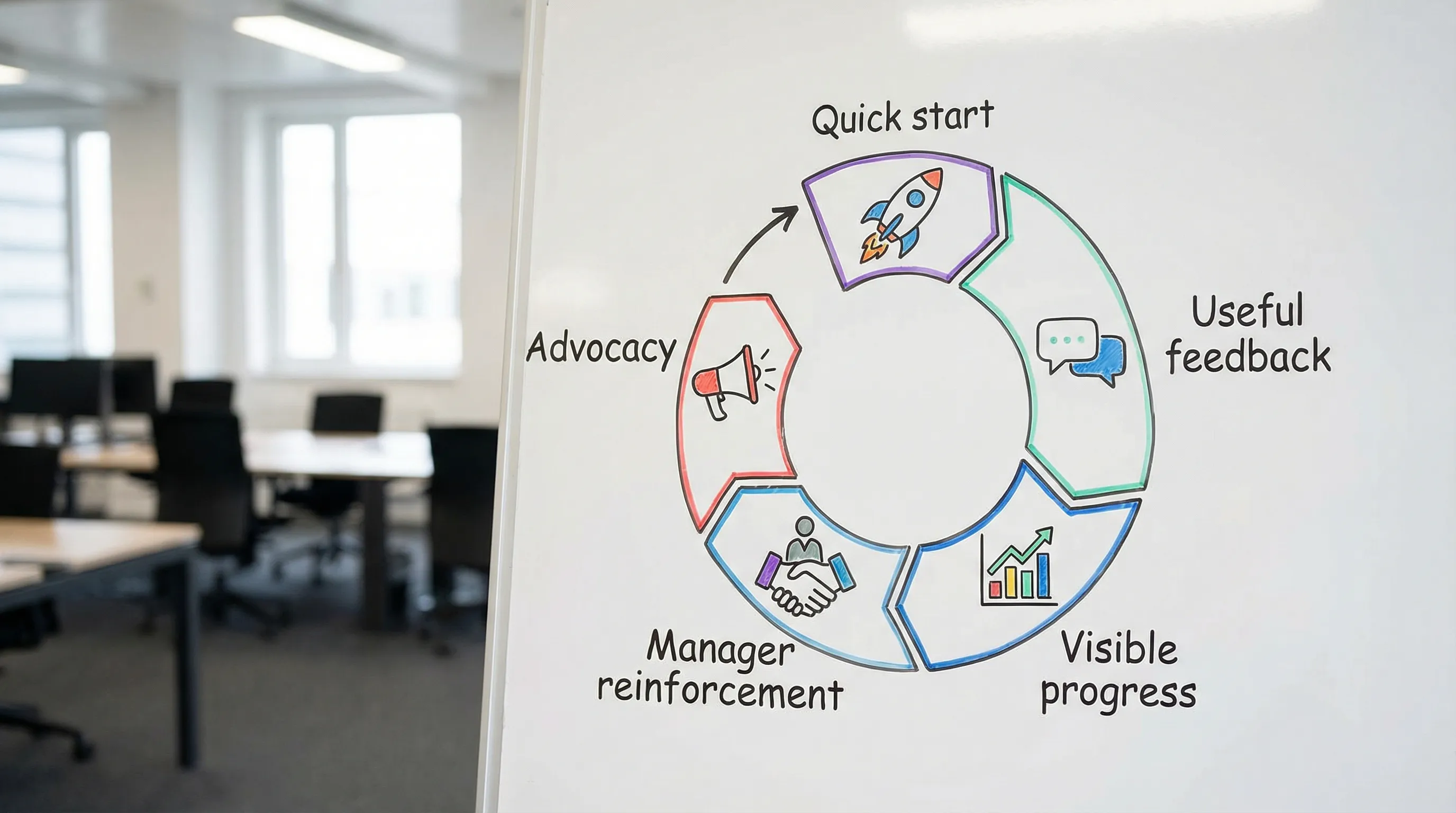
A simple “adoption flywheel” for AI enablement
Adoption tends to compound when your platform creates a reinforcing loop.
| Flywheel step | What the platform must do well | What you should see |
|---|---|---|
| Quick start | Reduce time to first practice | High first-week completion |
| Useful feedback | Make improvements obvious | Learners repeat scenarios |
| Visible progress | Show growth clearly | Confidence and motivation increase |
| Manager reinforcement | Equip coaching quickly | More consistent 1:1 coaching |
| Advocacy | Make success shareable | Organic peer-to-peer referrals |
If any step is weak (for example, feedback is vague), the loop breaks.
Implementation matters: a rollout plan that increases adoption
Even the best feature set will not save a rollout that feels like “another tool.” A lightweight implementation approach usually outperforms big-bang launches.
Start with one high-value use case
Pick a scenario where improved conversations clearly change outcomes, such as:
- Handling a top 3 objection
- Running discovery with a specific buyer persona
- De-escalating a common service escalation
- Confirming next steps and mutual action plans
When reps feel the payoff, they come back.
Build a manager cadence, not a one-time training
Adoption rises when the tool becomes part of weekly operations. Define a simple cadence that managers can actually sustain, such as reviewing practice results and assigning one targeted scenario each week.
Design for short sessions
Most teams underestimate how much “session size” matters. Several short practices per week often beat one long session because it fits real workflows and supports reinforcement.
Publish the scoreboard
When learners can see progress, adoption becomes self-propelled. Keep the scoreboard focused on a small set of skills so it drives clarity, not anxiety.
Vendor evaluation checklist: questions that predict adoption
Use these questions to separate “AI-washed” tools from adoption-ready enablement SaaS.
Learner experience
- How long does it take a new user to complete their first roleplay?
- Does the tool provide real-time feedback that is specific enough to act on?
- Can the experience match role, segment, and skill level without heavy setup?
Manager experience
- Can managers quickly see who needs coaching and on what?
- Does the platform support team-level progress tracking?
Enablement operations
- Can scenarios be updated quickly when messaging changes?
- Are analytics and dashboards clear enough for executive updates?
Security and scalability
- What security controls are available for enterprise deployment?
- How does the vendor handle sensitive content and customer context?
If a vendor cannot answer these crisply, adoption risk goes up.
Frequently Asked Questions
What is AI SaaS for enablement? AI SaaS for enablement is software that uses AI to improve sales and service readiness through personalized practice, roleplay simulations, feedback, and analytics, delivered as a cloud platform.
Which features matter most for enablement adoption? The most adoption-driving features are realistic AI roleplay, personalized scenarios, real-time feedback, adaptive guidance, lightweight daily practice prompts, and dashboards managers actually use.
How do you measure adoption for an enablement platform? Track weekly active learners, time to first completed practice, repeat practice frequency, manager participation, completion rates, and re-engagement after feedback.
Is AI roleplay useful for customer service teams or only sales? It is useful for both. Service teams can practice empathy, de-escalation, policy explanations, and resolution language, especially when scenarios reflect real customer situations.
How do you get managers to participate without adding extra work? Give managers simple visibility into progress and clear coaching prompts. When analytics make it obvious what to coach, managers can act in minutes rather than searching through recordings.
What should security and compliance teams look for in AI enablement tools? Look for enterprise-grade security, clear controls for sensitive content, and a vendor that can support your organization’s procurement and governance requirements.
Turn enablement into confident conversations with Scenario IQ
If your current enablement approach struggles with engagement, consistency, or measurable skill lift, AI roleplay can be a practical next step.
Scenario IQ delivers AI-powered roleplay simulations, personalized training scenarios, real-time feedback, and progress tracking analytics designed to help sales and service teams build confidence and improve performance through repeatable practice.
Explore how it could fit your enablement motion at Scenario IQ.