

Sales coaching has always been a leverage game. The best reps improve fastest because they get more practice, more targeted feedback, and more repetition than everyone else. The problem is that managers do not have unlimited time, and teams do not have unlimited safe opportunities to practice.
An AI powered virtual assistant for sales coaching closes that gap by giving reps on-demand practice, feedback, and guidance in the flow of work, without waiting for the next 1:1. Used well, it does not replace managers, it helps them scale consistent coaching moments across the team.
This guide breaks down the highest-impact use cases, what to watch out for, and how platforms like Scenario IQ support AI roleplay training with real-time feedback and analytics.
What is an AI powered virtual assistant for sales coaching?
In sales coaching, an AI powered virtual assistant is a tool that can interact with reps (often via chat or voice), simulate realistic buyer conversations, provide feedback, and recommend next actions based on skill goals and performance signals.
Unlike a generic chatbot, a sales-coaching virtual assistant is typically designed around:
- Practice (roleplay simulations, objection handling drills, discovery practice)
- Feedback (specific, behavior-based coaching notes, not vague tips)
- Progress tracking (competency scoring, improvement over time, team benchmarks)
- Repeatability (standardized scenarios so coaching is consistent)
Many teams adopt AI coaching now because it offers a practical way to increase training frequency. Broadly, generative AI is being adopted to boost productivity across business functions, including sales and customer operations. For background on the overall opportunity and productivity impact, see McKinsey’s research on generative AI.
Where an AI coaching assistant fits in your enablement stack
Most revenue teams already have a mix of LMS content, call recording, playbooks, and manager coaching. An AI powered virtual assistant tends to sit in the middle, turning static knowledge into interactive practice.
A simple way to think about it:
- LMS and playbooks tell reps what good looks like.
- Call recordings show what happened with real buyers.
- AI roleplay and coaching assistants create practice reps can repeat until it becomes habit.

High-impact use cases for an AI powered virtual assistant for sales coaching
Below are practical, field-tested use cases that map to how sales teams actually work. The best implementations start with one or two use cases tied to a KPI (conversion rate, pipeline velocity, ramp time), then expand.
1) On-demand roleplay before critical calls
Reps often know what they should say, but struggle when they have to say it under pressure. A virtual assistant can run a 5 to 10 minute simulation right before a meeting, playing the buyer persona and forcing the rep to respond in real time.
What this unlocks:
- Rehearsal for high-stakes moments (discovery, pricing, procurement)
- A consistent “warm-up” routine for every rep, not just top performers
- A manager-approved talk track that still leaves room for individuality
How Scenario IQ aligns: Scenario IQ is designed for AI-powered roleplay simulations with personalized scenarios and real-time feedback, so reps can practice the exact conversation they are about to have.
2) Objection handling drills (pricing, budget, competitors)
Objection handling is a muscle. It improves through repetition, not one-time exposure to a slide deck.
An AI powered virtual assistant can:
- Generate realistic objection variations (not a single scripted line)
- Score the rep on clarity, empathy, and structure
- Push follow-up objections when the rep answers too early or too vaguely
This is especially valuable for:
- “We are already using a competitor.”
- “This is not in the budget.”
- “Send me something and I will get back to you.”
3) Discovery coaching that improves qualification
Discovery quality determines everything that follows, positioning, value, pricing, and close plans. AI coaching assistants are effective here because they can enforce structure while still sounding conversational.
Common discovery skills to coach:
- Asking layered, non-leading questions
- Summarizing and confirming pain and impact
- Identifying decision process and stakeholders
- Establishing next steps with mutual commitments
A good assistant will give feedback like: “You asked about pain, but you did not quantify impact” or “You moved to demo too early, the buyer never agreed the problem matters.”
4) Manager-guided 1:1 prep with evidence and focus
Managers often spend 1:1 time on updates instead of coaching. An AI assistant can help reps arrive prepared by summarizing:
- Which skills have improved and which are lagging
- Which scenarios they struggled with most
- Which objection types trigger weak responses
This turns 1:1s into targeted coaching sessions.
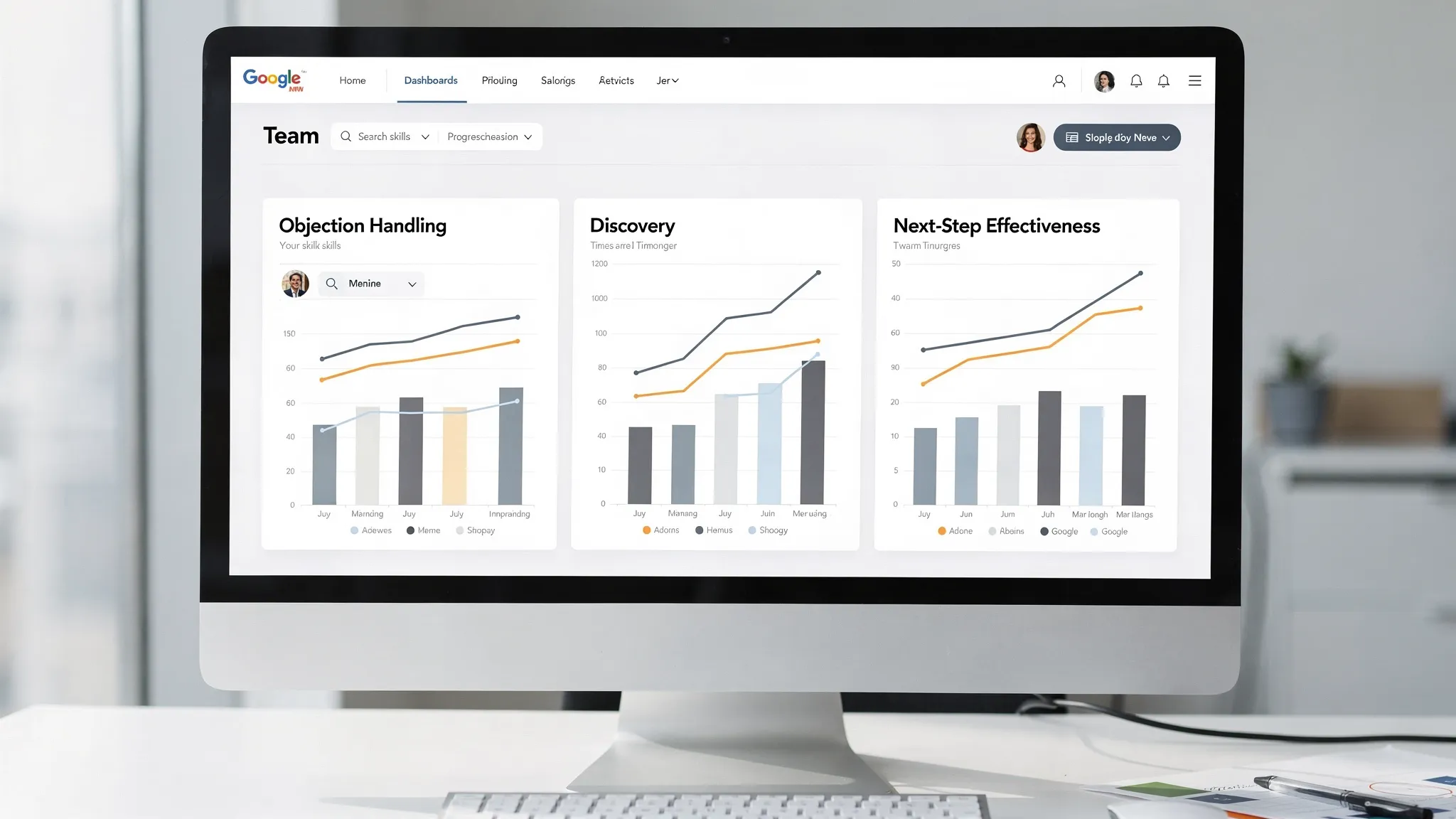
If you are running team-based enablement, progress tracking matters. Scenario IQ includes progress tracking analytics and performance metric dashboards, which can support this style of focused coaching without adding reporting burden.
5) Consistent onboarding and faster ramp for new hires
New hires need high-volume practice without risking live deals. AI roleplay makes it possible to do more reps in the first 30 days:
- Product and positioning practice
- “First discovery call” simulations
- Pricing conversations
- Handoffs (SDR to AE, AE to CSM)
Instead of hoping new hires absorb tribal knowledge, onboarding becomes measurable and repeatable.
6) Post-call reflection, “what to do next” coaching
After a call, reps often ask:
- “What should I follow up with?”
- “What did I miss?”
- “How do I push for next steps without being pushy?”
An AI powered virtual assistant can provide a structured reflection prompt (what was the buyer’s priority, what proof was used, what commitment was gained) and suggest next-step language.
Important note: If your assistant is generating follow-ups, you should ensure your team has clear rules about what data can be included, how compliance is handled, and how messages are reviewed before sending.
7) Coaching for tone, confidence, and executive presence
Sales coaching is not just content, it is delivery.
A strong virtual assistant can help reps practice:
- Speaking concisely (especially with executives)
- Using calm, confident pacing under pressure
- Handling interruptions and pushback
- Staying consultative during negotiation
This is one of the biggest hidden benefits: some reps avoid key conversations because they do not feel confident. Frequent low-stakes practice reduces that anxiety.
8) Reinforcement after training (turning workshops into habits)
Most training fails at the reinforcement stage. People attend a workshop, then revert to old behaviors.
An AI assistant can “nudge” behavior through short, daily practice:
- A 3-minute micro-scenario tied to this week’s skill focus
- Immediate feedback on one specific behavior (for example, summarizing and confirming)
- A weekly recap showing improvement
Scenario IQ explicitly supports daily actionable tips, which is a useful mechanism for reinforcement when paired with roleplay.
9) Coaching for cross-functional moments (sales to service handoffs)
Many “sales problems” are actually expectation-setting problems that show up later in onboarding and renewals.
Use an AI coaching assistant to practice:
- Setting implementation expectations clearly
- Introducing customer success as a partner
- Aligning on success criteria and timelines
Even if your main goal is closing more deals, cleaner handoffs reduce churn risk and escalations.
10) Team-wide consistency in messaging and positioning
In fast-moving markets, messaging drift is real. Different reps explain the product differently, and buyers experience inconsistent value.
A coaching assistant can standardize:
- Your core narrative
- Industry-specific positioning
- Competitive differentiation
This is especially helpful when launching:
- A new product line
- A new pricing model
- A refreshed ICP or vertical strategy
Use case selection: which ones drive ROI fastest?
Not every use case needs to be implemented at once. Start where you can measure impact in 30 to 90 days.
Here is a practical selection guide.
| Use case | Best for | What you need to make it work | KPI to track |
|---|---|---|---|
| Pre-call roleplay warmups | Mid-market and enterprise AEs | Defined buyer personas and 3 to 5 common scenarios | Win rate, meeting-to-next-step |
| Objection handling drills | Teams struggling with price pressure | A library of top objections and approved responses | Close rate, discount rate |
| Discovery coaching | Teams with pipeline quality issues | A discovery framework (your questions, your criteria) | SQL quality, pipeline conversion |
| Onboarding practice | Scaling teams and high hiring volume | A ramp curriculum mapped to skills | Time-to-first deal, time-to-quota |
| Reinforcement (micro-practice) | Post-training retention | Weekly skill focus and cadence | Adoption, skill score trends |
What to look for in an AI powered virtual assistant (so it actually coaches)
If you are evaluating tools, the difference between “cool AI” and “real coaching impact” usually comes down to a few core capabilities.
Realistic simulations, not generic chat
Sales conversations have tension, ambiguity, and buyer pushback. Your assistant should be able to simulate:
- Different personas and seniority levels
- Different industries and priorities
- Follow-up questions that test the rep’s reasoning
Scenario IQ’s focus on scenario-based training and adaptive feedback and guidance maps well to this requirement.
Feedback that is actionable and behavior-based
The feedback should be specific enough that a rep knows exactly what to do differently on the next attempt.
Good feedback examples:
- “You answered the objection, but you did not validate the concern first.”
- “You discussed features before confirming the business outcome.”
- “Your next step was vague, ask for a calendar commitment.”
Progress tracking your managers can use
Look for analytics that make it easy to coach at scale:
- Skill scoring trends over time
- Benchmarks across teams or regions
- Visibility into who is practicing and who is not
Scenario IQ includes progress tracking analytics and performance metric dashboards, which are directly relevant for manager coaching and enablement reporting.
Security and governance (especially for enterprise)
If reps are practicing on real customer situations, you need clarity on data handling, access controls, and compliance.
Scenario IQ states enterprise-grade security, which should be part of any serious evaluation process.
Implementation tips: how to roll this out without overwhelming the team
Most rollouts succeed when they are treated like an enablement program, not a software deployment.
Start with one measurable skill
Examples:
- Handling pricing pushback without discounting
- Running discovery with clear problem quantification
- Securing a concrete next step at the end of calls
Pick one, build scenarios around it, and measure improvement.
Build a “scenario library” tied to your sales process
Your best scenarios will mirror real moments:
- First call with a skeptical buyer
- Technical stakeholder joins late
- CFO asks for ROI and timeline
- Procurement demands a discount
A platform that supports personalised training scenarios helps you tailor practice to role, segment, and skill level.
Give managers a lightweight coaching workflow
AI coaching works best when managers reinforce it. Keep it simple:
- Reps complete 2 roleplays per week
- Managers review a summary, not raw transcripts
- Managers coach one behavior change per rep per week
Frequently Asked Questions
Is an AI powered virtual assistant going to replace sales managers or enablement? No. The highest-impact use is scaling practice and feedback between human coaching touchpoints. Managers still own prioritization, deal strategy, and judgment.
What sales roles benefit most from AI coaching assistants? SDRs and new AEs benefit quickly because repetition matters, but tenured reps also improve when practicing high-stakes moments like pricing, negotiation, and executive conversations.
How do you measure whether AI sales coaching is working? Tie the rollout to 1 to 2 measurable outcomes (for example, discovery-to-demo conversion, win rate, discount rate, ramp time) and track practice frequency plus skill score trends over time.
What is the difference between AI roleplay and a generic AI chatbot? Roleplay tools are designed to simulate buyer behavior, enforce scenario structure, and provide coaching feedback and analytics. Generic chatbots can help draft messages, but they usually do not deliver structured practice.
What should we watch out for when deploying AI coaching? The most common pitfalls are unclear success metrics, too many scenarios at once, feedback that is too generic, and missing governance around sensitive customer data.
Build a coaching culture that scales with Scenario IQ
If you want sales coaching that happens more than once a month, the fastest path is giving reps a safe place to practice and get feedback every week.
Scenario IQ provides AI-driven roleplay simulations, personalized scenarios, real-time feedback, and analytics that help teams build confidence, handle objections, and improve performance at scale. Explore how it fits your training approach at Scenario IQ.