

Most teams adopt AI in marketing for one reason: faster output. But speed is not the finish line. The real advantage comes when AI helps you deliver more relevant experiences and prove measurable business impact (pipeline, revenue, retention), not just more content.
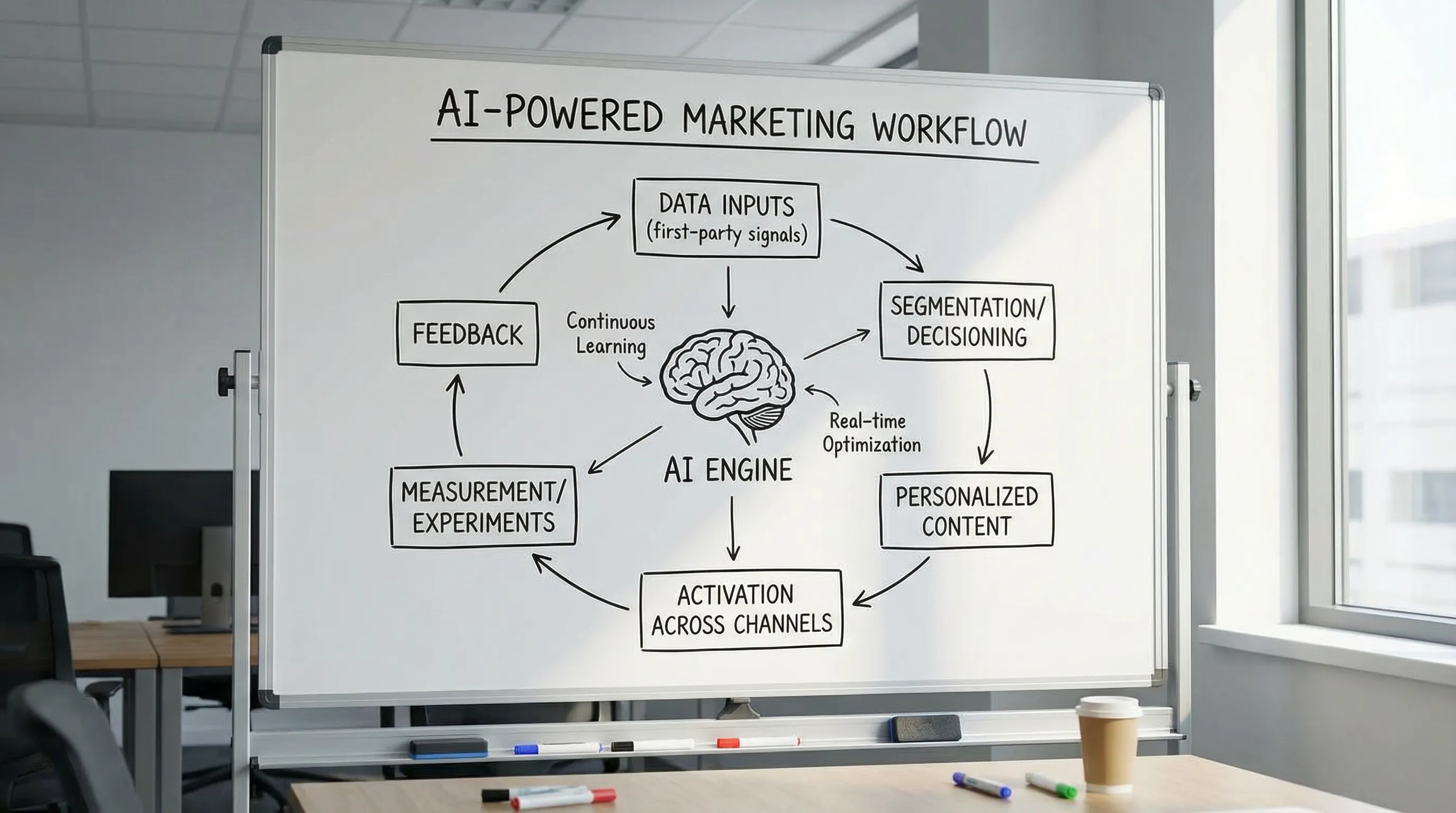
AI-powered marketing is shifting the discipline from “campaigns and channels” to a continuous loop of insight, personalization, experimentation, and optimization. Done well, it upgrades both sides of the equation: customer experience and marketing performance.
What “AI-powered marketing” actually means in 2026
AI-powered marketing is the use of machine learning and generative AI to improve marketing decisions and execution across the funnel, including:
- Predicting what audiences will do (propensity, churn risk, next best action)
- Personalizing messaging, offers, and journeys at scale
- Automating parts of production and orchestration (content variations, routing, bidding)
- Measuring impact with better experimentation and analytics
Two clarifications matter:
First, AI is not one tool. It is a set of capabilities that sit across your stack (CRM, data warehouse, CDP, ad platforms, email, analytics, customer service). Second, “generative AI” (copy, images, scripts) is only one slice. Many of the biggest gains come from decisioning (who, when, what, and why) rather than creation.
Personalization: the promise, the pitfalls, and what works
Personalization is where AI-powered marketing gets its reputation, for better and worse. Customers notice irrelevance instantly, and regulators notice sloppy data practices even faster.
A useful benchmark: McKinsey has reported that getting personalization right can lift revenue and improve efficiency, while getting it wrong can destroy value through wasted spend and customer distrust (McKinsey on personalization value). The point is not the exact percentage for your business, it is that personalization has a measurable upside only when it is systematic.
Start with “personalization you can prove”
The highest-performing teams avoid vague goals like “more personalized emails.” They define personalization as:
- A decision rule (who gets what)
- A hypothesis (why it should work)
- A measurement plan (how you will know)
That structure keeps AI grounded in outcomes.
The 4 building blocks of scalable personalization
1) Data that is usable, not just available
AI does not fix broken data. It amplifies it.
If your first-party data is scattered, outdated, or missing consent context, the best model in the world will still produce “confident wrong.” Before you scale personalization, make sure you can answer:
- What customer identifiers are reliable (email, account ID, device, hashed identifiers)?
- What events are collected consistently (views, trials, demos, renewals)?
- What consent and preference signals are attached and honored?
2) Segments that reflect intent, not demographics
Demographics are often weak predictors of buying behavior. Intent signals (product usage, content consumption, sales engagement, renewal timing) typically outperform “persona-only” segmentation.
A practical upgrade is moving from static segments (SMB vs enterprise) to dynamic intent clusters, refreshed daily or weekly.
3) Content that is modular
Personalization at scale fails when content is monolithic. Winning teams build message modules (value prop, proof point, CTA, objection response) that can be recombined based on audience and context.
Generative AI helps here, but the real unlock is the library and governance: approved claims, approved proofs, brand-safe phrasing, and industry-specific constraints.
4) Orchestration across touchpoints
Personalization is not an email trick. Customers experience brands across ads, web, sales outreach, onboarding, and support.
The maturity jump is coordinating:
- What marketing says
- What sales reinforces
- What service delivers
When those diverge, “personalization” feels like manipulation.
Personalization use cases by funnel stage
| Funnel stage | AI-powered marketing use cases | What “good” looks like | Common failure mode |
|---|---|---|---|
| Awareness | Creative variant testing, audience expansion, topic clustering | More qualified traffic at stable CAC | High volume reach with lower intent |
| Consideration | Website experience personalization, nurture sequencing | Higher demo or trial conversion | Overfitting to short-term clicks |
| Conversion | Lead scoring, next best action, offer optimization | Higher win rate, faster cycle time | Scores nobody trusts, sales ignores |
| Retention | Churn prediction, onboarding nudges, health-based messaging | Higher renewal and expansion | “Spray and pray” lifecycle blasts |
From personalization to performance: measurement is the differentiator
Personalization is exciting, but performance is what earns budget.
In AI-powered marketing, performance comes from causality, not correlation. Your dashboards can show that a segment clicked more, but leadership cares whether AI changed outcomes versus what would have happened anyway.
The performance stack: 3 levels of proof
1) Fast feedback (diagnostic metrics)
These are early indicators like CTR, open rate, landing-page engagement. They help you iterate quickly, but they can mislead when they become the goal.
2) Incrementality (experiments)
Incrementality answers the real question: did the AI-driven change cause lift?
Where possible, use controlled experiments:
- Holdout tests in lifecycle programs
- Geo tests for paid media
- A/B tests for web experiences
If you are serious about “from personalization to performance,” this is the layer you protect.
3) Business impact (revenue and retention)
Tie AI initiatives to durable outcomes:
- Pipeline created and influenced
- Win rate and deal velocity
- Customer retention and expansion
- Cost to acquire and cost to serve
If you cannot connect AI activity to one of these, it is a productivity project, not a growth project.
A metric map that keeps AI honest
| Objective | Primary metric | Guardrail metrics | Why it matters |
|---|---|---|---|
| Improve lead quality | Sales accepted leads (SAL) rate | CPL, speed-to-lead | Prevents “cheap leads” that never close |
| Increase conversion | Demo-to-opportunity or trial-to-paid | Refunds, churn, support tickets | Avoids optimizing into bad-fit buyers |
| Grow retention | Net revenue retention (NRR) | Product adoption, NPS (contextual) | Links messaging to customer health |
| Improve efficiency | CAC payback, cost per incremental lift | Brand search, unsubscribes | Keeps cost cutting from harming growth |
The hidden constraint: people and process
Most AI marketing rollouts stall for non-technical reasons:
- The team does not agree on what “good” looks like
- Brand and legal review cannot keep up
- Sales does not trust the scoring or the messaging
- Service is unprepared for the expectations marketing sets
This is why enablement is suddenly a core part of AI-powered marketing performance.
Train for the moments AI creates
When AI increases personalization, it also increases the number of “moments” your team must handle well:
- A prospect asks, “How did you know that?”
- A buyer challenges an AI-generated claim
- A customer references an offer that sales did not see
- A support agent faces frustration caused by mismatched expectations
These are communication and confidence problems, not software problems.
This is where scenario-based practice is useful. Platforms like Scenario IQ focus on AI roleplay training with personalized scenarios, real-time feedback, and analytics, so teams can practice objection handling, messaging consistency, and customer conversations in a controlled environment. If your marketing is getting smarter, your conversations need to keep pace.
Governance and risk: what to get right early
AI-powered marketing increases risk surface area: privacy, bias, brand safety, hallucinated claims, and regulatory exposure.
A practical starting point is aligning to recognized frameworks and guidance, such as the NIST AI Risk Management Framework for operationalizing AI risk.
Minimum viable governance (without slowing everything down)
Focus on a few non-negotiables:
- Data consent and purpose limits: ensure personalization respects consent and stated purposes (especially in regulated industries).
- Claim and proof controls: restrict AI from inventing product capabilities, pricing, guarantees, or compliance statements.
- Human review for high-stakes outputs: ads, landing pages with regulated claims, and sensitive segments.
- Model and prompt logging: keep records so you can audit what happened when something goes wrong.
Governance is also a performance issue. Brand-damaging mistakes create churn, support burden, and wasted spend.
A practical playbook: how to implement AI-powered marketing without chaos
AI adoption works best as a sequence. The goal is not to “AI everything,” it is to build capabilities that compound.
Phase 1: Pick one revenue-linked use case
Choose a use case with:
- Clear owner
- Clear baseline metric
- Ability to run a test
Examples: improving demo conversion on one product line, reducing churn in a specific cohort, or increasing sales accepted leads.
Phase 2: Build the measurement and guardrails first
Before scaling, lock in:
- What data feeds the decision
- How you will test incrementality
- What the AI is not allowed to do (claims, targeting, sensitive attributes)
This prevents you from “scaling confusion.”
Phase 3: Operationalize the human layer
This is the step most teams skip.
Update enablement so your go-to-market teams can execute the new experience consistently:
- Marketing: modular messaging, experiment discipline
- Sales: how to follow up on AI-qualified leads, how to handle objections created by personalization
- Service: how to resolve expectation gaps, how to reinforce value post-purchase
Scenario-based practice is especially effective here because it turns policies and playbooks into behavioral muscle memory.

What “good” looks like after 90 days
You do not need a full transformation to see progress. After roughly a quarter of focused execution, a strong AI-powered marketing program typically has:
- One or two AI use cases in production with documented experiments
- A repeatable workflow for content variants that is brand-safe
- A shared definition of qualified leads that sales actually uses
- A measurement view that separates activity from incremental impact
- Training in place so customer-facing teams can handle the new conversations confidently
If you want AI-powered marketing to move from personalization to performance, treat it as an operating system: data, decisions, measurement, and people.
When you are ready to strengthen the human side, explore Scenario IQ for AI-driven roleplay training that helps teams practice real customer scenarios, handle objections, and improve performance with feedback and analytics.