
The fastest growing pipelines in 2025 are not built by sending more messages. They are built by orchestrating AI, data, and humans to find fit, signal intent, and convert conversations into revenue. This playbook breaks down practical AI powered lead generation tactics you can deploy now, plus how to enable your team to turn those leads into qualified opportunities.
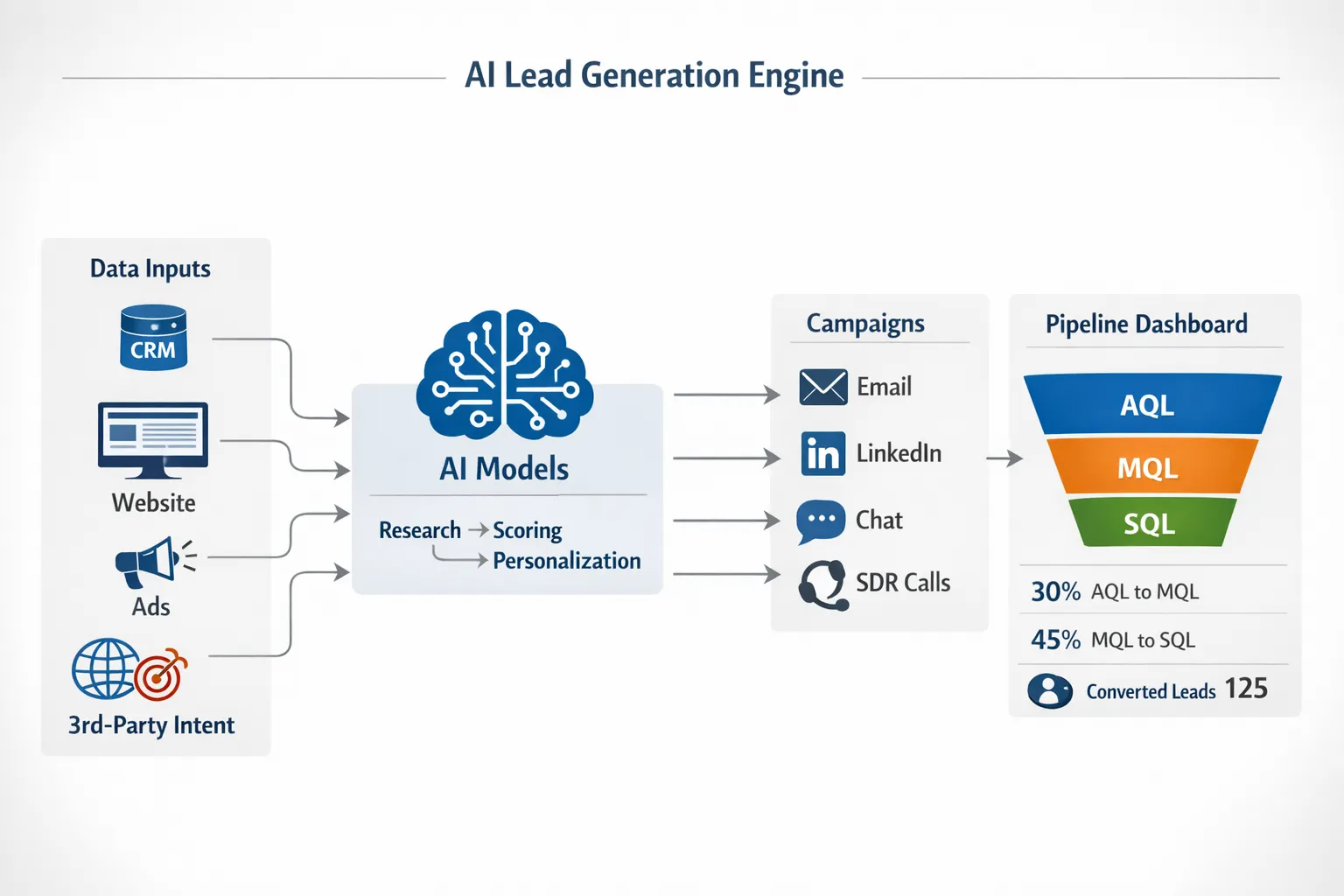
Start with the foundation, not the message
AI makes bad data more expensive. Before you scale outreach or ads, tighten the substrate that AI will use.
- Define an actionable ICP, include firmographic, technographic, buyer role, trigger events, and disqualifiers.
- Normalize CRM fields, deduplicate, and enforce required values for industry, employee band, ARR band, and lifecycle stage.
- Instrument intent events, page visits, content downloads, pricing page dwell time, and product usage if PLG, so AI scoring has real signals.
- Create a brand and compliance brief for models, tone, claims you can make, banned phrases, privacy rules, and opt out policy.
Tactic 1, AI research that finds real buying triggers
Generic personalization does not move the needle. Use AI to assemble a one page research brief per account, then map your value to an active trigger.
- Pull public signals, hiring, product launches, funding, tech changes, executive quotes, and build a short why now narrative.
- Summarize the account’s current stack and likely gaps, highlight 2 to 3 hypothesized pains based on their context.
- Generate a short list of relevant customer stories, match by industry and size, to ground your outreach in proof.
Pro tip, keep the brief visible inside your sequencing or call workflow so humans can verify and edit before hitting send.
Tactic 2, Personalization at scale with guardrails
AI can produce high performing first touch messages when you keep the structure tight and enforce constraints.
- Use a 4 sentence template, context hook based on the trigger, value aligned to ICP pain, proof with a relevant outcome, call to action that is specific and low friction.
- Set hard limits, 90 words maximum, one link maximum, no attachments, no fake familiarity, and do not invent facts.
- Add a quality gate, readability at grade 6 to 8, scan for banned claims, and compare intent to your brand brief before sending.
Run small controlled tests, 200 to 300 contacts per variant, and optimize for reply quality, not only open rate.
Tactic 3, AI intent capture on your website
Turn traffic into conversations by letting AI help qualify, route, and summarize interactions for your reps.
- Use a chat assistant that recognizes high intent paths, pricing, integrations, ROI calculators, and fast tracks to calendar with routing rules.
- Parse form free text with AI to extract buying timeline, budget signals, and product needs, then push to your CRM as structured fields.
- Summarize long chat or form notes into a one paragraph handoff that your SDR can use on the first call.
Always disclose when visitors are interacting with an automated assistant, and store transcripts with consent.
Tactic 4, Content that generates leads, not just clicks
AI can accelerate research, briefs, and distribution, but the goal is qualified demand. Use it to build assets that solve acute problems for your ICP.
- Create lighthouse assets tied to high value triggers, for example a migration checklist or a board ready ROI template, and gate them lightly.
- Use AI to cluster keywords by job to be done, then pair each cluster with a clear conversion next step, calculator, diagnostic, or webinar.
- Automate content audits, refresh old winners first, and connect each page to a purpose built CTA for its stage.
If you are surveying the market for supporting software, this curated AI-powered tools roundup can help you explore categories for research, content, and SEO workflows.
Tactic 5, Social selling with AI assisted relevance
Social is noisy, so use AI to surface the handful of posts and threads where your buyers actually show intent.
- Monitor executives and target accounts for posts that mention your category or pains, then draft tailored comments that add insight, not a pitch.
- Turn top performing comments into short DMs with a resource attached, and keep the CTA optional.
- Repurpose webinar clips into short posts with AI generated captions and hooks that match the persona.
Tactic 6, Paid programs with creative that learns fast
Use AI to generate tight creative variations and map them to funnel stage, then allocate spend based on incremental lift, not vanity metrics.
- Build creative templates for pain, proof, and product in use, then let AI produce variations by industry and role.
- Align landing pages to the ad’s message, and summarize form inputs into CRM friendly fields instantly.
- Rotate offers by stage, top of funnel guides, middle of funnel comparison checklists, bottom of funnel calculators and trials.
Tactic 7, AI scoring, routing, and conversation intelligence
Lead volume without prioritization wastes your team’s time. Let AI help decide who hears from you first and why.
- Combine fit and behavior into a single score, and show the top three reasons a lead is hot, not a black box.
- Route by buying signal, enterprise to account executive, mid market to SDR, customer expansion to CSM.
- Summarize first calls automatically, extract pains, stakeholders, next steps, and push summaries into the opportunity record.
Team enablement is the multiplier
Even the best AI engine cannot close a deal. The difference between a reply and a meeting is a human who can run a great conversation. This is where practice makes pipeline.
With Scenario IQ, your team can rehearse AI sourced conversations in a realistic environment so they are ready when the lead replies. The platform delivers AI powered roleplay simulations, personalized training scenarios, and real time feedback, with progress tracking analytics your managers can use to coach. Teams benefit from adaptive feedback and guidance, daily actionable tips, customizable skill levels, performance metric dashboards, and enterprise grade security that meets the needs of larger organizations.
Practical ways to use Scenario IQ for lead gen readiness:
- First response mastery, reps practice replying to inbound emails or chat handoffs within two minutes, choosing the best CTA and tone.
- Discovery drills, realistic simulations by persona, CFO, VP Sales, Head of Ops, that press on budget, timeline, and competing priorities.
- Objection handling sprints, rehearse common pushbacks like we are under contract, send me something, or we have no budget until Q3.
- Value articulation, short pitches mapped to the top three ICP pains you uncovered in your AI research briefs.
- Follow up that advances the deal, practice writing concise recaps with agreed next steps and meeting confirmations.
Managers can track skill progression and identify who needs support using built in analytics, without guessing. If you are deploying AI across your go to market, pairing it with deliberate practice is the fastest way to convert more of the leads you generate.
What to measure, and why it matters
Track outcomes, not only activities. The table below focuses your analytics on pipeline creation and conversion quality.
| Area | Primary metric | What good looks like | Notes |
|---|---|---|---|
| Top of funnel | AQL to MQL conversion rate | Rising steadily while reply quality holds | AQL is AI qualified lead based on fit and signal, do not flood MQLs without human review |
| Outbound | Positive reply rate | High single digits or better depending on segment | Focus on relevance indicators, meeting accepts per 100 contacts |
| Inbound | Speed to first human response | Under 5 minutes during business hours | AI can triage, but people set the tone |
| Discovery | MQL to SQL conversion rate | Improving as reps practice | Measure against scenario based coaching participation |
| Pipeline | SQL to opportunity rate | Climbing with stable win rates | Signals you are not lowering quality just to create opps |
| Content | Assisted pipeline | Clear contribution to opportunities | Attribute by first touch and multi touch models |
A 30, 60, 90 day rollout to fill your pipeline
Month one, fix the substrate. Clean data, define ICP with disqualifiers, instrument core intent events, build your brand and compliance brief for AI. Launch one Scenario IQ module focused on first responses and objections.
Month two, deploy two scalable plays. Programmatic outbound into your best fit segment, and high intent chat routing on pricing and integration pages. Use Scenario IQ to run discovery drills for the personas in those plays. Start reporting on reply quality and meeting accepts, not only sends.
Month three, expand and optimize. Add a lighthouse content asset with a matching retargeting flow. Introduce AI scoring with transparent reasons and adjust routing rules. Use Scenario IQ analytics to correlate practice participation with MQL to SQL lift, and double down on the drills that move that metric.
Guardrails and compliance you cannot skip
AI can help you move faster, but it also amplifies mistakes if you let it. Keep a short checklist and run it every time you launch a new play.
- Consent and privacy, honor opt outs, disclose automation in chat, and do not store personal data you do not need.
- Accuracy, no invented claims, verify any third party facts, and keep product comparisons fair and sourced.
- Brand and tone, use your brief to prevent style drift and avoid over familiarity that erodes trust.
- Deliverability, authenticate domains, warm new sending addresses gradually, and avoid attachments in first touches.
Bringing it together
AI powered lead generation works when three pieces click, clean data and clear ICP, models that spot fit and intent, and people who can run great conversations. If you have to choose a place to start, tighten your foundation and spin up one focused play where you can learn quickly.
When you are ready to turn more replies into meetings and more meetings into qualified pipeline, put practice on autopilot with Scenario IQ. Your team will get AI roleplays that mirror the conversations you are creating, with real time feedback and analytics that help managers coach what matters. That is how pipelines fill up faster and stay healthy in 2025.