
Lean marketing teams do not lose because they lack ideas. They lose because they spread limited time across too many channels, too many messages, and too many “maybe” priorities.
A practical AI marketing strategy for a small team is not “use AI everywhere.” It is a 90-day operating system that helps you:
- Choose the smallest set of bets that can win
- Produce consistent, high-quality assets faster
- Tighten the loop between marketing, sales, and service
- Learn from real conversations, then iterate weekly
This plan assumes a lean team (1 to 5 people) with limited design, limited ops, and a big need to show pipeline impact quickly.
What makes an AI marketing strategy work for lean teams
AI creates leverage, but only when you constrain the problem.
The highest-performing lean strategies share four traits:
1) One ICP, one primary pain, one “proof” offer
If your team has one quarter to show results, pick a narrow segment and a single primary outcome. You can expand later. In 90 days, focus beats coverage.
A simple way to frame it:
- ICP: the one buyer profile you can actually reach
- Pain: the costly, urgent problem they already feel
- Proof offer: the easiest way for them to experience value (trial, audit, demo, assessment, workshop)
2) One content engine, two distribution channels
Most lean teams do best with:
- One core asset per week (a page, webinar, playbook, case study, teardown)
- One owned channel (email, blog, community)
- One demand channel (paid search/paid social, partnerships, outbound, events)
AI helps you create and repurpose, but it cannot compensate for a scattered strategy.
3) Weekly learning loops built on customer language
Your best copy is already hidden in:
- Sales call notes
- Support tickets n- Live chat logs
- Win/loss reasons
- Objections in demos
AI can cluster themes quickly, but you still need a weekly habit of feeding it real inputs and shipping improvements.
4) Sales and service readiness is part of marketing
Campaigns fail when leads convert to meetings but stall in discovery, objections, or onboarding expectations.
This is where AI roleplay training can turn marketing momentum into revenue. If your team is changing positioning, offers, or target segments, you need sales and service to practice the new conversation patterns until they are fluent.
Scenario IQ, for example, focuses on AI-powered roleplay simulations with personalized scenarios, real-time feedback, and progress tracking so teams can build confidence, handle objections, and deliver a consistent experience.
The 90-day plan at a glance
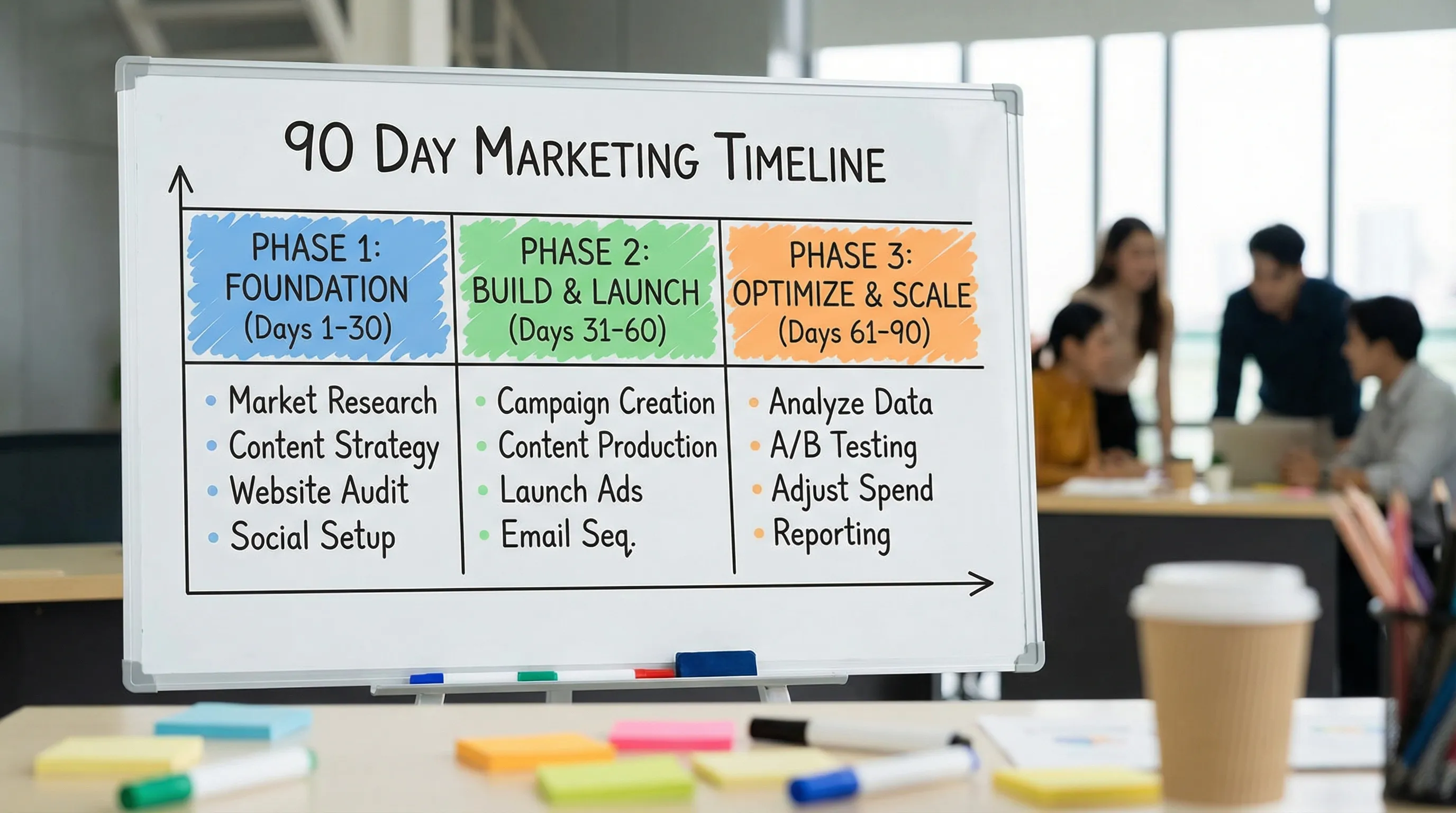
This plan is split into three 30-day phases:
- Days 1 to 30 (Foundation): decide the bet, build the measurement, create message assets, align sales and service
- Days 31 to 60 (Build and Launch): ship campaigns weekly, start conversations, capture objections, improve conversion points
- Days 61 to 90 (Optimize and Scale): double down on what works, tighten the funnel, build repeatable playbooks
Days 1 to 30: Foundation (decide, instrument, align)
The goal of the first 30 days is to remove ambiguity. You should exit this phase knowing exactly who you are targeting, what you are offering, how you will measure success, and how sales and service will run the play.
Step 1: Write your “one-page strategy” (in one afternoon)
Create a single page with:
- ICP definition (industry, company size, trigger events)
- Primary pain (what it costs them)
- Your promise (outcome, timeframe, constraints)
- Proof (case studies, benchmarks, expertise)
- Primary channel and secondary channel
- Offer and next step (demo, assessment, trial)
Where AI helps: generate draft ICP and pain hypotheses quickly, then validate with 5 to 10 real conversations.
Step 2: Build a messaging kit (so you stop rewriting from scratch)
Lean teams waste time because every asset starts at zero.
Create a messaging kit with:
- Brand voice rules (do and do not)
- 3 core value pillars
- 10 proof points (stats, outcomes, testimonials)
- 15 common objections and your best responses
- 5 “trigger event” narratives (what changed that makes action urgent)
Where AI helps: first drafts, tone variations, and “objection to response” mapping.
Step 3: Set up measurement that answers one question: “Are we creating pipeline?”
Avoid vanity metrics as your main score.
At minimum, track:
- Lead source and campaign
- Conversion rates: visit to lead, lead to meeting, meeting to opportunity
- Sales cycle stage drop-offs
- Time-to-first-response and time-to-meeting
If you have limited analytics maturity, start with basic CRM reporting and a simple dashboard.
For context on why focusing on high-impact workflows matters, McKinsey estimates generative AI can add significant economic value across functions, including marketing and sales, largely by boosting productivity and effectiveness in knowledge work (McKinsey Global Institute). The point is not the number, it is the direction: leverage comes from repeatable workflows.
Step 4: Align sales and service with a “conversation readiness” sprint
If marketing is about to increase volume or change positioning, sales and service should practice:
- New discovery questions aligned to the new ICP
- The top 10 objections you expect from the new campaign
- Clear handoffs: what marketing promised vs what service delivers
This is a strong use case for Scenario IQ-style AI roleplay simulations: you can create tailored scenarios (new ICP, new objections, new pricing questions), get real-time feedback, and track progress across the team.
Day 1 to 30 deliverables
| Deliverable | What “done” looks like | Why it matters |
|---|---|---|
| One-page strategy | One ICP, one pain, one offer, one primary channel | Focus and speed |
| Messaging kit | Pillars, proof points, objections, voice rules | Consistency across assets |
| Measurement baseline | Conversion rates by stage, source tracking, response times | Optimizing the right bottleneck |
| Sales/service readiness | Practiced talk tracks and objection handling | Higher close rates from the same demand |
Days 31 to 60: Build and Launch (ship weekly, learn weekly)
In this phase, you run weekly sprints. The goal is not perfection. The goal is steady output and fast learning.
The weekly sprint cadence (repeat 4 times)
Each week:
- Publish one core asset that supports your offer
- Launch one campaign tied to that asset
- Run one feedback session with sales/service
- Update one conversion point (landing page, email sequence, demo flow)
You can keep the team aligned with a simple rule: if it cannot ship this week, it is too big.
Core assets that work well in 90 days
Choose formats your team can produce reliably:
- “Problem to solution” landing page (with proof)
- A short playbook (5 to 8 pages)
- A teardown or benchmark report using your own expertise
- A webinar with a strong POV and real examples
- A case study that highlights measurable outcomes
Where AI helps: outlining, editing, repurposing, ad variations, and converting long content into sales enablement snippets.
Build an AI workflow that reduces content time without lowering quality
A lean, safe workflow looks like:
- Human defines the POV: what you believe, for whom, and why
- AI drafts: outline, first version, variations by channel
- Human validates: facts, claims, tone, and differentiation
- AI repurposes: email, social, ad copy, sales snippets
Important: keep a “claims checklist” so you do not publish unverified stats. AI is fast at writing, not at being correct.
Use real objections to drive messaging improvements
Every week, ask sales and service:
- What question did you hear 5+ times?
- Where do prospects get confused?
- Which competitor came up, and why?
Then update:
- Landing page sections
- Email sequences
- Demo deck or demo flow
- Talk tracks
This is also where AI roleplay training can close the loop. If your campaign introduces a new angle, create a matching simulation so reps can practice the exact conversation your marketing created.
Day 31 to 60 deliverables
| Deliverable | What “done” looks like | Signal to watch |
|---|---|---|
| 4 core assets | One per week, all tied to the same offer | Asset-to-meeting conversion |
| 4 campaign launches | One primary channel, one retargeting or email support | Cost per meeting and meeting quality |
| Objection library v2 | Updated weekly from real calls | Fewer repeated stalls |
| Sales/service practice loop | Regular roleplays and feedback | Higher meeting-to-opportunity rate |
Days 61 to 90: Optimize and Scale (double down and systematize)
Now you stop guessing and start allocating effort based on evidence.
Step 1: Find your bottleneck and fix only that
Most lean funnels break in one of these places:
- Plenty of traffic, weak landing conversion
- Plenty of leads, weak lead-to-meeting
- Plenty of meetings, weak meeting-to-opportunity
- Plenty of opportunities, weak close rate
Pick the biggest constraint and spend two weeks improving it.
Examples:
- If lead-to-meeting is low, tighten qualification and rewrite follow-up.
- If meetings are high but opportunities are low, the issue is usually messaging alignment or discovery quality.
This is where training becomes a growth lever. If the bottleneck is discovery or objections, roleplay practice with real-time feedback can move the needle faster than another round of top-of-funnel spending.
Step 2: Turn what worked into a repeatable playbook
Document:
- The best-performing offer page structure
- The email sequence that created the most meetings
- The objections that caused drop-off and the best responses
- The campaign settings and audience rules that performed
A playbook is how a lean team scales without hiring immediately.
Step 3: Introduce one scaling move, not five
Choose one:
- Add one new channel (only after the first is stable)
- Add one adjacent ICP segment
- Expand one asset into a quarterly pillar
- Increase budget on the proven campaign
Step 4: Build durable alignment between marketing, sales, and service
At this point, you should have enough signal to run a monthly “revenue narrative” meeting:
- Marketing: what we promised and what content resonated
- Sales: what prospects asked, what stalled deals
- Service: what customers struggled with, what drove retention
If you use Scenario IQ for training, this is a good time to map your top scenarios to your funnel stages (first call, objection handling, pricing, onboarding expectations) and track improvement over time.
KPIs to track (without drowning in dashboards)
Pick a small set of metrics per stage.
| Funnel stage | KPI | Why it matters |
|---|---|---|
| Awareness to lead | Landing page conversion rate | Measures message to action fit |
| Lead to meeting | Lead response time, meeting rate | Speed and follow-up quality |
| Meeting to opportunity | Opportunity creation rate | Discovery quality and ICP fit |
| Opportunity to close | Win rate, sales cycle length | Objection handling and proof |
| Post-sale | Time to onboarding success, top ticket themes | Reduces churn and drives expansion |
Common pitfalls in an AI marketing strategy (and how to avoid them)
Treating AI as the strategy
AI can multiply output, but it cannot pick your ICP, promise, or positioning. Make the strategic calls first, then automate.
Publishing faster than you can validate
If you cannot verify a claim, do not publish it. Instead, use qualitative proof: customer quotes, examples, screenshots, process explanations.
Forgetting that conversion depends on conversations
If your campaigns generate interest but sales cannot confidently run discovery or handle objections, you will see pipeline leakage. Training is not separate from marketing performance, it is part of it.
Putting it into action with Scenario IQ
If your 90-day plan includes new messaging, a new segment, or a stronger offer, you will likely need your team to practice new conversations quickly.
Scenario IQ provides AI-driven, personalized scenario-based training with real-time feedback, adaptive guidance, and progress tracking analytics. That makes it a practical companion to a lean AI marketing strategy because you can:
- Turn new campaign angles into roleplay scenarios
- Practice objection handling before leads spike
- Track team improvement as your funnel evolves
Explore Scenario IQ at scenarioiq.ai when you are ready to connect marketing momentum to sales and service execution.