

Marketing teams in 2026 face a paradox: AI can compress weeks of research, creative iteration, and campaign optimization into days, but only if you have the right people, process, and governance around it. That’s why the decision between hiring an AI marketing company (an agency or consultancy that operationalizes AI for you) and building an in-house AI marketing team has become a board-level question.
This guide breaks the choice down into practical trade-offs, a scoring framework you can use with stakeholders, and a realistic “hybrid” path that often wins.
What an “AI marketing company” actually is (and isn’t)
An AI marketing company is typically a marketing agency, growth partner, or consultancy that uses AI across parts of the marketing lifecycle, for example:
- Strategy and positioning research assisted by LLM workflows
- Creative production pipelines (concepting, copy variants, design support)
- Media buying optimization and experimentation
- Marketing operations and automation (lead routing, lifecycle messaging)
- Measurement support (dashboarding, attribution modeling)
What it is not: a magic box that “does marketing automatically.” The value comes from repeatable operating systems (prompts, playbooks, QA checks, data workflows) plus specialists who know how to apply them to your category.
What an in-house AI marketing team actually requires
In-house doesn’t just mean “hire a prompt expert.” It usually means you own:
- The AI-enabled marketing workflow design
- Tool selection, integration, and security reviews
- Data access and governance (what can be used, where it can be stored)
- Experiment design and performance accountability
- Brand voice, compliance, and approvals
In practice, in-house is a commitment to building capability, not just output.
The core decision: output vs capability
A simple way to frame the decision:
- If you need fast output (campaigns shipped, pipeline influenced this quarter), an AI marketing company often wins.
- If you need durable capability (your team becomes meaningfully stronger over 12 to 24 months), in-house often wins.
Most organizations need both, which is why hybrid models are common (more on that later).
A clear decision framework (8 criteria that actually matter)
Use the criteria below to drive a decision that survives budget scrutiny and stakeholder debate.
1) Time to impact
If you have an upcoming launch, revenue shortfall, or competitive pressure, speed matters.
- AI marketing company tends to win when you need a running start: proven playbooks, ready-to-go specialists, and faster production throughput.
- In-house tends to win when you can invest in enablement and accept a slower ramp while building internal systems.
A useful self-check: if “first measurable lift” must happen within 60 to 90 days, outsourcing often de-risks execution.
2) Strategic control and brand nuance
Brand nuance is where many AI efforts break. Models can generate, but they can’t be accountable for reputation.
- In-house wins when your brand is sensitive (regulated categories, complex enterprise messaging, high PR risk) or when differentiation is subtle.
- AI marketing company wins when your category is more pattern-driven (clear ICP, established messaging, strong benchmarks) and you have internal reviewers who can enforce voice and claims.
3) Access to (and permission for) your data
AI-powered marketing improves with real context: customer language, win-loss notes, product usage signals, funnel conversion by segment.
- In-house wins when AI workflows require deep integration with CRM, product analytics, and internal knowledge bases.
- AI marketing company wins when data can be shared safely (or anonymized) and the work can be done with limited systems access.
For AI risk and governance, the NIST AI Risk Management Framework is a strong baseline for thinking about privacy, reliability, and accountability.
4) Talent availability and management overhead
Hiring “AI marketing” talent is hard because you are often hiring three things at once: marketing fundamentals, experimentation discipline, and AI workflow literacy.
- AI marketing company wins when you cannot hire quickly, or when you don’t want to manage a specialized team.
- In-house wins when you have strong marketing leadership and can coach an experimentation culture.
A common failure mode: hiring one senior “AI marketer” without ops support, governance, or creative capacity, then expecting a transformation.
5) Tooling, integrations, and security posture
Your real bottleneck may be procurement and integration, not idea generation.
- In-house wins if you can standardize tooling and build secure internal workflows that other teams can reuse.
- AI marketing company wins if they already run a mature stack and can deliver output without heavy integration (or they can complement your team’s stack).
If you operate across regions, keep an eye on evolving regulation and organizational policy, especially for customer data and automated decisioning.
6) Measurement and accountability
Marketing impact is easiest to debate and hardest to prove. AI can increase output volume, but volume is not value.
- In-house wins when you want one owner accountable for business outcomes, and you can align marketing with sales and finance on definitions.
- AI marketing company wins when you need help building the measurement system itself (tracking plan, dashboards, experimentation cadence), then operating it.
For broader context on AI’s potential value across business functions (including marketing and sales), McKinsey’s research is a useful starting point: The economic potential of generative AI.
7) Change management across sales and service
This criterion is routinely underestimated.
Even perfect marketing fails if:
- Sales can’t articulate the new value proposition.
- SDRs mishandle inbound objections created by new ads.
- Customer service can’t support the promise you just marketed.
If you change messaging, you must change conversations.
This is where platforms like Scenario IQ fit naturally regardless of your marketing model: you can run AI roleplay simulations to train sales and service teams on the exact scenarios your new campaigns generate, get real-time feedback, and track readiness via progress analytics. It reduces the “marketing says one thing, sales says another” gap that destroys conversion.
8) Scalability across products, regions, and segments
- AI marketing company wins if you need immediate scale and breadth (multi-channel, multi-geo, multiple offers) with predictable throughput.
- In-house wins if you want a repeatable internal engine that compounds over time, especially when knowledge retention is critical.
Side-by-side comparison (use this table in stakeholder reviews)
| Dimension | AI marketing company | In-house team |
|---|---|---|
| Speed to launch | Faster ramp with established playbooks | Slower ramp, faster later once systems mature |
| Brand control | Shared, requires strong internal review | Highest control, closest to product and customers |
| Data access | Often limited for security and logistics | Deep access possible, easier to operationalize signals |
| Cost structure | Variable, retainer or project based | Fixed costs, hiring and tooling overhead |
| Operational burden | Lower internal management load | Higher, you own hiring, process, performance |
| Security and compliance | Depends on partner maturity and contracts | Easier to align with internal security standards |
| Experimentation cadence | Often strong if partner is disciplined | Strong if culture and leadership support it |
| Long-term capability | You rent capability | You build capability that compounds |
A scoring model you can actually use (simple, not fake precision)
Instead of debating opinions, run a quick scoring workshop. Assign each criterion a weight based on business reality, then score each option 1 to 5.
| Criterion | Weight (High/Med/Low) | AI marketing company score (1-5) | In-house score (1-5) | Notes |
|---|---|---|---|---|
| Time to impact | ||||
| Brand nuance and approvals | ||||
| Data access and governance | ||||
| Hiring feasibility | ||||
| Tooling and integration | ||||
| Measurement maturity | ||||
| Sales and service alignment | ||||
| Scale needs |
How to interpret results:
- If “Time to impact” and “Hiring feasibility” are weighted high, outsourcing frequently wins short term.
- If “Data access,” “Brand nuance,” and “Governance” are weighted high, in-house often wins.
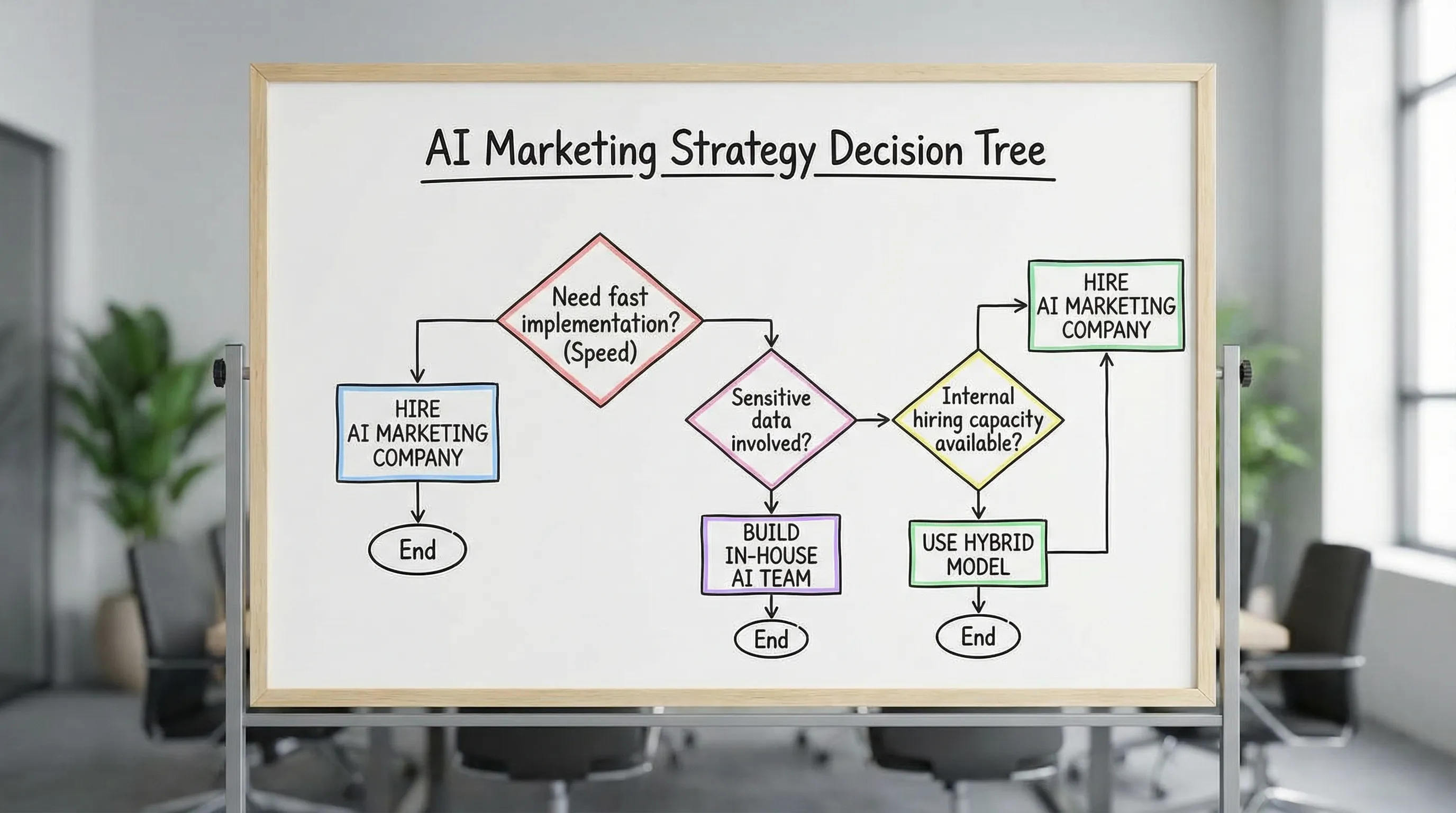
- If scores are close, choose a hybrid approach and define clear boundaries (strategy vs execution, core vs burst capacity).
What the cost conversation should include (beyond “agency vs salaries”)
A realistic cost comparison includes more than headcount.
Costs that often get missed with an in-house build
- Recruiting time and opportunity cost
- Enablement time for tooling, QA, governance
- Management bandwidth (especially for experimentation)
- Tool sprawl if different teams adopt different AI apps
Costs that often get missed with an AI marketing company
- Internal review time (brand, legal, product, compliance)
- Knowledge transfer gaps (partner learns, then resets if team changes)
- “Black box” risk if workflows are not documented
The right question is not “which is cheaper,” it’s “which produces measurable impact with acceptable risk, at the speed we need.”
The hybrid model (often the best answer)
Hybrid models work because they separate what must stay close to your business from what can be modular.
A common, effective split:
- Keep in-house: positioning, ICP decisions, approvals, first-party data strategy, lifecycle architecture, performance accountability.
- Outsource: campaign production bursts, channel specialists (paid search, paid social), creative iteration at scale, short-term experimentation pods.
To make hybrid work, insist on two things:
- A shared measurement plan (same definitions for pipeline, CAC, qualified leads, conversion rates).
- Documented workflows (prompt libraries, QA checklists, brand and claims guidelines).
Where most teams slip: handoff from marketing to sales and service
AI can help you generate more leads, more content, and more campaigns. But if your revenue team isn’t prepared for the conversations those campaigns create, performance stalls.
Examples:
- A new comparison campaign increases competitor objections, but reps still answer with generic scripts.
- A “fast setup” promise increases churn and tickets because onboarding and support were not trained for the expectation.
This is exactly the type of operational gap AI roleplay training is designed to close.
With Scenario IQ, you can turn your go-to-market changes into practice:
- Build personalized training scenarios based on your new ads, landing pages, and outbound messaging.
- Give reps real-time feedback on objection handling, clarity, and confidence.
- Track improvement with analytics so enablement is measurable, not anecdotal.
The point is not to “train more,” it’s to make your marketing investment convert.

Recommended decision paths (by company situation)
If you’re early-stage or resource constrained
You likely need speed, pattern-based execution, and help building a repeatable funnel.
An AI marketing company can get you moving fast, but protect your future by keeping a lightweight in-house owner for:
- Brand voice and claims
- ICP clarity
- Measurement definitions
If you’re mid-market with an existing marketing team
Hybrid is usually strongest:
- Keep strategy, lifecycle, and analytics ownership in-house.
- Bring in an AI marketing company for channel depth and creative velocity.
- Use structured enablement so sales and service adopt the new messaging fast.
If you’re enterprise or in regulated categories
In-house ownership of governance, data, and approvals is often non-negotiable. You can still use partners, but with tighter boundaries:
- Partners execute within your approved frameworks.
- Internal teams own data access, compliance, and final claims.
A practical 90-day implementation plan (works for either choice)
Align on what success means
Define success in shared business terms (not “more content”): pipeline influenced, qualified conversations created, conversion rate changes, churn reduction, or ticket deflection.
Choose 1 to 2 high-leverage use cases
Good first use cases are narrow, measurable, and high volume, such as:
- Landing page and ad variant testing for a single offer
- Email lifecycle optimization for activation
- Objection-led content tied to late-stage deals
Build the QA and governance layer early
Set rules for:
- What data can be used in AI tools
- Approval workflows (brand, legal, product)
- Source requirements for claims
- Human review checkpoints
Enable the teams that close the loop
When campaigns change, train the humans who handle the next conversation. If you want a concrete way to operationalize that, use AI roleplay to practice:
- The new pitch
- The top objections introduced by the campaign
- The support scenarios created by the promise
Then track improvement so you can see whether enablement is translating to better outcomes.
The decision in one sentence
Choose an AI marketing company when speed and specialized execution matter most right now. Choose an in-house team when governance, data proximity, and long-term capability matter most. Choose hybrid when you need both, which is most teams.
If you want the marketing decision to show up in revenue, make sure sales and service are trained for the new reality, not the old script. Scenario-based AI roleplay is one of the fastest ways to get there.
Explore Scenario IQ here: https://scenarioiq.ai