

Early-stage teams do not have the luxury of wasted cycles. You need qualified conversations on the calendar, you need them fast, and you need your reps ready to turn those conversations into revenue. This guide breaks down the AI lead generation tools and tactics that work for startups right now, plus the exact enablement moves that help your team convert the pipeline you create.
What AI lead generation actually means in 2025
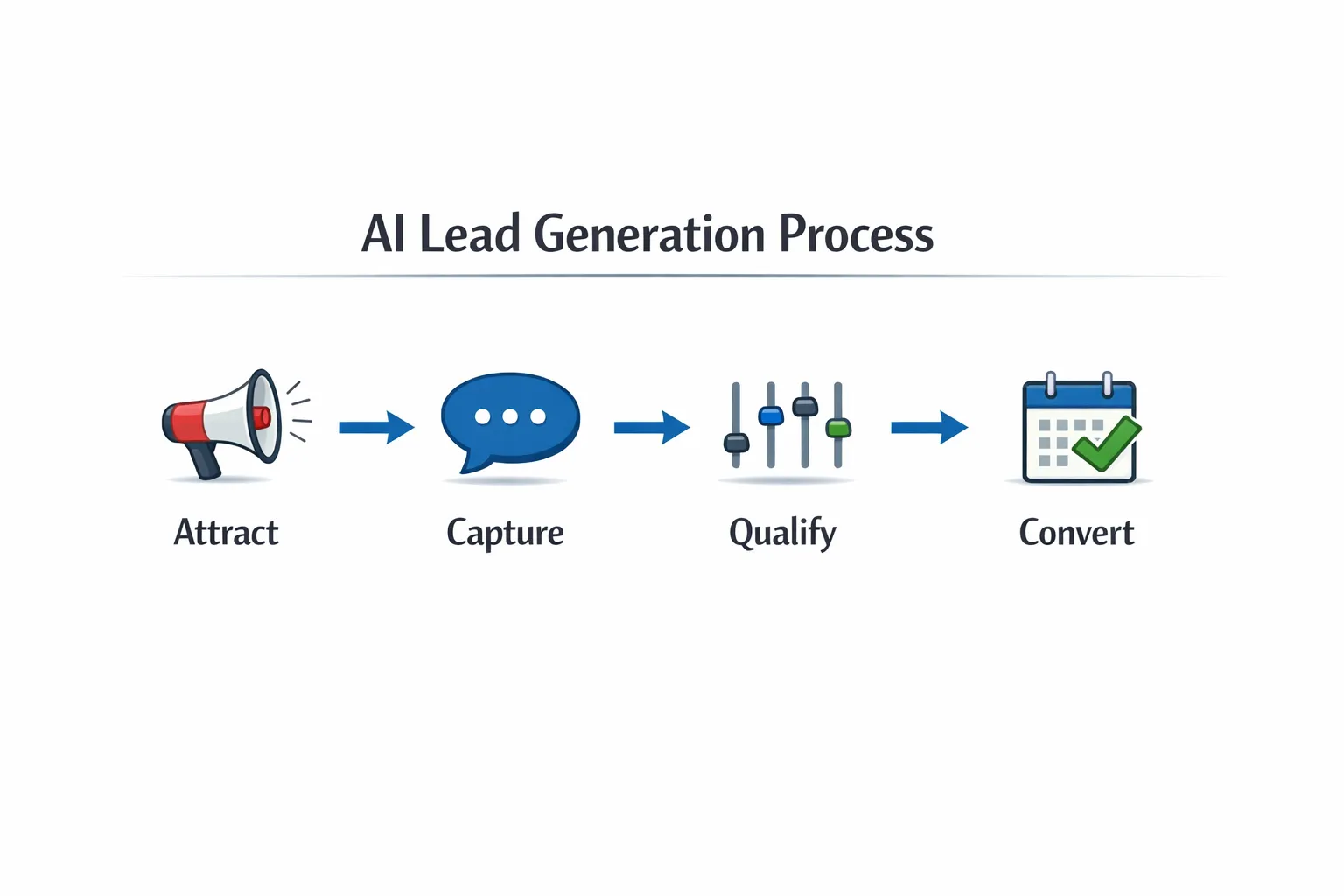
AI for lead generation is not one magic tool. It is a system that combines four jobs:
- Attract: reach the right buyers with targeted content and ads, shaped by AI audience insights.
- Capture: convert interest on your site or landing pages with chat and forms that personalize in real time.
- Qualify: apply intent signals, enrichment, and lead scoring so sales spends time where it matters.
- Convert: route instantly, book meetings, and ensure reps can handle objections and close.
Generative AI is particularly strong in the first three, and when paired with great sales training it amplifies the fourth. McKinsey estimates generative AI could add trillions in economic value, with sales and marketing among the biggest beneficiaries. See McKinsey’s analysis in The economic potential of generative AI for the broader context.
The essential AI lead gen stack for startups
You do not need a bloated toolset to win. You need a few categories that integrate cleanly, show value quickly, and produce measurable lift.
| Category | What it does | Startup tip | Metric to watch |
|---|---|---|---|
| Data and enrichment | Append firmographic and technographic data to contacts and accounts | Enrich only the fields you actually use in routing and messaging | Enrichment match rate |
| Intent signals and scoring | Identify who is in-market based on behavior and content consumption | Start with website behavior and email engagement before buying external intent | Score lift vs. baseline |
| Outreach and personalization | Generate and send tailored emails or messages at scale | Create 3 to 5 micro-segment templates, then let AI personalize within rails | Reply rate, positive intent |
| Website chat and booking | Engage visitors, answer questions, and book meetings on-site | Offer 2 to 3 fast pathways, for example demo, pricing, success stories | Chat-to-meeting conversion |
| Routing and rev ops | Auto-assign based on ICP fit and intent, keep data clean | Keep your rules simple so speed to lead stays under 5 minutes | Time to first touch |
| Sales training and simulation | Prepare reps to convert the leads you fought to earn | Roleplay common objections and tailor by segment | Meeting-to-opportunity rate |
Evaluate tools like a founder, not a shopper
- Speed to value, can you launch in a week and prove a metric moved.
- Data quality, avoid vanity data you will not act on.
- Compliance, ensure consent capture and regional privacy rules are respected.
- Simplicity, fewer steps and fewer tabs increase adoption.
- Instrumentation, every tool must expose the metric you care about.
If you need a mental model for choosing speed, clarity, and automation, look outside sales tech too. In high-velocity domains, traders pick platforms that are extremely fast, visually clear, and automation-friendly. The same criteria help you avoid bloat in your go-to-market stack. For a concrete example from another industry, see this fast options trading platform for Interactive Brokers that prioritizes speed, clean multi-view interfaces, and rule-based automation. Your sales tools should feel similarly responsive and unambiguous.
Tactics that work right now
1) Micro-segmentation, then controlled personalization
Start with three to five micro-segments that map to your ideal customer profile. Examples include a target persona plus a trigger event. Build short, specific value statements for each segment and feed those as rails into your AI copy. AI should personalize within these rails, not invent net-new messaging. Keep your personalization elements tight, for example role, problem indicator, relevant proof, and clear next step.
2) Programmatic content for capture
Use AI to generate landing pages or knowledge articles centered on a single pain point for each micro-segment. Pair these with a site chat that offers context-aware prompts, for example “see pricing for your team size” or “how top [industry] teams handle [objection].” The goal is to move visitors from reading to booking in one click.
3) Deliverability as a growth lever
Cold outreach fails without proper setup. Follow Google’s bulk sender guidelines so your domain reputation stays healthy. That means SPF, DKIM, and DMARC authentication configured, one-click unsubscribe, and low complaint rates. Google documents the requirements here: Bulk sender guidelines. Send modest volumes per domain, segment lists, and remove non-engagers to protect deliverability.
4) Speed to lead with intelligent routing
The moment someone fills a high-intent form or engages your chat, reach out. The classic Harvard Business Review study found contacting online leads within five minutes can dramatically improve qualification odds compared with a slower response. The principle still holds, even if the exact multiplier varies by channel and market. See HBR’s The Short Life of Online Sales Leads for the original analysis: The Short Life of Online Sales Leads. Use round-robin assignment, notify via Slack or CRM tasks, and give reps the context the prospect already provided so the conversation starts strong.
5) Founder-led and expert-led social
Early on, founders and domain experts outperform branded pages. Use AI to rapidly repurpose core ideas into short posts, carousels, and email snippets. Keep a consistent point of view and focus on problems, not product features. Add crisp calls to action, for example “DM ‘demo’ for a teardown of your current process.”
6) Offline conversion feedback for ads
If you run paid, make your algorithms smarter by passing back offline conversions. Feed your ad platforms signals like “sales-qualified” or “opportunity created,” not just leads. Over time, your models optimize for quality, not volume.
Real-world flows you can copy
High-intent website flow
A visitor reads a pain-point article, the chat offers a relevant case snippet plus a one-click “see how we handle [objection]” path, AI answers one or two clarifying questions, then drops into instant calendar booking. Sales receives a short qualification summary along with the meeting invite.
Targeted outbound flow
Identify a trigger, for example a new funding round, a hiring spree in a specific department, or a technology switch. Enrich the account to confirm ICP fit, then run a three-touch sequence tailored to that trigger. Keep the ask simple. Offer a teardown, a benchmark report, or a concise playbook that directly addresses the trigger.
Partnership flow
Find a complementary product that shares your ICP. Co-create a checklist or mini-guide. Promote through both channels with UTM tracking. Use AI to craft co-branded outreach that references both value props and routes meetings to the right owner based on region or segment.
Enablement is the multiplier: train your team to convert
The fastest way to waste a great lead is to put an unprepared rep on the call. Skills like objection handling, discovery, summarizing next steps, and calibrated closing make or break conversion. This is where AI simulations create real leverage.
Scenario IQ helps teams build these conversion muscles with:
- AI-powered roleplay simulations that mirror your micro-segments and objections.
- Personalized training scenarios that adapt to each rep’s skill level.
- Real-time feedback and adaptive guidance after each scenario.
- Progress tracking analytics and performance metric dashboards for managers.
- Team-focused learning that scales across roles and regions.
- Daily actionable tips to keep improvements continuous.
- Enterprise-grade security so training data stays protected.
Put simply, you use AI to create more qualified conversations, then you use Scenario IQ to ensure your people turn those conversations into revenue with confidence.

Practical governance for a small team
- Data ethics and compliance, ensure you have consent where required, honor unsubscribe immediately, and document how AI uses customer data.
- Change control, one owner maintains prompts, templates, and playbooks. Version your prompts and log performance changes when you update them.
- Minimal integration surface, prefer native integrations where possible to reduce breakage. If you use automation, keep the flow short and observable.
A simple 12-week plan
Weeks 1 to 4, build the rails and prove a lift
Define three micro-segments and write the core value statements for each. Configure email authentication and baseline deliverability. Launch a minimal site chat with two clear options, book a demo and see pricing. Ship a short sequence per segment and instrument reply and meeting rates. Run two sales simulations per rep per week to tune discovery and objection handling.
Weeks 5 to 8, scale outreach and speed
Add trigger-based signals to your targeting. Feed offline conversions back to ad platforms. Tighten routing rules so high-intent leads get human contact in minutes. Expand your simulation library to include new objections that surfaced from early calls.
Weeks 9 to 12, optimize for quality
Prune segments that do not convert and double down on the ones that do. Refine copy using win-call language you hear on recordings. Adjust scoring thresholds so sales only sees the top priority leads. Increase the frequency of targeted roleplay for reps whose meeting-to-opportunity rates lag.
Metrics that matter
- Reply rate and positive intent rate on outbound, quality beats quantity.
- Chat-to-meeting conversion on your website, reflect visitor intent in the first two prompts.
- Time to first touch on high-intent leads, aim for minutes, not hours.
- Meeting-to-opportunity rate, the clearest indicator of enablement impact.
- Spam complaint rate, protect it like your brand. Poor deliverability erases gains fast.
- Cost per qualified meeting, a useful sanity check for channel mix decisions.
Common pitfalls to avoid
- Tool sprawl that adds steps without adding outcomes. If a tool does not move a metric, remove it.
- Over-personalization that reads uncanny or incorrect. Constraints improve trust.
- Ignoring compliance and domain reputation. One bad month of sending can take weeks to repair.
- Under-investing in training. AI can get you the meeting, but people still win the deal.
Bringing it all together
Startups win when they combine a lean AI stack, focused tactics, and a team that knows how to convert. Use AI to find and engage the right buyers, automate the handoffs, and keep your motion instrumented. Then, close the loop with targeted practice and feedback so every rep is ready for the conversations your AI creates.
If you want to accelerate the conversion side of your pipeline, Scenario IQ provides AI-powered roleplay simulations, personalized scenarios, real-time feedback, and analytics to help your team handle objections and close with confidence. Learn more at Scenario IQ.