

Marketing and sales alignment usually breaks down in small, expensive ways: a lead gets routed late, the first sales email doesn’t match the ad promise, no one trusts the dashboard, and “quality” becomes a debate instead of a definition. AI in marketing can fix a lot of this, but only when automation is designed around shared revenue outcomes, not isolated team efficiency.
Below are practical, field-tested automation ideas that tighten handoffs, reduce friction, and create a single operating rhythm across marketing and sales.
What “alignment” actually means in 2026
Alignment is not a weekly meeting or a shared spreadsheet. Operationally, it looks like this:
- Marketing and sales agree on what a “good lead” is, in writing, and the definition is enforced by systems.
- Every lead has a clear next step within minutes or hours, not days.
- Sales conversations reflect marketing positioning (and marketing updates based on what’s working in calls).
- Revenue reporting is trusted because source, stage, and attribution rules are consistent.
AI helps most when it reduces the number of judgment calls humans have to make in the middle of a fast-moving funnel.
The alignment layer: map the journey, then automate the handoff points
Before you automate anything, identify the handful of moments where alignment matters most:
- Lead creation: what data is captured, normalized, and enriched.
- Qualification: who gets followed up, when, and with what message.
- Routing and speed-to-lead: how quickly the right rep engages.
- Pipeline progression: whether stage movement reflects reality.
- Closed-loop learning: what marketing learns from won and lost deals.
A simple way to design automations is to assign an “owner” to each moment (Marketing Ops, RevOps, Sales Ops) and define a measurable success metric.
| Journey moment | Automation objective | Primary owner | A metric that shows alignment is improving |
|---|---|---|---|
| Lead capture | Reduce junk and duplicates | Marketing Ops | Duplicate rate, form completion quality |
| Qualification | Prioritize high intent fast | RevOps | MQL to SQL conversion, time to first touch |
| Routing | Get the right rep, immediately | RevOps/Sales Ops | Speed-to-lead, reassignment rate |
| Pipeline hygiene | Stages reflect buyer reality | Sales Ops | Stage aging, slip rate, forecast accuracy |
| Feedback loop | Turn call reality into messaging | Marketing + Enablement | Win rate by message/theme, objection trends |
Practical automation ideas that improve marketing and sales alignment
These ideas are most effective when implemented as small, measurable workflows rather than one big “AI transformation.”
1) Automate lead enrichment and normalization so sales stops arguing with data
Misalignment often starts with dirty inputs: inconsistent job titles, missing industry, unknown employee size, and duplicate accounts.
Practical automation ideas:
- AI-assisted field normalization: standardize job titles (for example, “VP, RevOps” vs “Revenue Operations Leader”) into consistent personas.
- Company enrichment and verification: enrich firmographics and flag risky records (free email domains, suspicious IP patterns, incomplete company fields).
- Duplicate detection with fuzzy matching: identify near-duplicate companies and contacts before they hit the CRM.
Why it aligns teams: marketing stops flooding sales with “technically captured” leads that are operationally unusable.
Tip: treat enrichment rules as a product. Version them, document them, and review monthly.
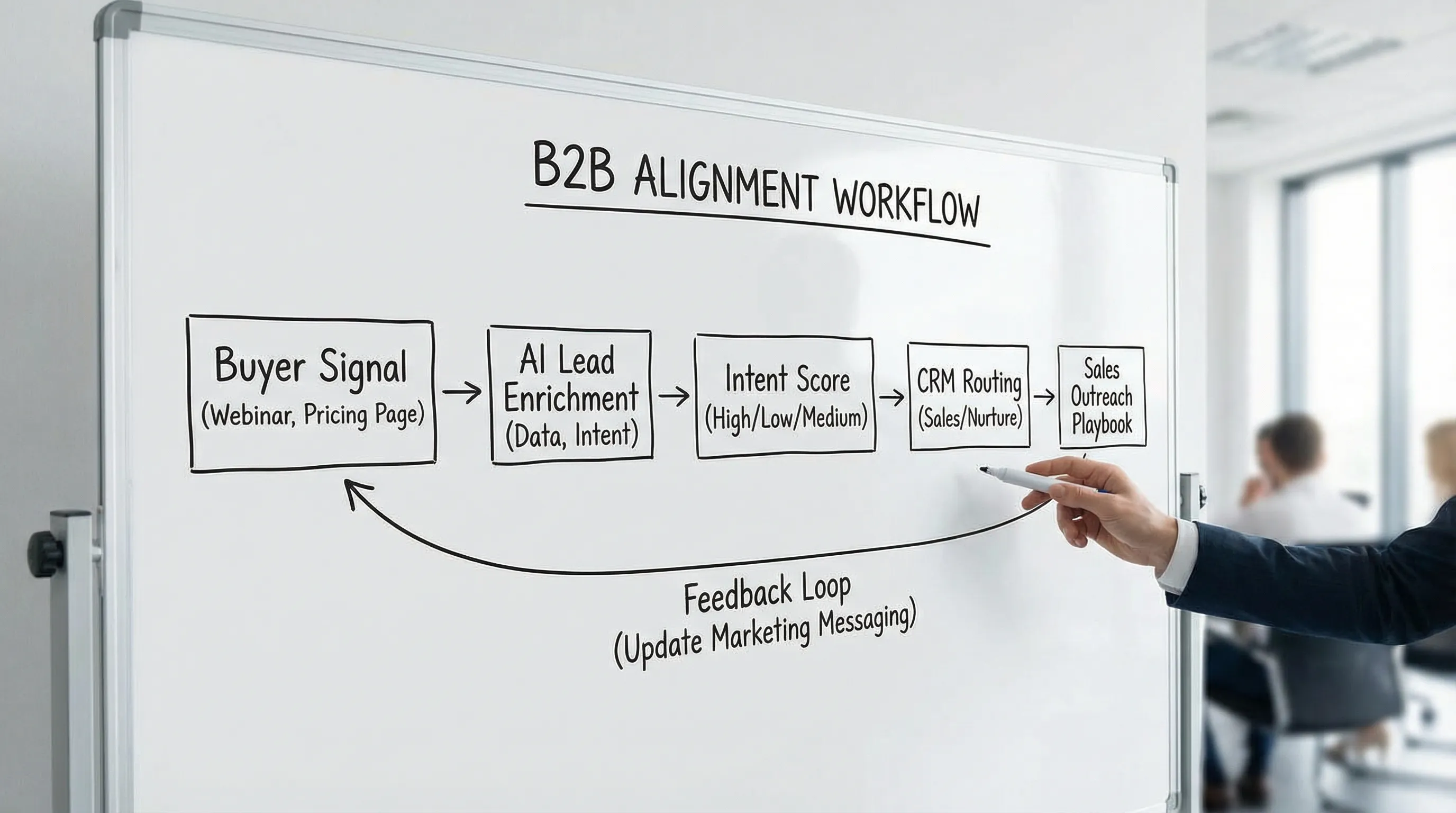
2) Use AI-based intent signals to trigger shared plays, not just nurture sequences
The most valuable shift is moving from “marketing nurtures, sales follows up later” to “signals trigger a coordinated play.”
Practical automation ideas:
- Intent-to-action routing: when intent spikes (pricing page visits, competitor comparisons, high-fit content consumption), trigger both:
- a sales task (call/email within SLA)
- a marketing action (high-relevance follow-up content)
- Persona-based personalization: AI can help select the most relevant proof point (case study angle, security language, ROI framing) based on role and industry.
Why it aligns teams: marketing and sales react to the same buyer behavior and share accountability for response time.
If you need a framework for ethical data use, the FTC guidance on AI is a strong starting point for aligning automation with consumer protection expectations.
3) Automate SLAs with real enforcement, not reminders
Most SLAs fail because they are social agreements, not system behaviors.
Practical automation ideas:
- SLA timers by segment: high-fit inbound leads get a tighter response SLA than low-fit leads.
- Auto-escalation: if a lead isn’t touched within the SLA window, re-route or notify a manager.
- SLA analytics: track speed-to-lead by team, region, and source, then review in pipeline meetings.
Why it aligns teams: SLA compliance becomes measurable and improvable, not a recurring argument.
4) AI-assisted lead scoring that is explainable to reps
Lead scoring fails when it becomes a black box. AI can help, but sales needs to understand the “why,” quickly.
Practical automation ideas:
- Hybrid scoring: combine explicit fit (firmographics) with behavioral signals (content, web, email engagement) and sales feedback.
- Reason codes: attach human-readable reasons to the score, such as “Viewed pricing twice in 7 days” or “Matches ICP: Mid-market SaaS, RevOps leader.”
- Feedback loop button: allow reps to quickly label leads as “good” or “bad” so RevOps can calibrate.
Why it aligns teams: sales trusts the prioritization, and marketing learns which signals actually correlate with pipeline.
5) Auto-generate sales follow-ups that match marketing promises
Misalignment shows up instantly when a prospect hears one message in ads and another in the first sales email.
Practical automation ideas:
- Campaign-aware outreach: include campaign context in the CRM record so the rep sees the offer, angle, and landing page.
- Draft first-touch emails: generate a draft that references what the buyer did and the promise they saw. Keep it editable and brand-safe.
- Landing page to talk track: auto-summarize the landing page into “what we promised” and “what to ask next.”
Why it aligns teams: the first sales touch reinforces marketing narrative instead of resetting it.
6) Conversation intelligence to turn call reality into better marketing
One of the highest-leverage alignment loops is: calls reveal objections and language, marketing updates positioning, sales improves conversion.
Practical automation ideas:
- Auto-tag objections: categorize recurring objections (price, security, integration, change management) and trend them over time.
- Message resonance tracking: identify which value props correlate with next-step conversion.
- Competitive intel extraction: summarize competitor mentions and the context in which they appear.
Why it aligns teams: marketing stops guessing what buyers care about, and sales gets better enablement rooted in reality.
For governance and risk management, many teams reference the NIST AI Risk Management Framework when establishing policies for AI-driven insights.
7) Pipeline hygiene automation that prevents “stage drift”
Stage drift is a silent killer of alignment. Marketing thinks pipeline is healthy, sales thinks it’s stuck, finance doesn’t trust forecasts.
Practical automation ideas:
- Auto-flag aging deals: if a deal sits in a stage beyond a threshold, create a required next step (or prompt for close-lost reasons).
- Stage change validation: prompt reps to confirm key fields when moving stages (decision timeline, stakeholders, next meeting date).
- Loss reason normalization: use AI to standardize loss notes into structured categories.
Why it aligns teams: everyone sees the same pipeline reality, and reporting becomes actionable.
8) Align enablement with automation: train the behaviors your workflows expect
Even the best automation fails if reps do not execute the plays consistently.
This is where AI roleplay training can connect the dots: if your workflow triggers a “call within 10 minutes” task, reps need confidence and language to handle the likely objections right then.
With Scenario IQ, teams can practice AI-powered roleplay simulations tailored to your scenarios, get real-time feedback, and track progress with analytics. That means marketing can help define the messaging and offers, RevOps can define the triggers, and sales can practice the exact conversations the automation creates.
A simple alignment win: build roleplays around your top inbound sources (for example, “pricing page lead,” “webinar attendee,” “competitor comparison visitor”) so the follow-up experience matches what marketing set in motion.
A lightweight “alignment automation” stack (without over-engineering)
You do not need 12 tools to start. Most teams can improve alignment with a few core capabilities:
- A CRM as the system of record
- Marketing automation for campaigns and lifecycle
- A routing and enrichment layer (often handled by RevOps tooling)
- Conversation insights to capture voice-of-customer
- An enablement and training loop to reinforce behaviors
The key is not tool count, it is workflow ownership and measurement.
How to implement without breaking trust (or compliance)
AI that improves alignment also changes decision-making. That requires guardrails.
Set clear boundaries for where AI can decide vs recommend
A practical approach:
- AI can recommend: next best action, suggested email draft, likely objection.
- Humans should usually decide: deal stage changes, final lead disqualification, pricing commitments.
Create a shared “definition of done” for each automation
Alignment fails when automations produce outputs that teams interpret differently. For every workflow, document:
- Trigger conditions
- Who it routes to
- Expected response time
- Data fields required
- How success will be measured
Protect customer data and brand integrity
Use enterprise-grade security practices, access control, and auditability. Also set content rules for AI-generated customer-facing text (tone, claims, prohibited language). The goal is speed without improvisation.
A 30-day rollout plan focused on measurable alignment
Instead of deploying everything at once, pick two workflows that reduce friction immediately.
Week 1: Diagnose the two biggest leaks
Look for:
- Long speed-to-lead on inbound
- Low MQL to SQL conversion
- High reassignment rate
- Inconsistent first-touch messaging
Week 2: Implement one routing and one messaging automation
Examples:
- Intent-based routing with SLA enforcement
- Campaign-aware first-touch drafts for inbound leads
Week 3: Add the feedback loop
Decide what will update the system:
- Rep lead quality feedback
- Call-derived objections and themes
- Win and loss reason normalization
Week 4: Train the plays and review metrics
Run targeted practice on the exact scenarios your automations create. If you use AI roleplays, align scenarios to your triggers and plays so the training translates directly into pipeline outcomes.

The KPI set that proves alignment (and makes it hard to argue)
Pick a small, balanced scorecard that both teams review together:
| KPI | Why it matters | Typical owner |
|---|---|---|
| Speed-to-lead (by segment) | Directly affects conversion | RevOps |
| MQL to SQL conversion | Measures lead quality and follow-up | Marketing + Sales |
| SQL to Opportunity conversion | Measures qualification consistency | Sales |
| Win rate by source/message | Shows what resonates | Marketing + Sales |
| Pipeline stage aging | Reveals friction and forecast risk | Sales Ops |
| Top objection trends | Drives better messaging and training | Enablement |
If you only track one thing, start with speed-to-lead for your highest-fit inbound segment. It is highly actionable and often improves results quickly.
Where AI delivers the most alignment per dollar
Not every AI project is worth it. In most orgs, the highest ROI alignment automations are the ones that:
- reduce time-to-action (routing, SLAs)
- reduce ambiguity (reason codes, structured loss reasons)
- turn unstructured data into shared truth (call insights)
- reinforce behaviors (scenario-based training)
When AI in marketing is connected to sales execution and coaching, alignment stops being a slogan and becomes a system.