

Personalization used to mean adding a first name to an email. In 2026, customers expect brands to remember context (what they bought, what they asked, what went wrong last time) and respond in a way that feels human, consistent, and timely across every channel. That is a high bar, and it is exactly why AI in customer experience has shifted from “nice to have” experimentation to a core capability.
When it is done well, AI-powered personalization scales the best parts of your top performers, such as great discovery questions, calm service recovery, crisp objection handling, without requiring your team to grow at the same rate as volume.
What “personalization that scales” actually means
Personalization that scales is not just about more segments or more automation. It is the ability to:
- Use real-time context (intent, history, sentiment, channel) to tailor the experience.
- Stay consistent across touchpoints so customers do not have to repeat themselves.
- Improve over time by learning what works and what frustrates customers.
- Maintain trust with clear consent, secure data handling, and appropriate boundaries.
This matters because customer expectations are high and unforgiving. McKinsey reports that 71% of consumers expect personalized interactions and 76% get frustrated when they do not happen, which makes “generic” experiences an acquisition and retention risk, not just a missed opportunity (McKinsey research).
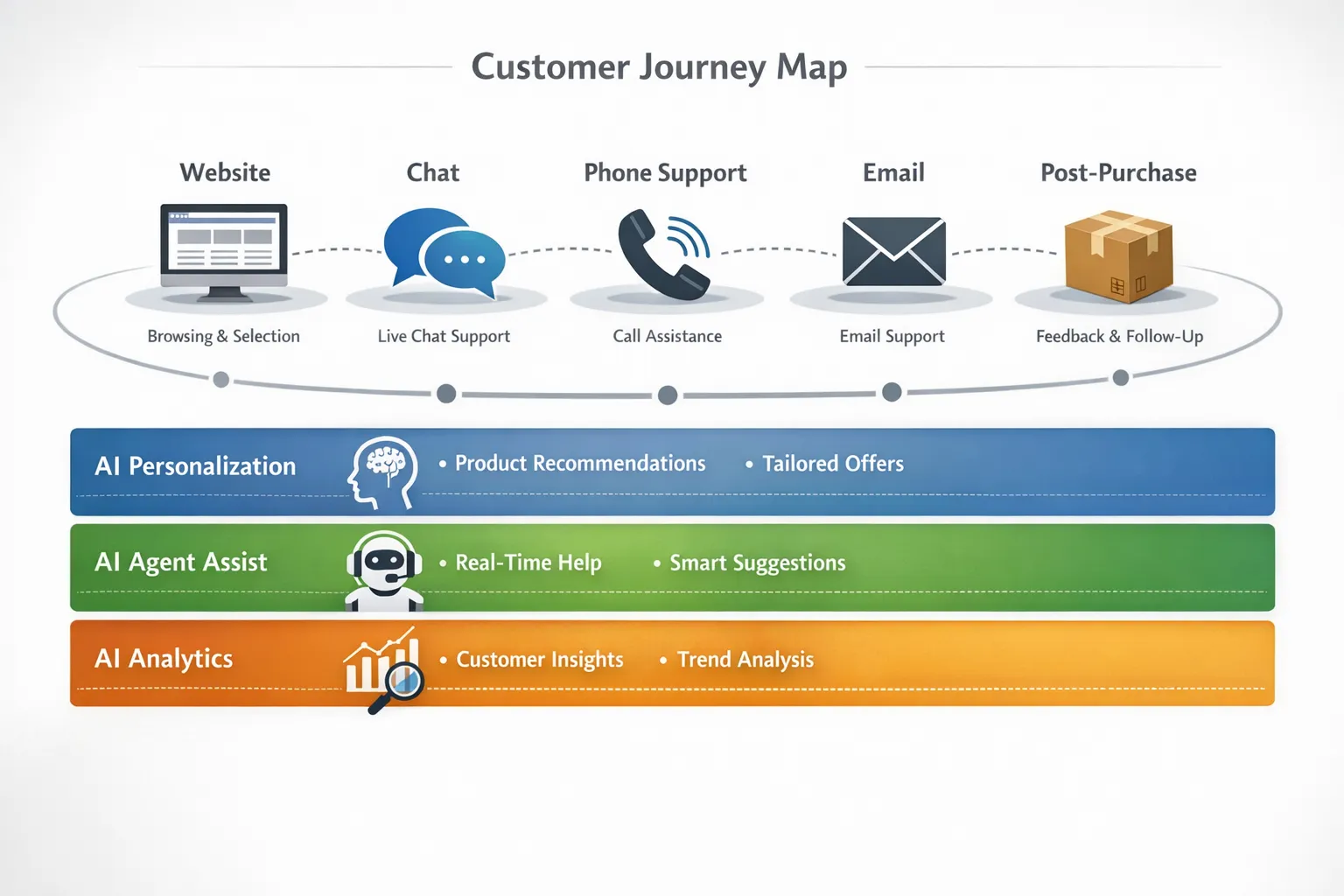
Where AI drives personalization across the customer journey
AI becomes practical in customer experience when it is mapped to concrete journey moments, not vague “AI transformation” goals. Below are common touchpoints where personalization can scale, along with what to measure and what to watch out for.
| Journey touchpoint | What AI can personalize | Typical approach | Key risk to manage | What to measure |
|---|---|---|---|---|
| Website and in-app | Content, navigation, offers | Recommendations, propensity models, personalization rules | “Creepy” targeting, overfitting | Conversion rate, bounce rate, time-to-value |
| Chat and messaging | Next-best response, triage, tone | Agent assist, retrieval from knowledge base, intent detection | Hallucinated answers, policy violations | First-contact resolution (FCR), containment rate, CSAT |
| Contact center | Prioritization, routing, coaching | Sentiment analysis, QA automation, agent guidance | Biased scoring, inconsistent coaching | AHT, QA scores, repeat contact |
| Sales conversations | Discovery prompts, objection handling | Conversation intelligence, guided playbooks | Over-scripted interactions | Win rate, cycle length, pipeline velocity |
| Post-purchase | Proactive help, usage nudges | Churn prediction, anomaly detection | False alarms, noisy outreach | Retention, product adoption, NPS |
| Service recovery | Tailored remediation offers | Case classification, policy-aware recommendations | Unfair outcomes, compliance risk | Escalation rate, resolution time, churn after incident |
The point is not to “AI everything.” The point is to pick moments where:
1) customers feel friction, 2) your team’s quality varies, 3) speed and consistency matter.
The foundation: data, consent, and context (before models)
The biggest reason personalization fails is not model quality. It is missing context, fragmented systems, and unclear permissioning.
Prioritize first-party data and usable signals
Personalization works best when it is grounded in signals you can explain and defend:
- Purchase and product usage history
- Support case history and outcomes
- Stated preferences (channels, frequency, topics)
- Behavioral signals (intent, pages viewed, time-in-product)
If your “single customer view” is mostly guesswork, AI will simply scale inconsistency faster.
Treat consent and transparency as features
Customer experience teams increasingly operate inside tight privacy expectations and regulations. Even when an experience is technically compliant, it can still feel invasive.
A useful rule: personalization should feel like help, not surveillance. If you cannot answer “why did we show this?” in one sentence, it is usually too far.
For practical guidance, the FTC’s business guidance is a helpful reference point for transparent data practices, and many organizations align internal policies accordingly.
Connect the “why” to the “now”
AI that personalizes well usually has access to “now” context, not just static profile data:
- Current goal (what the customer is trying to do)
- Current sentiment (confused, angry, ready to buy)
- Current constraints (budget, time, urgency)
This is why AI is especially powerful in conversations, because intent and emotion surface quickly when someone speaks or writes.
Scaling personalization also means scaling people (not just software)
Many teams invest in AI for customer-facing channels and forget the part that customers notice most: the human interaction.
Even with strong automation, customers still escalate to a person when:
- the issue is emotional or high-stakes,
- policies require discretion,
- multiple systems and edge cases collide.
So personalization at scale requires consistent human delivery across managers, reps, shifts, and regions.
This is where scenario-based practice becomes a force multiplier. If your team can rehearse real conversations (pricing pushback, service recovery, renewal risk, an angry customer who has already contacted support twice), then the “personalization layer” is not just your software. It is your people’s ability to respond with the right tone, questions, and next steps.
How AI roleplay training supports customer experience personalization
Personalization is a communication skill as much as it is a data problem. Teams need to reliably do things like:
- Ask better questions to uncover real intent
- Acknowledge emotion without escalating it
- Set expectations clearly (especially around policies and timelines)
- Handle objections while staying consultative
- Adapt language to the customer’s level of knowledge
Scenario IQ focuses on AI-powered roleplay simulations that help teams practice these moments using personalized scenarios, with real-time feedback and progress tracking analytics. That combination is particularly relevant for CX organizations because it makes coaching more consistent and less dependent on a single manager’s bandwidth.
Instead of hoping new hires learn “how we talk to customers here” by shadowing, AI roleplay can reinforce the standards you want at scale, and keep raising the bar for tenured reps through adaptive practice.
Examples of CX scenarios worth training (because they drive loyalty)
The highest-leverage scenarios are often the ones that feel “messy” in real life:
- A customer asks for a refund outside policy, and threatens to post online
- A customer is confused by pricing tiers and feels misled
- A handoff failed (sales promised something support cannot deliver)
- A high-value account shows early churn signals and asks for concessions
- A customer complains about long wait times and wants a supervisor
These are the interactions where personalization is not “recommend a product.” It is “respond in a way that preserves trust.”

What to measure: proving AI-driven personalization is working
To keep personalization from becoming a never-ending experiment, tie efforts to business outcomes and operational metrics. A balanced measurement approach usually includes:
- Customer outcomes (CSAT, NPS, sentiment, retention)
- Operational outcomes (FCR, AHT, cost per contact)
- Commercial outcomes (conversion, expansion, renewal)
- Risk outcomes (complaint rates, compliance issues, escalations)
Here is a practical way to align initiatives to KPIs.
| Initiative | Primary KPI | Secondary KPIs | Common measurement mistake |
|---|---|---|---|
| Personalized self-serve help | Containment rate | CSAT, recontact rate | Celebrating containment while CSAT drops |
| Agent assist for better responses | FCR | AHT, QA scores | Optimizing speed while quality declines |
| Next-best action for retention | Retention rate | Expansion, NPS | No holdout group, cannot prove lift |
| Personalized onboarding | Activation rate | Support contacts per user | Measuring clicks, not time-to-value |
| Scenario-based coaching for CX teams | QA score improvement | CSAT, escalations, adherence | Training volume tracked, not behavior change |
Two practical tips that prevent “vanity wins”:
- Use A/B testing or holdouts where possible (especially for proactive outreach and next-best action).
- Track distribution, not just averages. If personalization helps your best reps but confuses everyone else, the mean may hide the problem.
Common pitfalls (and how to avoid them)
AI in customer experience can backfire when it prioritizes automation over trust. These are the failure modes that show up most often.
Hallucinations and confident wrong answers
If AI is used to answer customers, it must be constrained by trusted sources. Many teams address this by grounding responses in an approved knowledge base and adding workflow rules for sensitive topics.
A good operational standard: if the system is not sure, it should ask a clarifying question or escalate, not improvise.
Inconsistent tone across channels
Customers notice when chat feels warm but email feels robotic, or when support is empathetic but billing is blunt. Tone inconsistency is often a training issue, not a tooling issue.
This is another area where practice helps: teams can rehearse the same scenario across chat, phone, and email so the brand voice stays consistent.
Bias and uneven outcomes
Personalization systems can unintentionally produce unfair treatment, such as giving better remediation only to customers who complain the loudest or sound a certain way.
Mitigations include:
- Auditing outcomes by segment
- Using policy-aware guardrails
- Requiring human review for high-impact decisions
“Creepy” personalization
If customers feel watched, personalization becomes a liability. Avoid using sensitive inferences unless they are necessary to deliver value and clearly consented to.
As Salesforce has highlighted in its customer research over the years, trust is a decisive factor in whether customers embrace personalized experiences (Salesforce State of the Connected Customer).
A practical rollout approach for personalization that scales
A manageable rollout typically looks like this:
- Start with one journey moment where friction is obvious (for example, repeat contacts, onboarding confusion, or a top objection in sales).
- Instrument the baseline (current CSAT, FCR, AHT, conversion, escalations).
- Add AI with guardrails (approved knowledge, escalation rules, compliance constraints).
- Train the team on the new behaviors so humans and automation reinforce each other.
- Review weekly, not quarterly with clear ownership (CX, ops, enablement, security).
In other words, scale the loop: detect friction, personalize response, measure impact, coach behaviors.
Bringing it together: AI + training is what makes personalization durable
AI can help you identify intent faster, recommend next steps, and keep experiences consistent. But the customers who stay are often the ones who felt understood during a high-stakes moment.
That is why the strongest customer experience strategies pair technology with behavior change. AI can power the personalization layer, and scenario-based practice can help your team deliver it consistently.
If you are building personalization that scales and you want the human side to scale too, you can explore Scenario IQ for AI-driven roleplay simulations, real-time feedback, and analytics that support team-wide performance improvements without relying solely on manual coaching.