

Customers want instant answers, not tickets. The right AI helpdesk setup deflects repetitive requests, speeds up resolution, and protects customer satisfaction. This guide walks you through a practical, low-risk implementation that reduces volumes while keeping the human touch where it matters most.
What “deflection” really means (and why customers should like it)
Deflection is not about hiding support. It is about guiding customers to the fastest correct outcome, ideally without waiting in a queue. In an AI helpdesk, you will track three related concepts:
- Deflection rate, the share of help-seeking sessions resolved via self-service instead of an agent
- Containment rate, the share of bot conversations handled end to end without a handoff
- First contact resolution, whether the issue was solved the first time, bot or human
Set these up so you never trade speed for accuracy. The goal is fewer tickets with equal or higher CSAT.
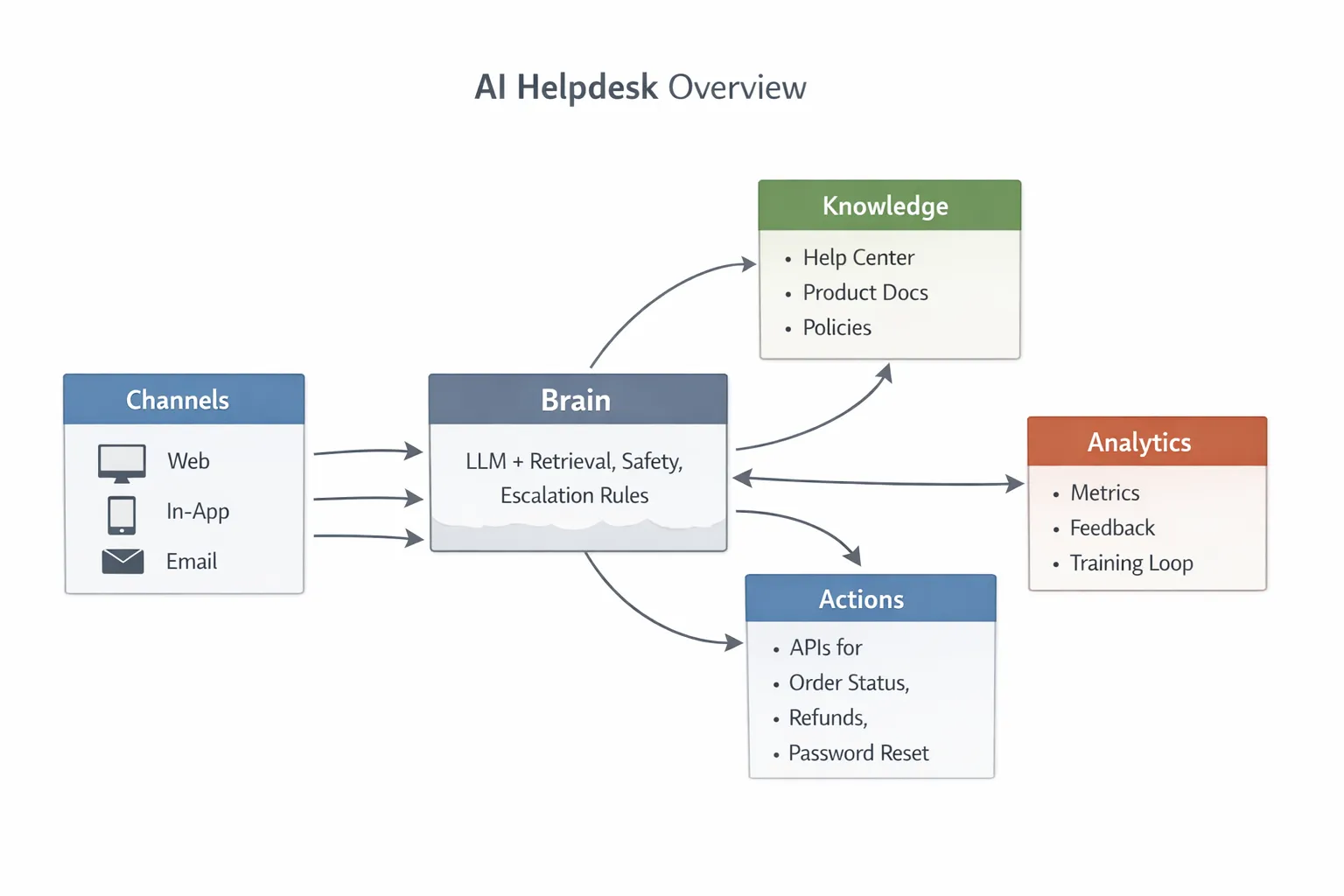
The blueprint for an AI helpdesk customers do not hate
To deliver fast and trustworthy answers, design around these building blocks:
- Channels, offer help where customers already are, web widget, in‑app, mobile, email triage, messaging
- Knowledge, a clean, structured knowledge base plus product docs, policy pages, and status pages
- Actions, secure API connections for common tasks like order lookup, cancellations, refunds, password resets
- Reasoning and guardrails, retrieval augmented generation for grounded answers, strong refusal and escalation rules for out‑of‑scope or high‑risk requests
- Identity and authentication, session-aware identity, OAuth or magic link for account-specific actions
- Analytics and feedback, instrumentation for deflection, CSAT, FCR, fallback reasons, and content gaps
Step-by-step setup to deflect tickets without hurting CSAT
- Identify high-volume intents with clear ROI, analyze the last 3 to 6 months of tickets, group by intent, and pick 5 to 10 that are repetitive, easy to automate, and safe.
- Make your knowledge base AI-ready, consolidate duplicate articles, add short summaries, include authoritative sources, and label versions and effective dates for policies.
- Design answer patterns for each intent, set success criteria, what the bot should achieve, the minimal data it needs, edge cases, and the exact handoff trigger when confidence is low.
- Wire up the top 3 to 5 actions securely, start with read-only, then progress to write actions. Use scoped API keys, per-intent permissions, and explicit confirmation prompts before irreversible steps.
- Configure retrieval and grounding, index only reviewed content, add citations in responses, and prefer links to canonical docs over long generated text.
- Set escalation rules and conversation checklists, define what information to collect before handoff, ID, order number, screenshots, and how to summarize context for agents.
- Pilot on a small cohort and A/B test, route a percentage of traffic to the bot on two or three intents, measure containment and CSAT, then iterate weekly.
- Roll out gradually and expand coverage, add 2 to 3 intents per sprint once metrics stabilize.
Response and tone playbook
Customers want clarity, options, and proof. Keep responses short, cite the source, and give a direct next step.
- Structure answers as headline, key steps, link to source, next action
- Offer alternatives when the bot is unsure, present two or three options with clear descriptions
- Use confirmations for high-impact actions, confirm details before proceeding
- Always include a handoff option with context, make it easy and fast to reach a human
Example microcopy for a refund policy request:
- Top line, You can request a refund within 30 days if the item is unused and in original packaging.
- Steps, Start a return in your account, choose reason, upload photo, receive label.
- Source, See Refund Policy, updated Oct 2025, linked.
- Next step, Do you want me to create the return label now or connect you to an agent?
Metrics that matter and how to instrument them
Good analytics make continuous improvement obvious. Track definitions consistently so teams can trust the numbers.
| Metric | What it tells you | How to calculate | Where to measure |
|---|---|---|---|
| Deflection rate | Share of help-seeking sessions resolved without an agent | Self-service resolved sessions divided by total help-seeking sessions | Web widget, help center, bot |
| Containment rate | Share of bot conversations completed end to end | Bot-resolved conversations divided by total bot conversations | Virtual agent |
| First contact resolution (FCR) | Effectiveness of first touch, bot or human | Issues resolved on first touch divided by total issues | Bot plus agent |
| CSAT | Customer satisfaction with the outcome | Percent positive responses to a short post-resolution survey | Bot plus agent |
| Average handle time (AHT) | Effort to resolve when escalated | Average agent time spent per case | Agent platform |
| Escalation rate | How often the bot hands off | Handoffs divided by total bot conversations | Virtual agent |
| Self-service resolution time | Speed of self-service | Median time from first message to resolution | Virtual agent |
| Article helpfulness | Knowledge quality | Useful votes or resolved after article divided by total article views | Help center |
| Bot fallback rate | Where the model is unsure | Responses that trigger fallback divided by total bot responses | Virtual agent |
Instrument these events from day one so you can link changes, new intents or new actions, to outcomes.
Keep customers happy while you deflect
- Give the fastest path, always show the one-tap action or the exact article section first, keep explanations secondary
- Be transparent about limitations, if you cannot do something, say it clearly and offer the fastest human route
- Confirm important details, repeat back email, order ID, dates to build trust
- Reduce re-entry pain, summarize the conversation and pass it to the agent so customers never repeat themselves
- Proactively notify, offer status updates or reminders when the next step takes time
- Respect privacy, ask only for the minimum data necessary, explain why it is needed
- Make it accessible and inclusive, support simple language, keyboard navigation, and localization where your customers need it
Train your team to complement the bot
Even a great AI helpdesk will escalate complex or sensitive cases. The difference between a smooth or frustrating handoff is how well your people handle edge cases, policy nuances, and emotions.
Scenario IQ helps you prepare agents for that moment with:
- AI-powered roleplay simulations that mirror your top intents and escalation scenarios
- Personalized training scenarios that adapt to skill level and industry context
- Real-time feedback on clarity, empathy, and policy adherence
- Progress tracking analytics and performance metric dashboards to measure improvement over time
- Team-focused learning with daily actionable tips and adaptive guidance that reinforce good habits
- Enterprise-grade security so training scenarios respect your compliance standards
Use Scenario IQ to rehearse high-stakes handoffs, new policy rollouts, and crisis communications, so the human side of your helpdesk is as strong as the automation. Learn more at Scenario IQ.

Industry-specific considerations
Regulated or complex workflows need extra care in design and data access.
- Travel and payments, support must understand vouchers, virtual cards, and reconciliation. If you run a travel marketplace or agency, align your bot and backend with your payment stack. For example, a specialized travel payment platform like Elia Pay centralizes methods such as CB, SEPA, and virtual cards and focuses on fraud prevention and accounting reconciliation. Your AI helpdesk should know what data it can read or write, and when to route to a human for payment disputes.
- Healthcare, enforce consent and privacy by design. Keep protected health information out of prompts unless the session is authenticated and consented. Always log disclosures and escalate clinical advice.
- Fintech, apply strict refusal rules for personalized financial advice and prevent irreversible transactions without explicit confirmations and multi-factor checks.
- SaaS and B2B, prioritize entitlement-aware answers. For example, renewal terms or feature availability should be gated by account plan and region.
Security, privacy, and governance checklist
- Use least-privilege credentials for every action the bot can take
- Redact PII in logs by default and restrict transcript access by role
- Keep a clear source-of-truth index, only approved and versioned documents feed retrieval
- Implement safety rails, refusal policies for legal, medical, and financial advice and for out-of-scope questions
- Audit all write actions, include who, when, and what changed with a link to the conversation
- Offer easy human override, agents must be able to stop or reverse bot actions where possible
A pragmatic 90-day roadmap
- Days 0 to 30, stand up the stack for 3 intents, password reset, order status, refund status, instrument metrics, and run a limited pilot with clear success thresholds.
- Days 31 to 60, add 3 to 5 more intents and the first write action, for example cancel order. Launch help center improvements based on content gaps discovered in bot fallbacks.
- Days 61 to 90, scale coverage to 60 to 70 percent of inbound volume, tune escalation summaries, and formalize a weekly improvement ritual, review metrics, add content, improve prompts, and refresh training scenarios in Scenario IQ.
Common pitfalls to avoid
- Pushing the bot live without clean knowledge, garbage in means confused answers
- Letting the model guess account data, never hallucinate sensitive fields
- Over-optimizing for containment, you may reduce escalations but hurt FCR and CSAT if the bot resists handoff
- Ignoring tone and microcopy, small wording changes often double completion rates
- Treating success as static, intents, policies, and product changes will drift unless you update the bot and retrain people
Bringing it all together
An effective AI helpdesk balances automation and empathy. Start with a narrow intent set, ground responses in verified content, secure the few actions that matter, and instrument everything. Deflection follows naturally when customers can complete tasks faster than opening a ticket, and CSAT rises when escalation is effortless and agents are prepared.
If you want your team to shine at the moments the bot hands off, rehearse those conversations before and after go-live. Scenario IQ provides AI-powered roleplay simulations, personalized scenarios, real-time feedback, and analytics so your service organization builds confidence and consistency where it counts. Explore how it works at Scenario IQ.