
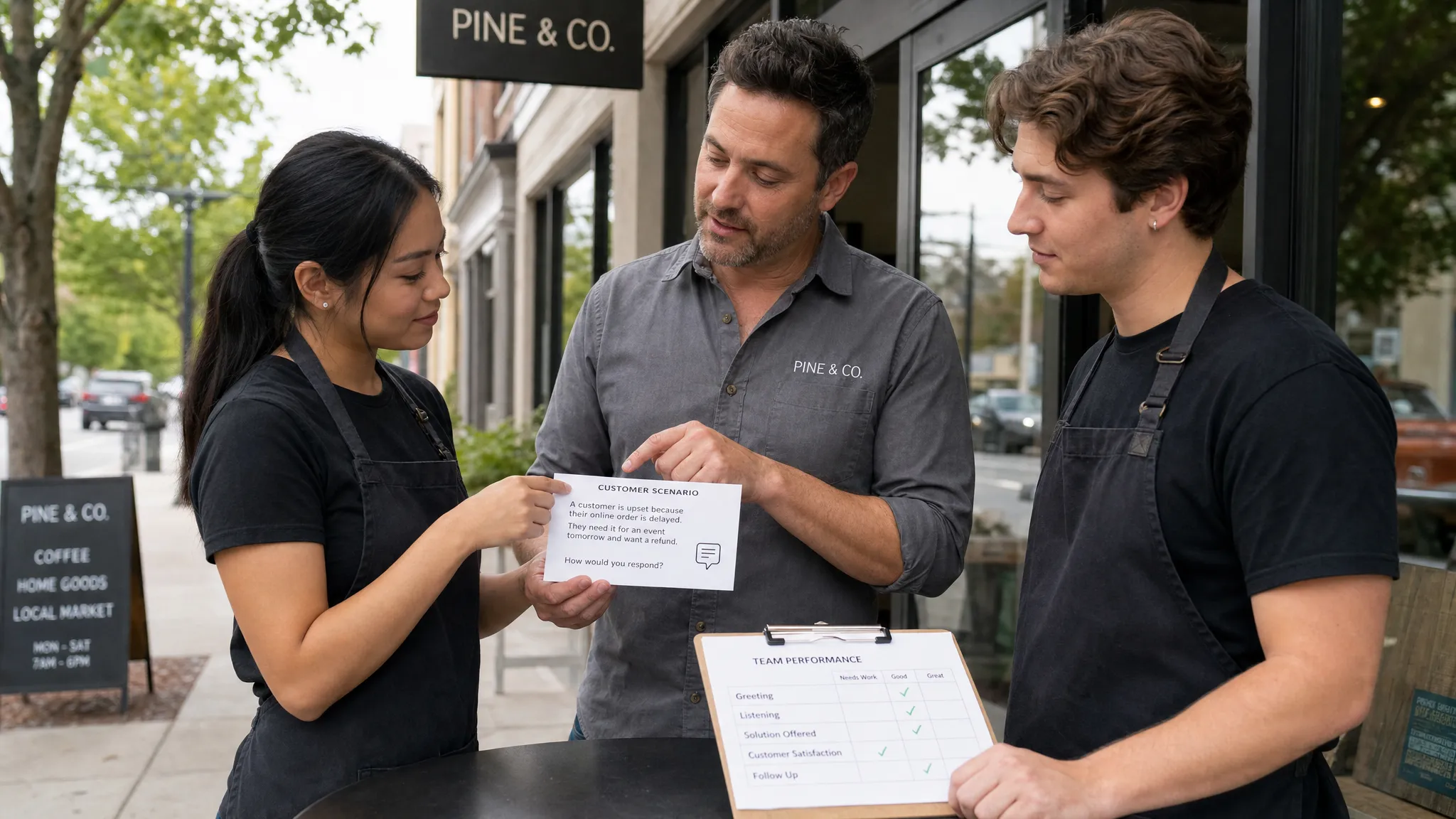
Small businesses often feel the training squeeze first. New hires need to get productive quickly, customer expectations keep rising, and managers rarely have hours each week to run practice sessions. That is why interest in AI for small businesses is moving beyond marketing automation and bookkeeping. For many teams, the most practical use case is better training.
The challenge is not that small businesses do not care about development. It is that traditional training is difficult to scale. A manager explains the process once, a rep shadows a senior teammate, a service agent learns from real customer calls, and everyone hopes the lessons stick. The result is often inconsistent performance, uneven confidence, and avoidable mistakes in live conversations.
AI-powered team training changes that pattern. Instead of saving practice for occasional workshops, employees can rehearse realistic conversations, receive immediate feedback, and build skills in short sessions that fit around daily work.
Why team training is harder for small businesses
Large companies can dedicate teams to enablement, learning design, coaching, and quality assurance. Small businesses usually cannot. Training is often handled by the founder, a department lead, or the strongest employee on the team. That can work early on, but it becomes fragile as the business grows.
The most common training gaps show up in everyday moments:
- New employees learn different answers depending on who trained them.
- Sales reps struggle with objections they have heard before but never practiced.
- Customer service staff know the policy, but freeze when a customer is upset.
- Managers coach based on memory, not objective performance patterns.
- Experienced employees become the bottleneck for onboarding and support.
The U.S. Small Business Administration emphasizes the importance of clear employee expectations and ongoing management practices. In reality, small business leaders need a way to make those expectations repeatable without turning every manager into a full-time trainer.
That is where AI training tools can be useful. The goal is not to replace the human judgment of a manager. The goal is to give every team member more chances to practice the conversations that matter before they have them with real customers.
What AI-powered team training actually does
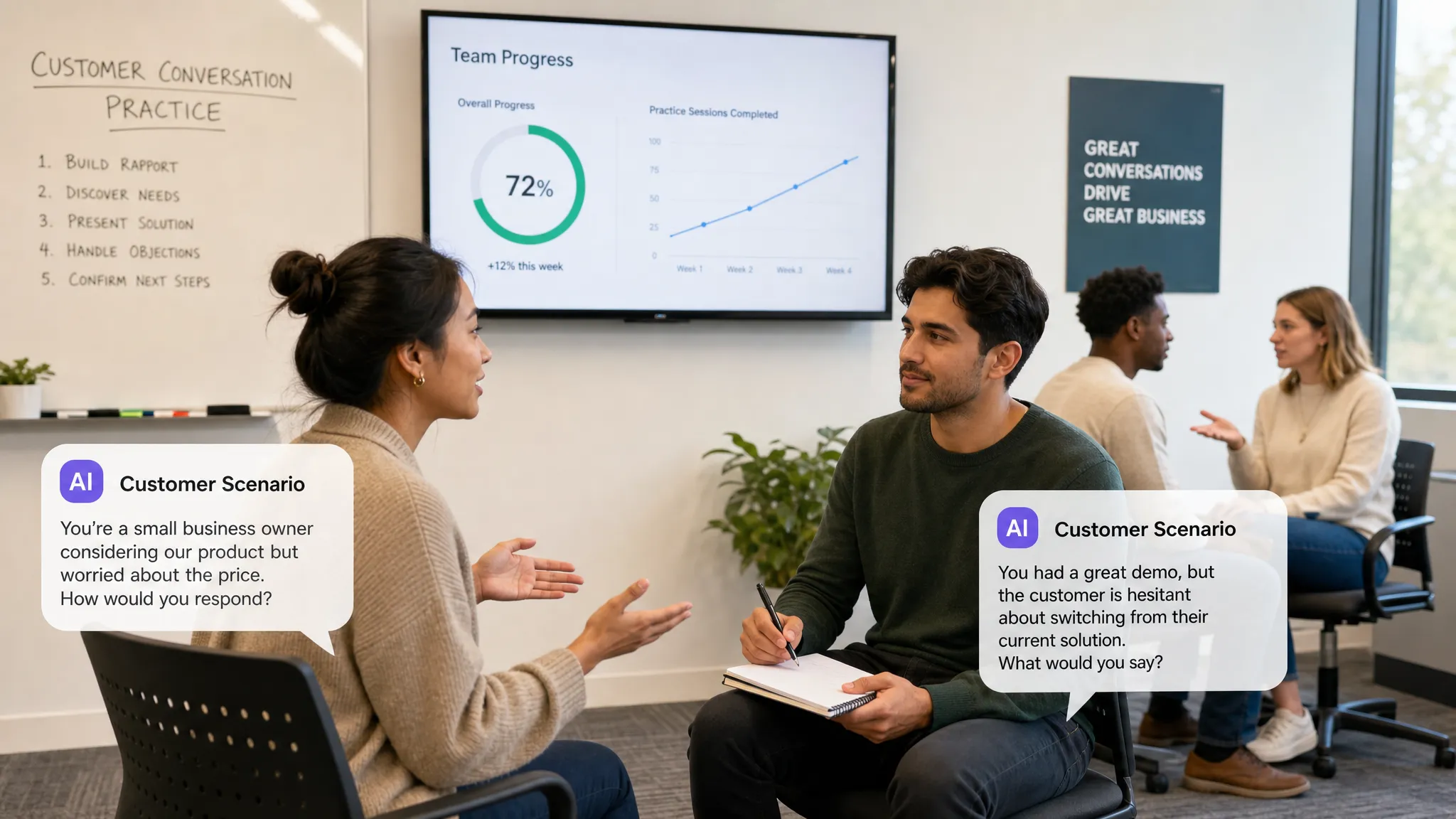
AI training is sometimes misunderstood as a library of generic courses. For small teams, the more valuable model is scenario-based practice. Employees interact with a simulated customer, prospect, teammate, or stakeholder. The AI responds dynamically, asks follow-up questions, raises objections, and adapts based on what the employee says.
In a sales environment, that might mean practicing a price objection, a competitor comparison, or a discovery call with a skeptical buyer. In a service environment, it might mean handling a refund request, calming an angry customer, or explaining a policy clearly. In operations, it could involve conflict resolution, shift handoffs, or manager feedback conversations.
AI roleplay is especially helpful because it creates a safe space for repetition. Employees can try, make mistakes, improve, and try again without risking a deal, a review, or a customer relationship.
Scenario IQ, for example, supports AI-powered roleplay simulations, personalized training scenarios, real-time feedback, adaptive guidance, progress tracking analytics, team-focused learning, customizable skill levels, daily actionable tips, performance metric dashboards, and enterprise-grade security. For a small business, that means training can become more consistent without requiring a large enablement department.
Where AI for small businesses can improve training first
The best place to start is not with every training topic. Start with the conversations that directly affect revenue, customer satisfaction, retention, or operational consistency. AI works best when the scenario has a clear context, a desired behavior, and a way to evaluate the response.
| Team area | Example AI training scenario | Skill being developed |
|---|---|---|
| Sales | A prospect says the price is too high after a demo | Objection handling and value articulation |
| Customer service | A frustrated customer wants an exception to policy | Empathy, de-escalation, and clear communication |
| Retail | A shopper is browsing but hesitant to buy | Needs discovery and helpful product guidance |
| Home services | A customer questions a quote or timeline | Trust building and expectation setting |
| Onboarding | A new hire practices explaining the company offer | Message consistency and confidence |
| Management | A supervisor gives feedback after a missed target | Coaching, clarity, and accountability |
This is why AI training can be more practical than a one-time workshop. A workshop may introduce the right technique, but a simulated scenario helps employees use it under pressure. The difference matters because real conversations rarely follow a script.
From knowledge transfer to behavior change
Many training programs fail because they stop at information. Employees read a document, watch a video, or attend a meeting. They understand the concept, but they have not practiced the behavior enough to use it naturally.
Scenario-based AI training is built around active practice. A rep does not just learn that they should ask better discovery questions. They practice asking them. A service agent does not just read that they should acknowledge the customer's frustration. They rehearse saying it in a calm, specific way.
This matters for small businesses because customer experience is often personal. One awkward conversation can cost a relationship. One well-handled objection can save a deal. One confident new hire can reduce pressure on the rest of the team.
The most effective AI training programs usually combine three elements: realistic scenarios, immediate feedback, and manager follow-up. AI can identify patterns, such as missed discovery questions or unclear explanations. Managers can then reinforce the most important behaviors in team meetings, one-on-ones, and real-world coaching.
How to choose AI training tools for a small business
Small businesses do not need the most complex AI system on the market. They need tools that solve real training problems, are easy to roll out, and help managers see whether employees are improving.
Look for AI training software that supports the way your team actually works. If your biggest challenge is sales confidence, prioritize roleplay for discovery, objection handling, and closing conversations. If your biggest challenge is customer service consistency, prioritize de-escalation, policy explanation, and escalation practice. If you are onboarding new staff, focus on company messaging, common customer questions, and baseline communication skills.
A useful evaluation framework looks like this:
| Selection factor | Why it matters for small businesses | What to look for |
|---|---|---|
| Scenario realism | Generic practice does not prepare people for real customers | Customizable scenarios based on your products, policies, and customer types |
| Feedback quality | Employees need to know exactly what to improve | Real-time feedback, adaptive guidance, and clear next steps |
| Ease of use | Managers do not have time for complex administration | Simple setup, repeatable workflows, and team-friendly learning paths |
| Skill levels | New hires and experienced employees need different challenges | Customizable difficulty and role-specific practice |
| Progress visibility | Leaders need to know if training is working | Analytics, dashboards, and performance tracking |
| Security | Training may involve sensitive internal processes | Strong data protection and enterprise-grade security practices |
AI adoption should also include basic governance. The NIST AI Risk Management Framework is a useful reference for thinking about trustworthy AI, including risk management, transparency, and responsible use. Even small businesses benefit from clear rules about what information employees should enter into AI tools and who can access performance data.
A practical rollout plan for AI team training
The biggest mistake is trying to automate the entire training program at once. A better approach is to pick one high-impact use case, prove value, then expand.
| Rollout stage | What to do | Success signal |
|---|---|---|
| Week 1 | Identify one recurring conversation that causes lost sales, escalations, or manager intervention | The team agrees this scenario is worth practicing |
| Week 2 | Build or select a realistic AI roleplay scenario for that conversation | Employees recognize the situation as realistic |
| Week 3 | Ask each team member to complete short practice sessions and review feedback | Participation is high and feedback is specific |
| Week 4 | Review performance patterns, update coaching, and refine the scenario | Managers can identify improvement areas and next steps |
For example, a small B2B company might start with price objections. The first scenario could involve a prospect who likes the solution but says the budget is too tight. The AI can challenge the rep, ask for justification, compare alternatives, and evaluate whether the rep connects price to business value.
A service team might start with refund conversations. The AI can simulate different emotional states, from confused to angry, and coach employees on empathy, clarity, and policy explanation.
The key is to keep each scenario focused. A single roleplay should not try to teach every skill at once. It should develop one or two behaviors that matter in real conversations.
Measuring whether AI training is working
Small businesses need practical measurement. You do not need a complex learning analytics model to know whether training is improving. You need a baseline, a few focused metrics, and a regular review rhythm.
Start by asking what business outcome the training should support. Better sales conversations may connect to conversion rate, average deal size, or follow-up quality. Better service conversations may connect to customer satisfaction, escalation rate, or first-contact resolution. Better onboarding may connect to time to productivity and manager confidence.
| Metric | What it tells you | How to use it |
|---|---|---|
| Scenario completion rate | Whether employees are actually practicing | Track adoption and remove barriers |
| Feedback themes | Which skills need more coaching | Use patterns to guide manager follow-up |
| Confidence score | How prepared employees feel before live conversations | Compare self-assessment before and after practice |
| Manager review notes | Whether behavior is changing on the job | Connect AI practice to real performance observations |
| Business outcome trend | Whether training supports the larger goal | Compare against a baseline over time |
Be careful not to overclaim causation too quickly. If revenue improves after training, AI practice may be one factor among many. The strongest approach is to connect roleplay data, manager observations, and business outcomes over time.
This is where performance metric dashboards and progress tracking analytics can help. They give leaders a clearer view of who is practicing, where the team is improving, and which skills still need attention.
Keeping the human element in AI training
AI is most powerful when it supports human coaching, not when it replaces it. Small businesses often win because they know their customers personally, care deeply about service, and adapt quickly. AI training should preserve that advantage.
Managers should still define what good looks like. They should review feedback themes, listen to employee concerns, and adjust scenarios as the business changes. If a new competitor enters the market, create a competitor objection scenario. If customers are confused by a policy change, create a service explanation scenario. If new hires are struggling to explain the offer, create a messaging scenario.
The human role is also essential for context. AI can evaluate clarity, structure, tone, and completeness, but leaders know the company's values, customer promise, and commercial priorities. The best training programs combine AI repetition with manager judgment.
Common mistakes to avoid
The first mistake is using generic scenarios that do not reflect your real customers. Employees quickly disengage when practice feels artificial. Use actual objections, common customer questions, and realistic emotional dynamics.
The second mistake is treating AI training as a one-time onboarding tool. It is useful for onboarding, but it is also valuable for continuous improvement. Top performers can practice advanced scenarios, managers can prepare for difficult feedback conversations, and service teams can rehearse new policies before they go live.
The third mistake is measuring only activity. Completion matters, but quality matters more. A team can finish every module and still struggle if feedback is not reviewed, scenarios are not updated, and managers do not reinforce better behaviors.
Finally, avoid using AI training without clear expectations. Employees should understand why they are practicing, how feedback will be used, and what improvement looks like. When the purpose is development rather than surveillance, adoption is usually stronger.
Frequently Asked Questions
Is AI for small businesses affordable enough for team training? It can be, especially when you start with a focused use case instead of trying to replace every training process. The value depends on the time saved, consistency gained, and performance improvements you can measure.
Can AI roleplay help a small sales team close more deals? AI roleplay can help reps practice discovery, objection handling, follow-up, and closing conversations before speaking with real prospects. It does not guarantee more revenue, but it can improve readiness and confidence in moments that affect deals.
Will employees feel judged by AI training? They might if the rollout is unclear. Position AI training as practice and coaching, not surveillance. Explain how feedback will be used, focus on skill growth, and have managers reinforce improvements constructively.
What team should use AI training first? Start with the team that has frequent, high-impact conversations. For many small businesses, that is sales or customer service. Choose the area where better communication can quickly improve revenue, retention, or customer satisfaction.
How often should employees practice with AI scenarios? Short, regular sessions are usually better than occasional long sessions. A few focused practices each week can help employees build muscle memory without disrupting daily work.
Build a stronger team without adding training overhead
Small businesses need training that is practical, repeatable, and connected to real performance. AI can help by giving every employee more opportunities to practice the conversations that shape customer trust, sales outcomes, and service quality.
Scenario IQ is built for AI-driven, scenario-based training with roleplay simulations, personalized scenarios, real-time feedback, adaptive guidance, analytics, and team-focused learning. If your team needs more confidence in customer conversations, sales calls, or service interactions, AI training can help you move from occasional coaching to continuous skill development.