

Most small businesses don’t have a “marketing department”, they have a person (often the owner) juggling content, email, social, reviews, and lead follow-up between customer calls. AI for small business marketing is powerful because it can remove the busywork: drafting, summarizing, repurposing, and improving what you already do, without adding headcount.
This guide focuses on quick wins you can implement this week on a small budget, plus simple ways to measure whether each win is actually working.
What “AI for small business marketing” should mean (on a tight budget)
If budget is limited, AI should do one of three jobs:
- Increase output (create more usable drafts and variations)
- Increase quality (clearer positioning, better calls to action, fewer mistakes)
- Increase speed (shorten the time from idea to published asset)
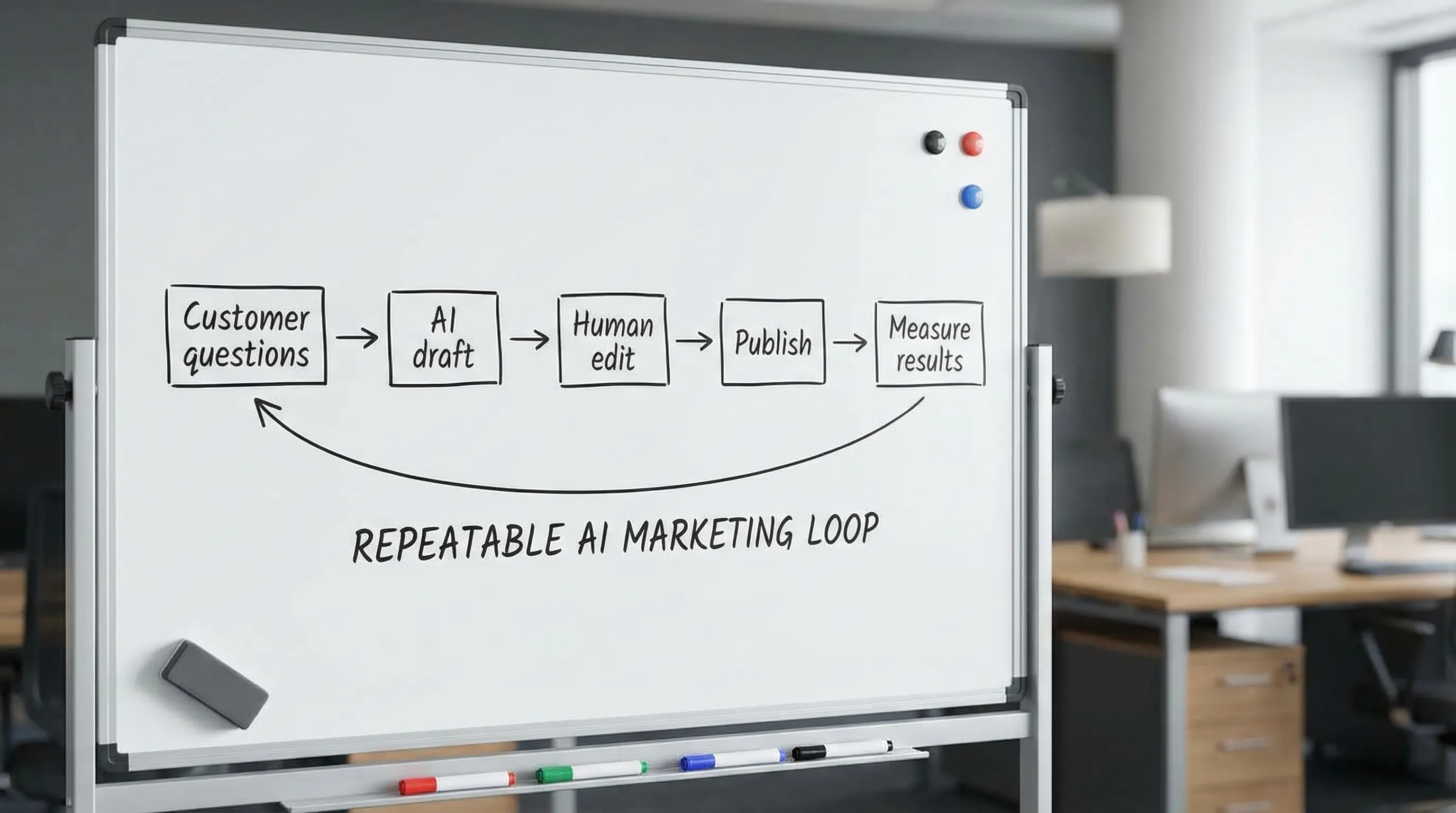
The best small-business use cases are rarely “replace your whole marketing strategy.” They are repeatable micro-workflows like: turning a customer question into a FAQ-style post, turning a blog into 10 social captions, or turning call notes into a follow-up email.
A quick reality check on risk
Generative AI can confidently produce incorrect details (“hallucinations”). Treat it like a fast junior assistant:
- You provide the facts, offers, prices, policies, and constraints
- It proposes structure, copy, variations, and improvements
- You approve, edit, and publish
For guidance on responsible use, the NIST AI Risk Management Framework is a practical reference, even for small teams.
Quick win #1: Turn customer conversations into a month of content
Your best marketing copy is already in your inbox, DMs, and sales calls.
Workflow (30 to 60 minutes):
1) Gather 10 to 20 real customer questions or objections (email, chat, reviews, call notes). Remove personal data.
2) Paste them into an AI tool and ask it to: - Cluster them into themes - Identify the language customers use - Suggest content angles for each theme
Prompt you can copy:
“Here are customer questions and objections. Group them into 5 to 7 themes. For each theme: (1) summarize the underlying concern, (2) list the exact customer phrases worth quoting, (3) propose 3 content ideas: a short social post, an email, and a blog outline. Keep it specific to my business.”
Why it works: you stop guessing what to post and start answering what people already ask.
Metric to watch: replies, saves, time-on-page, and “contact us” clicks from those pages.
Quick win #2: Fix your homepage message in 20 minutes
Small businesses often lose leads because the website is unclear, not because the offer is bad.
What to do: paste your current homepage hero section (headline, subhead, bullets, call-to-action) and ask AI to generate 5 tighter options.
Prompt:
“Rewrite this homepage hero for a small business. Requirements: 1 clear outcome, 1 specific audience, 1 differentiator, 1 call-to-action. Avoid hype. Keep headline under 10 words. Provide 5 versions.”
Then, validate quickly:
- Read it to someone who doesn’t know your business
- Ask: “What do we do, who is it for, and what should I do next?”
If they can’t answer in 10 seconds, iterate.
Metric to watch: conversion rate on your main CTA (book, call, quote, trial).
Quick win #3: Repurpose one good piece into five formats (without sounding robotic)
You don’t need to “create more content.” You need to reuse the few things that already work.
Take your best-performing:
- Blog post
- Case study
- Webinar or short video
Ask AI to generate:
- 5 social captions in your brand voice
- 2 short emails (one educational, one promotional)
- A Google Business Profile post
- A simple one-page checklist
Make it sound like you:
Before generating, provide a “voice card”:
- 3 adjectives (for example: direct, friendly, practical)
- Words you never use (for example: “revolutionary,” “game-changing”)
- 2 examples of past writing you like
Metric to watch: output speed (hours saved) plus engagement rate by format.

Quick win #4: Local SEO improvements that cost $0
If you serve a local area, the cheapest marketing channel is often your existing presence.
Google Business Profile: upgrade the basics
Use AI to draft:
- A tighter business description
- Service descriptions written in customer language
- A weekly posting calendar (1 post per week is enough)
Then implement it in your Google Business Profile.
Review replies that build trust
Replying to reviews improves conversion even if it doesn’t directly “rank” you.
Prompt:
“Write 3 reply options to this review in a warm, professional tone. Keep under 70 words. Mention one specific detail from the review, thank them, and invite them back. No discounts.”
Metric to watch: calls, direction requests, website clicks, and conversion rate from local traffic.
Quick win #5: Write higher-performing emails (without becoming spammy)
Email is still one of the highest ROI channels because you’re speaking to people who already know you.
Use AI for:
- Subject line variations (10 options)
- A clearer structure (hook, value, proof, CTA)
- Personalization tokens (industry, use case, location)
A simple email structure that converts:
- First line: the customer situation
- Middle: one useful tip (or one strong proof point)
- CTA: one action
If you need deliverability guidance, Mailchimp’s general best practices are a solid baseline: Email marketing field guide.
Metric to watch: reply rate (often a better quality signal than opens), click-through rate, and downstream conversions.
Quick win #6: Make your ads cheaper by improving the landing page, not the targeting
When budgets are small, you can’t afford leaky landing pages.
Ask AI to critique your landing page against:
- Clarity (what is this and who is it for?)
- Proof (testimonials, guarantees, case results, reviews)
- Friction (too many fields, unclear pricing, confusing steps)
- Match (does the page match the ad promise?)
Prompt:
“Act as a conversion copywriter. Critique this landing page for message match, clarity, trust, and friction. Then propose 10 specific edits ranked by expected impact. Do not invent claims.”
Metric to watch: cost per lead and lead-to-customer rate (not just clicks).
Quick win #7: Build a simple “content brief” generator to keep quality consistent
Small teams struggle with consistency. AI can standardize your inputs so each piece is easier to publish.
Create a reusable template that includes:
- Target customer (role, context, pain)
- One primary takeaway
- Offer mention (optional, subtle)
- Proof available (testimonial, numbers you can verify)
- CTA
Then have AI generate briefs for each topic.
This prevents the common failure mode: random posts that sound fine but don’t connect to your offer.
Metric to watch: time from idea to publish, and how often content is reused in sales conversations.
Quick win #8: Upgrade your follow-up speed with AI-assisted responses
Many small businesses lose deals because they respond too slowly, not because the offer is wrong.
Use AI to draft:
- First-response templates for common inquiries
- Quote follow-ups
- “Nudge” emails after no response
Guardrail: Never allow AI to send messages without human review if it might:
- Commit to pricing
- Promise delivery times
- Reference sensitive customer data
Metric to watch: response time and appointment set rate.
Quick win #9: Practice objection handling (so marketing leads actually convert)
Marketing doesn’t fail in the ad account, it often fails in the handoff: the lead arrives, then the team hesitates, misses key questions, or fumbles objections.
This is where roleplay training can create an outsized impact on a small budget.
With Scenario IQ, teams can use AI-powered roleplay simulations and personalised training scenarios to practice real conversations, get real-time feedback, and track improvement via progress analytics. Instead of hoping people “pick it up,” you can rehearse:
- Price objections
- Competitive comparisons
- “Need to think about it” stalls
- Upsell and cross-sell moments
If your marketing is generating leads but close rates are inconsistent, improving sales and service conversations is one of the fastest ways to lift ROI without spending more on ads.
Metric to watch: lead-to-meeting rate, close rate, and time-to-first-response.
Quick win #10: Set up a tiny measurement system (so you don’t fool yourself)
AI makes it easy to ship more. Your job is to ship more of what works.
Use a simple scorecard and review it weekly. Tools like Google Analytics and Google Search Console are free and enough for most small businesses.
Here’s a practical way to map quick wins to measurable outcomes:
| Quick win | Typical time to implement | Typical cost | Primary metric | Secondary metric |
|---|---|---|---|---|
| Turn customer questions into content | 1 to 2 hours | $0 to low | Leads from content | Engagement (saves, time) |
| Homepage message refresh | 30 to 60 min | $0 | CTA conversion rate | Bounce rate |
| Repurpose 1 asset into 5 formats | 1 to 2 hours | $0 to low | Output per week | Engagement rate |
| Google Business Profile upgrade | 1 hour | $0 | Calls, clicks | Review volume |
| Email improvement | 1 hour per campaign | $0 to low | Reply rate | Click-through |
| Landing page improvements | 2 to 4 hours | $0 to low | Cost per lead | Lead-to-customer |
| Follow-up templates | 1 to 2 hours | $0 to low | Response time | Appointment rate |
| Objection-handling practice | Ongoing weekly | Varies | Close rate | Confidence scores (internal) |
A 7-day “small budget” implementation plan
If you want momentum, do this in one week:
Day 1: Collect inputs
Gather:
- Top 20 customer questions
- Top 10 objections
- 3 examples of your best past copy
- Your current offers and constraints (pricing, regions, policies)
Day 2: Fix the homepage hero and one key landing page
Make clarity improvements first. Avoid new designs, just tighten messaging and proof.
Day 3: Create one “pillar” piece and repurpose it
Publish one strong post or guide. Repurpose into emails and social.
Day 4: Upgrade Google Business Profile and review replies
Tight description, add a post, draft reply templates.
Day 5: Improve one email campaign
Rewrite subject lines and the first 3 lines. Add one clear CTA.
Day 6: Speed up response and follow-up
Draft templates for the most common inquiries. Add a short internal checklist.
Day 7: Train the conversation
Run a 30-minute roleplay session on your top objection, then apply insights back into your landing page and email copy.
Common mistakes to avoid (so AI helps instead of hurting)
Letting AI invent specifics
Always provide your real:
- Pricing rules
- Availability
- Guarantees
- Case study details
If you don’t have proof for a claim, don’t publish it.
Publishing without a brand filter
Your voice is an asset. Give AI a style guide (even a short one) and edit for tone.
Measuring vanity metrics only
Views and likes can be fine early signals, but the business metrics that matter are:
- Qualified leads
- Response time
- Appointments
- Close rate
- Revenue per customer
The bottom line
AI for small business marketing is not about doing everything. It’s about doing the few repeatable things that compound: clearer messaging, faster content production, better follow-up, and better conversations when leads come in.
If you pick just 2 to 3 quick wins from this list and track one metric per win, you’ll build a system that improves every month, even on a small budget.
If you want to increase conversion once leads arrive, explore how Scenario IQ supports sales and service teams with AI roleplay simulations, real-time feedback, and progress tracking, so your marketing effort translates into closed deals and better customer experiences.