

Revenue teams have more data, more channels, and more pressure than ever. AI can remove the grunt work from prospecting, but results come from a well designed workflow, clean inputs, and reps who know how to start confident conversations. Here is a practical guide to using AI for sales prospecting from list building to outreach, with concrete steps, metrics, and coaching tips you can put to work this quarter.
What “AI for sales prospecting” actually means
AI is not one tool, it is a set of capabilities that map to each step of prospecting:
- Define and refine an Ideal Customer Profile with real buying signals
- Build and clean lists from multiple data sources
- Enrich accounts and contacts with relevant context
- Score and prioritize who to reach first
- Generate and personalize first touch messaging
- Orchestrate multichannel sequences and timing
- Measure outcomes and learn what to do next
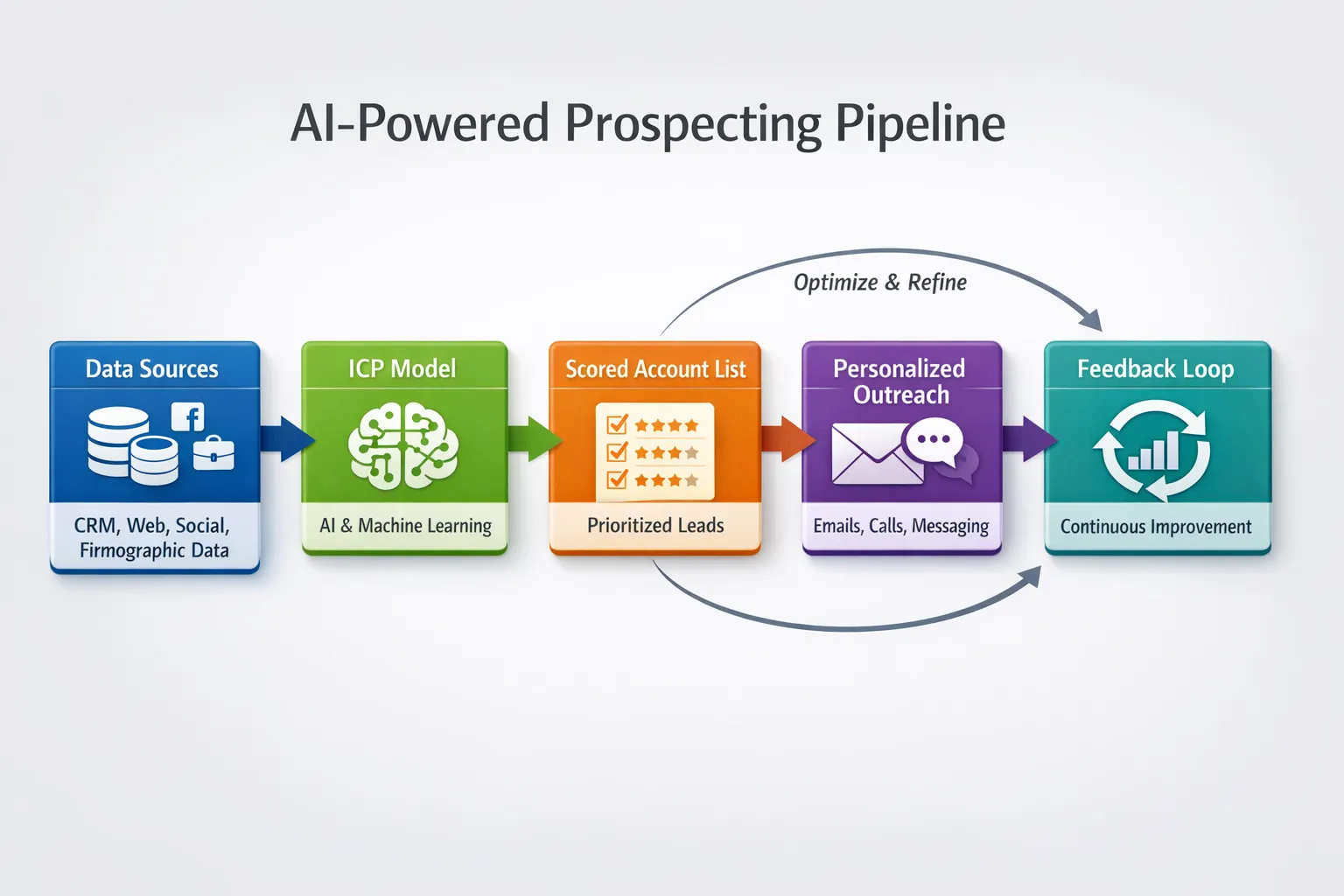
The goal is simple, spend more time with the right people, arrive with relevant value, book more qualified meetings.
Stage 1: ICP 2.0, build your model with signals, not opinions
Most teams define an ICP with firmographics only, for example industry, size, region. AI lets you enrich that view with behavioral and change signals so your lists reflect who is actually in market.
Start with these inputs:
- Firmographic fit, industry, employee count, revenue band, geography
- Technographic stack, systems that increase or decrease the need for your solution
- Trigger events, leadership hires, funding, product launches, expansion, compliance deadlines
- Intent and engagement, content interactions, partner referrals, community chatter, events
- Negative signals, reasons to deprioritize even if fit looks good
Use AI to mine public data for triggers, classify accounts by similarity to your best customers, and propose positive or negative signals to test. Keep it human in the loop, sales leaders should approve the signal definitions and revisit them monthly.
Stage 2: List building that stays clean
AI accelerates the tedious parts of list creation, but data hygiene matters more than speed. Consolidate accounts and contacts from your CRM, marketing automation, data providers, product telemetry, events, and partner lists. Use AI to standardize company names, deduplicate contacts, and flag low quality entries, for example personal emails on corporate accounts, missing job titles, invalid countries.
If you sell into regulated markets, your list building practices should reflect how those industries think about data accuracy, privacy, and automation. For a cross industry perspective, see how artificial intelligence is reshaping the health insurance sector, including fraud detection, data security, and claims automation. This illustrates why disciplined data handling improves both compliance and business outcomes. Read more about how artificial intelligence is reshaping the health insurance sector for context.
Compliance quick check, confirm opt in or permissible use under applicable laws, maintain an up to date suppression list, and log the source of every contact.
Stage 3: Research and enrichment that actually helps a conversation
AI can summarize a prospect’s digital footprint in seconds. Keep the output short and actionable so a rep can use it in a first touch.
Aim for five research snippets per account:
- One sentence problem hypothesis tied to your value
- One recent trigger event with source
- One relevant metric you help improve, framed in their language
- One proof point, customer in a similar industry or size
- One question that invites dialogue, not a pitch
At the contact level, capture role, responsibilities, and a short reason they would care. Avoid invasive personalization, be relevant to the business change that matters to them.
Stage 4: Scoring and prioritization, from hunches to ranked queues
A simple, transparent approach wins. Create a composite score that blends fit, intent, and recency. Use weights that reflect your sales motion, for example recency matters more in event driven outbound, fit matters more in account based plays.
Define three bands for execution:
- A, top tier, immediate action, multichannel sequence and a call
- B, good fit or moderate intent, email plus social and nurture
- C, low fit or no signal, nurture only or recycle
AI can maintain the score as new signals arrive, but your reps should be able to explain why an account ranked high. If they cannot, simplify the model.
Stage 5: Personalization that converts at scale
Personalization is not a merge field. Use AI to produce concise, business relevant messages anchored in your research snippets. Keep it human, and make the first 140 characters count on mobile.
Message framework for first touch:
- Relevance reason, tie to a trigger event or role priority
- Value hypothesis, the outcome you help achieve
- Social proof, one short proof point
- Clear ask, a single low friction next step
Sample email:
Subject, Cutting agent handle time by focusing on claims complexity
Hi Dana, noticed your team is expanding self service after last quarter’s announcement. Teams like Acme Health used our workflow to reduce escalations while improving first contact resolution. If handling the high complexity queue is on your 2025 plan, open to a 12 minute chat next week to share how they approached it?
The same framework applies to LinkedIn and voicemail. Keep it short, specific, and centered on the business change.
Stage 6: Multichannel outreach and timing
AI can suggest the right channel based on persona and past outcomes. As a rule of thumb, combine email, phone, and social over 10 to 15 business days, then pause or recycle. Front load manual steps for A band accounts.
Two practical tips:
- Call within minutes of a positive email reply or a high intent signal, speed to conversation beats clever copy
- Keep subject lines and openers simple, curiosity plus relevance outperforms gimmicks
Deliverability matters. Warm up new sending domains, maintain list quality, and throttle volume. AI can monitor bounce and spam signals and adjust cadence.
Stage 7: Measurement, learn fast and redeploy energy
Prospecting is an optimization game. Decide the metrics that govern your loop, set baselines, and run small experiments. Focus on positive outcomes, not vanity activity counts.
| Metric | Definition | Why it matters |
|---|---|---|
| Positive reply rate | Percentage of responses that express interest or ask for more info | Quality of targeting and messaging |
| Meeting rate | Meetings booked divided by delivered messages or calls | Real pipeline signal, not just replies |
| Time to first touch | Minutes from signal to outreach | Captures responsiveness to intent |
| Bounce rate | Undeliverable messages divided by total sent | Data hygiene and domain health |
| Call connection rate | Live conversations divided by dials | List quality and dialing strategy |
| Opportunity creation rate | SQLs or opportunities per 100 accounts touched | Ultimate prospecting effectiveness |
Run A/B tests on one variable at a time, subject lines, opening sentence, call opener, channel order. Stop experiments quickly that show clear underperformance and redeploy to winners.
Common pitfalls to avoid
- Over automation, blasting generic messages erodes brand and domain health
- Unclear ICP, no AI can fix bad targeting
- Creepy personalization, avoid irrelevant personal facts, focus on business triggers
- Ignoring compliance, maintain opt outs and respect regional regulations
- No human review, allow reps to edit AI content and add their voice
- Thin follow up discipline, great first emails die without consistent multichannel steps
Where AI roleplay fits, coach the conversation, not just the copy
Tools that build lists and write emails get you to the starting line. Conversion happens in the moment, on the phone, in reply threads, and when objections appear. Scenario based practice closes the gap between generated content and human performance.
With Scenario IQ, your team can turn AI prospecting into booked meetings through:
- AI powered roleplay simulations, practice cold opens, discovery pivots, and objection handling
- Personalized training scenarios, mirror your ICP, industries, and trigger events
- Real time feedback, improve clarity, empathy, and talk to listen balance
- Progress tracking analytics and performance metric dashboards, see skills move alongside reply and meeting rates
- Team focused learning and customizable skill levels, onboard new reps and uplevel veterans
- Adaptive feedback and daily actionable tips, keep improvement continuous
- Enterprise grade security, safe for organizations that sell into regulated markets
If you are investing in AI for sales prospecting, pair it with coaching that turns responses into meetings. Learn more at Scenario IQ.
A 7 day sprint to activate AI prospecting
Day 1, Align on ICP and signals
Agree on fit criteria and top three trigger events. Document negative signals and approval rules.
Day 2, Consolidate data and clean
Export sources, deduplicate, standardize company names and titles, remove obvious bad contacts.
Day 3, Enrich and research
Use AI to summarize account context and create five research snippets per A and B accounts.
Day 4, Score and queue
Blend fit, intent, and recency into A, B, C bands. Build daily queues for each rep.
Day 5, Message kits
Create AI assisted templates per persona that follow the relevance, value, proof, ask framework. Enable safe edits by reps.
Day 6, Sequence and dial
Launch multichannel sequences. Schedule call blocks that align with time zones and intent signals.
Day 7, Review and coach
Inspect outcomes, edit templates, and run roleplay in Scenario IQ against common objections. Set next week’s experiments.
Bringing it all together
AI for sales prospecting is about leverage, give your team cleaner lists, sharper messages, and smarter timing so they can spend more time in quality conversations. Close the loop with coaching and analytics, and you will see fewer touches to book a meeting and more net new pipeline from the same headcount.
If you want help turning AI powered research and messaging into confident, consistent outreach, consider pairing your stack with scenario based practice on Scenario IQ.