

Sales calls fail for predictable reasons: the rep misses a key discovery question, handles an objection too early, talks past the buyer’s real concern, or “checks the box” on a closing line without earning the close.
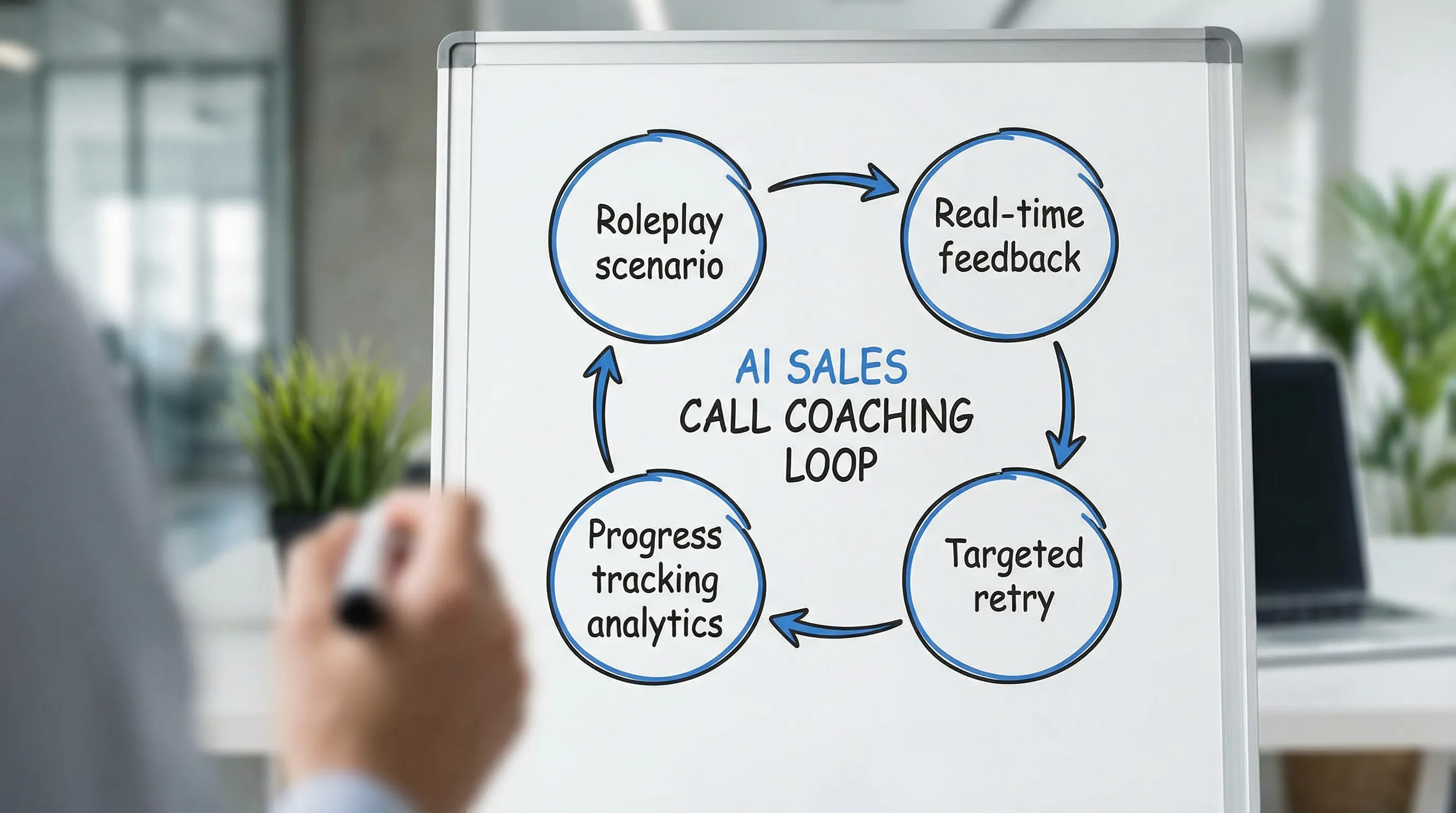
AI for sales calls changes how teams improve these moments. Instead of hoping reps absorb best practices in a workshop and use them weeks later, AI roleplay lets them practice objections and closing sequences repeatedly, get immediate feedback, and build muscle memory before they get on real calls.
This guide explains how to use AI roleplay to coach objection handling and closing, what “good” looks like, and how to roll it out without turning training into busywork.
Why objection handling and closing break down on real calls
Objections and closing are where skill gaps show up most because they combine message, timing, and emotional control.
Common failure patterns include:
- Treating symptoms, not causes (answering “too expensive” with price defense instead of uncovering what “expensive” is compared to).
- Mis-timed closing (closing before mutual agreement on problem, impact, and decision process, or never closing at all).
- One-size-fits-all talk tracks (the same response used for a CFO, a technical evaluator, and a frontline manager).
- Low exposure to edge cases (reps rarely practice the hard scenarios until they happen live).
AI roleplay is specifically useful here because it can simulate pressure, vary buyer personalities, and force reps to respond in-the-moment.
What AI roleplay adds versus traditional sales coaching
Traditional coaching is often limited by calendar time and call availability. Managers can only listen to so many calls, and roleplays often become predictable.
AI roleplay gives you:
- High reps, low cost per rep: practice daily without needing a manager or a peer.
- Scenario variation: the same objection can show up with different context, tone, and stakes.
- Immediate feedback loops: coaching right after the rep responds, when the moment is fresh.
- Consistent standards: every rep can be evaluated against the same rubric.
Platforms like Scenario IQ focus on AI-driven, personalized scenario-based training with real-time feedback and progress tracking, so reps can build confidence and improve performance over time.

Define your objection “map” before you train it
Objection handling improves fastest when your team stops treating objections as random events and starts treating them as a small set of repeatable categories.
A practical objection map includes:
- Category (price, priority, trust, competition, internal politics, security, timing)
- Root cause (unclear value, missing stakeholder, risk, lack of urgency)
- Best next move (diagnose, reframe, validate, quantify, align, close for next step)
- Proof assets (case study themes, ROI model inputs, security overview, references)
Here’s a simple rubric you can build into AI roleplays.
| Objection type | What it often really means | Coaching goal in roleplay | “Good” rep behaviors to reinforce |
|---|---|---|---|
| “It’s too expensive.” | Value is unclear, budget is allocated elsewhere, or risk is high | Diagnose and quantify | Ask “compared to what?”, quantify cost of inaction, align to success metrics |
| “We’re happy with our current vendor.” | Switching risk, inertia, hidden dissatisfaction | Create contrast without attacking | Validate, explore gaps, position differentiation with evidence |
| “Send me something.” | Low engagement or unclear next step | Earn a commitment | Confirm intent, propose a specific next meeting, define decision criteria |
| “Not a priority right now.” | No compelling event, weak impact, misaligned stakeholder | Establish urgency honestly | Explore impact timeline, identify triggers, align to business initiatives |
| “We need to think about it.” | Unanswered concerns, missing stakeholders, fear of being sold | Surface the real blocker | Ask what specifically needs thinking, identify who else is involved, recap agreed value |
| “Security/legal will block this.” | Unknown requirements, prior bad experience, lack of trust | De-risk | Ask for requirements early, outline process, offer security documentation path |
This table becomes your training blueprint: each row is a roleplay scenario family, with multiple variations.
How to coach objections with AI roleplay (a repeatable sequence)
The best objection handling is structured, not improvisational. In AI roleplay, you want reps to practice a sequence until it becomes automatic.
1) Validate without surrendering
A strong rep response acknowledges the concern without conceding the deal.
Examples of what to practice:
- “That makes sense. Help me understand what you’re comparing it to.”
- “Totally fair. Before we decide, can I ask what you’d need to see to feel confident?”
AI feedback should score tone and wording here, because defensiveness is a common failure.
2) Diagnose with precision questions
Most teams under-train discovery inside objections. Your roleplays should force follow-ups.
Examples:
- “When you say timing is tough, is that because of bandwidth, budget cycle, or something else?”
- “What would have to be true for this to become a priority?”
If the rep jumps to pitching, the AI should prompt: “Ask one more diagnostic question.”
3) Reframe around outcomes (not features)
Once the root cause is clear, reps reframe the conversation around the buyer’s goals.
Examples:
- “If we can reduce escalations by X and protect renewals, does the investment make more sense?”
- “If we map this to your Q2 initiative, could that justify pulling it forward?”
4) Prove with the right asset, in the right amount
Roleplays should train reps to use just enough proof. Not a 10-minute product dump.
Coachable behaviors:
- Offer a relevant example (“a similar team in a regulated environment…”) rather than generic claims.
- Ask permission before going deep (“Would it help if I shared how others handled security review?”).
5) Close for the next commitment
A close is not always “sign today.” Often it is the next concrete step.
The AI should evaluate whether the rep:
- Summarizes agreed points (problem, impact, fit).
- Proposes a clear next step with date/time.
- Confirms stakeholders and decision process.
How to coach closing skills with AI (beyond “ask for the sale”)
Closing is a set of micro-skills. AI roleplay works well when you train each one deliberately.
Train “micro-commitments” throughout the call
Reps should practice getting agreement on:
- The problem definition
- The impact and urgency
- Evaluation criteria
- Who needs to weigh in
- What a successful rollout looks like
In roleplay, the buyer should push back if the rep tries to close without earning these commitments.
Practice closing language that fits the moment
You can build roleplays around different closes, for example:
- Decision close: “Based on what we’ve covered, are you ready to move forward?”
- Process close: “What are the steps from here to a decision, and who owns each step?”
- Calendar close: “Let’s lock the next meeting now so momentum doesn’t slip. Does Tuesday or Thursday work?”
The point is not to memorize lines, it is to match language to context.
Coach risk reduction, not pressure
Modern buyers resist pressure, but they respond to clarity.
Roleplays should reward reps who:
- Clarify what happens after signing (implementation, onboarding, success metrics)
- Offer a realistic path for internal alignment
- Address deal risk directly (“What would stop this from moving forward?”)
Designing AI roleplays your team will actually use
Many training programs fail because scenarios feel unrealistic or disconnected from the pipeline. Build scenarios from your real deals.
Start with your top 10 “money moments”
Pick scenarios that directly affect revenue and conversion, such as:
- Price pushback after a strong demo
- “We’re evaluating 2 competitors” late-stage call
- Procurement demands a concession
- Executive sponsor is lukewarm
- Security review stalls the deal
Then vary:
- Buyer persona (CFO vs VP vs admin)
- Deal size and urgency
- Competitive pressure
- Tone (skeptical, rushed, friendly, combative)
Use skill levels to keep reps in the right challenge zone
If every roleplay is too hard, reps avoid it. If too easy, improvement stalls.
A practical progression:
- Beginner: one objection, cooperative buyer
- Intermediate: layered objections, mixed signals
- Advanced: multi-stakeholder dynamics, timeline pressure, competitor traps
Scenario IQ supports customizable skill levels and personalized training scenarios, which is the kind of structure that helps teams improve without burning out.
What to measure: turning roleplay into sales performance
To build credibility with reps and leadership, your AI training must connect to observable improvement.
Good training metrics include:
- Objection handling score (did they validate, diagnose, reframe, and close?)
- Talk-to-question ratio (are they asking enough quality questions?)
- Next-step conversion (did they secure a scheduled follow-up?)
- Consistency over time (are scores improving week over week?)
Scenario IQ includes progress tracking analytics and performance metric dashboards, which can help managers identify patterns (for example, a team that consistently struggles with “not a priority” objections).
Implementation: a lightweight rollout plan that sticks
AI roleplay works best as a habit, not an event.
Set expectations for short, frequent practice
A sustainable pattern is brief daily or near-daily sessions. The goal is to make practice routine, not a quarterly initiative.
Create a single shared rubric
Make sure reps know what “good” means. Use the same rubric in onboarding, roleplay, and manager 1:1s:
- Validate
- Diagnose
- Reframe
- Prove
- Close
When coaching language and AI scoring align, reps improve faster.
Let managers coach the pattern, not the script
Managers should review trends and coach the underlying skill.
Examples:
- “You’re answering price too early. Stay in diagnosis one more question.”
- “Your closes are vague. Lock a date and confirm stakeholders.”
Common pitfalls (and how to avoid them)
AI roleplay can fail when teams treat it like a compliance task.
Avoid these traps:
- Too many scenarios at once: start with a small set of high-impact objections.
- Generic roleplays: pull language from real calls, emails, and lost deals.
- Over-optimizing for the score: ensure the rubric rewards real sales outcomes (clarity, commitments), not robotic phrasing.
- Ignoring enablement content: roleplay is practice, but reps still need clear messaging, positioning, and proof assets.
Frequently Asked Questions
What is AI for sales calls, exactly? AI for sales calls typically refers to using AI to improve sales conversations, often through roleplay simulations, coaching feedback, and performance analytics.
Can AI roleplay really improve objection handling? Yes, because it enables repeated practice with immediate feedback. Reps can train validation, diagnosis, reframing, and closing sequences until they become consistent.
How do you make AI roleplays feel realistic? Base scenarios on real deals: your common objections, buyer personas, competitive situations, and decision processes. Add variations in tone and context so reps cannot memorize answers.
What should you measure to prove AI training is working? Track objection handling quality (by rubric), next-step conversion in roleplays, improvement over time, and whether the coached behaviors show up in real calls and pipeline movement.
Is AI roleplay secure for enterprise teams? It can be, depending on the platform. Look for enterprise-grade security, clear data handling practices, and controls that match your organization’s requirements.
Build confident reps who can handle objections and close
If your team’s results depend on a few top performers, or if reps freeze when buyers push back, AI roleplay is one of the fastest ways to standardize great call behavior.
Scenario IQ delivers AI-powered roleplay simulations, personalized scenarios, real-time feedback, and analytics to help teams practice the toughest moments of sales calls before they happen live. Explore how it works at Scenario IQ.