

AI is rewiring how revenue gets created. In 2025, the teams winning deals fastest are pairing smarter data with AI-assisted workflows and consistent skills training, then measuring the impact in weeks, not quarters. Research supports the shift. McKinsey finds that marketing and sales is one of four functions positioned to capture the majority of generative AI’s value across the enterprise, alongside customer operations, software engineering, and R&D. That concentration of value means revenue teams stand to gain outsized benefits if they implement AI intentionally rather than experimentally.
This playbook shows revenue leaders how to deploy AI for sales and marketing with a repeatable framework, concrete use cases, and an enablement plan that keeps people at the center.
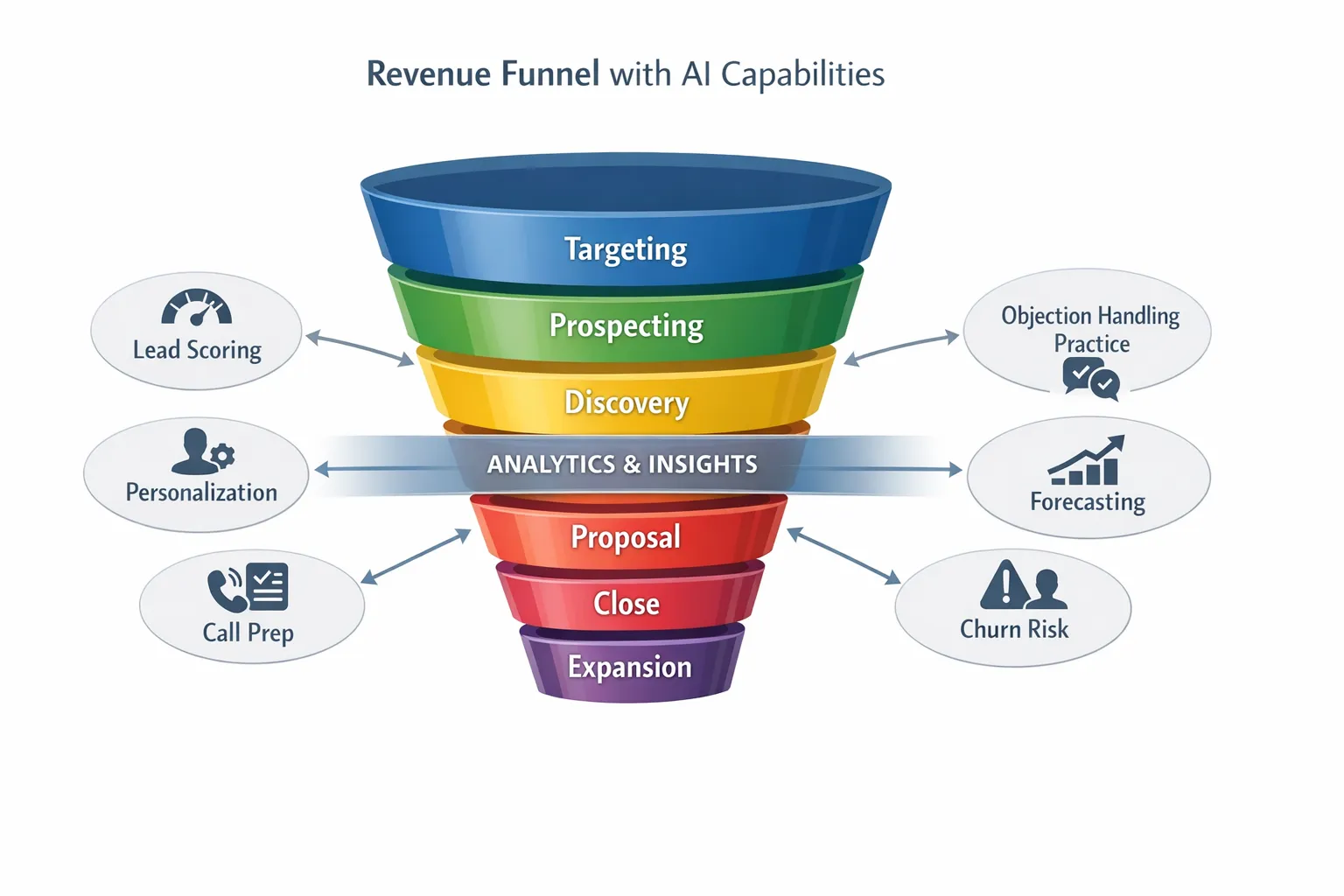
How to use this playbook
- Start with the five pillars below to structure your rollout.
- Map the use cases table to your funnel and tech stack.
- Launch a 90 day pilot with tight measurement and a training plan.
- Scale what works, retire what does not, and keep humans in the loop.
For context, Gartner has long predicted that most B2B buyer seller interactions would occur in digital channels by 2025, which raises the bar on personalization, speed to lead, and consistent execution at scale. AI can help, but only if paired with clear processes and skills development.
The five pillars of an AI revenue operating system
1) Data foundation and governance
AI learns from your data. Make sure it is accurate, accessible, and compliant.
- CRM hygiene, standardize lifecycle stages, contact roles, and required fields.
- Content and knowledge base, centralize battlecards, pricing guardrails, case studies, FAQs, and legal language for controlled retrieval.
- Signals, unify intent, website analytics, product usage, support tickets, and call transcripts for targeting and risk modeling.
- Guardrails, define PII handling, retention, human review steps, and brand and tone guidelines.
2) Workflow design, not just tools
Embed AI where work actually happens, prospecting cadences, meeting prep, follow ups, proposals, QBRs, and renewals. Document who owns each step, what the AI produces, what people edit, and how output gets logged.
3) Enablement and change management
Skills drive outcomes. Reps and managers need to practice new motions, objection handling, and ethical use guidelines. Scenario based training lets teams rehearse realistic conversations before they are in front of customers.
4) Measurement and attribution
Set baselines, pick a few high impact metrics, and run A B tests. Attribute AI’s contribution to reply rates, stage conversion, cycle time, win rate, and ramp time.
5) Trust and risk controls
Put humans in the loop for sensitive steps, limit where AI can auto send, log sources used for generated content, and review models for bias or hallucinations.
AI use cases across the revenue funnel
| Funnel Stage | Use Case | Primary Owner | AI Assist | Core KPI |
|---|---|---|---|---|
| Targeting | ICP and account scoring | RevOps | Rank accounts by fit and intent from firmographics and signals | Meetings per 100 accounts |
| Prospecting | Personalization at scale | SDR | Draft first touch emails and call openers using persona and trigger data | Positive reply rate |
| Inbound | Speed to lead and routing | Marketing Ops | Classify and prioritize inbound by form data and behavior, route instantly | First response time |
| Discovery | Meeting prep and call guidance | AE | Summarize research, propose discovery questions, live note suggestions | Stage conversion to qualified |
| Objections | Practice and mastery | Sales Enablement | Simulated roleplays with realistic objections and real time feedback | Call to meeting conversion |
| Proposal | Drafts and redlines | AE | Create proposal skeletons with approved language, flag risky terms | Cycle time from proposal to sign |
| Forecast | Pipeline risk signals | Sales Managers | Surface deal risks from activity patterns and notes | Forecast accuracy |
| Expansion | Renewal and upsell signals | CSM | Identify churn risk and expansion triggers from product usage and tickets | Net revenue retention |
For automated top of funnel coverage, some teams complement rep led outreach with an automated prospecting platform that finds, qualifies, and engages leads around the clock. If you are exploring that motion, evaluate an option like an automated prospecting platform to book meetings directly on calendars while your team focuses on discovery and closing.
Role based plays you can deploy this quarter
SDR, create more first meetings without burning your lists
- Targeting, use a simple 2x2 approach, two personalization points tied to value, two crisp calls to action. Have AI pull public data points and draft, then you approve.
- Phone, use AI to generate 30 second call openers tailored to persona and trigger. Practice them in a safe environment first, see Enablement section.
- Cadence optimization, A B test two subject lines and two CTA variants per persona, retire losers weekly.
What to track, positive replies, held meeting rate, meetings per rep per week, and no show rate.
AE, run better discovery and move to close faster
- Discovery, have AI summarize the account, recent news, and similar customer wins. Use it to propose a 6 question discovery outline and two value hypotheses.
- Objections, keep a living library of objections by segment. Practice until your answers are concise, confident, and on brand.
- Proposals, use AI to assemble a proposal skeleton from approved product blurbs, case studies, and pricing guardrails, then you customize.
What to track, qualified opportunity rate, stage conversion, days in stage, and win rate.
Marketing, fuel personalization and speed without losing the brand
- Segment briefs, AI drafts briefs that include ICP pain, messaging pillars, and proof points pulled from your content library.
- Asset variants, generate first drafts of email and ad variants by segment and lifecycle stage, then tighten for voice and claims.
- Inbound routing, classify forms and chat transcripts to route hot leads in minutes.
What to track, MQL to meeting conversion, cost per opportunity, and contribution to pipeline.
Customer success, protect NRR and surface expansion
- Risk signals, combine usage dips, ticket sentiment, and stakeholder changes to flag accounts for outreach.
- Renewal prep, AI compiles outcomes achieved, benchmarks, and proposed next steps for QBRs.
- Upsell timing, identify product qualified expansion events and recommended talk tracks.
What to track, gross and net revenue retention, time to resolution, and renewal cycle time.
The enablement engine that makes AI stick
AI augments workflows, but performance improves when people practice. That is where scenario based training comes in.
With Scenario IQ, revenue and service teams can rehearse key moments before they happen with customers:
- AI powered roleplay simulations that mirror your ICP, industry, and product language.
- Personalized training scenarios that adapt to each rep’s skill level and goals.
- Real time feedback that highlights what landed and what did not, down to objection handling and clarity.
- Progress tracking analytics and performance metric dashboards for managers and enablement leaders.
- Team focused learning, run playbooks across pods and geographies with consistent standards.
- Adaptive guidance and daily actionable tips that keep skills sharp between formal sessions.
- Enterprise grade security to protect customer and company data.
Practical rollout idea, publish a monthly “moment that matters” scenario set, one SDR prospecting call, one AE discovery, one pricing objection, and one CSM renewal. Use Scenario IQ to score, coach, and compare improvement week over week.

Measurement that proves impact
Establish a clean baseline two to four weeks before your pilot. Then, instrument the following leading and lagging indicators.
- Leading indicators, reply rate, speed to lead, discovery show rate, talk time balance, and proposal turnaround time.
- Lagging indicators, stage conversion, sales cycle length, win rate, ACV, and net revenue retention.
- Quality indicators, compliance exceptions, brand tone adherence, hallucination rate, and manual overrides.
Run controlled experiments. For example, split a persona into two cohorts, Cohort A uses AI drafted emails plus scenario practice, Cohort B uses your current approach. Compare reply rates and meetings booked over two weeks before rolling out broadly.
Governance and risk, build trust as you scale
- Human in the loop by design, require approvals for outbound to new domains, pricing language, and legal clauses.
- Source control, use retrieval augmented generation so AI only pulls from approved content hubs.
- PII and compliance, document how PII is handled, anonymized, and retained, and restrict sensitive fields from prompts.
- Model oversight, monitor for drift, bias, and poor suggestions. Keep a fail safe path back to manual processes.
Harvard Business Review has outlined how generative AI is changing sales work, particularly around content creation and guidance. The takeaway is consistent, AI accelerates routine tasks and surfaces insights, people still own judgment, relationships, and accountability.
A 90 day rollout plan for revenue leaders
Week 0 to 2, choose two high impact use cases, for most teams that is outbound personalization and discovery prep. Clean the data and content those use cases require. Define guardrails and success metrics. Set up Scenario IQ and import your first scenarios.
Week 3 to 4, build and test. Draft prompts, create content retrievals, and rehearse with managers and a small rep cohort. Tune for tone and accuracy. In Scenario IQ, run baseline simulations to identify top coaching areas.
Week 5 to 8, pilot live. Turn on AI support for your pilot cohort. Hold 15 minute daily standups to review results, errors, and improvements. In Scenario IQ, assign weekly simulations tied to the live motion and track progress.
Week 9 to 12, scale and standardize. Document what worked. Expand to more teams and regions. Update playbooks, dashboards, and training paths. Review governance and finalize where AI can auto send versus recommend only.
Acceptance criteria for go wide, statistically significant lift in reply or conversion rates, reduced proposal turnaround, improved discovery scores in Scenario IQ, and no material compliance issues.
Credible sources and further reading
- McKinsey, The economic potential of generative AI and where marketing and sales capture outsized value. Read the research.
- Gartner, Future of Sales insights on the digital shift in buyer seller interactions. Explore Gartner’s perspective.
- Harvard Business Review, How generative AI is changing sales work. See the HBR article.
Frequently Asked Questions
Do we need a new data stack before we start with AI? No. Start with a narrow use case that uses data you already trust, for example CRM fields, approved content, and recent call notes. Improve data quality as you scale.
How do we keep AI generated content on brand and accurate? Use retrieval from an approved content hub, define tone and terminology in prompts, and require human review for sensitive assets. Log sources so reviewers can verify claims quickly.
What skills should we train first? Focus on discovery excellence and objection handling. These moments drive the biggest swings in pipeline quality and win rate. Scenario based practice builds confidence before customer conversations.
How do we prove ROI fast? Establish a baseline, run a two to four week A B test with a clear north star metric, for example positive replies or proposal turnaround, and track both leading and lagging indicators.
What about compliance and customer privacy? Set PII rules upfront, restrict sensitive fields from prompts, and use enterprise grade tools that meet your security requirements. Keep humans in the loop for anything legal, pricing, or privacy sensitive.
Put this playbook into practice with Scenario IQ
If you are ready to turn AI for sales and marketing into repeatable revenue, Scenario IQ helps your team build the skills and confidence to execute. Use AI powered roleplay simulations, personalized training scenarios, and real time feedback to sharpen discovery, objection handling, and service conversations. Track progress with performance metric dashboards, enable team focused learning with adaptive guidance and daily actionable tips, and rely on enterprise grade security.
See how fast your team can improve when practice becomes a habit. Get started at Scenario IQ.