

Choosing an AI for business leaders course in 2026 is less about learning trendy tools and more about building durable decision-making skills. Leaders now have to set AI strategy, manage risk, align teams, and prove business outcomes, often while regulations and customer expectations keep tightening. The right course should leave you with a repeatable playbook, not a slide deck.
Below is a practical, executive-focused checklist to evaluate courses in 2026, plus a framework for turning learning into measurable performance.
Why “AI literacy” is not enough for leaders in 2026
Many courses still focus on basic AI concepts or prompt tips. Useful, but incomplete. Leaders need to be able to:
- Choose high-value AI use cases and stop low-value ones early
- Govern AI safely (privacy, security, bias, auditability)
- Lead change (operating model, skills, adoption, measurement)
- Communicate clearly with technical teams and non-technical stakeholders
A strong course reflects the reality that AI is now a business capability, not a side project.
The outcomes a great AI for business leaders course should deliver
Before evaluating providers, define what “done” looks like. In 2026, the best courses aim for outcomes like these:
1) A business-first AI strategy you can defend
You should finish the course with an AI strategy narrative that answers:
- What problems are we solving, and why now?
- Which workflows will change, and who owns them?
- What data is required, and what constraints exist?
- How will we measure value in 30, 90, and 180 days?
If a course cannot help you produce an executive-ready strategy artifact (even a lightweight one), it is likely too theoretical.
2) Practical governance that matches 2026 expectations
In 2026, governance is not optional. Even if you are not in a heavily regulated industry, customers and partners increasingly expect responsible AI practices.
Look for content aligned with established frameworks, such as:
- The NIST AI Risk Management Framework (AI RMF 1.0) for mapping and managing AI risks
- ISO/IEC 42001, an AI management system standard many organizations use to structure AI governance
A credible course teaches you how to set policies and decision rights, not just “AI ethics” in the abstract.
3) A repeatable way to prioritize AI use cases
In 2026, AI use cases compete for data, budget, and attention. A good course gives you a simple scoring model you can reuse across departments.
It should cover:
- Value sizing (revenue impact, cost reduction, risk reduction)
- Feasibility (data readiness, integration complexity, change impact)
- Risk (privacy, security, compliance, customer trust)
- Time-to-value and pilot design
4) Change leadership and adoption, not just technology
The course should explicitly teach adoption mechanics:
- How to redesign workflows around AI assistance
- How to define roles (product owner, risk owner, data owner)
- How to build enablement programs that stick
- How to reduce “shadow AI” (unsanctioned tools and processes)
If adoption is not a major module, your organization will likely see fragmented experimentation instead of durable impact.

What the curriculum should include (2026-ready module checklist)
An AI for business leaders course does not need to turn you into an engineer. It should make you effective at decisions. Use this module checklist to evaluate syllabi.
Business strategy and operating model
Look for instruction on:
- AI as a capability (how it changes operating model and accountability)
- Centralized vs federated AI teams
- Vendor strategy (build, buy, partner)
- AI portfolio management
GenAI fundamentals for executives (without hype)
A modern course should explain, in plain language:
- Where GenAI performs well (drafting, summarizing, classification, copilots)
- Where it fails (hallucination risk, brittle reasoning, hidden data leakage)
- Why evaluation matters (quality, safety, reliability)
Data, security, and privacy in leader terms
You do not need a deep technical dive, but you do need actionable literacy:
- Data sensitivity tiers and approved usage boundaries
- Secure deployment patterns (especially for customer data)
- Third-party risk considerations
- How to ask the right questions of IT and security
AI risk and compliance in 2026
Depending on your industry and geography, a good course should at least cover:
- High-level regulatory landscape and emerging obligations
- Documentation and audit readiness basics
- When to require human oversight and how to define it
If your organization operates in the EU or sells into the EU, the EU AI Act is particularly relevant for risk-based obligations.
Measuring ROI and performance
Courses should go beyond “AI is transformative” and teach measurement practices:
- Baselines (before AI)
- Leading indicators (adoption, cycle time, quality sampling)
- Lagging indicators (revenue, churn, cost-to-serve, risk events)
- Experiment design (A/B tests where possible, phased rollouts)
How to evaluate course quality: a 2026 scorecard
Use the table below as a decision tool when comparing programs.
| What to evaluate | What “good” looks like in 2026 | Questions to ask before buying |
|---|---|---|
| Business relevance | Uses cases mapped to real functions (sales, service, ops, HR, finance) | “Can you show examples in my industry or function?” |
| Governance depth | Teaches frameworks, policies, and decision rights | “Do you cover risk management and audit readiness?” |
| Hands-on practice | Real exercises, simulations, or applied assignments | “What will I produce by the end of the course?” |
| Measurement rigor | Clear ROI models and metrics | “How do you teach value measurement beyond anecdotes?” |
| Tool neutrality | Concepts transfer across vendors, not a single-tool tutorial | “Is this course tied to one platform, or principles-first?” |
| Change management | Adoption, operating model, enablement | “How do you address behavior change and adoption?” |
| Instructor credibility | Practitioners with recent implementation experience | “Who teaches, and what have they implemented lately?” |
| Ongoing support | Office hours, updates, community, refreshers | “How do you keep content current as AI changes?” |
Course formats: which one fits your role and timeline?
Not every leader needs the same format. The best choice depends on your goal: awareness, decision capability, or execution.
| Format | Best for | Watch-outs |
|---|---|---|
| Executive education (university or institute) | Strategy, governance, leadership context | Can be light on hands-on application to your workflows |
| Cohort-based programs | Accountability and peer learning | Quality varies widely, check instructor depth |
| Corporate internal training | Standardization across leadership | Can become generic if not tailored to functions |
| Workshops + applied project | Turning one priority use case into a plan | Requires time from cross-functional stakeholders |
| Simulation-based practice | Building communication and decision confidence | Needs realistic scenarios and feedback, not “roleplay theater” |
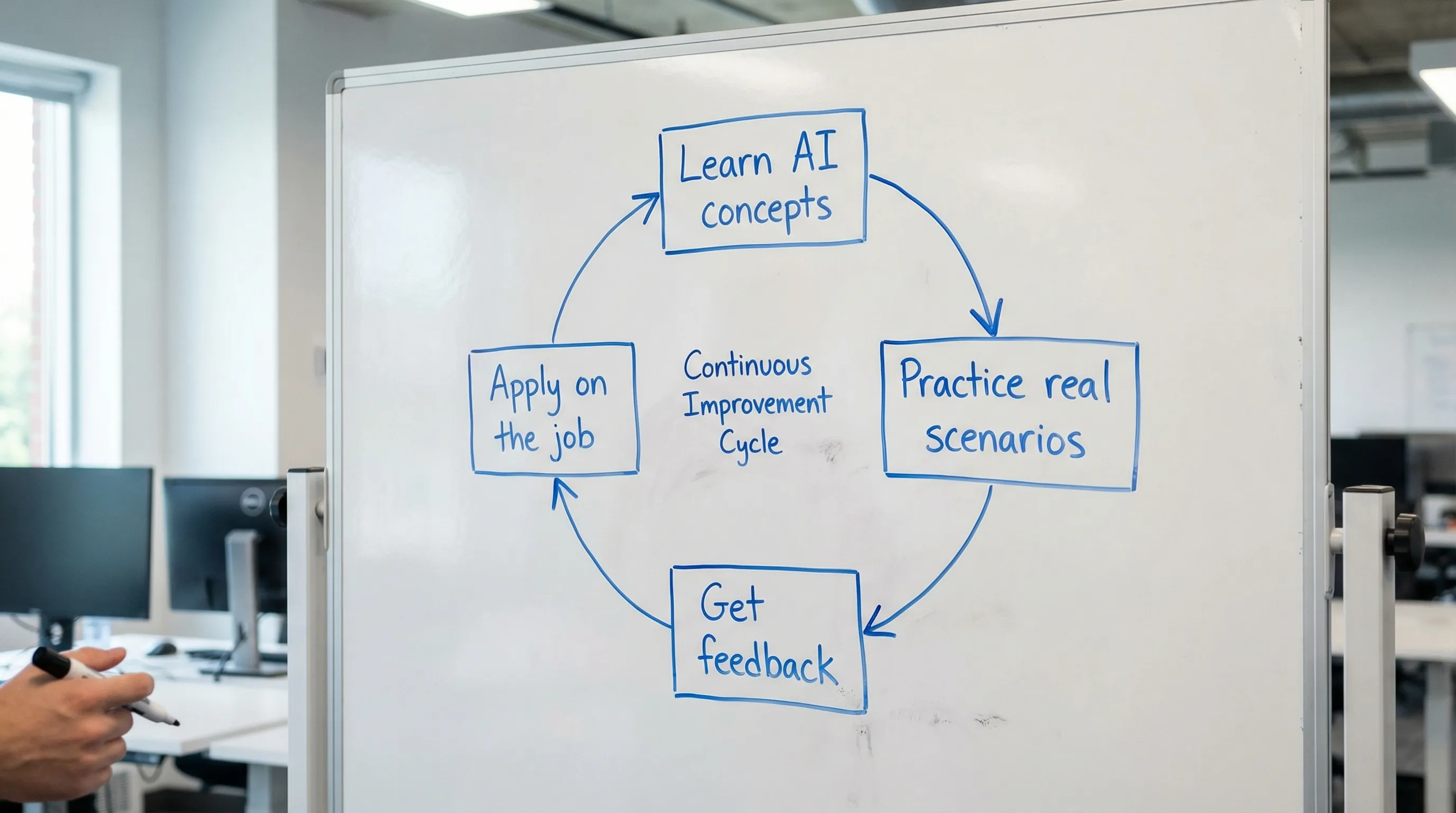
A useful pattern in 2026 is to pair a strategy-oriented course with practice-based training that reinforces day-to-day execution.
The missing piece most courses ignore: leadership conversations under pressure
Even leaders who understand AI strategy can struggle in the moments that decide outcomes, for example:
- Explaining AI direction to skeptical teams
- Handling customer concerns about AI usage
- Coaching managers on AI-enabled workflow changes
- Navigating objections from legal, security, or finance
In 2026, leadership credibility is built through consistent communication, not just correct strategy.
That is why practice and feedback matter. Look for programs that include realistic scenarios, either live or simulated, where you practice responding to objections and making tradeoffs.
Red flags to avoid when choosing an AI for business leaders course
Some programs look impressive but underdeliver. Be cautious if you see these signs:
Over-focus on prompts and tools
Prompts are tactical. Leaders need governance, operating models, and measurement. A prompt-only course is a skills workshop, not an executive program.
No explicit risk, privacy, or security content
If the course does not address risk management, it is out of date for 2026.
No deliverables
If you cannot point to a concrete output (use case shortlist, governance plan, pilot metrics, operating model draft), the learning may not translate into execution.
“Guaranteed ROI” claims without a method
Credible programs teach you how to measure value, not promise a universal outcome.
A simple selection process (that prevents expensive mistakes)
Use this quick approach to choose confidently:
Align stakeholders first
Before purchasing, confirm what success means with your key partners (IT, security, legal, finance, HR). That prevents a course from optimizing for the wrong outcome.
Ask for a sample lesson and a sample assignment
A course can sound great on a syllabus. The real test is the work product and the quality of feedback.
Prioritize transfer to the job
Choose the course that most directly helps you execute in your environment, even if it is less “prestigious” on paper.
Frequently Asked Questions
What is the best AI for business leaders course in 2026? The best course is the one that fits your role and outputs. Look for strategy, governance, measurement, and hands-on application, not only tool tutorials.
How long should an AI for business leaders course take? Many leaders get value from a 4 to 8 week program or a short intensive plus an applied project. The key is time for practice and feedback, not total hours.
Should business leaders learn prompting in 2026? Yes, but as a small part of the curriculum. Leaders should understand capabilities and limitations, then focus more on governance, adoption, and ROI.
What topics are non-negotiable for AI leadership training now? AI risk management, data privacy and security basics, use case prioritization, operating model, and measurement should all be covered.
How can I ensure the course leads to real business impact? Choose a program with deliverables and measurement, then reinforce learning with scenario practice and manager coaching so behaviors change on the job.
Put learning into practice with Scenario IQ
A course can give you frameworks, but execution requires practice, especially for high-stakes sales and service conversations where objections, compliance concerns, and customer trust come into play.
Scenario IQ helps teams build confidence with AI-powered roleplay simulations and personalised training scenarios, supported by real-time feedback, progress tracking analytics, and adaptive guidance. If your 2026 goal is not just understanding AI, but improving how your leaders and teams communicate and perform in real situations, explore Scenario IQ.