

Most teams do not need another “AI 101” deck. They need a practical AI for business course that fits into real calendars, connects to real workflows, and produces a pilot your leadership can actually greenlight.
Below is a ready-to-run syllabus designed for busy sales, service, and operations teams, plus the managers who support them. It’s structured to move from literacy to execution in six weeks, with lightweight daily practice and one focused live session per week.
What this AI for business course is designed to achieve
By the end of the program, participants should be able to:
- Explain how modern AI (including generative AI) works at a business level, and where it fails.
- Identify, score, and prioritize AI use cases based on value, feasibility, and risk.
- Build reliable prompts and repeatable AI workflows (not one-off chats).
- Apply AI safely with privacy, security, and governance guardrails.
- Deliver a small, measurable pilot proposal (or an implemented pilot, depending on scope).
This aligns with what many organizations are chasing right now: measurable productivity and new value creation. For example, McKinsey estimated generative AI could add $2.6 trillion to $4.4 trillion annually across use cases, largely through productivity and automation in knowledge work.
Format that works for busy teams
A common failure mode is trying to do too much in a single workshop. Instead, use a simple cadence:
- Weekly live session (60 to 75 minutes): concept + demo + team activity
- Daily practice (10 minutes): a single prompt drill, reflection, or micro-simulation
- Weekly assignment (30 to 45 minutes): a deliverable that compounds into the capstone
If you have customer-facing teams (sales or service), the “daily practice” is where AI roleplay shines, because it trains communication behaviors, not just tool usage.
Syllabus overview (6 weeks)
| Week | Theme | Live session outcome | Weekly deliverable |
|---|---|---|---|
| 1 | AI fundamentals for business | Shared vocabulary, realistic expectations, AI risk basics | “Where AI helps us” map for 2 to 3 workflows |
| 2 | Use case discovery and prioritization | A ranked backlog of AI opportunities | Opportunity scorecard + top 1 use case selection |
| 3 | Prompting and workflow design | Prompts that are testable, reusable, and role-specific | Prompt pack v1 + evaluation checklist |
| 4 | Function labs (sales, service, ops) | Practice scenarios, objection handling, and quality standards | Before/after baseline (quality or time) + improved workflow |
| 5 | Governance, security, and change adoption | Guardrails for safe rollout and procurement readiness | AI usage policy draft + rollout plan outline |
| 6 | Capstone | A pilot plan leadership can approve | Pilot brief: metrics, risks, timeline, owners |
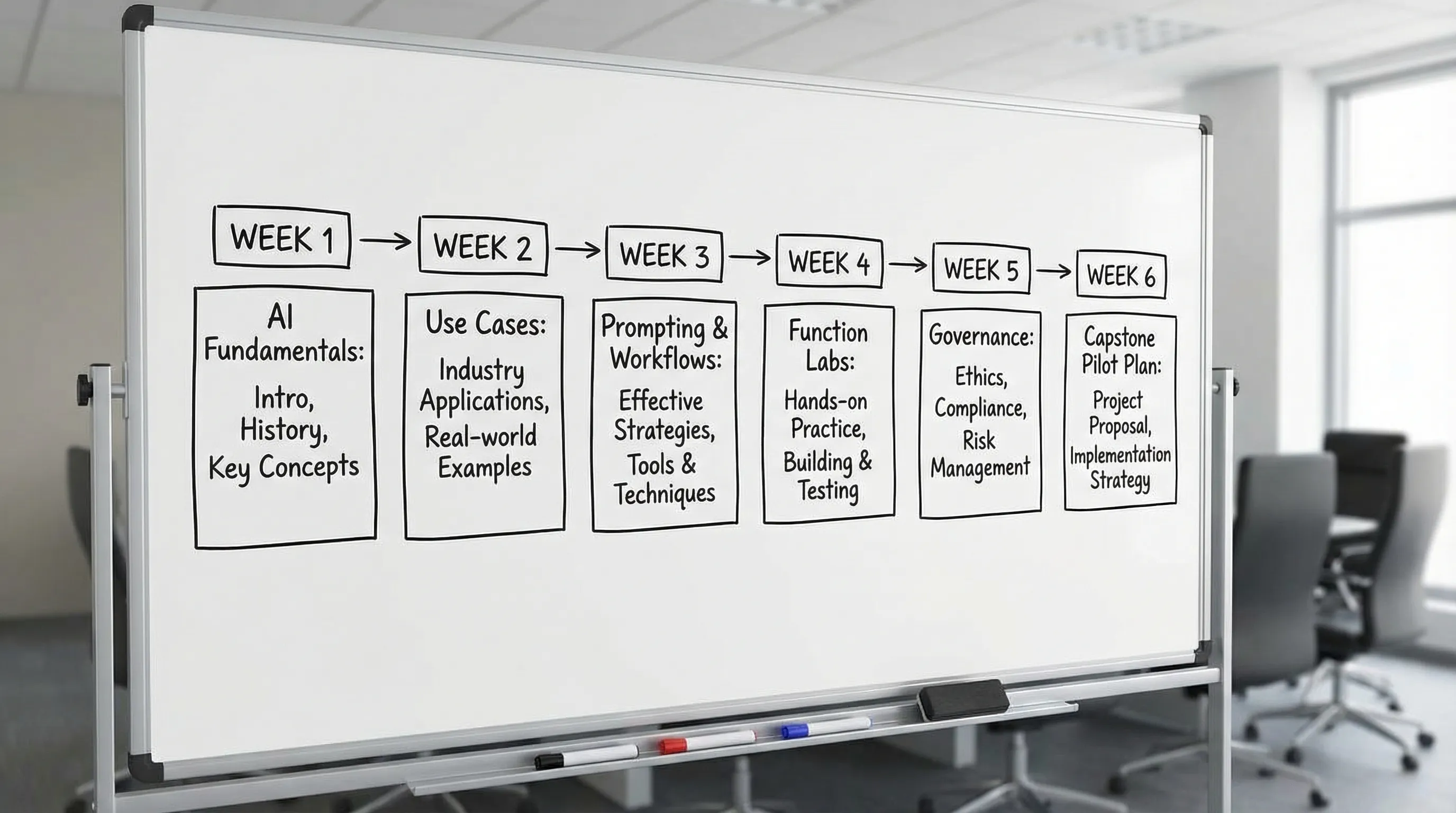
Week 1: AI fundamentals for business (with realistic expectations)
What to teach (and what to skip): Your team does not need deep neural network theory. They do need clarity on capabilities and limits, because misuse usually comes from false assumptions.
Cover these concepts in plain language:
- The difference between predictive AI and generative AI
- Why generative AI can “hallucinate” and how to design around it
- Where AI performs best (summarization, drafting, classification, pattern finding)
- Where AI is risky (legal advice, sensitive data, unverifiable facts)
Team activity (15 minutes): Pick 2 to 3 common workflows (for example, “handle a price objection,” “summarize a support ticket,” “write a QBR recap”) and mark:
- What is repetitive
- What requires human judgment
- What requires trusted sources
Deliverable: a one-page “Where AI helps us” map for those workflows.
Suggested references for this week (optional):
Week 2: Use case discovery and prioritization (value, feasibility, risk)
This is the week that prevents random “AI projects” from multiplying without ROI.
A simple scoring model your team can actually use
Use a light scorecard with 1 to 5 ratings. Keep it understandable so stakeholders trust it.
| Dimension | What “5” looks like | What “1” looks like |
|---|---|---|
| Business value | Clear revenue impact or major time savings | Nice-to-have, unclear impact |
| Feasibility | Data and tooling ready, low integration | Requires new systems and heavy IT |
| Risk | Low sensitivity, easy to validate outputs | High privacy, regulatory, or brand risk |
| Measurability | Success metric is obvious | No clear metric or baseline |
Team activity (20 minutes)
Have each participant propose one use case, then score as a group. For sales and service teams, strong starting points often include:
- Better discovery notes and call summaries
- Objection handling practice and coaching
- Knowledge base assisted responses with citations
- Ticket triage and routing
Deliverable: a ranked backlog and a selection of the top 1 use case for the capstone.
Week 3: Prompting and workflow design (from chat to system)
Prompting should be taught like a business skill: structured, testable, and aligned to outcomes.
Teach a repeatable prompt template
A practical template for business teams:
- Role: “You are a customer success manager…”
- Task: “Draft a renewal email…”
- Context: product, customer profile, constraints
- Sources: what to rely on (and what not to)
- Output format: bullets, table, talk track, etc.
- Quality checks: tone, policy, factual verification steps
Build evaluation into the course
Busy teams skip evaluation, then lose trust when outputs vary. Introduce a simple checklist:
| Check | Example question |
|---|---|
| Accuracy | Can we verify key claims from trusted sources? |
| Completeness | Did it answer the customer’s actual question? |
| Tone | Does it match our brand and service style? |
| Compliance | Does it avoid sensitive data and restricted topics? |
Deliverable: Prompt pack v1 (5 to 10 prompts) plus the evaluation checklist.
Week 4: Function labs (sales, service, ops) with practice that changes behavior
This week is where learning becomes performance.
Sales lab: discovery and objections
Focus on two high-frequency scenarios, such as:
- Price objection with a skeptical buyer
- Competitor comparison without trash-talking
The goal is to build consistent talk tracks and better questioning habits.
Service lab: de-escalation and clarity
Practice:
- Handling frustrated customers while keeping policy boundaries
- Explaining complex issues in plain language
Operations lab: standardization and quality
Practice:
- Turning tribal knowledge into reusable SOP drafts
- Creating QA checklists for recurring tasks
Where AI roleplay fits (especially for customer-facing teams)
For sales and service teams, simulations help teams practice under pressure without risking customer relationships. Tools like Scenario IQ provide AI-driven roleplay simulations, personalized training scenarios, and real-time feedback, so reps can rehearse objections, tone, empathy, and clarity repeatedly.
Use the lab to establish:
- A baseline (for example, conversion rate on a simulated objection, or rubric score)
- Target behaviors (ask 2 clarifying questions before pitching, confirm understanding, summarize next steps)
- A practice rhythm (short daily reps with feedback)
Deliverable: a before/after snapshot using a rubric (quality) or time-to-complete (efficiency), plus an improved workflow or talk track.

Week 5: Governance, security, and adoption (so it scales safely)
This week makes the difference between “a cool experiment” and a program leadership will support.
What to cover (without turning it into legal training)
- Data handling basics (what cannot be pasted into AI tools)
- Human-in-the-loop rules (what must be reviewed)
- Documentation expectations (how prompts, workflows, and decisions are recorded)
- Vendor considerations (security posture, access control, auditability)
If your organization needs a formal management system view, you can reference ISO/IEC 42001 (AI management systems standard) as a useful north star for governance structure.
Adoption: the overlooked part
Most AI rollouts fail quietly because:
- Managers do not model usage
- Teams lack “approved” workflows
- Measurement is unclear
So the course should produce a lightweight enablement plan: who trains whom, how success is measured, and how feedback updates the workflow.
Deliverable: AI usage policy draft (one page) plus rollout plan outline.
Week 6: Capstone that leadership can approve
The capstone should look like something a director or VP can say yes to in one meeting.
Capstone pilot brief (suggested structure)
| Section | What good looks like |
|---|---|
| Problem | Tied to a real KPI (conversion, AHT, CSAT, backlog) |
| Proposed workflow | Specific steps, tools used, where humans review |
| Training plan | Who needs practice, how often, and how coached |
| Risk controls | Data rules, review gates, escalation paths |
| Success metrics | Baseline, target, and measurement method |
| Timeline and owners | 2 to 6 week pilot window with named owners |
Metrics that make sense for sales and service
Pick one primary metric and 1 to 2 supporting metrics.
Examples:
- Sales: meeting-to-opportunity conversion, objection handling rubric score, cycle time
- Service: first response time, resolution quality score, CSAT, escalation rate
- Ops: time saved per task, error rate, rework rate
Deliverable: pilot brief ready for approval.
How to run this course with minimal overhead
Roles
- Course owner (often L&D or RevOps): runs sessions, tracks deliverables
- Functional manager: confirms scenarios are realistic and aligned to policy
- SMEs (light involvement): review prompt packs and quality rubrics
Keep the content “close to the work”
The fastest path to ROI is to train on the exact conversations and documents your team already produces. For customer-facing organizations, that means:
- The 10 most common objections
- The 10 most common ticket types
- Your approved positioning and policies
Then practice those repeatedly until performance stabilizes.
Where Scenario IQ fits into an AI for business course
If you are building this program for sales or service teams, Scenario IQ can support the highest-leverage part of the syllabus: repeated practice with feedback.
Because Scenario IQ focuses on AI roleplay simulations, personalized scenarios, real-time feedback, and progress tracking analytics, it can be used to:
- Turn Week 4 labs into ongoing daily reps
- Track improvement over time with performance metrics
- Standardize coaching across teams while still personalizing scenarios by skill level
If you want to operationalize this syllabus with scenario-based practice, you can explore Scenario IQ here: Scenario IQ | AI Sales & Service Training.