
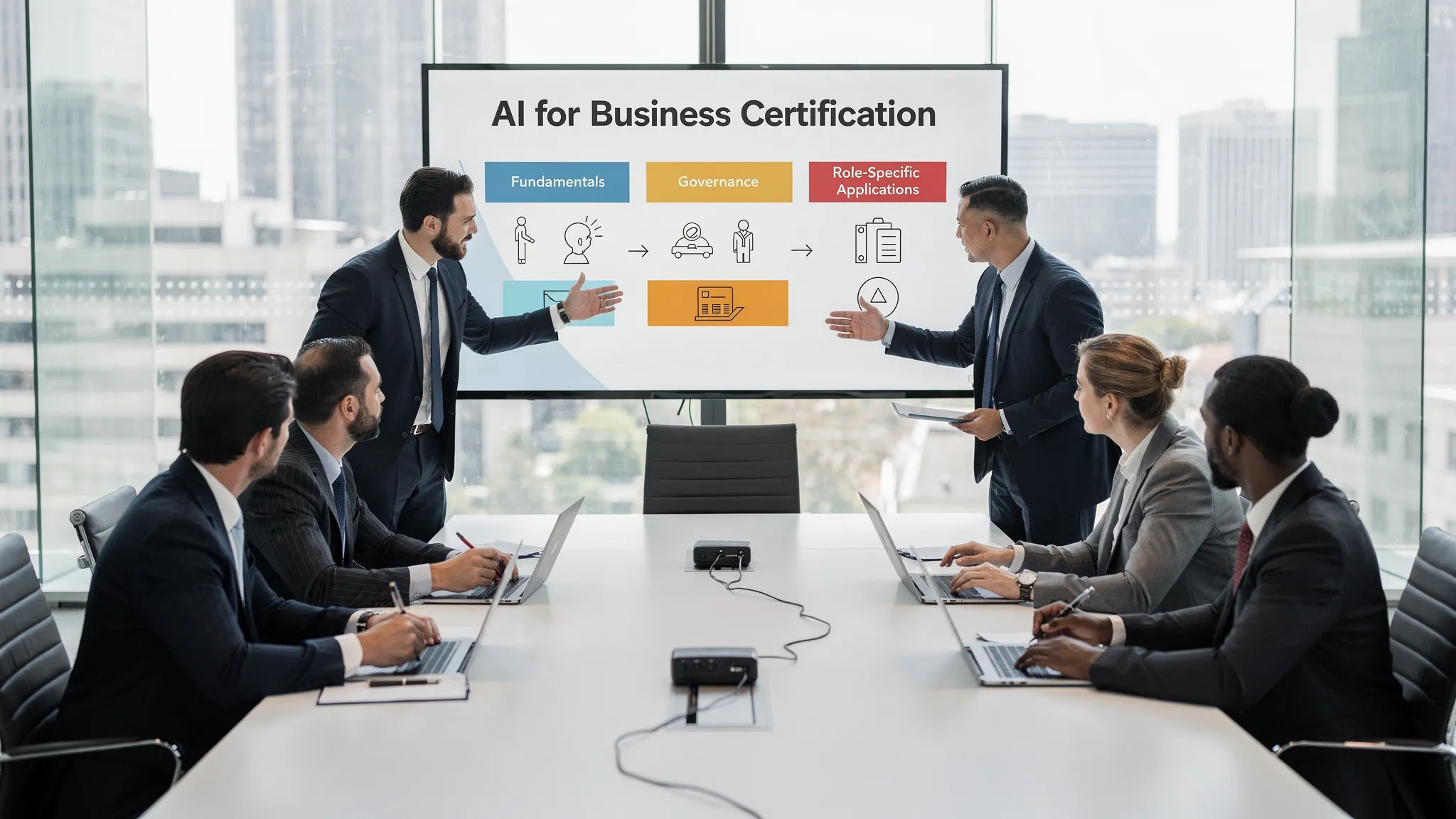
In 2026, “AI skills” is no longer a niche requirement reserved for data science teams. Sales, service, operations, HR, finance, and enablement leaders are being asked to deploy AI responsibly, measure results, and upskill teams quickly. That shift has created an explosion of courses and badges. The hard part is not finding an AI for Business Certification, it is choosing credentials that hiring managers and executives actually recognize, and that map to real work.
This guide breaks down which certifications tend to matter most in 2026, what each one signals, and how to pick the right path based on your role (without wasting time on credentials that look good on LinkedIn but do not translate into performance).
What “AI for business” credentials need to prove in 2026
The most valuable AI credentials in 2026 share one trait: they demonstrate you can apply AI to business outcomes with appropriate risk controls.
In practice, strong business-oriented AI credentials cover a mix of:
- AI literacy (what models can and cannot do, basic terminology, common failure modes)
- Generative AI workflows (prompting, evaluation, human-in-the-loop review, automation boundaries)
- Data and measurement (KPIs, experimentation, monitoring, ROI)
- Governance, privacy, and risk (policy, vendor assessment, compliance, auditability)
- Change management (training, adoption, process redesign)
A certification does not need to cover all of these. But if it covers only tool usage (or only theory), it will be weaker for business credibility.
The 4 categories of AI credentials (and what each is good for)
Vendor-neutral certifications (best for credibility across companies)
These credentials travel well across employers because they are not tied to one platform. They are especially valuable for:
- AI governance and risk roles
- Business leaders who need to set policy and direction
- Analytics professionals working across heterogeneous tool stacks
Vendor-specific cloud certifications (best when your organization standardizes on a platform)
If your company runs on Microsoft, Google Cloud, or AWS, platform certifications can be highly practical. They signal you can work inside a real production ecosystem (identity, security, cost management, deployment patterns).
University/executive education certificates (best for leadership framing)
Many universities offer “AI for business” programs. These can help with strategy, operating models, and case studies, but they vary widely in rigor and assessment.
Course completion certificates and micro-credentials (best for skill building, weaker as a standalone signal)
Certificates from online programs can still be useful, especially if they include projects and assessments. However, employers often treat them as “evidence of learning,” not proof of competence.
AI for Business Certification: the credentials that matter most in 2026
Below are credentials that are commonly recognized and map well to real business use cases. Availability, names, and exam codes can change, so always verify current requirements on the issuer’s site.
1) Microsoft Certified: Azure AI Fundamentals (AI-900)
This is one of the most widely recognized entry-level AI certifications for business and non-specialist audiences because it is clear, standardized, and assessment-based.
- Best for: business professionals, sales/service leaders, project managers, analysts starting in AI
- What it signals: baseline AI literacy plus familiarity with how AI is delivered in a modern cloud ecosystem
- Official reference: Microsoft AI-900 certification overview
2) IAPP Artificial Intelligence Governance Professional (AIGP)
In 2026, AI governance is no longer optional. Organizations want proof that leaders understand risk, accountability, and compliance expectations. AIGP is one of the clearest signals in this area.
- Best for: legal, compliance, security, risk, procurement, AI program owners, senior leaders
- What it signals: structured knowledge of AI governance practices and terminology
- Official reference: IAPP AIGP
3) INFORMS Certified Analytics Professional (CAP)
If your “AI for business” work is tied to analytics maturity, measurement, and decision-making (not only generative AI), CAP can be a strong, vendor-neutral credential.
- Best for: analytics leaders, BI managers, decision science practitioners, ops and finance analysts
- What it signals: end-to-end analytics competence, from problem framing to deployment and lifecycle
- Official reference: INFORMS CAP
4) Google Cloud certifications (useful when your org builds on Google Cloud)
Google Cloud’s credential ecosystem is often relevant when teams operationalize ML and genAI products. For business-forward audiences, look for foundational or “leader” style certifications, and for technical teams, professional-level certifications.
- Best for: teams standardized on Google Cloud, product and platform stakeholders
- What it signals: cloud-grounded understanding of how AI capabilities are delivered and governed
- Official reference: Google Cloud certifications
5) AWS certifications related to machine learning (best for technical implementation credibility)
For business stakeholders, AWS credentials matter most when you partner closely with engineering or own delivery outcomes. Many organizations still treat AWS ML credentials as a strong technical signal.
- Best for: technical product managers, analytics engineers, ML/AI engineers, solution architects
- What it signals: ability to implement ML solutions in an enterprise cloud environment
- Official reference: AWS Certification
6) ISO/IEC 42001 training (AI management systems)
ISO/IEC 42001 is a formal standard for AI management systems. ISO itself does not “certify people” in the same way vendors do, but accredited training and lead implementer/auditor courses can be meaningful in regulated or enterprise contexts.
- Best for: governance, risk, compliance, security, quality management, internal audit
- What it signals: understanding of management system requirements, controls, and audit readiness
- Official reference: ISO/IEC 42001 overview
7) DeepLearning.AI and similar programs (best as proof of practical learning, not governance)
If your goal is to actually become fluent in modern genAI concepts and workflows, high-quality course providers can be extremely helpful. Treat these as skill accelerators and pair them with job-relevant proof (projects, playbooks, measured outcomes).
- Best for: cross-functional operators, enablement and training teams, PMs, analysts
- What it signals: structured learning, sometimes with hands-on exercises
- Example provider: DeepLearning.AI
Quick comparison table: choosing the right credential
Use this as a starting point for matching credentials to business needs.
| Credential | Primary focus | Best for | Strongest signal to employers |
|---|---|---|---|
| Microsoft AI-900 | AI fundamentals in a cloud context | Non-technical business roles, managers | Baseline AI literacy that is standardized and test-verified |
| IAPP AIGP | Governance and responsible AI | Risk, compliance, AI program owners | Ability to build and communicate governance practices |
| INFORMS CAP | Analytics lifecycle and decision-making | Analytics leaders, BI, ops and finance | Business value framing plus measurement discipline |
| Google Cloud certifications | Cloud AI ecosystem (varies by level) | Orgs on Google Cloud | Platform-aligned execution readiness |
| AWS ML-related certifications | Technical ML delivery | Technical PM, engineering-adjacent | Implementation credibility in enterprise environments |
| ISO/IEC 42001 training | AI management systems and auditability | GRC, audit, security, quality | Enterprise readiness for controls and compliance |
| DeepLearning.AI style certificates | Skill building | Cross-functional builders | Practical fluency (stronger when paired with work samples) |
Which AI for business certification path fits your role?
If you are a business leader (VP, Director, GM)
Your credibility comes from making good decisions, not writing code. Prioritize:
- A fundamentals credential (often Microsoft AI-900) to standardize vocabulary
- A governance credential (often IAPP AIGP) if you are accountable for risk
- An analytics or measurement credential (often CAP) if your org struggles with ROI proof
What matters most in interviews and performance reviews is your ability to:
- choose high-value use cases
- define success metrics
- manage risk and compliance
- drive adoption (training, workflows, incentives)
If you work in sales enablement or customer service leadership
“Knowing AI” is not the same as performing better in customer conversations. Credentials can help, but your advantage comes from operational skills:
- applying AI to objection handling, discovery, and QA
- coaching consistently across a team
- reinforcing playbooks until they show up in live calls
A fundamentals credential can be useful for baseline literacy, but the bigger lever is hands-on practice with feedback loops.
If you are a product manager or operations leader shipping AI features
You need enough technical grounding to partner with engineering, plus governance fluency. A strong combination is:
- a cloud fundamentals AI credential (Microsoft/Google/AWS aligned to your stack)
- governance basics (AIGP or ISO/IEC 42001 training in regulated contexts)
- measurement discipline (CAP-style thinking even if you do not pursue the full credential)
If you are in compliance, security, privacy, or internal audit
Prioritize governance-first credentials:
- IAPP AIGP
- ISO/IEC 42001 training
Then learn enough genAI mechanics to audit effectively (model risk, data flows, vendor responsibilities, evaluation and monitoring).
A practical selection framework (so you do not over-collect badges)
Before you enroll, answer these five questions:
1) What decision will this certification help you make?
Examples include vendor selection, policy design, use case prioritization, or enabling frontline adoption.
2) Does it include a proctored exam or rigorous assessment?
For business credibility, assessment-based certifications tend to carry more weight than completion certificates.
3) Is it aligned to your company’s platform reality?
If your organization is “all in” on Microsoft, an Azure-aligned certification will typically translate into faster on-the-job impact.
4) Can you show an artifact from what you learned?
The fastest way to make a credential real is to produce an outcome, such as:
- an AI use case scorecard
- a policy or governance checklist
- a KPI dashboard definition
- a call coaching rubric
- a prompt and evaluation playbook for a team
5) Will it change behavior, or only add knowledge?
In 2026, many teams have plenty of AI knowledge. They lack consistent execution. Pick credentials (and training) that force practice, feedback, and iteration.
What employers increasingly look for (beyond the certification)
A credible AI for Business Certification gets you past the first filter. What separates top candidates and high-performing teams is evidence of applied capability.
Demonstrated evaluation and quality control
Leaders are increasingly expected to know how to reduce hallucinations and errors in AI-assisted workflows. That usually means:
- clear acceptance criteria
- human review steps for high-risk outputs
- basic measurement (accuracy proxies, defect rates, time saved)
Operational adoption (training that changes performance)
If you lead revenue or service teams, “AI readiness” often lives inside real conversations: discovery calls, renewals, escalations, complaint handling, and negotiation.
That is where scenario practice becomes a competitive advantage.
Turning credentials into performance gains with Scenario IQ
Certifications help, but they rarely make someone confident in a difficult customer conversation. Scenario IQ focuses on what most AI programs miss: practice under pressure, with feedback.
With Scenario IQ, teams can use AI-driven roleplay simulations to rehearse realistic sales and service scenarios, receive real-time feedback, and track progress with analytics. This helps turn AI knowledge into consistent execution, especially for objection handling, communication, and customer experience.
Frequently Asked Questions
What is the best AI for Business Certification in 2026 for non-technical professionals? Microsoft’s AI-900 is a common starting point for baseline AI literacy. Pair it with a governance credential (like IAPP AIGP) if you own risk or policy.
Are AI certifications worth it, or should I just learn on the job? Certifications are worth it when they speed up credibility, standardize vocabulary, or unlock a role requirement. For performance, you still need applied practice and measurable outcomes.
Which credential matters most for AI governance? IAPP AIGP is a widely recognized governance-focused credential. In more regulated environments, ISO/IEC 42001 training can also be valuable for management system and audit readiness.
Do Coursera or online course certificates count as an AI certification? They can demonstrate learning, but employers often view them as less rigorous than exam-based certifications. They are strongest when paired with work samples and measurable impact.
Should I choose a vendor-neutral or vendor-specific certification? Choose vendor-specific when your company standardizes on a cloud platform and you need execution speed. Choose vendor-neutral when you need cross-company credibility, governance depth, or analytics breadth.
CTA: Pick a credential, then build real-world capability
If your goal is better sales or service performance, do not stop at certification. Use your learning to build repeatable behaviors in the moments that matter.
Explore Scenario IQ to train your team with AI roleplay simulations, personalized scenarios, and real-time feedback that turns knowledge into confident conversations and better outcomes.