
Training rarely fails because people are unwilling to learn. It fails when learning is generic, low-frequency, and disconnected from the moments where performance is judged. In sales and service, those moments are conversations: discovery calls, objections, renewals, escalations, price pressure, and frustrated customers.
Traditional training usually delivers information. Effective training builds behavior. That requires realistic practice, timely feedback, and measurable improvement over time. This is where the best AI features create an advantage. They turn training into a repeatable performance system: employees practice more often, managers see skill gaps earlier, and teams improve without waiting for the next workshop.
The need is not theoretical. The World Economic Forum's Future of Jobs Report 2025 says employers expect 39% of workers' core skills to change by 2030. For revenue and customer-facing teams, that means training has to keep up with changing products, buyer expectations, and service standards.
What makes AI training different from traditional training?
AI is not valuable because it makes training look more advanced. It is valuable when it solves the core problems that hold training back: lack of personalization, limited practice time, inconsistent coaching, and weak measurement.
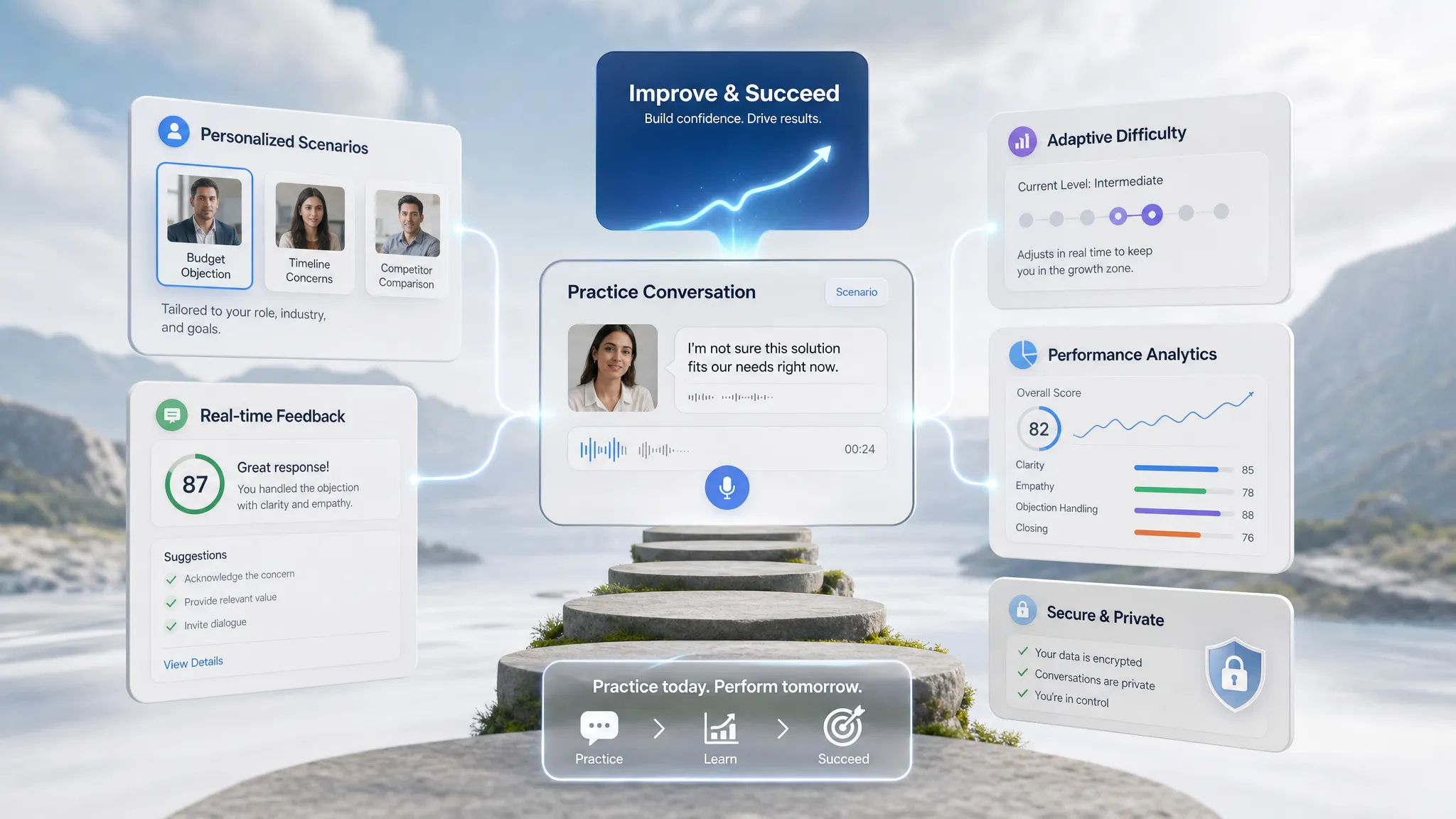
A static course gives everyone the same material. AI-driven training can adjust the situation, difficulty, and feedback based on the learner's role and performance. A classroom roleplay might give each person one turn. AI roleplay can give every rep or agent unlimited, private practice. A manager may not have time to review every attempt. AI can surface trends, highlight gaps, and help managers focus coaching where it matters.
The most effective AI features do three things well:
- They make practice more realistic, so learners build skill transfer for real conversations.
- They make feedback faster, so employees can adjust while the learning moment is still fresh.
- They make progress visible, so leaders can coach from evidence instead of anecdotes.
Research on feedback supports this shift. In The Power of Feedback, Hattie and Timperley describe effective feedback as information that helps learners understand goals, current performance, and next steps. AI cannot replace a skilled manager's judgment, but it can make that feedback loop more consistent across a team.
The AI features that improve training effectiveness
Not every AI feature improves learning. Some features are impressive in a demo but add little value after the first week. The features that matter are the ones that strengthen practice quality, feedback quality, and manager visibility.
| AI feature | Why it improves training | What to look for |
|---|---|---|
| Personalized training scenarios | Learners practice situations tied to their role, market, and skill gaps | Scenario customization by role, product, customer type, and experience level |
| AI-powered roleplay simulations | Teams get safe, repeatable practice for high-stakes conversations | Natural dialogue, realistic objections, branching customer responses |
| Real-time feedback | Learners improve immediately instead of waiting for a coaching session | Clear guidance on strengths, missed opportunities, tone, structure, and next steps |
| Adaptive difficulty | Training stays challenging without overwhelming the learner | Scenarios that become easier or harder based on performance |
| Progress tracking analytics | Managers can identify patterns and prioritize coaching | Dashboards that show trends by person, team, skill, and scenario type |
| Daily actionable tips | Learning is reinforced between formal sessions | Short prompts that connect to recent performance and current goals |
| Team-focused learning | Managers can scale best practices across groups | Shared benchmarks, cohort views, and repeatable coaching themes |
| Enterprise-grade security | Teams can train with confidence and protect sensitive data | Clear controls, secure access, privacy practices, and governance support |
Personalized scenarios make training relevant
Generic training often sounds right but fails in the field. A new sales rep handling a first discovery call does not need the same practice as an experienced account executive negotiating procurement. A support agent dealing with billing confusion needs a different scenario than a success manager trying to save a renewal.
Personalized training scenarios help employees practice the conversations they actually face. In sales, that might mean roleplaying a skeptical CFO, a busy operations leader, or a champion who needs help building internal consensus. In service, it might mean handling an upset customer, explaining a policy clearly, or escalating without losing trust.
This matters because relevance increases engagement and transfer. When a learner recognizes the scenario, the practice feels less like a quiz and more like preparation. Personalization also makes coaching more precise. Instead of telling a rep to improve communication, a manager can focus on a narrower behavior, such as clarifying business impact before presenting a solution.
AI roleplay creates safe repetition
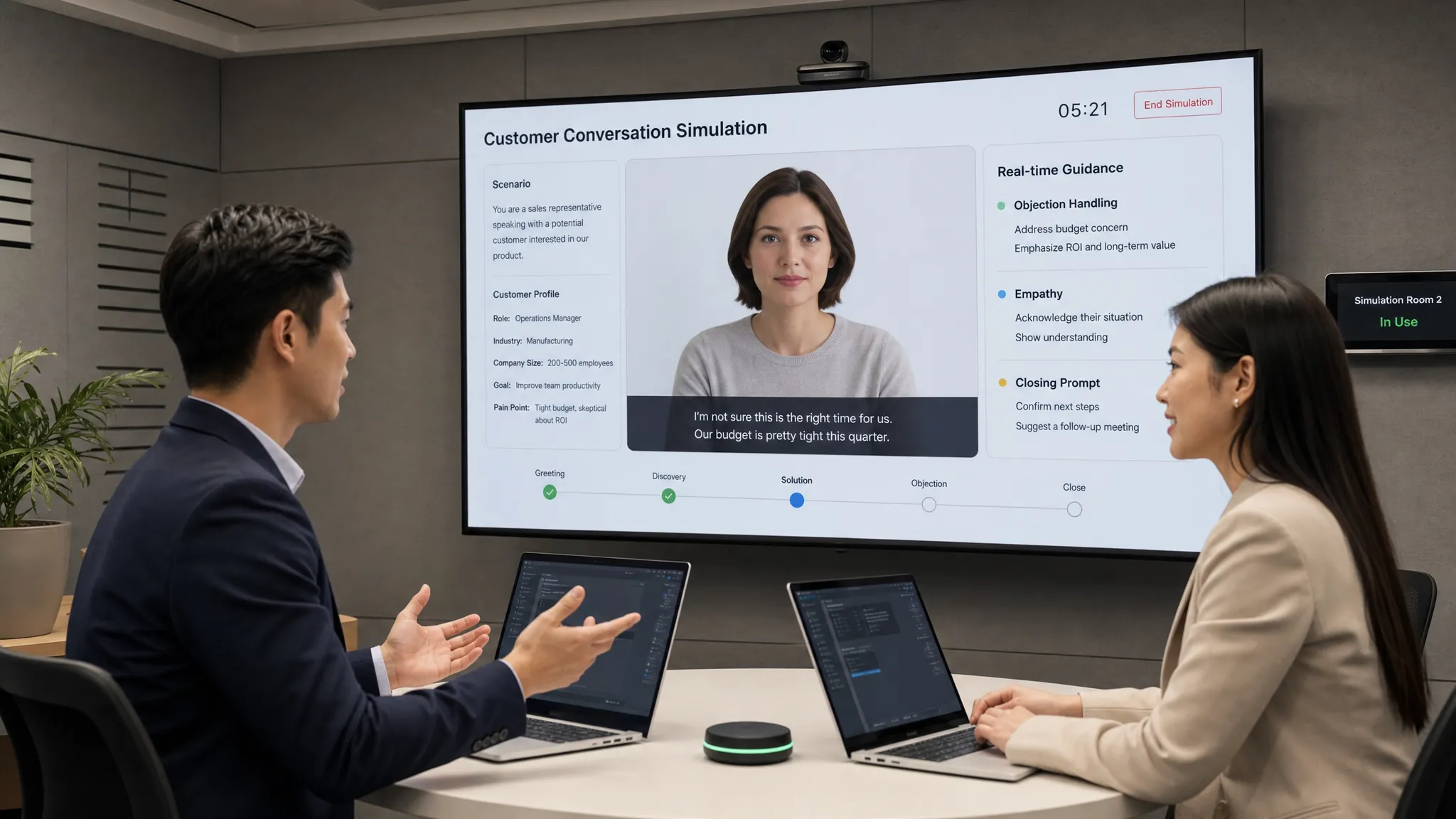
Skill improves through practice, but real customer conversations are a costly place to learn the basics. AI-powered roleplay gives employees a safe environment to rehearse before the stakes are real.
For sales teams, roleplay can simulate common situations such as pricing pushback, competitive comparisons, stalled deals, budget objections, or closing conversations. For service teams, it can simulate angry customers, unclear requests, compliance-sensitive conversations, or empathy under pressure.
The value is repetition with variation. One practice round teaches a script. Multiple rounds with different customer personalities teach judgment. A learner can try a response, see how the simulated customer reacts, adjust, and repeat. Over time, this builds confidence because employees have already faced the difficult moment before it happens live.
Real-time feedback turns practice into improvement
Practice alone is not enough. People can repeat weak habits if no one helps them see what needs to change. Real-time feedback is one of the most important AI features because it shortens the distance between action and correction.
Effective feedback should be specific, behavioral, and actionable. A weak feedback note says the conversation could be better. A useful one identifies what happened and what to do next, such as asking a clarifying question before answering the objection or summarizing the customer's concern before moving to resolution.
For sales and service leaders, the benefit is consistency. Every team member can receive guidance after every practice attempt, even when managers are busy. Managers can then use their time for deeper coaching rather than repeating the same basic observations across the team.
AI feedback works best when it supports, rather than replaces, human coaching. The system can flag patterns and suggest next steps, while managers bring context, judgment, and accountability.
Adaptive difficulty keeps learners in the growth zone
Training is ineffective when it is too easy or too hard. If scenarios are too easy, learners memorize safe responses and stop improving. If they are too hard, learners lose confidence and disengage.
Adaptive training solves this by adjusting based on learner performance. A new rep might begin with a cooperative buyer who asks basic questions. As skill improves, the scenario can introduce ambiguity, competing priorities, budget constraints, or a more skeptical stakeholder. A support agent might start with a simple troubleshooting request and later handle a frustrated customer with an urgent deadline.
This progression keeps practice in the growth zone. Learners experience challenge, but not chaos. They can build fluency step by step, which is especially useful for onboarding, product launches, and teams moving into new markets.
Analytics help managers coach from evidence
Many training programs measure completion because it is easy. Completion tells you whether someone finished a module. It does not tell you whether they can handle a tough conversation.
AI-enabled progress tracking analytics give leaders a more useful view. Instead of asking who attended training, managers can ask which skills are improving, which objections cause the most difficulty, and which teams need reinforcement before a campaign or launch.
Useful training dashboards often focus on indicators such as:
- Scenario completion and practice frequency
- Skill scores across conversation structure, listening, objection handling, empathy, and closing
- Improvement trends over time
- Common missed steps or recurring coaching themes
- Team-level readiness for specific scenarios or campaigns
The goal is not to turn training into surveillance. The goal is to make coaching more fair and focused. When managers have evidence, they can support people earlier and celebrate progress more clearly.
Reinforcement prevents one-and-done learning
Most training fades if it is not reinforced. The Institute of Education Sciences practice guide on organizing instruction and study highlights the value of spacing learning over time rather than relying only on massed practice. In workplace terms, that means a single kickoff session is rarely enough.
AI can support reinforcement through short, daily actionable tips, targeted refreshers, and practice prompts based on recent performance. A rep who struggles with pricing objections can receive a quick tip and a short scenario the next day. A service agent who needs to improve empathy can get a reminder before practicing another difficult customer interaction.
This is where AI training becomes part of the work rhythm. Instead of interrupting the week with large training blocks, teams can build skill through small, repeated moments. Those moments compound over time.
Security and governance make AI usable at scale
For organizations, training effectiveness is not only about learning outcomes. The platform also has to meet security, privacy, and governance expectations. This is especially true when training scenarios involve customer conversations, sales processes, regulated industries, or internal messaging.
The NIST AI Risk Management Framework emphasizes that AI systems should be governed, mapped, measured, and managed. In training software, that translates into practical questions about data handling, access controls, model behavior, transparency, and administrative oversight.
Leaders should look for AI features that make adoption safer, such as enterprise-grade security, clear user permissions, configurable scenarios, and reporting that supports responsible management. The more central AI becomes to training, the more important these foundations become.
Where AI features create the biggest impact
The best use cases are not abstract. They are tied to recurring performance moments where better conversations lead to better outcomes.
| Training moment | What AI practice can improve | Example scenario |
|---|---|---|
| New hire onboarding | Faster confidence and role readiness | A new rep runs discovery with a prospect who has unclear priorities |
| Product launch training | Consistent messaging and objection handling | A customer asks why the new feature matters compared with the old workflow |
| Sales objection handling | Better responses under pressure | A buyer says the price is too high and a competitor is cheaper |
| Customer service escalation | Calm communication and clear next steps | A frustrated customer demands an immediate resolution |
| Renewal or retention conversations | Value reinforcement and risk reduction | An account signals possible churn due to low adoption |
| Manager coaching | More targeted coaching conversations | A manager reviews skill trends and assigns a focused roleplay |
These moments are ideal because they happen often, are easy to define, and have clear performance signals. If a team can practice them repeatedly, leaders can measure progress and connect training to business priorities.
How to evaluate AI training features before you buy
A strong AI training platform should feel useful after the demo, not just during it. Before choosing a tool, evaluate whether the features support real behavior change.
Ask practical questions:
- Can the platform create scenarios that match our actual sales or service conversations?
- Does it support different roles, skill levels, and learning goals?
- Is feedback immediate, specific, and easy for learners to act on?
- Can managers track progress over time and identify team-wide coaching priorities?
- Does the platform support enterprise security and responsible data handling?
- Will the experience encourage regular practice, or will it become another unused learning portal?
It is also worth piloting with a real team and a real conversation challenge. Choose one high-value skill, such as handling price objections or de-escalating frustrated customers. Run a focused pilot, review practice frequency and feedback quality, then ask managers whether the insights changed their coaching behavior.
Frequently Asked Questions
What AI features are most important for effective training? The most important AI features are personalized scenarios, AI-powered roleplay, real-time feedback, adaptive difficulty, progress analytics, reinforcement prompts, and enterprise-grade security. Together, they help employees practice realistic situations, improve faster, and give managers better coaching data.
How does AI roleplay improve sales and service training? AI roleplay gives employees safe, repeatable practice for high-stakes conversations. Sales reps can rehearse objections, discovery, and closing. Service teams can practice empathy, escalation, and problem resolution before handling real customers.
Can AI training replace managers? No. AI training works best as a coaching multiplier. It can provide frequent practice, immediate feedback, and performance insights, while managers provide context, accountability, judgment, and human support.
What metrics should leaders track in AI training? Leaders should track practice frequency, scenario completion, skill improvement over time, common coaching themes, readiness by scenario, and team-level progress. Completion is useful, but it should not be the only measure.
Is AI training only useful for large enterprises? No. Organizations of many sizes can benefit when training depends on conversation quality. The key is choosing AI features that match the team's goals, complexity, and security requirements.
Turn AI features into measurable training gains
AI makes training more effective when it helps people practice the right conversations, receive useful feedback, and improve over time. For sales and service teams, that means more confidence before customer interactions and more visibility for leaders responsible for performance.
Scenario IQ brings these capabilities together with AI-powered roleplay simulations, personalized training scenarios, real-time feedback, adaptive guidance, progress tracking analytics, team-focused learning, daily actionable tips, customizable skill levels, performance metric dashboards, and enterprise-grade security.
If your team needs to build confidence, handle objections, improve communication, and strengthen customer conversations, explore Scenario IQ and see how scenario-based AI training can turn practice into performance.