

AI-driven marketing is no longer a “big brand only” advantage. In 2026, the fastest wins tend to come from small, well-scoped use cases that plug into tools you already run (CRM, email, ads, analytics) and ship in weeks, not months.
This guide gives you 10 AI-driven marketing use cases you can launch this quarter, plus what to measure, what data you need, and how to avoid the most common pitfalls.
What “AI-driven marketing” means (in practical terms)
AI-driven marketing is the use of machine learning and generative AI to predict outcomes, personalize experiences, automate decisions, and scale content or analysis with guardrails. The key is not “using AI,” it is using AI to move a business metric (pipeline, conversion rate, retention, cost per acquisition, time-to-first-response).
A useful rule: if you cannot name the KPI you expect to improve within 30 to 60 days, the use case is probably too broad for a quarter.
How to pick quarter-ready AI use cases
The best “launch this quarter” initiatives share three traits:
- You already have the data (or can instrument it quickly).
- The workflow already exists (AI accelerates it rather than replacing it).
- Success is measurable with a clear baseline.
For risk management, it also helps to keep humans in the loop for anything customer-facing until quality is proven, an approach aligned with common AI governance guidance like the NIST AI Risk Management Framework.
The 10 use cases at a glance
| Use case | Best for | Time to first value | Primary KPI | Main risk to manage |
|---|---|---|---|---|
| 1) Predictive audience segmentation | Better targeting and spend efficiency | 2 to 6 weeks | CPA, CVR, ROAS | Data leakage, biased segments |
| 2) AI-assisted email optimization | Lifecycle and newsletter teams | 1 to 3 weeks | Open rate, CTR, revenue per send | Brand drift, over-personalization |
| 3) Landing page personalization | High-traffic pages | 2 to 6 weeks | Conversion rate | Fragmented analytics, thin traffic |
| 4) Creative variant generation for paid social | Performance marketers | 1 to 4 weeks | CTR, CPA | Policy violations, low-quality claims |
| 5) Budget pacing and bid recommendations | Multi-campaign advertisers | 2 to 8 weeks | CPA stability, spend efficiency | Over-automation, seasonality |
| 6) Predictive lead scoring and routing | B2B demand gen | 2 to 8 weeks | MQL to SQL, speed-to-lead | Bad labels, rep distrust |
| 7) Conversational AI for qualification | Inbound-heavy sites | 1 to 6 weeks | Meetings booked, deflection rate | Hallucinations, compliance |
| 8) Social listening with AI summarization | Brand and comms | 1 to 3 weeks | Response time, sentiment trend | Misread sarcasm, false positives |
| 9) Churn prediction and next-best-action | Subscription and repeat purchase | 4 to 10 weeks | Retention, expansion | Wrong interventions, privacy |
| 10) AI roleplay for campaign and sales readiness | Teams launching new messaging | 1 to 4 weeks | Conversion lift, QA scores | Inconsistent talk tracks |

1) Predictive audience segmentation (propensity-based targeting)
What it is: Use historical behavior to predict who is most likely to convert (or churn), then build segments for ads, email, and onsite personalization.
How to launch this quarter: Start with a single outcome, such as “requested demo” or “first purchase,” and a single channel to activate (email or paid retargeting). Keep the first model simple, then iterate.
What to measure: Conversion rate by segment, CPA/ROAS, lift versus your current targeting.
Common pitfall: Teams accidentally train on post-conversion signals (data leakage), which makes the model look great in testing and fail in production.
2) AI-assisted email optimization (subject lines, offers, timing)
What it is: Use AI to generate and test multiple subject lines, preview text, and body variants, and to recommend send-time windows by cohort.
How to launch this quarter: Pick one lifecycle email (abandoned cart, trial onboarding, webinar follow-up). Generate 5 to 10 on-brand variants, A/B test, then roll winners into a lightweight “prompt and approve” workflow.
What to measure: Open rate, CTR, downstream conversion, unsubscribe and spam complaint rate.
Common pitfall: Optimizing opens while harming revenue or increasing complaints. Always tie optimization to a business event, not just top-of-funnel engagement.
3) Landing page personalization (message to match intent)
What it is: Dynamically change headlines, proof points, or CTAs based on traffic source, firmographics, or prior behavior.
How to launch this quarter: Personalize only one element at first (usually headline plus subhead). Start with clear intent buckets like “pricing traffic” vs “blog traffic” or “enterprise” vs “SMB.”
What to measure: Conversion rate, bounce rate, time-to-convert, form completion rate.
Common pitfall: Running too many variants on too little traffic. If sample size is thin, personalize for only the highest-volume traffic sources.
4) Creative variant generation for paid social (faster testing)
What it is: Generate more ad variations (copy hooks, headlines, image concepts) to accelerate learning and avoid creative fatigue.
How to launch this quarter: Create a brand-safe prompt library that includes approved claims, differentiators, and compliance rules. Generate variants, then have a human reviewer approve final ads before publishing.
What to measure: CTR, CPA, frequency, creative fatigue indicators (declining CTR, rising CPA over time).
Common pitfall: Letting AI invent product claims. This can create compliance and trust issues fast. Add a strict “no new claims” rule to your review checklist.
5) Budget pacing and bid recommendations (campaign-level automation)
What it is: Use AI to recommend budget shifts based on marginal returns, pacing, and conversion lag.
How to launch this quarter: Begin with a “recommendation only” phase. Let the system propose weekly reallocations, then compare against your team’s choices. Once accuracy is proven, automate within capped thresholds.
What to measure: CPA stability, spend pacing accuracy, incremental conversions per dollar.
Common pitfall: Forgetting conversion lag. Many channels have delayed attribution, so premature budget cuts can kill winners.
6) Predictive lead scoring and routing (faster follow-up, higher win rates)
What it is: Score inbound leads based on likelihood to become pipeline, then route them to the right rep, territory, or nurture track.
How to launch this quarter: Use a single definition of “good outcome” (for example, SQL or opportunity created). Train a model, then pilot it with one segment (like mid-market) before rolling out globally.
What to measure: Speed-to-lead, MQL to SQL conversion, SQL to opportunity conversion.
Common pitfall: Rep distrust. If sellers do not understand why a lead is “hot,” they will ignore it. Add explainability, even if it is basic (top contributing factors), and coach teams on how to use the score.
7) Conversational AI for qualification (chat that books meetings)
What it is: A website or in-app assistant that answers questions, qualifies visitors, and routes high-intent buyers to sales or success.
How to launch this quarter: Start with a limited scope, such as pricing questions, integration questions, and “talk to sales.” Use retrieval from approved content (help docs, pricing page, security page) rather than free-form generation.
What to measure: Meetings booked, qualification completion rate, deflection rate (for support), handoff success.
Common pitfall: Hallucinations. Use a system that can cite sources and include safe fallback behavior (offer a human handoff when confidence is low). You can also review consumer protection considerations from bodies like the U.S. FTC when designing customer-facing automation.
8) Social listening with AI summarization (faster signal extraction)
What it is: AI summarizes themes across mentions, reviews, and comments, then flags emerging issues and content opportunities.
How to launch this quarter: Define 10 to 20 tracked topics (product names, competitor comparisons, pain points). Set weekly summaries and daily alerts for spikes.
What to measure: Time-to-response, share of voice trends (if you track it), qualitative reduction in manual monitoring time.
Common pitfall: Misclassifying tone (sarcasm, slang). Keep humans in the loop for escalations and brand responses.
9) Churn prediction and next-best-action (retain and expand)
What it is: Identify at-risk customers, then recommend retention actions (education sequence, success outreach, discount, feature activation).
How to launch this quarter: Start with “early warning” scoring only, then add playbooks. A simple approach is to pilot one intervention per risk tier, measure lift, then expand.
What to measure: Retention rate, expansion rate, support ticket volume, product activation metrics.
Common pitfall: Spamming customers with “save” offers that train discount-seeking behavior. Prioritize education, value realization, and targeted outreach.
10) AI roleplay to make your messaging stick (campaign readiness at scale)
What it is: Before and during a campaign launch, use AI roleplay to train marketing, sales, and service teams on the new message, positioning, and objection handling, so leads do not fall through the cracks after you generate demand.
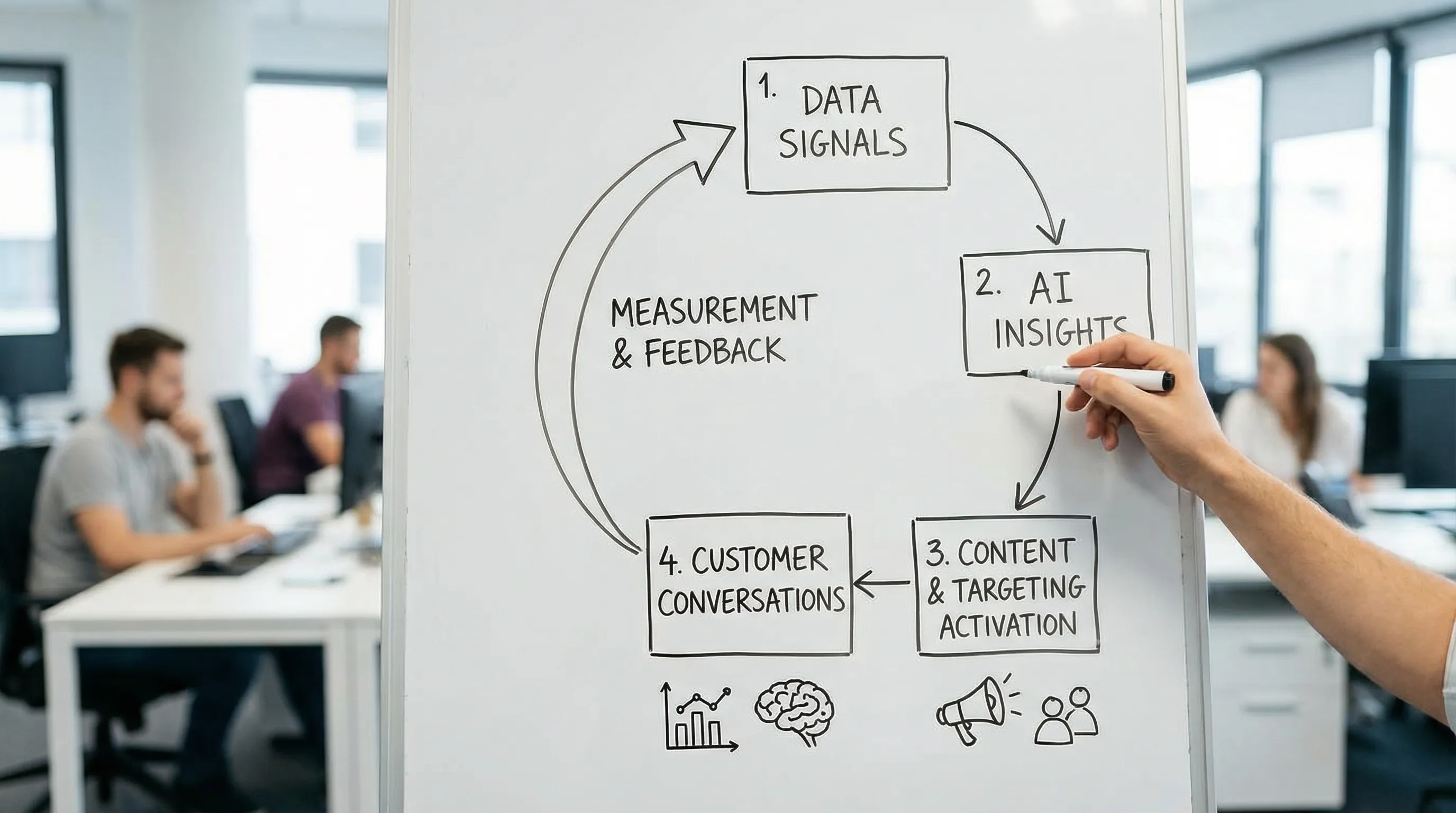
This is one of the most overlooked AI-driven marketing accelerators: great targeting and creative are wasted if customer-facing conversations are inconsistent.
How to launch this quarter:
- Build scenarios around your campaign’s top promises and top objections.
- Run short, repeatable practice sessions for reps and frontline teams.
- Track progress and coach the gaps that show up most often.
What to measure: Lead-to-meeting rate, meeting-to-opportunity rate, QA scores, confidence and consistency (via training analytics).
Where Scenario IQ fits: Scenario IQ provides AI-driven, personalized scenario-based roleplay with real-time feedback and progress analytics. That makes it a practical layer for turning new positioning into consistent conversations across sales and service teams, especially when you are launching new offers, handling competitor comparisons, or tightening qualification.
A simple 90-day rollout plan (without boiling the ocean)
Weeks 1 to 2: Pick one KPI and baseline it. Decide what you are improving (CPA, conversion rate, retention, speed-to-lead). Document the current performance and the data sources you will trust.
Weeks 3 to 6: Pilot one use case in one channel. Keep scope narrow. Build the workflow, add review steps, and ship.
Weeks 7 to 10: Expand coverage and add guardrails. Roll to additional segments, add monitoring, and document what “good” looks like.
Weeks 11 to 13: Operationalize. Turn the pilot into a repeatable process with owners, QA, and reporting.
Minimum data checklist (to launch most use cases)
You do not need perfect data, but you do need consistent definitions.
- A clear conversion event (purchase, demo request, SQL, renewal)
- Channel attribution or at least source tracking (UTMs, referrers)
- CRM or customer database with basic fields (industry, size, lifecycle stage)
- Content and policy “source of truth” for customer-facing AI (approved pages, docs)
Frequently Asked Questions
What is AI-driven marketing in simple terms? AI-driven marketing uses AI to make marketing decisions and outputs faster and smarter, like predicting who will convert, personalizing messages, and automating testing.
Which AI marketing use case is fastest to launch? Email optimization and social listening summaries are often the fastest because they build on existing workflows and require less engineering.
Do I need a data scientist to launch these use cases? Not always. Many tools provide built-in models and automation. You usually need a clear KPI owner, a data-aware marketer, and someone who can manage integrations.
How do I prevent AI from making incorrect claims in ads or emails? Use strict brand prompts, limit AI to approved source material, require human approval for customer-facing outputs, and maintain a claims checklist.
How should I measure ROI for AI-driven marketing? Tie each use case to one metric, baseline it, run a controlled test when possible, and report incremental lift (not just activity volume).
Where does sales and service training fit into AI-driven marketing? AI can generate more leads and interactions, but revenue depends on how well teams handle real conversations. Training and reinforcement help ensure the message converts consistently.
Launch smarter campaigns with teams that can close
If you are rolling out new targeting, new positioning, or a new campaign this quarter, the fastest way to protect ROI is to make sure every lead gets a consistent, confident conversation.
Scenario IQ helps organizations practice real scenarios with AI roleplay simulations, get real-time feedback, and track improvement with progress analytics. Explore how it works at Scenario IQ.