

Training platforms are in the middle of a major shift: static e-learning and “watch then quiz” modules are giving way to interactive practice, realistic conversations, and coaching that adapts to each learner. That change is largely powered by modern AI, especially conversational models that can simulate customers, prospects, patients, or internal stakeholders.
If you are evaluating AI development services for a training platform, the stakes are high. Done well, AI can increase practice volume, standardize coaching, and surface performance insights. Done poorly, it can create unsafe outputs, privacy risk, and a product that never reaches reliable scoring or ROI.
This buyer guide is written for L&D leaders, sales enablement, customer service ops, product owners, and procurement teams who need a practical way to evaluate vendors, scope a project, and decide whether to build, partner, or buy.
Start with the decision: build, partner, or buy
Before you compare service providers, clarify what you are actually purchasing. Most organizations land in one of three paths.
Buy a proven AI training platform (fastest time to value)
This is typically the best route when your goal is to launch quickly and iterate on training outcomes, not invent core AI infrastructure.
A purpose-built platform should already provide the “hard parts” that often stall custom builds, such as roleplay orchestration, scoring logic, analytics, and enterprise controls.
For example, Scenario IQ is designed for AI-driven roleplay training with personalized scenarios, real-time feedback, progress tracking analytics, adaptive guidance, enterprise-grade security, and performance dashboards. If your needs align with those capabilities, buying can reduce implementation risk and internal engineering load.
Partner with AI development services (custom experience on top of your learning ecosystem)
Choose this path when you have unique requirements, such as:
- A proprietary competency model and scoring rubric that must match internal coaching standards
- Highly regulated data flows and approval processes
- Deep integration requirements across LMS, HRIS, CRM, contact center tools, and data warehouses
- A need to embed AI practice experiences inside an existing platform you already own
In this model, an AI development services team builds or extends components like conversation engines, scoring, analytics pipelines, admin tooling, and evaluation harnesses.
Build in-house (maximum control, highest delivery burden)
This is usually justified only if:
- AI is a core differentiator of your business model
- You have ongoing budget for ML engineering, data engineering, product, and security
- You can sustain continuous evaluation, red-teaming, and model updates
If you cannot commit to that long-term operational load, you may end up with a brittle prototype that is expensive to maintain.
What “AI development services” should include for training platforms
Many vendors describe themselves broadly as AI developers. For training platforms, you want teams who understand the full loop: scenario design, learner interaction, feedback, measurement, and governance.
1) Scenario design and simulation orchestration
A training simulation is not just a chatbot.
It requires:
- Scenario templates (context, persona, constraints, success criteria)
- Role-based behaviors (prospect vs customer vs manager)
- Difficulty levels and branching behaviors
- Consistent, repeatable run conditions so performance is comparable over time
Ask whether the vendor has built systems for scenario libraries, versioning, and A/B testing. Without that, you cannot reliably iterate on training quality.
2) Scoring, rubrics, and feedback that learners trust
In training, “accuracy” is not the only goal. Learners need feedback that is:
- Specific (what to change)
- Actionable (what to say instead)
- Aligned to your rubric (what your managers coach)
- Consistent (two learners shouldn’t get contradictory evaluations for the same behavior)
Your vendor should be able to implement rubric-driven evaluation, calibration workflows, and reviewer tools for spot-checking.
3) Analytics that connect practice to performance
A serious training platform should measure more than completion rates. Buyers should expect:
- Skill progression over time
- Common objection patterns and response quality
- Cohort comparisons by region, team, or role
- Coaching insights (where managers should focus)
If you are buying development services, confirm the vendor can design event tracking, metrics definitions, dashboards, and data exports that fit your BI and governance model.
4) Safety, privacy, and security by design
Training conversations often contain sensitive information (customer details, pricing talk-tracks, health or financial context, internal policies). Your vendor should demonstrate a credible safety program, not vague promises.
Useful references to benchmark against:
- NIST AI Risk Management Framework (AI RMF 1.0) for governance and risk controls
- OWASP Top 10 for LLM Applications for prompt injection and related risks
At minimum, expect clear answers on data retention, access controls, audit logging, and how they handle model and prompt security.
The buyer’s evaluation framework (what to compare across vendors)
Below is a practical way to evaluate AI development services specifically for training platforms.
Fit-to-purpose checklist
Use this to quickly separate generalist AI teams from training-ready teams.
| Evaluation area | What “good” looks like | Red flags |
|---|---|---|
| Roleplay realism | Persona consistency, controlled tone, scenario constraints, difficulty tuning | “It’s basically ChatGPT with a prompt” |
| Rubric scoring | Transparent criteria, calibration tools, repeatability, bias checks | Scores change unpredictably, cannot explain why |
| Feedback quality | Specific coaching, examples, next-best responses, tailored to level | Generic advice, inconsistent guidance |
| Analytics | Skill progression, team insights, exports, dashboarding plan | Only raw transcripts or vanity metrics |
| Safety & privacy | Threat modeling, testing, access controls, documented policies | Hand-waving about “we’re secure” |
| Delivery capability | Clear milestones, evaluation harness, monitoring plan | Prototype-first with no reliability plan |
A practical question set for vendor calls
You do not need a 60-page RFP to uncover capability. A focused set of questions often reveals who has done this before.
On training outcomes
- How do you convert our competency framework into scoring criteria that are stable and auditable?
- How do you measure whether AI feedback improves learner performance over time?
- Can you support multiple skill levels and role variations without rebuilding everything?
On technical architecture
- What is your approach to model selection, orchestration, and fallback behaviors if the model fails?
- How do you handle evaluation at scale (automated tests plus human review)?
- How do you monitor for drift, regressions, or unsafe outputs after launch?
On security and compliance
- What data is stored, for how long, and who can access it?
- How do you defend against prompt injection and data exfiltration in conversational apps?
- Can you support enterprise requirements such as SSO, audit logs, and customer-managed policies (where required)?
Keep the conversation anchored on training realities: repeatability, scoring consistency, and measurable improvement.
Key architecture choices that affect cost and risk
Even if you are not building in-house, understanding core architecture choices helps you avoid vendor lock-in and surprise costs.
Model strategy: one model, many models, or hybrid
A common pattern in training platforms is to use different approaches for different tasks:
- Simulation dialogue: conversational model
- Scoring and classification: a more constrained evaluator approach (sometimes separate prompts, sometimes smaller models)
- Safety checks: dedicated filters, policies, or rules
Ask vendors how they separate these concerns. If everything is routed through a single prompt and a single model, you may see unstable scoring and limited controls.
Evaluation harness: your reliability “engine”
For training, you need the equivalent of unit tests and regression tests, but for conversations and scoring.
A strong vendor will propose:
- Golden set scenarios for repeatable testing
- Rubric-based expected outcomes
- Periodic human review to catch subtle failure modes
- Release gates for prompt/model changes
If a vendor cannot describe their evaluation harness, you are buying ongoing instability.
Data pipeline design: transcripts are not enough
To generate actionable insights, you need structured events and metrics, not just conversation logs. Confirm how they will capture and define:
- Attempts, completions, retries
- Skill tags and rubric dimensions
- Confidence or quality indicators (carefully defined)
- Time-to-proficiency measures
Implementation plan: what a realistic rollout looks like
A training platform AI rollout should be staged so you can validate learning value before scaling.
| Phase | Typical goal | What you should have at the end |
|---|---|---|
| Discovery and rubric alignment | Define skills, scenarios, success criteria | Scenario library outline, scoring rubric draft, risk register |
| Prototype (controlled) | Validate roleplay flow and feedback usefulness | 5 to 20 scenarios, initial scoring, internal review loop |
| Pilot | Prove outcomes with a real cohort | Performance baseline, improvement signals, revised scenarios |
| Scale | Expand roles, regions, and content | Admin process, monitoring, analytics, governance cadence |
Procurement tip: structure the contract so early phases pay for validated milestones, not vague “AI capability.”
Cost drivers buyers often miss
Buyers frequently underestimate a few cost drivers that show up after the first demo.
Ongoing iteration is not optional
Training content changes. Messaging changes. Objections evolve. If you want consistent outcomes, you will need a workflow for updating scenarios and scoring criteria.
Ask vendors how they support:
- Scenario versioning and rollbacks
- Prompt/model change management
- Post-launch monitoring and incident response
Safety and compliance work is real engineering
If your organization requires security reviews, vendor risk assessments, or specific compliance mapping, that effort must be planned.
Look for teams that can speak concretely about controls and evidence, not just marketing language.
Adoption tooling can matter more than AI quality
Even excellent AI roleplay will fail if managers and learners do not adopt it. Buyers should ensure the delivery plan includes:
- Manager enablement (what to coach and how to interpret analytics)
- Internal comms and rollout support
- A clear feedback loop from learners to improve scenarios
If you buy a platform rather than bespoke development, confirm these workflows exist in-product or can be supported with your team’s processes.
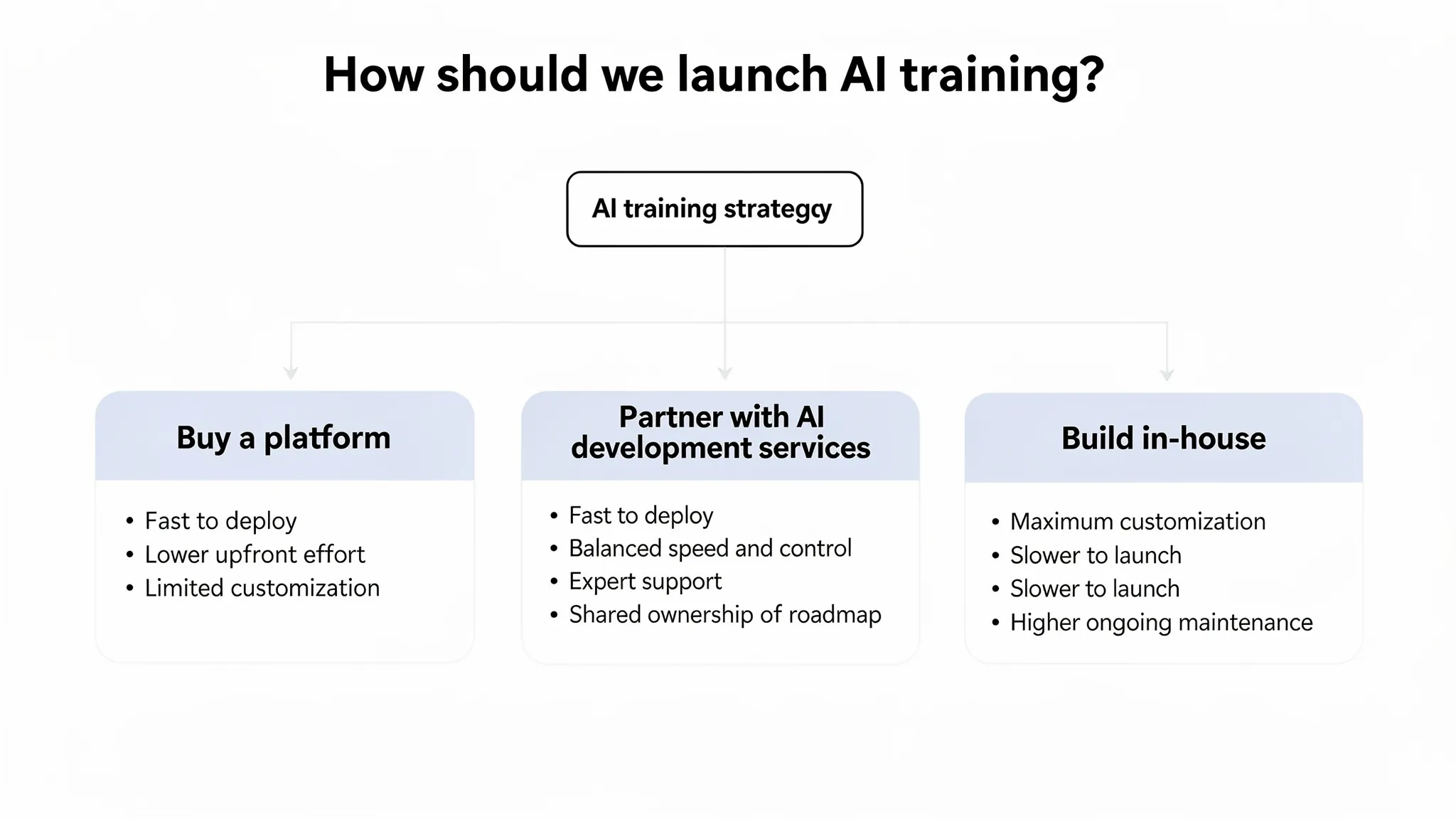
How to compare a platform purchase vs AI development services
If your primary goal is to deploy AI roleplay training across teams, a proven platform can be the lowest-risk path. Development services are best when you must deeply customize the experience or embed it into a broader product.
Here is a practical comparison you can reuse internally.
| Option | Best for | Tradeoffs to plan for |
|---|---|---|
| Buy an AI roleplay training platform | Fast rollout, lower engineering burden, proven workflows | Less flexibility than full custom, roadmap dependency |
| Hire AI development services | Custom scenarios, unique scoring, deep integrations | Higher delivery risk, ongoing maintenance planning |
| Build in-house | Maximum control and differentiation | Highest long-term cost, requires dedicated AI ops and governance |
If you are leaning toward “buy,” use the vendor evaluation checklist to ensure the platform is training-first (scoring, analytics, governance), not just conversational.
What “good” looks like in a training-first AI product
Whether you buy or build, the standard should be the same: the AI must create practice that is realistic, measurable, and safe.
A training-first solution typically includes:
- AI-powered roleplay simulations that can be tailored to roles and industries
- Personalized scenarios and adjustable skill levels
- Real-time feedback that maps to a rubric
- Progress tracking analytics and performance dashboards
- Enterprise-grade security and operational controls
These are the kinds of capabilities Scenario IQ is positioned around, which is why many teams evaluate it when their goal is sales and service performance improvement through AI roleplay training. You can explore the platform at Scenario IQ and use the framework in this guide to compare it with custom development proposals.
Buyer next steps: make your decision defensible
To move from research to a confident purchase decision, align your stakeholders around three artifacts:
- A one-page success definition: Which roles, which skills, what measurable improvement, and in what timeframe.
- A scenario and rubric starter set: 10 to 20 high-value situations and a scoring rubric that managers agree on.
- A vendor scorecard: Use the tables in this guide to rate each option on scoring consistency, analytics maturity, safety posture, and rollout risk.
Once you have those, the choice between AI development services and a ready platform becomes much clearer, and your rollout is far more likely to deliver measurable impact.