
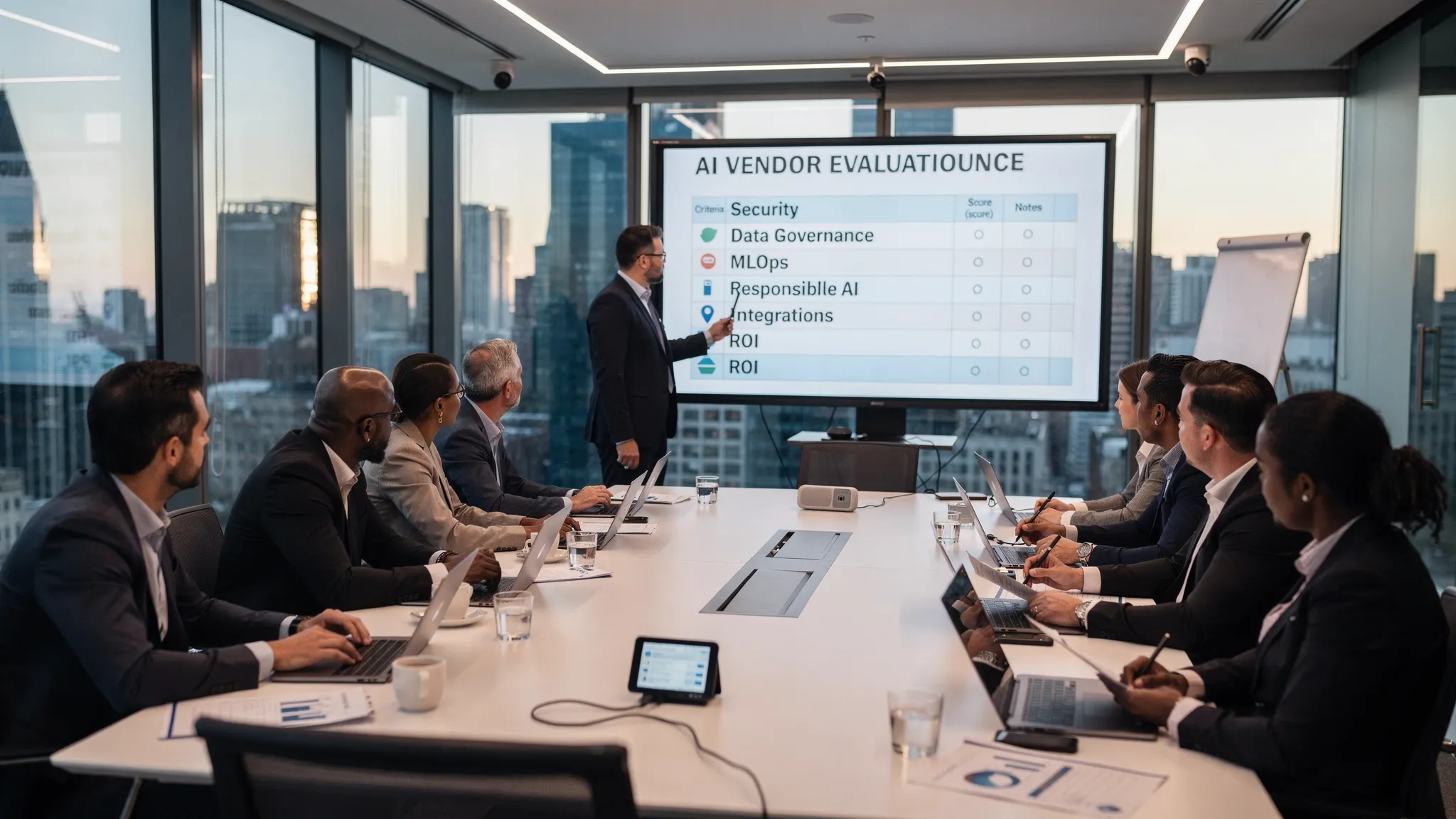
Choosing among AI development companies in 2026 is less about who can “build an AI app” and more about who can deliver a reliable, secure, governable AI capability that survives real-world usage. Between rapidly changing foundation model options, stricter AI governance expectations, and higher scrutiny on data handling, procurement teams need a checklist that goes beyond demos and buzzwords.
This guide gives you a practical evaluation framework to compare AI development partners consistently, with questions you can reuse in RFPs, interviews, and reference checks.
What “AI development company” should mean in 2026
In 2026, a credible AI development partner should be able to do more than prompt an LLM. They should be able to:
- Translate business outcomes into measurable AI requirements (accuracy, latency, cost, compliance).
- Architect for modern AI patterns like retrieval augmented generation (RAG), tool use (agents), and hybrid ML.
- Operationalize models with monitoring, drift management, and incident response.
- Implement security, privacy, and governance suitable for your risk profile.
If a vendor cannot explain how they handle model failures, data leakage risk, and ongoing evaluation, they are not an “AI development company” in the way buyers need in 2026.
Step 0: Clarify your use case and risk level before evaluating vendors
Your checklist will only work if you start with two decisions:
1) What outcome are you buying?
Examples:
- Internal copilots for sales, service, HR, or engineering.
- Customer facing conversational experiences.
- Document intelligence (summarization, extraction, classification).
- Forecasting, anomaly detection, personalization.
Write the outcome as a metric (for example, reduce average handle time by X percent, raise conversion rate by Y percent, or cut onboarding time by Z days). Vendors should respond to outcomes, not just features.
2) Are you in a higher risk category?
Higher risk contexts (regulated industries, decisions affecting employment, credit, healthcare, or safety) demand stronger governance. A useful reference point is the NIST AI Risk Management Framework, which many enterprises use as a baseline for AI risk controls.
2026 Evaluation Checklist (with weighted scoring)
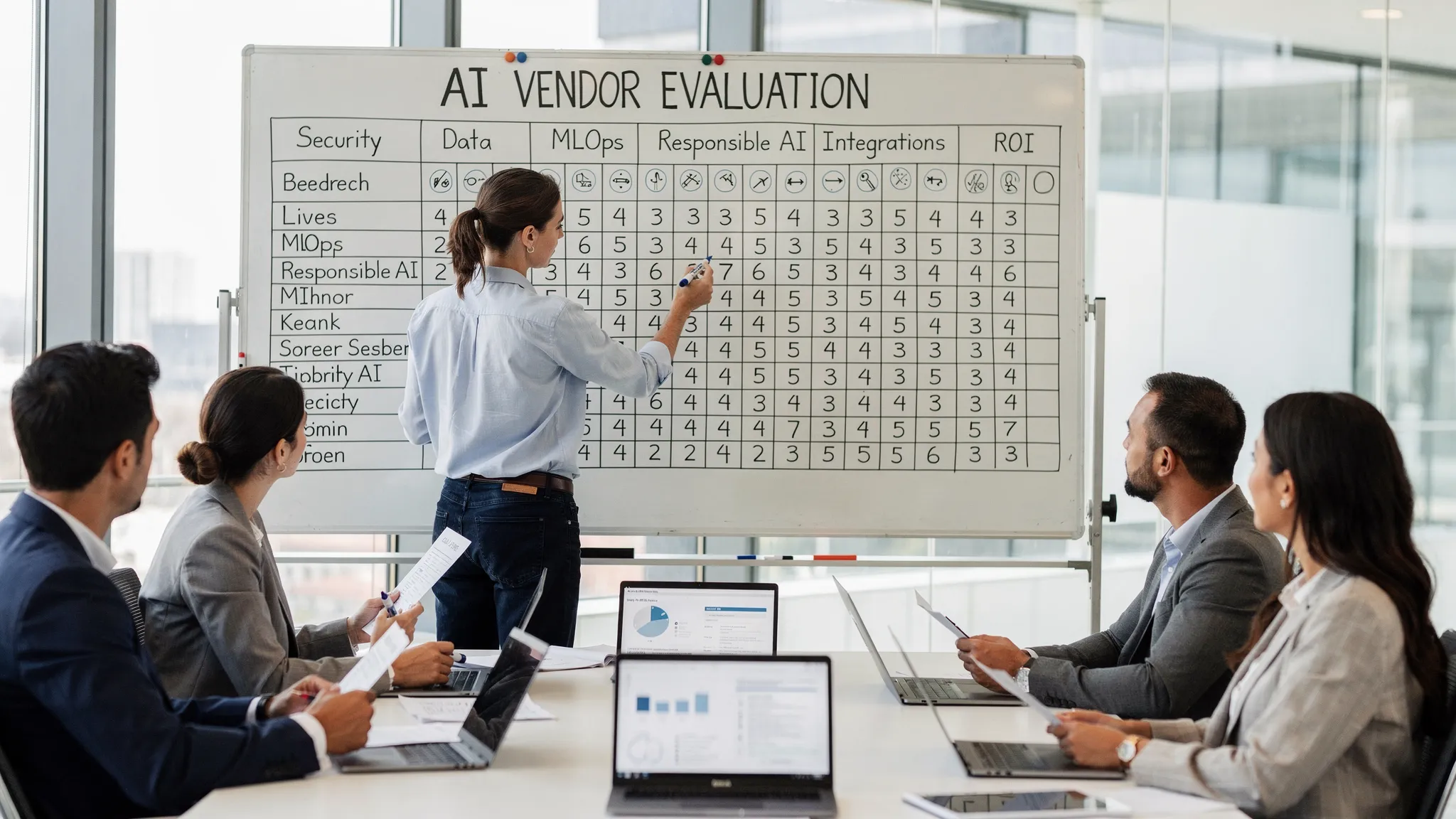
Use the categories below to score each vendor 1 to 5, then apply weights based on your needs.
| Category | What “good” looks like in 2026 | Suggested weight |
|---|---|---|
| Business alignment | Outcome based discovery, measurable success criteria, clear ROI story | 15% |
| Technical architecture | Sound approach to RAG/agents, integration, performance, cost controls | 20% |
| Data governance & privacy | Clear data flows, minimization, retention, lawful basis, vendor isolation | 15% |
| Security & compliance | Security program, audits, secure SDLC, incident response maturity | 15% |
| MLOps/LLMOps | Continuous evaluation, monitoring, rollback, reproducibility, versioning | 15% |
| Responsible AI & safety | Bias testing, red teaming, guardrails, explainability appropriate to use case | 10% |
| Delivery & change mgmt | Realistic roadmap, enablement, documentation, handover | 5% |
| Commercials & legal | Transparent pricing, IP terms, SLAs, portability and exit plan | 5% |
You can adjust weights, but avoid letting “demo quality” dominate the decision.
1) Business alignment: can they map AI to measurable outcomes?
A strong partner will push you to define success early, then design evaluation around that definition.
Ask:
- What metrics will prove this is working (quality, latency, cost per task, adoption, deflection, conversion)?
- What is your plan for a pilot that avoids “toy demo” success?
- How do you prevent scope creep when stakeholders discover new AI possibilities?
Red flags:
- They promise universal automation without discussing change management.
- They cannot propose an evaluation plan beyond “user feedback.”
2) Technical capability: architecture that fits 2026 realities (RAG, tools, and reliability)
The vendor should demonstrate a principled approach to modern AI architectures and tradeoffs.
What to look for
Retrieval and knowledge grounding (RAG): For most enterprise text use cases, reliability depends on retrieval quality, document freshness, permissioning, and citation strategies more than the base model choice.
Tool use (agents): If they propose agents, they should describe guardrails (tool allowlists, spending limits, step limits), audit logs, and failure handling.
Integration: Expect concrete experience with identity providers, CRMs, ticketing systems, and data warehouses.
Performance and cost controls: In 2026, total cost of ownership often comes down to caching, batching, routing to smaller models, and evaluation driven prompt changes.
Ask:
- How do you measure and improve retrieval quality (for example, recall, precision, groundedness)?
- When do you choose smaller models or hybrid ML instead of the largest model available?
- What is your approach to hallucination reduction and answer verification?
3) Data governance and privacy: you should understand every data flow
Many AI failures in production are data failures: unclear retention, accidental training exposure, or overly broad access.
Minimum expectations
- Data flow diagrams (what data enters, where it is stored, who can access it, how long it persists).
- Clear separation between your data and other customers’ data.
- Support for least privilege and role based access.
- A documented approach to data minimization and retention.
If you operate in regulated contexts, verify alignment with relevant privacy regimes and internal policies. For general privacy principles and enforcement posture, the FTC’s business guidance on AI is a useful reference point when shaping vendor expectations.
Ask:
- Will any of our data be used to train models, even in aggregated form?
- What is your retention policy for prompts, outputs, logs, and embeddings?
- How do you handle tenant isolation and access controls?
4) Security and compliance: treat AI as production software (plus extra risk)
Your AI vendor should behave like a mature software security organization.
Evidence to request
- Security documentation and audit reports relevant to your needs (commonly SOC 2 Type II for many SaaS contexts).
- Secure SDLC practices (threat modeling, code review, dependency scanning).
- Incident response plan with timelines and communication procedures.
- Penetration testing approach and remediation practices.
Ask:
- How do you prevent prompt injection and data exfiltration in LLM apps?
- How are secrets managed (API keys, tokens), and how is access logged?
- What is your process for vulnerability disclosure and patch SLAs?
5) MLOps and LLMOps: can they run and improve the system after launch?
In 2026, a vendor should assume that models, prompts, and data will change. Your evaluation should focus on operational readiness.
What “good” looks like
- An evaluation harness with test sets tied to your business outcomes.
- Monitoring for quality regressions, latency, cost spikes, and safety events.
- Clear rollback strategy (prompt versions, model routing changes, feature flags).
- Reproducibility (ability to recreate an output path for audit and debugging).
Ask:
- How do you build and maintain gold datasets for ongoing evaluation?
- What monitoring do you set up on day one, and what triggers an incident?
- How do you handle model upgrades without breaking workflows?
6) Responsible AI and safety: governance is now part of delivery
Even if you are not in a heavily regulated sector, buyers increasingly expect responsible AI practices.
A helpful management system standard to be aware of is ISO/IEC 42001 (AI management systems). A vendor does not need certification to be competent, but they should speak clearly about how they manage AI risks.
Ask:
- How do you test for bias and harmful outputs relevant to our users?
- Do you perform red teaming (structured adversarial testing)? What did you learn recently?
- How do you ensure users know when they are interacting with AI, when applicable?
Red flags:
- “The model provider handles safety, so we don’t need to.”
- No plan for human escalation paths in customer facing flows.
7) Delivery, enablement, and adoption: can they drive real usage?
AI projects fail when users do not trust the output or do not change habits. Evaluate how the vendor helps your teams adopt the solution.
Ask:
- What does implementation look like week by week, and who is accountable?
- What training, documentation, and internal enablement do you provide?
- What does handover look like if we want to own the system long term?
This is also a good place to decide whether you need to build at all. Some outcomes, especially around sales and service readiness, can be achieved faster with specialized platforms rather than custom development.
8) Commercials and legal: pricing transparency and an exit plan
AI spend can become unpredictable if pricing is tied to usage without controls.
Ask:
- Is pricing based on tokens, seats, calls, compute, or outcomes? What are the biggest cost drivers?
- What guardrails exist to prevent runaway usage costs?
- Who owns prompts, fine-tunes, evaluation datasets, and integrations?
- How do we export our data and configurations if we leave?
A practical vendor interview script (copy/paste)
Use these questions in a 60 to 90 minute evaluation call:
- Walk us through a similar production deployment. What failed, and how did you fix it?
- Show your evaluation approach for quality and safety. What metrics do you track weekly?
- Describe your data retention defaults for prompts, outputs, embeddings, and logs.
- Explain how you defend against prompt injection and sensitive data leakage.
- What is your model strategy (single provider vs multi model routing), and why?
- What does the first 30 days look like, and what do you need from our team?
How to compare proposals objectively (example scoring rubric)
If you want a quick decision aid, use a rubric like this and require evidence for each score.
| Score | Definition | What evidence looks like |
|---|---|---|
| 1 | Claims only | Vague answers, no artifacts |
| 2 | Some experience | One example, limited documentation |
| 3 | Repeatable delivery | Templates, playbooks, clear process |
| 4 | Proven at scale | Multiple comparable deployments, strong references |
| 5 | Best in class | Measurable outcomes, mature governance, strong auditability |
Common red flags when evaluating AI development companies
Watch for patterns that predict pain later:
- Overreliance on a demo that is not connected to your data or workflows.
- No clear position on privacy, retention, and whether your data trains models.
- “Agent” proposals without guardrails, audit logs, and cost controls.
- No ongoing evaluation plan, only a one-time acceptance test.
- Vague security answers, or unwillingness to share security documentation.
Frequently Asked Questions
What should I look for in AI development companies in 2026? Look for operational maturity: evaluation harnesses, monitoring, security controls, clear data retention policies, and responsible AI practices, not just impressive demos.
How do I verify an AI vendor’s security claims? Ask for security documentation (commonly SOC 2 Type II for many SaaS contexts), incident response procedures, secure SDLC details, and evidence of penetration testing and remediation.
Do we need a custom AI development company, or can we buy an off-the-shelf solution? If your use case is a common workflow (like sales coaching or service enablement), a specialized platform can be faster and lower risk than custom build. Custom development is best when your workflow is unique or requires deep integration and governance.
What questions reveal whether a vendor can run AI in production? Ask how they monitor quality and safety, how they handle model upgrades, what triggers an incident, and how they roll back changes. Production readiness is mostly about evaluation and operations.
If your goal is better sales and service performance, consider build vs buy
If you are evaluating AI development companies because you want to improve frontline conversations, objection handling, or customer experience, you may not need a custom AI build to get results.
Scenario IQ provides AI-driven, personalized roleplay training with real-time feedback and progress tracking analytics, helping teams build confidence and consistency in sales and service scenarios.
If you want to accelerate performance without waiting for a full custom development cycle, explore Scenario IQ and see how scenario-based AI training can fit into your enablement strategy.