

Faster resolutions are a growth lever, not just a support metric. AI can cut the time to solve by detecting intent, surfacing the right answer, and removing busywork. The teams that win pair automation with well trained agents, clear guardrails, and strong measurement.
What “faster” really means in support
Speed is a set of outcomes, not a single number. Use a balanced scorecard so quick replies do not create recontacts.
| Metric | What it tells you | How AI helps |
|---|---|---|
| First Contact Resolution | Share of issues solved in one interaction | Intent detection, policy aware responses, smart routing |
| Average Handle Time | Time agents spend per conversation | Summaries, suggested replies, auto logging and wrap up |
| Time to First Response | Time from customer message to first reply | Instant triage and acknowledgment, multilingual drafts |
| Self Service Containment | Share resolved by bot or help center | Retrieval grounded answers and safe automation |
| Reopen or Recontact Rate | Repeat contacts about the same issue | Root cause analysis, better guidance and deflection |
| CSAT or Customer Effort | Experience of getting help | Clear next steps, fewer transfers, consistent answers |
Industry reports like Zendesk’s Customer Experience Trends and Salesforce’s State of Service show organizations investing in AI to improve these metrics, while warning that training and change management determine real world impact. See Zendesk’s trends overview at zendesk.com/customer-experience-trends and Salesforce’s research hub at salesforce.com/resources/research-reports/state-of-service.
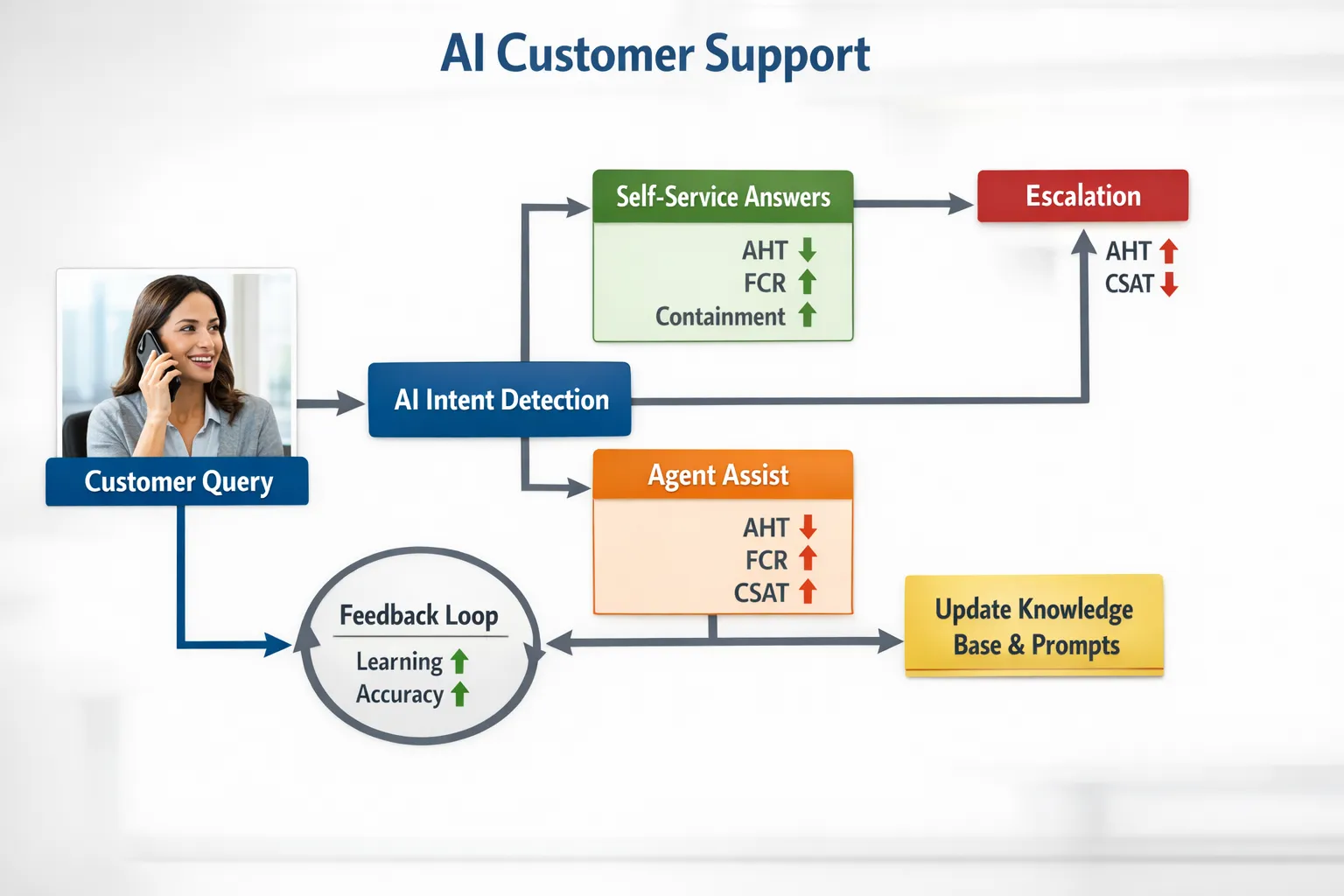
AI customer support best practices for faster resolutions
1) Start with high intent journeys that drive volume and cost
Map the top 15 to 25 contact reasons by volume and by cost to serve. Choose intents that are deterministic enough to automate or accelerate, such as order status, password reset, plan changes, refunds under a threshold, or shipping issues. Define success criteria in terms of FCR, containment, and CSAT before you write a single prompt.
- Write canonical answers for each intent, including eligibility rules and edge cases.
- Add structured data where possible, such as refund thresholds and exception paths, so the assistant can reason without guessing.
- Pilot with one channel first, for example chat, then expand.
2) Ground every AI answer in a clean knowledge base
Hallucinations create recontacts. Use retrieval grounded generation, clear citations, and tight context windows.
- Consolidate policies into a single source of truth with version control and owners.
- Chunk content into task sized snippets with explicit titles, effective dates, and scope.
- Require the AI to cite the policy or article it used. Prefer short, linked snippets over long free text.
A strong KB does more for speed than any prompt tweak. McKinsey has noted that most time savings in service come from eliminating search and rework, not from fully automating complex cases. See the broader analysis at mckinsey.com.
3) Use AI for triage and routing before full automation
Fast routing is often a bigger win than full self service. Classify intent, language, sentiment, and customer tier, then route to the shortest path to resolution.
- Autotag tickets with intent and urgency so workforce managers can staff intelligently.
- Prefill forms and case fields from the conversation to eliminate manual steps.
- Suggest the next best action, for example request a photo, issue a replacement, or escalate to billing.
4) Design human in the loop escalation that actually speeds things up
Set firm handoff rules, then make handoffs useful. When a bot escalates, it should include a concise summary, the verified customer data, attempted steps, and the relevant citations. Agents should never re ask basic questions.
- Use timeouts, confidence thresholds, and sensitive topic lists to trigger handoff.
- Show the agent a one screen brief, not a transcript dump.
- Let customers choose to talk to a human at any time to avoid frustration.
5) Supercharge agents with real time assist, not replacement
Agent assist should feel like cruise control, not a back seat driver. Focus on removing clicks and searching.
- Offer suggested replies with cited sources, editable before sending.
- Auto summarize long threads and generate disposition notes and follow ups.
- Provide live policy checks, for example whether a fee waiver is allowed.
Training matters. Agents need to practice supervising AI, correcting responses, and knowing when to override.
6) Instrument the entire funnel, then iterate weekly
Measure by intent and by channel so you can tune where it matters most. Review a small, representative sample of conversations every week to calibrate.
| Best practice | What it speeds up | Implementation tips |
|---|---|---|
| Intent level dashboards | Bottleneck discovery | Track AHT, FCR, and CSAT by intent and segment |
| Containment analytics | Self service performance | Separate silent abandonment from true resolution |
| Quality checks with rubrics | Accuracy and consistency | Score citations, policy adherence, and tone |
| Error budget for AI | Safe iteration speed | Roll back prompts when error rate exceeds threshold |
7) Treat prompts and policies as products
Prompts need owners, versions, tests, and release notes. Build a small evaluation set per intent that includes tricky edge cases.
- Keep prompts short and explicit, with structured instructions and examples.
- Log failures, for example wrong policy, missing step, or tone issue, then update both KB and prompts.
- Red team sensitive scenarios before broad rollout.
For governance guidance, the NIST AI Risk Management Framework is a practical reference for mapping risks, measuring controls, and managing change.
8) Automate the right actions, not every action
Start with low risk, high frequency actions such as order status lookups, appointment bookings, or simple credits under a limit. Keep humans in the loop for identity sensitive or high dollar moves.
- Use clear guardrails like maximum refund and allowed dispositions.
- Record the decision trail and the policy citation for audits.
- Provide customers a receipt of the action taken.
9) Protect customer data and latency budgets
Speed and privacy are both non negotiable. Minimize the data you send to models, mask personally identifiable information, and cache static answers to reduce round trips.
- Redact PII before sending data to external services.
- Separate sensitive lookups into secure, scoped microservices.
- Set latency SLOs per channel, for example 1 to 2 seconds for chat suggestions.
10) Train your people for AI enabled support
Tools only work when people trust and master them. Roleplay the new flows, calibrate judgment, and reinforce good behaviors with timely feedback.
- Practice escalations, exception handling, and tone adjustments.
- Coach agents to edit AI drafts rather than rewrite from scratch.
- Track skill adoption by team and identify where confidence is low.

A 60 day plan to cut resolution times
Days 1 to 15, baseline and focus
Audit top intents by volume and cost, sample conversations, and document canonical answers with owners. Stand up basic intent tagging and a lightweight agent assist for two intents. Establish a weekly review with ops, QA, and knowledge owners.
Days 16 to 30, pilot and measure
Launch self service for the easiest intent and expand agent assist to five intents. Track AHT, FCR, containment, and recontact by intent. Run calibration sessions to review failures and fix root causes in the KB.
Days 31 to 60, expand and coach
Add guardrailed automations for low risk actions such as replacements under a threshold. Enable summarized handoffs for escalations. Train all agents on the new flows with targeted roleplays and publish a living playbook with prompts, policies, and examples.
Real world scenarios to practice for speed
- Shipping delay with partial stock, explain options, set realistic timelines, and preempt recontacts with proactive updates.
- Refund policy exception, verify eligibility, cite the policy, and document the exception trail.
- Outage triage, detect spikes, acknowledge impact, offer workarounds, and route complex cases to engineering with clean summaries.
- Password reset with identity verification, follow a clear KBA flow, respect privacy, and offer step by step guidance.
- Subscription change with proration, calculate impacts, surface alternatives, and confirm next billing date.
Common pitfalls that slow resolutions
- Uncurated knowledge, conflicting policies force agents to hunt or guess.
- Over automation without escape hatches, customers get stuck and recontact.
- No measurement by intent, teams cannot see where to tune.
- Latency sprawl, multiple sequential calls slow every reply.
- Lack of agent training, AI drafts get ignored or misused.
Turning best practices into daily habits with Scenario IQ
Faster resolutions require both smarter systems and confident people. Scenario IQ helps support teams adopt AI assisted workflows faster with training that sticks.
- AI powered roleplay simulations let agents practice high intent scenarios safely.
- Personalized training scenarios mirror your common issues, policies, and tone.
- Real time feedback highlights policy adherence, clarity, and empathy.
- Progress tracking analytics and performance metric dashboards show skill adoption and impact over time.
- Team focused learning with adaptive feedback and daily actionable tips builds habits.
- Customizable skill levels support new hires and senior agents alike.
- Enterprise grade security supports training at any scale.
If you are rolling out agent assist, new escalation paths, or self service flows, scenario based training compresses the adoption curve and protects your KPIs.
FAQs
What is the fastest way to see impact from AI in support? Start with agent assist on two to three high volume intents. Suggested replies, summaries, and auto logging can reduce handle time within weeks while you harden self service.
How do we prevent AI mistakes from hurting CSAT? Ground answers in a maintained knowledge base, require citations, set confidence thresholds with human handoff, and review a weekly sample to fix root causes.
What should we measure besides AHT? Track FCR, containment, recontact rate, and CSAT by intent and by channel. Speed without first contact resolution usually creates more tickets later.
How do we handle sensitive cases? Use clear guardrails for actions, require human approval for high risk moves, and redact PII. Follow frameworks like the NIST AI RMF for governance.
How do we train agents to use AI effectively? Practice with realistic scenarios, coach when to accept or edit AI drafts, and give immediate feedback. Platforms like Scenario IQ provide AI powered roleplays, real time feedback, and analytics to accelerate adoption.
Can AI help with back office steps that slow resolutions? Yes, use AI to extract details, populate forms, summarize cases for handoffs, and suggest next actions. Save full automation for low risk tasks with clear policies.
Move from ideas to faster resolutions
Ready to shorten time to solve without sacrificing quality? Give your team hands on practice with AI assisted workflows. Explore how scenario based training can accelerate adoption and protect your KPIs with Scenario IQ.