

Retention is rarely lost in one dramatic moment. It is usually chipped away by slow replies, inconsistent answers, frustrating handoffs, and “we don’t know” moments that make customers quietly start shopping around.
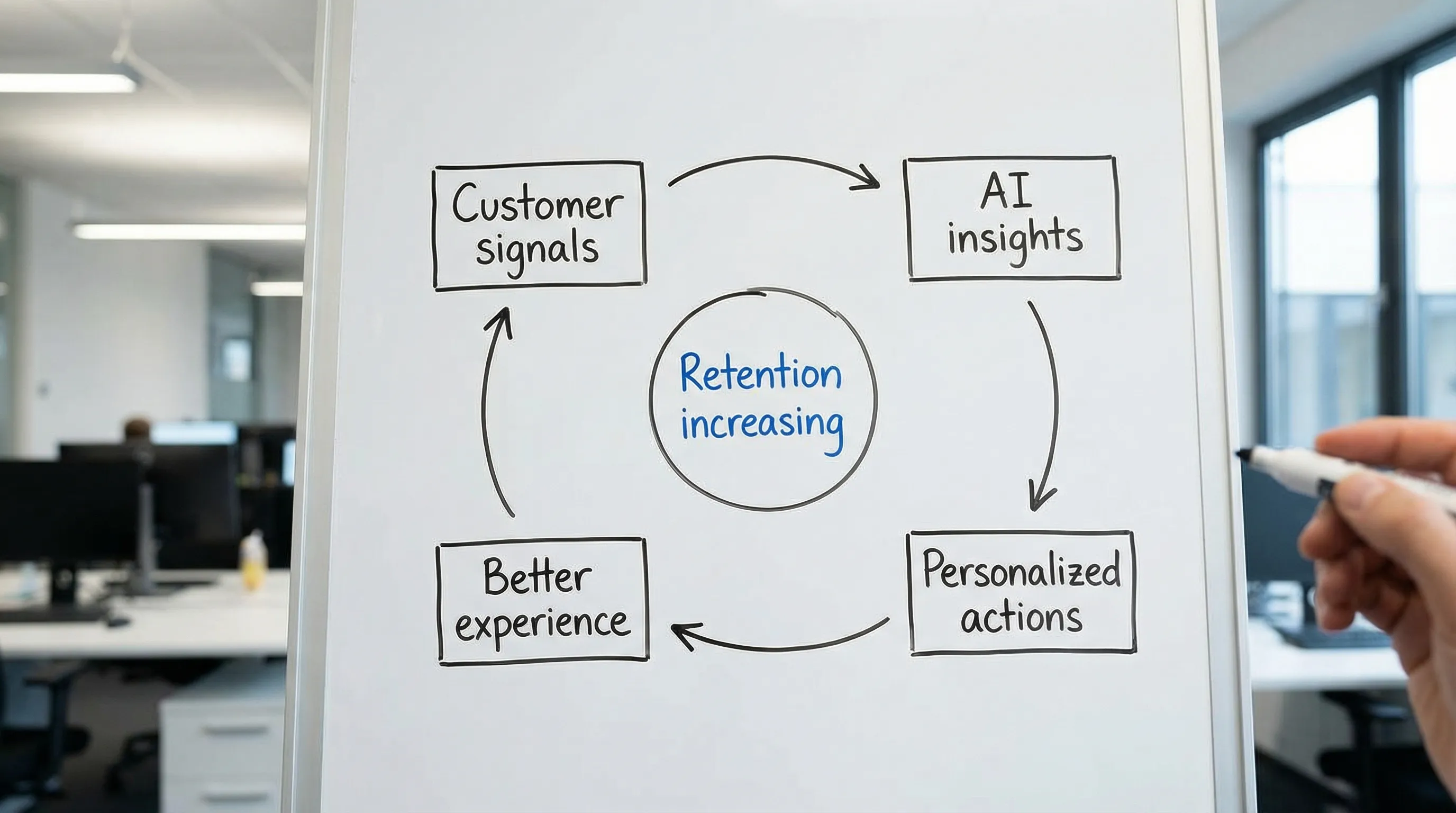
The good news is that AI is now practical enough to fix many of these leaks, not just with chatbots, but with better personalization, proactive support, and stronger service conversations. Below are AI customer experience examples that directly support retention, plus what to measure and how to roll them out responsibly.
What “AI in customer experience” actually means (and what it is not)
In customer experience (CX), AI typically refers to systems that can:
- Understand and generate language (LLMs for chat, email, knowledge search, summarization)
- Predict outcomes (churn risk, likelihood to renew, likely next issue)
- Personalize experiences (next best action, content recommendations, tailored onboarding)
- Assist humans in real time (agent assist, coaching prompts, quality scoring)
It is not a replacement for having a clear CX strategy, a reliable product, or a well-trained team. In practice, the highest-retention programs combine AI with strong processes and better conversations.
Why these AI customer experience examples are retention levers
Retention improves when customers consistently experience:
- Fast time-to-value (they “get it” quickly and succeed early)
- Low effort support (they resolve issues without repeating themselves)
- Trust and confidence (they feel heard, safe, and guided)
- Personal relevance (they are not treated like a generic account)
That matters financially. A widely cited Harvard Business Review piece on retention economics notes that increasing retention can significantly increase profitability in many businesses (often referenced as 25% to 95% profit improvement for a 5% retention increase, depending on context and industry). See HBR: The Value of Keeping the Right Customers.
10 AI customer experience examples that increase retention
The examples below are written as repeatable patterns you can apply in SaaS, financial services, retail, healthcare, and service-heavy industries.
1) AI-guided onboarding that adapts to a customer’s intent
What it looks like: During onboarding, AI detects a customer’s goal (for example, “set up integrations” vs “train my team”) and dynamically adjusts checklists, in-app tips, and recommended next steps.
Why it retains: Customers who reach a “first success” milestone quickly are less likely to churn. Adaptive onboarding reduces confusion, decision fatigue, and support tickets.
What to measure: Time-to-first-value, onboarding completion rate, week-4 active usage, early-life ticket volume.
2) Proactive support triggered by early warning signals
What it looks like: AI flags accounts showing risk patterns, such as repeated failed logins, error spikes, low feature adoption, negative sentiment in tickets, or billing friction. It then triggers help content, a concierge message, or a support outreach.
Why it retains: You solve problems before customers feel abandoned.
What to measure: Reduction in repeat contacts, churn rate for “flagged” cohort vs control, resolution time after proactive outreach.
3) Conversational AI that resolves simple issues end-to-end (with clean handoffs)
What it looks like: A chat assistant handles common requests (order status, password reset, appointment changes, refunds eligibility) and when it cannot, it transfers to a human with full context.
Retention detail that matters: The handoff. If customers have to restate everything, you lose the benefit.
What to measure: Containment rate (with quality checks), customer effort score, CSAT by channel, escalation quality.
4) Agent assist that improves service consistency in real time
What it looks like: While an agent is chatting or on a call, AI suggests relevant knowledge articles, recommended troubleshooting steps, required disclosures, and empathy-forward phrasing.
Why it retains: Customers experience fewer “wrong answers,” fewer holds, and less channel hopping.
What to measure: First contact resolution (FCR), average handle time (AHT) with guardrails, QA scores, complaint rate.
5) Ticket and call summarization that eliminates “start over” moments
What it looks like: AI generates a clean, structured summary of the issue, what was tried, customer sentiment, and next steps. The summary follows the customer across channels.
Why it retains: Customers feel recognized and progress feels continuous.
What to measure: Reopen rate, transfer rate, time-to-resolution, “had to repeat myself” survey item.
6) Personalized recommendations that are actually helpful (not just “more stuff”)
What it looks like: AI suggests next best actions, features, content, or services based on usage patterns and customer goals, not just popularity.
Why it retains: Customers perceive ongoing value and discovery, especially in subscription models.
What to measure: Adoption of recommended actions, retention by adoption cohort, expansion rate (when relevant), support contacts per active user.
7) “Voice of the customer” AI that turns feedback into prioritized fixes
What it looks like: AI clusters themes across surveys, reviews, tickets, call transcripts, and social mentions. It highlights top churn-driving pain points and emerging issues.
Why it retains: Customers stay when they see improvement and when the biggest friction points disappear.
What to measure: Frequency of top complaint themes over time, NPS verbatim trends, churn reasons mix.
8) Churn prediction models paired with human outreach scripts
What it looks like: A model predicts renewal risk, then routes accounts into specific playbooks (education, executive check-in, technical remediation, pricing clarity).
Important: Prediction alone does not retain. The retention gain comes from what your team says and does next.
What to measure: Save rate by playbook, renewal rate by risk band, time-to-intervention after risk trigger.
9) Billing and policy clarity assistants (the “friction killers”)
What it looks like: AI helps customers understand invoices, usage charges, plan changes, return policies, or claim eligibility, and routes edge cases to specialists.
Why it retains: Billing confusion is a top driver of distrust and “I’m done” cancellations.
What to measure: Billing-related contact rate, dispute rate, cancellation reasons tied to pricing confusion.
10) AI coaching for service and success teams (practice, not theory)
What it looks like: Teams practice difficult scenarios, objection handling, de-escalation, and renewal conversations in simulated roleplays, with immediate feedback.
Why it retains: Many retention failures are conversation failures. Customers leave after feeling dismissed, rushed, or bounced around.
What to measure: QA consistency, escalation rate, CSAT for high-emotion cases, retention for customers with support interactions.
Quick mapping: AI CX use case to retention metric
| AI customer experience example | Primary retention mechanism | Metrics to track |
|---|---|---|
| Adaptive onboarding | Faster time-to-value | Activation rate, week-4 usage, early churn |
| Proactive support | Prevents frustration | Repeat contacts, churn in flagged cohort |
| Conversational AI + handoff | Low-effort resolution | Effort score, containment quality, CSAT |
| Agent assist | Consistent, correct answers | FCR, QA, complaint rate |
| Summarization | No “start over” | Reopen rate, transfer rate |
| Helpful personalization | Ongoing value discovery | Feature adoption, retention by cohort |
| VoC clustering | Faster product/service fixes | Theme frequency, churn reasons |
| Churn prediction + playbooks | Timely intervention | Save rate, renewal rate by band |
| Billing clarity | Reduces distrust | Disputes, billing contacts, cancels |
| AI coaching | Better human moments | CSAT in escalations, QA consistency |
Implementation guidance: what to do first (without boiling the ocean)
A practical rollout usually succeeds when you sequence it like this:
Start with “high volume, low risk” workflows
Summarization, internal knowledge search, agent assist, and tagging are often easier to govern than fully autonomous customer-facing bots.
Then add customer-facing automation where the boundaries are clear
Password resets, appointment changes, order status, and policy FAQs tend to be good early candidates, as long as escalation is smooth.
Finally, build predictive and personalized experiences
Churn prediction and next best actions are powerful, but they depend on data quality, clean event tracking, and clear playbooks.
| Phase | Best for | Typical outcomes |
|---|---|---|
| Phase 1: Assist humans | Support, success, service desks | Faster handling, higher consistency |
| Phase 2: Automate simple requests | High-volume CX teams | Lower effort, shorter queues |
| Phase 3: Predict + personalize | Subscription and relationship models | Higher renewal rates, better LTV |
Common pitfalls that hurt retention (even with “good AI”)
Most failed AI CX projects fail for reasons that customers feel immediately:
- AI that confidently gives wrong answers (trust collapses fast)
- No clean escalation path (customers get stuck in loops)
- Inconsistent tone across channels (the brand feels chaotic)
- “Personalization” that feels creepy (unclear consent or overreach)
- Teams who are not trained to work with AI (agents ignore assist tools, or follow them blindly)
A solid governance baseline helps. For general guidance on designing AI systems responsibly, see the NIST AI Risk Management Framework.

How Scenario IQ fits into retention-focused CX improvements
Many of the AI customer experience examples above still depend on people delivering great moments, especially when customers are confused, upset, or ready to cancel.
Scenario IQ focuses on AI-driven roleplay training so sales, service, and customer success teams can practice realistic scenarios, build confidence, and improve communication. If you are rolling out AI in your CX stack, training becomes even more important because:
- Agents must learn how to validate AI suggestions without sounding scripted
- Teams need repeatable de-escalation and objection-handling behaviors
- Managers need consistent coaching signals to improve outcomes across the team
You can learn more at Scenario IQ.
Frequently Asked Questions
What are the best AI customer experience examples for small teams? Start with AI that saves time internally, like ticket summarization, knowledge search, and response drafting, then add a chatbot only for the simplest requests with a clear handoff.
Do chatbots actually improve retention? They can, if they reduce effort and solve real problems. Retention drops when bots block access to humans, give incorrect answers, or fail to carry context into escalation.
How do you measure whether AI improved customer retention? Track retention cohorts before and after, and also leading indicators like time-to-first-value, first contact resolution, repeat contacts, and sentiment trends in tickets.
What customer data should you avoid using for AI personalization? Avoid using sensitive data unless you have a strong legal basis, clear consent where required, and strict controls. When in doubt, use behavioral signals (usage patterns) rather than personal attributes.
How can teams improve the “human” side of AI-driven CX? Use structured practice. Roleplay common escalations, billing disputes, cancellation requests, and expectation-setting conversations, then reinforce what “good” looks like with coaching.
Improve retention by improving the conversations customers remember
If you are investing in AI for customer experience, don’t leave results to chance at the moment that matters most, the live customer interaction.
Scenario IQ helps teams practice high-stakes sales and service scenarios with AI roleplays and real-time feedback, so customers get clearer answers, better empathy, and more consistent resolutions.
Explore Scenario IQ here: https://scenarioiq.ai