
“Free” is a powerful word, especially when you are trying to learn AI fast, upskill for a new role, or train a team without blowing up the budget. The good news is that AI courses online free do exist, and many are genuinely high quality.
The catch is that most free options teach knowledge, not performance. They can help you understand concepts like machine learning, prompting, or Python workflows, but they often fall short on practice, feedback, and measurable skill transfer.
This guide shares legitimate free options (not shady “free trial” traps), how to pick the right one for your goals, and what free learning typically misses so you can fill the gaps.
What “AI courses online free” actually means (and why it matters)
Before you choose a course, clarify what kind of “free” you are getting. In 2026, most providers use one of these models:
- Fully free: All lessons and exercises are available at no cost (sometimes with optional paid certificates).
- Free access with limits: Some modules are free, advanced labs or assessments are paid.
- Audit for free: You can view most content for free, but graded assignments and certificates cost money.
- Free, but you pay in other ways: Heavy upsells, aggressive lead capture, or low-quality content farms.
If your goal is to build real capability, the best free courses are usually backed by organizations with a reputation to protect (major cloud vendors, universities, established AI communities).
Legit free AI course options (worth your time)
Below are reputable starting points, organized by the kind of outcome they best support.
Free courses for AI fundamentals (broad, beginner-friendly)
If you are new to AI, prioritize courses that explain basic terminology, model types, and real-world use cases before diving into tools.
- Google AI Education: Solid primers and learning paths for core concepts and practical applications. Great starting point for non-engineers too. (Google AI)
- Microsoft Learn (AI skills): Structured modules with a practical, job-role flavor (especially if you work in a Microsoft stack). (Microsoft Learn AI)
- IBM SkillsBuild: Free learning content focused on job skills, including AI basics and applied topics. (IBM SkillsBuild)
Free courses for hands-on ML and data science (more technical)
If you want skills that transfer into building models or working with data, choose programs that include coding and iterative practice.
- Kaggle Learn: Short, practical micro-courses (Python, pandas, intro ML) with exercises that force you to write code, not just watch videos. (Kaggle Learn)
- fast.ai: Well-known, practitioner-oriented deep learning education. Expect a steeper learning curve, but strong “build things” energy. (fast.ai courses)
- MIT OpenCourseWare: University-level content, often theory-heavy, excellent if you want depth and rigor. (MIT OCW)
Free courses for generative AI and LLM tooling (practical, fast-moving)
For people focused on GenAI, look for material that covers prompting, evaluation, safety basics, and working with modern model tooling.
- Hugging Face Course: Great for understanding transformers and modern NLP workflows, with a maker mindset. (Hugging Face Course)
- OpenAI developer docs: Not a “course” in the classic sense, but one of the most direct ways to learn implementation patterns and best practices. (OpenAI docs)
“Audit for free” options (good content, weaker accountability)
Some platforms offer high-quality courses where you can often access the learning materials without paying, but you typically pay for certificates, graded items, or full tooling.
- Coursera: Many courses can be audited for free (access to videos/readings without a certificate). Availability varies by course. (Coursera Help Center)
- edX: Many courses offer an audit track with free access to course materials, with paid verification options. (edX)
Quick comparison table: which free option fits your goal?
Use this to avoid the common trap of picking an advanced course when you actually need fundamentals, or picking a fundamentals course when you need portfolio outcomes.
| Option | Best for | Strength | Typical gap to plan for |
|---|---|---|---|
| Google AI Education | Beginners, generalists | Clear explanations, practical orientation | Limited personalized feedback |
| Microsoft Learn | Job-role skilling | Structured paths, ecosystem relevance | Less depth outside Microsoft context |
| Kaggle Learn | Hands-on beginners | Practice-based micro-lessons | Narrow scope per module |
| fast.ai | Builders | Strong “ship projects” focus | Steeper curve, self-direction required |
| MIT OCW | Deep understanding | Rigor and theory | Not optimized for modern tooling pace |
| Hugging Face Course | NLP and transformers | Modern LLM ecosystem knowledge | Requires time to practice and integrate |
| OpenAI docs | Implementers | Direct, practical reference | Not a structured curriculum |
| Coursera/edX (audit) | Guided learning | High-quality instructors | Accountability and assessments often paid |
What free AI courses usually miss (and why learners get stuck)
Free learning is not “bad.” It is just optimized for distribution, not transformation. Here are the most common missing pieces.
1) Real feedback on your work (not just “correct/incorrect”)
Quizzes and auto-graders can check basic understanding. They rarely tell you:
- Why your approach is fragile
- How to improve reliability and edge-case handling
- Whether your solution would work in your actual job context
This is especially true for GenAI use cases where quality is subjective and depends on constraints, tone, risk, and business goals.
2) Practice under pressure (the difference between knowing and doing)
Many learners can explain concepts, but freeze when they must apply them in real situations, like:
- Handling an objection in a customer conversation
- Writing a prompt that must be safe, compliant, and brand-consistent
- Diagnosing why a model output became inconsistent after a workflow change
Performance comes from repetition with realistic scenarios, not from watching one more lecture.
3) A skill measurement system you can trust
Certificates are not the same as proof of ability. Most free courses do not provide:
- Clear skill rubrics
- Consistent scoring across attempts
- Trend data over time
- Team-level visibility for managers
If you are learning for career outcomes (or training a team), you eventually need measurable capability, not “completion.”
4) Role-specific and company-specific training
Generic AI courses rarely reflect your reality:
- Your industry terminology
- Your product constraints
- Your customer objections
- Your compliance requirements
- Your internal tools and workflows
That mismatch creates the “I learned it, but I still can’t use it at work” problem.
5) Safe, guided repetition for communication skills
A lot of AI value is unlocked through communication, not code: discovery calls, support interactions, escalation handling, consultative selling, and internal alignment.
Free AI courses typically do not help people practice these conversations in a way that builds confidence.
How to get the most out of free AI courses (without wasting months)
You can absolutely build strong skills using free resources, if you add structure and practice.
Choose one outcome and build backwards
Pick one clear target for the next 30 days, for example:
- “I can build and evaluate a simple text classifier.”
- “I can reliably draft support replies in our brand voice, with safety checks.”
- “I can explain AI tradeoffs to non-technical stakeholders.”
Then choose one primary course and one practice loop. The most common mistake is collecting courses instead of building competence.
Add a weekly project that produces an artifact
Free courses are much more effective when you produce something tangible:
- A small repo with a README and results
- A prompt library with before/after examples
- A short evaluation report with criteria and failure cases
Artifacts force clarity and make your learning visible to employers or stakeholders.
Create feedback, even if the course does not
If you do not have a mentor, you can still create feedback mechanisms:
- Share work in practitioner communities (Kaggle notebooks, open-source spaces)
- Compare outputs against a rubric you define (accuracy, tone, hallucination risk, time saved)
- Re-run the same task weekly and track improvement
When “free” is not enough: the training gap for sales and service teams
If you are learning AI to improve how humans perform (sales conversations, support quality, objection handling, escalation management), traditional free courses are often the wrong tool.
They teach concepts, but your team needs:
- Scenario-based practice that mirrors real customer interactions
- Real-time feedback that helps people change behavior in the moment
- Progress tracking analytics so leaders can see whether training translates into performance
- Consistency at scale (especially across reps, regions, and skill levels)
This is where specialized platforms can complement free education.
A practical complement: AI roleplay training with Scenario IQ
If your priority is better conversations that close deals or resolve issues faster, consider training designed around roleplay, not lectures.
Scenario IQ provides AI-driven, personalized scenario-based training for sales and service teams, including:
- AI-powered roleplay simulations
- Personalized training scenarios
- Real-time feedback
- Adaptive feedback and guidance
- Progress tracking analytics and performance metric dashboards
- Team-focused learning
- Enterprise-grade security
This kind of practice layer addresses what free AI courses usually miss: repetition in realistic situations, coaching-style feedback, and measurable improvement.

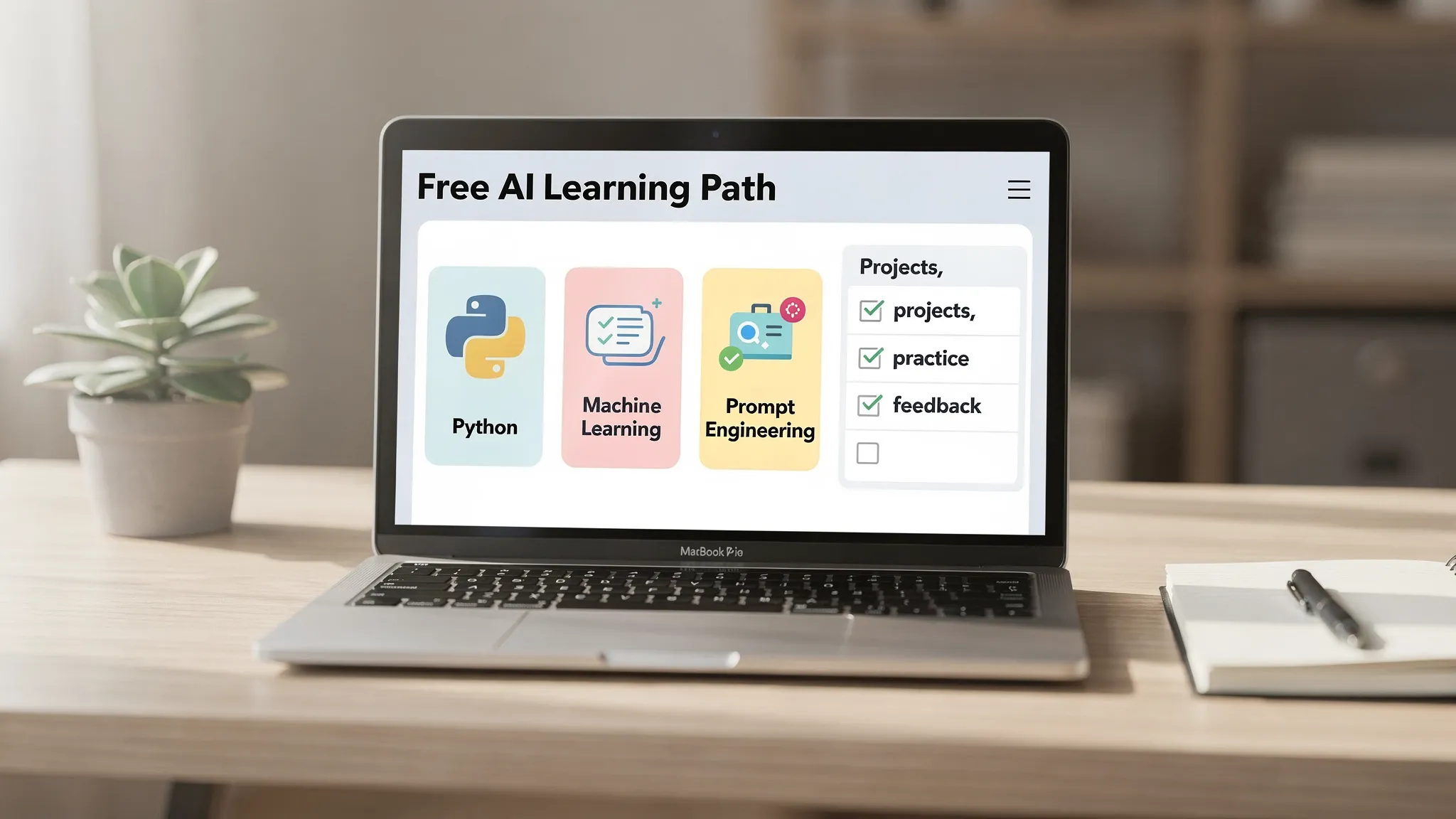
A simple learning path that combines free courses with real skill-building
If you want a dependable approach, use this three-part stack:
Foundation (week 1 to 2)
Start with one fundamentals track (Google AI Education or Microsoft Learn). Your goal is shared vocabulary and basic mental models.
Build (week 2 to 4)
Add hands-on practice (Kaggle Learn, fast.ai, or Hugging Face Course). Your goal is to produce one small project artifact.
Perform (ongoing)
Add realistic practice and measurement:
- For technical roles: peer review, benchmarks, repeated evaluation tasks
- For customer-facing roles: scenario roleplay, objection handling drills, and analytics that show progress
Free AI courses online are a strong beginning. The fastest learners treat them as the classroom, then add a practice environment that looks like the real job.