

Most sales leaders don’t need “AI” in the abstract, they need outcomes: faster ramp time, better discovery calls, consistent objection handling, cleaner handoffs, and higher win rates. AI consulting services for sales enablement can help you get there, but only if the engagement is scoped to your revenue process (and not a generic chatbot project).
Below is a practical set of questions to ask when evaluating an AI consultant or consulting firm for sales enablement, plus what strong answers look like and what should raise concerns.
Start with the business problem, not the model
Before you talk about tools, ask questions that force clarity on the enablement gaps and the behaviors you want to change.
Questions to ask
- Which specific sales behaviors are you trying to improve, and how will you measure them?
- What are the top 3 revenue-impact moments in our sales cycle that AI should support first? (example: discovery, negotiation, renewal save)
- What is your point of view on “AI for sales enablement” versus traditional enablement?
What good looks like
A credible consultant will translate your goals into measurable enablement metrics, such as:
- Time to first deal
- Conversation quality (talk-to-listen ratio, question depth, next-step clarity)
- Objection handling consistency
- Conversion by stage
- Renewal risk indicators and save plays
They should also push back if your goal is too vague (“use AI to improve sales”) and insist on defining a baseline.
Clarify the deliverables (so you don’t buy a slide deck)
Many teams hire consulting and end up with strategy recommendations that never reach reps. Ask for tangible outputs.
Questions to ask
- At the end of 30, 60, and 90 days, what will we have in hand?
- Which deliverables are included: playbooks, conversation frameworks, prompt libraries, simulations, coaching guides, dashboards, integrations?
- How do you validate that new content and workflows actually change rep behavior?
What good looks like
Look for a consultant who proposes an implementation path, not just a roadmap. In sales enablement, “done” usually means:
- A defined set of scenarios and skills (by role, segment, and deal type)
- A practice and coaching system that reps actually use
- Instrumentation to track adoption and outcomes
Data readiness: what will the AI learn from, and what will it touch?
Sales enablement is messy because the “truth” is spread across CRM fields, call recordings, email threads, and tribal knowledge. You want a consultant who is realistic about data limitations and privacy.
Questions to ask
- What data sources do you need, and which are optional? (CRM, call recordings, knowledge base, LMS, ticketing)
- How will you handle poor CRM hygiene or inconsistent stage definitions?
- Will any customer or employee data be used to train models, and if so, how is it protected?
- What’s your approach to data minimization and retention?
What good looks like
A strong approach typically includes:
- Using only the minimum data required for the use case
- Clear separation between “content for coaching/training” and “production systems”
- A plan for data cleaning and governance (especially stage definitions and outcome fields)
For security and risk alignment, it’s reasonable to ask if their approach maps to recognized frameworks like the NIST AI Risk Management Framework.
Workflow integration: where will reps and managers actually use it?
Sales enablement fails when it adds extra steps. AI should show up inside existing rhythms: onboarding, weekly 1:1s, deal reviews, QBR prep, and training.
Questions to ask
- Which rep and manager workflows will change, specifically?
- How will this integrate with our CRM and enablement stack (or will it be a separate destination)?
- What does “day in the life” look like for a rep and for a frontline manager?
What good looks like
You want a consultant who can describe the operational cadence, for example:
- Reps practice targeted scenarios before key meetings
- Managers review a small set of coaching signals weekly
- Enablement iterates scenarios based on real objections appearing in the field
Approach to training: do they understand skill-building, or just automation?
Sales enablement is primarily a behavior change problem. AI can help, but only if the engagement includes a practice mechanism.
Questions to ask
- How will you help reps practice, not just consume content?
- How do you tailor training by role and skill level (new hire vs senior, SMB vs enterprise, inbound vs outbound)?
- How will you generate or curate realistic scenarios and objection paths?
What good looks like
Look for an answer that emphasizes:
- Role-specific scenarios (persona, industry, deal size, buying stage)
- Adaptive difficulty
- Feedback that is actionable (what to say differently, what question to ask next)
- Manager visibility without turning coaching into surveillance
If your priority is skill practice and objection handling, platforms built for AI roleplay training can reduce the amount of custom build required. For example, Scenario IQ focuses on AI-powered roleplay simulations, personalized scenarios, and real-time feedback designed to build confidence and consistency in sales and service conversations.
Model strategy: how do they manage accuracy, hallucinations, and guardrails?
If an AI system influences what reps say, it needs controls. You’re not just buying “smart,” you’re buying “safe and reliable enough for revenue teams.”
Questions to ask
- What failure modes do you plan for in sales use cases? (hallucinations, overconfidence, wrong policy guidance, biased coaching)
- What guardrails do you implement? (approved knowledge sources, refusal behaviors, policy constraints)
- How do you evaluate quality over time, not just in a demo?
What good looks like
A consultant should describe an evaluation approach that includes:
- Test sets based on your real objections and edge cases
- Human review loops (enablement and legal/compliance where needed)
- Ongoing monitoring and iteration
They should also be honest about where AI should not be used (for example, generating regulated claims without approved language).
Coaching and adoption: who owns this after the consultants leave?
Adoption is usually the biggest risk. Ask how the program becomes “owned” by enablement and frontline managers.
Questions to ask
- What change management is included: comms, manager training, office hours, champions?
- How will you drive manager participation (the multiplier), not just rep usage?
- What happens after the pilot, and what internal roles do we need?
What good looks like
A credible plan includes:
- A pilot group with clear success criteria
- Manager enablement (how to coach with the new signals)
- A lightweight operating system (monthly scenario refresh, quarterly skill focus)
Analytics: what will we learn, and what actions will it drive?
“Dashboards” are easy. Useful enablement analytics connect behavior to outcomes and suggest next actions.
Questions to ask
- Which metrics will you track that are leading indicators of performance?
- How do you connect training activity to pipeline outcomes without overclaiming causality?
- What recommendations will the system generate for reps and managers?
What good looks like
Expect a balanced answer. Good consultants avoid pretending attribution is perfect, but they still propose practical measurement such as:
- Cohort analysis (pilot vs control where possible)
- Pre/post skill scoring using consistent rubrics
- Conversion and cycle-time shifts at the segment level
Security, privacy, and procurement: get the hard questions answered early
If your vendor can’t pass basic security and privacy requirements, the project stalls. Treat this as first-class from the start.
Questions to ask
- What enterprise security controls do you support? (SSO, RBAC, audit logs, encryption)
- Where is data stored, and what subprocessors are used?
- Can you support our compliance needs (industry or regional)?
- Do you offer an option that avoids using sensitive customer data in model training?
What good looks like
You’re looking for specificity, plus alignment with your internal security team’s expectations (often including SSO, role-based permissions, and clear retention policies). If the engagement involves a platform, ask for security documentation early so procurement does not become the critical path.
Commercials and ROI: what are we paying for, and what must change to win?
AI consulting engagements can drift if pricing is not tied to a scoped outcome.
Questions to ask
- Is pricing project-based, retainer-based, or outcome-based, and what is included?
- What assumptions are behind your ROI estimate?
- What internal effort do you require from our team, and how many hours per week?
What good looks like
A serious consultant will ask about:
- Rep capacity for training
- Manager coaching bandwidth
- Enablement content maturity
- Sales cycle length (short cycles show impact faster, long cycles need leading indicators)
They should also separate “quick wins” (like standardizing objection frameworks and practice) from longer-term changes (like deep CRM process redesign).
A practical scorecard for evaluating AI consulting services
Use this table to compare firms side-by-side without getting distracted by buzzwords.
| Evaluation area | Questions to ask | Strong signals | Red flags |
|---|---|---|---|
| Business alignment | “Which behaviors and metrics will improve first?” | Clear baseline, measurable outcomes, prioritization | Vague promises, no measurement plan |
| Deliverables | “What will exist in 90 days?” | Playbooks, scenarios, coaching system, rollout plan | Strategy deck only |
| Data and privacy | “What data do you need and why?” | Data minimization, governance, retention clarity | “We need everything,” unclear training usage |
| Workflow fit | “Where does this show up in rep/manager routines?” | Embedded into onboarding and coaching cadence | Extra tools, extra steps, low manager involvement |
| Quality and guardrails | “How do you prevent hallucinations and policy issues?” | Testing, monitoring, source grounding, escalation | Demos only, no QA plan |
| Adoption | “How will you drive manager and rep usage?” | Change plan, champions, enablement ownership | “If it’s good, they’ll use it” |
| Security | “What controls and documentation can you provide?” | SSO/RBAC, auditability, clear subprocessors | Delays, vague answers |
| ROI realism | “Which assumptions must be true to hit ROI?” | Transparent assumptions and tradeoffs | Guaranteed results, no dependencies |
When you might not need heavy consulting
Sometimes the right move is not a large custom build. If your main gap is that reps are not practicing, or managers lack a consistent coaching mechanism, you may get faster results by adopting a purpose-built training platform and focusing consulting time on scenario design, rollout, and measurement.
Scenario-based AI roleplay tools are designed for exactly this: repeated practice, feedback, and tracking. If you want to explore that route, you can review Scenario IQ and evaluate whether AI-driven simulations and real-time feedback match your enablement goals.
A simple way to run the selection process
To keep momentum and avoid “pilot purgatory,” structure the evaluation like this:
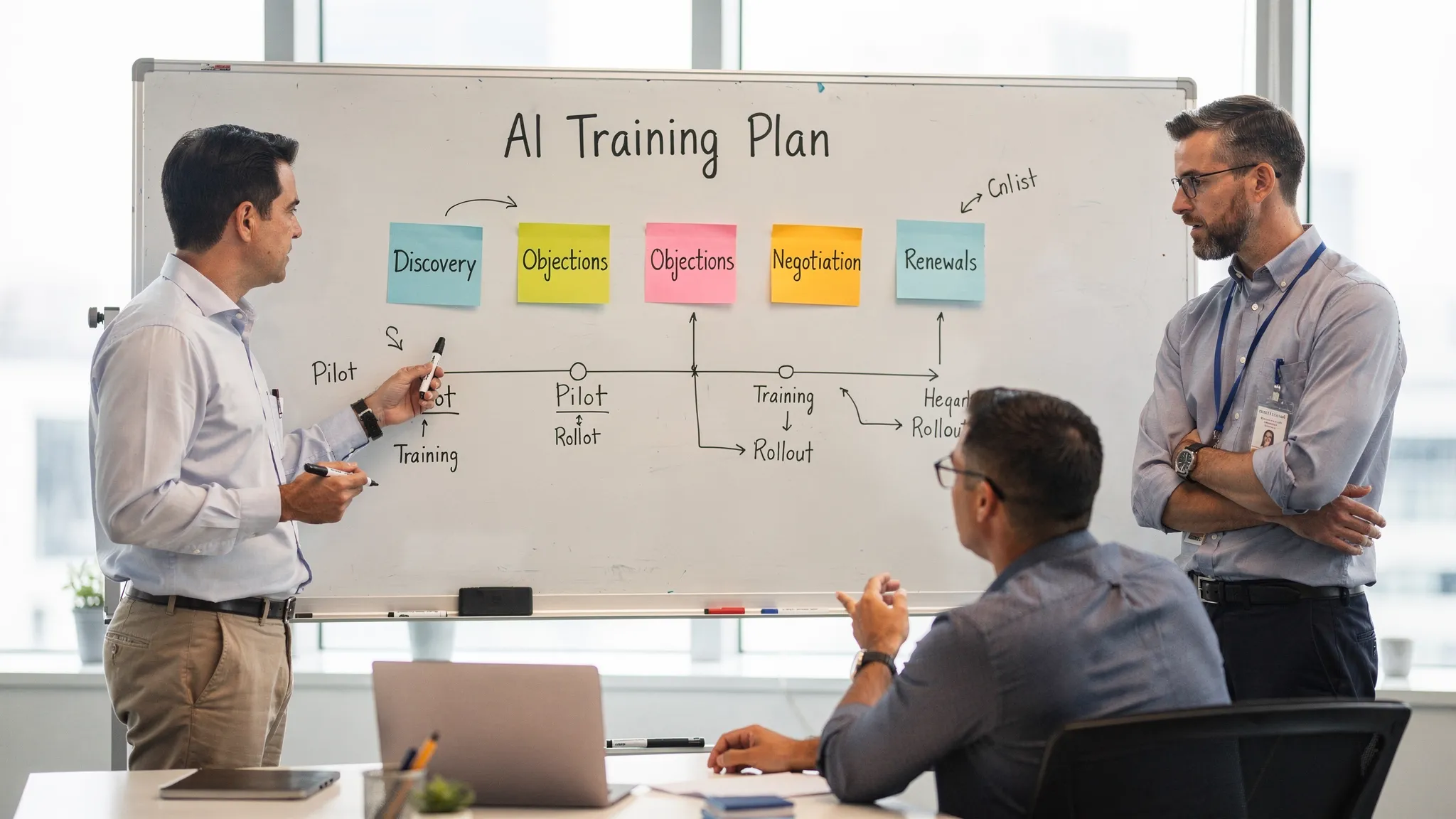
- Week 1 to 2: Discovery (confirm use cases, success metrics, constraints)
- Week 3 to 6: Pilot (limited roles, defined scenarios, measurement plan)
- Week 7 to 10: Rollout plan (enablement ops, manager coaching, analytics cadence)
Ask every consulting candidate to propose their version of this timeline with named deliverables and required inputs from your team.
Closing thought: buy enablement outcomes, not AI theater
The best AI consulting services for sales enablement feel almost “unsexy” at first: lots of time in your pipeline stages, your call reality, your managers’ coaching habits, and your data constraints. That’s a good sign. It means the work is grounded in how deals actually get won.
If your organization is exploring AI roleplay training as part of that enablement strategy, you can see how Scenario IQ approaches personalized simulations, feedback, and progress tracking at scenarioiq.ai.