

Choosing between AI consulting firms and building in-house AI is less about “who’s smarter” and more about two practical questions: What will it cost over 12 to 36 months, and how much control do you need to keep?
In 2026, most teams are no longer debating whether AI matters. They are debating how to operationalize it without ballooning costs, creating compliance risk, or losing velocity. This guide breaks down the real cost drivers, the different kinds of control, and a decision framework you can use even if your AI roadmap is still evolving.
What “AI consulting” and “in-house AI” actually mean
Before comparing cost and control, define the two models clearly.
AI consulting firms
AI consulting firms (from boutique specialists to large systems integrators) typically help with:
- AI strategy and use case selection
- Data readiness and architecture
- Model selection (build, fine-tune, or use APIs)
- Implementation and integration into business workflows
- MLOps and governance processes
- Change management and enablement
Their value is often speed and pattern recognition: they have seen similar problems across industries and can stand up an initial solution quickly.
In-house AI
In-house AI means your organization owns the delivery with internal roles such as:
- Product owner for AI initiatives
- Data engineers
- ML engineers and data scientists
- Platform and DevOps engineers
- Security, privacy, and compliance partners
In-house value is usually compounding advantage: your team learns your domain, data, and systems deeply, then iterates continuously.
Cost comparison: where the money really goes
Many cost comparisons stop at day rates versus salaries. That is incomplete. The biggest costs in AI are usually ongoing ownership costs: maintenance, monitoring, data pipelines, governance, and the organizational time it takes to actually get adoption.
Here is a practical breakdown.
Cost categories that matter (and who typically pays them)
| Cost category | AI consulting firms | In-house AI |
|---|---|---|
| Discovery and scoping | Often packaged as workshops or an initial phase | Internal time, often spread across leaders and SMEs |
| Core build and integration | Project fees, SOW changes can add cost | Salaries plus engineering time |
| Data work (pipelines, quality, labeling) | Sometimes included, often underestimated | Usually your responsibility long-term |
| Model costs (API usage, hosting, inference) | May be passed through or bundled | You pay directly and optimize over time |
| Security, privacy, compliance | Often documented, but accountability remains yours | You build repeatable controls and audits |
| Monitoring and ongoing improvements | Retainers, managed services, or new projects | Continuous work, but cheaper per iteration once mature |
| Hiring and retention | Not your cost (but you still need internal owners) | Recruiting, ramp time, attrition risk |
| Vendor lock-in risk | Higher if architecture is proprietary | Lower if you standardize internally |
Typical consulting cost dynamics
Consulting can look expensive on paper, but it can be cost-effective when:
- You need a fast path to a working pilot.
- Your team lacks a specific skill (for example, MLOps, evaluation, or regulated-industry documentation).
- You want to avoid permanent headcount for a short-term build.
The less obvious cost drivers are:
- Ambiguity premiums: unclear requirements lead to change requests.
- Internal coordination time: your SMEs and IT still spend significant time validating requirements, testing, and signing off.
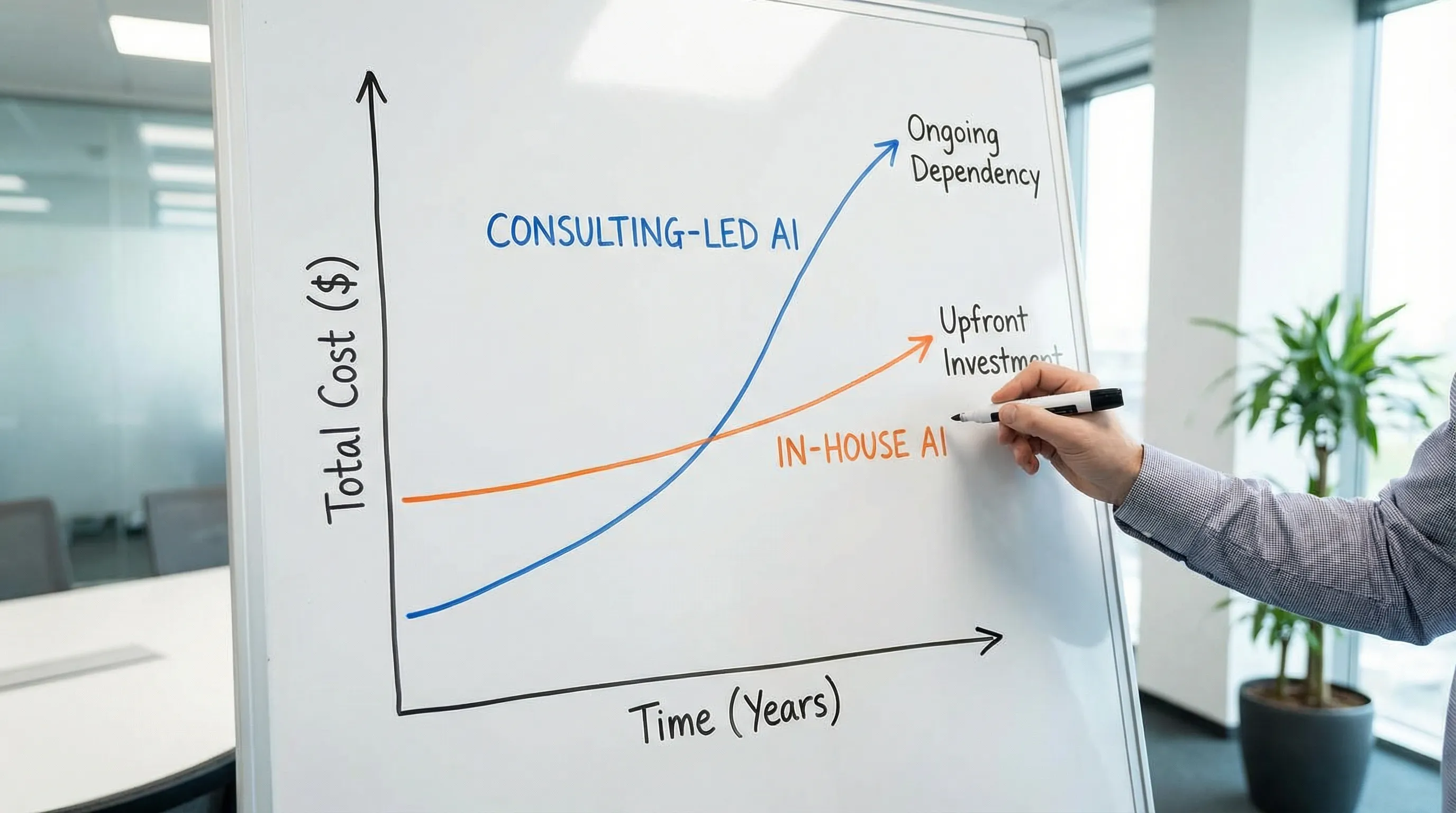
- Long-term dependency: if your internal team cannot operate the system independently, you may pay for ongoing help.
Typical in-house cost dynamics
In-house AI often has a higher upfront commitment, but can become cheaper per unit of progress as you mature. Hidden costs include:
- Time-to-hire and ramp time: hiring senior AI talent can be slow, and productivity is not immediate.
- Platform sprawl: multiple tools for experimentation, evaluation, monitoring, and governance.
- Operational rigor: production AI needs monitoring, incident response, and versioning, not just notebooks.
A good mental model is:
- Consulting often optimizes for time-to-first-solution.
- In-house often optimizes for time-to-nth-solution (the 5th, 10th, 20th iteration that drives real ROI).
Control comparison: what “control” actually includes
“Control” is not one thing. Most teams mean a mix of the following.
Control of data and privacy
If you operate in regulated environments or handle sensitive customer information, you may need tighter control over:
- Data residency and retention
- Access controls and audit trails
- Vendor risk management
- Model input and output logging policies
Even when working with AI consulting firms, you still own the risk. A consultant can help you design controls, but your organization remains accountable.
A useful reference for governance language is the NIST AI Risk Management Framework (AI RMF), which many organizations use as a baseline for risk and control discussions.
Control of IP and differentiation
Ask: is this AI capability a differentiator, or is it plumbing?
- If it is a differentiator (pricing, underwriting, core product recommendations), you usually want in-house ownership.
- If it is plumbing (internal search, basic automation, first-line support workflows), consulting or vendors can be fine, provided you avoid lock-in.
Control of roadmap and iteration speed
This is where in-house teams often win. When AI is embedded in daily operations, you will need frequent iteration:
- Updating prompts and policies
- Improving evaluation and quality gates
- Adjusting to new data sources
- Handling edge cases and drift
Consultancies can support iteration via retainers, but you should assume iteration is continuous. If iteration is the norm, the economics often shift toward in-house.
Control of quality and accountability
When an AI-driven workflow fails (bad outputs, unsafe recommendations, customer escalation), you need clear ownership:
- Who triages incidents?
- Who has authority to roll back?
- Who updates guardrails?
In-house makes accountability clearer. Consulting can work if you explicitly define operational responsibilities, escalation paths, and SLAs.
When AI consulting firms are the better choice
AI consulting firms tend to be a strong fit when one or more of these are true.
You need speed and a credible starting point
If leadership needs a working proof of value in weeks, a good consultancy can accelerate:
- Use case selection
- Architecture decisions
- Initial build and integration
The key is to define success as more than a demo. Require a path to production: monitoring, documentation, and a handoff plan.
You have gaps in specialized expertise
Some skills are hard to hire quickly, especially if AI is not your core business. Examples include:
- Evaluation frameworks and quality measurement
- MLOps practices for model versioning and rollbacks
- Security and compliance documentation for regulated deployments
A consulting partner can “import” these capabilities while your internal team learns.
You are still uncertain about the right use cases
If you are not sure whether the ROI is in sales enablement, customer service, operations, or product, consulting can help reduce expensive trial-and-error by using proven discovery methods.
You want a defined, finite outcome
If you can clearly define a deliverable (for example, “ship an internal knowledge assistant integrated with our helpdesk”), consulting can be efficient, especially if you keep the scope tight.
When in-house AI is the better choice
In-house AI tends to win when AI becomes a long-term capability, not a one-time project.
AI is core to your competitive advantage
If your data, domain, and workflows are unique, repeated iteration is the source of moat. In that case, you want:
- Internal ownership of the pipeline
- Reusable patterns across teams
- A learning loop that compounds
You need ongoing control over risk and compliance
If you face strict audit expectations, building an internal AI operating model can be worth it:
- Standard model evaluation
- Consistent approval workflows
- Repeatable vendor risk processes
Your AI backlog will not stop growing
Most organizations that succeed with AI build more than one use case. They build dozens. If you can already see the backlog, in-house capability usually pays off.
The hybrid approach (often the highest-performing option)
Many organizations land on a hybrid model that balances speed and control:
Consulting to bootstrap, in-house to scale
A common pattern is:
- Consultants help with strategy, architecture, and the first production use case.
- An internal team is staffed in parallel.
- Ownership transitions intentionally after the first release.
This works best when you formalize the transfer: code ownership, runbooks, monitoring dashboards, and training for internal operators.
In-house product ownership with targeted specialist partners
Instead of outsourcing everything, keep a strong internal AI product owner and use consulting for narrow, high-leverage areas:
- Security reviews
- Evaluation design
- Data architecture
- Model optimization
Build vs buy for specific workflows
Not every AI-enabled capability needs to be built. If a workflow is common and non-differentiating, buying a proven product can deliver faster ROI with less operational burden.
A practical decision framework: cost and control questions to ask
Use these questions to choose the right model for your next 90 to 180 days.
How frequently will this system change?
- If changes are monthly or weekly, favor in-house or a hybrid with strong internal ownership.
- If changes are rare, consulting can be cost-effective.
Is the data sensitive, regulated, or hard to access?
- If yes, prioritize architectures and partners that support strict governance.
- If the data is low sensitivity, you can move faster with fewer constraints.
Is the AI outcome measurable?
If you cannot measure success (conversion lift, handle time reduction, training completion to performance correlation), costs expand in both models because decision-making becomes subjective.
Do you need knowledge transfer or just delivery?
If you want to build a long-term capability, require:
- Documentation
- Internal enablement
- Ownership handoff
If you only need a deliverable, optimize the contract for delivery milestones.
How expensive is failure?
When failures are costly (brand risk, compliance risk, patient safety, financial risk), you usually want:
- Stronger controls
- Clear accountability
- More internal ownership
What is the opportunity cost of waiting?
If delaying AI adoption means losing pipeline, customer satisfaction, or operational efficiency today, consulting or buying can be the fastest path to value.
To summarize the decision logic, here is a quick comparison.
| Decision factor | Usually favors AI consulting firms | Usually favors in-house AI |
|---|---|---|
| Time-to-value | You need results fast | You can invest in a runway |
| Use case clarity | Unclear, needs discovery | Clear, repeatable backlog |
| Differentiation | Not a moat | Strategic moat |
| Risk tolerance | Moderate, manageable | Low tolerance, strict governance |
| Talent availability | Hard to hire quickly | You can hire and retain talent |
| Long-term iteration | Limited | Continuous |
Don’t ignore the people side: adoption is where ROI is won
One cost driver that is often underestimated in both models is human adoption. AI initiatives fail less often because the model is “bad” and more often because:
- Teams do not trust the outputs.
- Managers cannot coach consistent behaviors.
- Employees freeze in real customer conversations when objections arise.
- Processes change, but frontline habits do not.
This matters directly to cost and control:
- If adoption is weak, you will pay for extra consulting cycles or extra internal iteration.
- If managers cannot measure behavior change, the organization loses control over outcomes.
For customer-facing teams, this is where AI roleplay training can help: it builds confidence and consistency before real calls, chats, and escalations.
Scenario IQ focuses on AI-driven, personalized scenario-based training for sales and service teams, with capabilities such as AI-powered roleplay simulations, real-time feedback, and progress tracking analytics. Whether you choose AI consulting firms, an in-house AI team, or a hybrid approach for your broader AI roadmap, tightening frontline execution helps you realize ROI faster and more predictably.

Bottom line: choose the model that matches your maturity
If you need a fast, credible start, AI consulting firms can reduce time-to-value and de-risk early decisions, especially when your internal capability is not yet staffed.
If AI will be a long-term differentiator or requires continuous iteration under strict governance, in-house AI tends to deliver more control and better economics over time.
For many organizations, the best answer is hybrid: use consulting to accelerate the first wave, but build internal ownership so the capability compounds instead of resetting with each new project.