

Buying help from AI consulting companies can feel like hiring a “black box.” Everyone promises revenue lift, smarter forecasting, and automation, yet many go-to-market (GTM) teams end up with a slide deck, a half-finished prototype, and little adoption.
This guide is a practical way to choose an AI consulting partner that actually improves how your sales, service, and revenue operations teams perform, without taking on unnecessary risk.
What AI consulting companies should (and should not) do for a GTM team
A strong AI consulting engagement for GTM typically does three things:
- Improves decisions (better prioritization, segmentation, forecasting, routing).
- Improves execution quality (messaging consistency, objection handling, service resolution quality).
- Improves speed (less manual work in lead ops, notes, follow-ups, QA, and reporting).
What it should not do is create “AI theater,” meaning impressive demos that are not connected to frontline workflows, CRM reality, or measurable KPIs.
Common GTM use cases worth paying for
You do not need all of these at once. The best AI consulting companies help you pick the 1 to 2 use cases with the highest expected ROI and lowest implementation risk.
- Lead and account prioritization (propensity, fit scoring, next-best action)
- Sales forecasting improvements (pipeline health, risk signals, deal slippage)
- Conversation and ticket intelligence (themes, compliance, coaching opportunities)
- Workflow automation (enrichment, routing, follow-up drafting with guardrails)
- Enablement and performance uplift (coaching, practice, feedback loops)
Step 1: Define the outcome in GTM language (not AI language)
Most disappointing engagements start with “We want AI” instead of “We want measurable improvement in X.” Before you evaluate firms, define:
Your north star metric and the mechanism
Examples:
- Increase qualified pipeline by 15% by improving lead scoring and SDR prioritization.
- Reduce time-to-first-response by 30% with triage automation and better agent guidance.
- Increase win rate in a specific segment by improving discovery quality and objection handling.
If you cannot describe the mechanism, the consultant will pick one for you, and it may be optimized for what is easiest to build instead of what moves revenue.
Your constraints
Write these down. They should shape vendor selection.
- Data availability and quality (CRM hygiene, call recordings, ticket tags)
- Security requirements (PII, customer recordings, regulated industries)
- Change capacity (who will own rollout, training, governance)
- Time-to-value (weeks vs quarters)
Step 2: Decide which “type” of AI consulting company you need
“AI consulting” covers very different capabilities. Many GTM teams hire a strategy-heavy firm when they actually need integration and adoption, or they hire a technical build shop when they need process redesign.
| Type of partner | Best for | Watch-outs |
|---|---|---|
| Strategy and operating model | Use case selection, AI roadmap, governance, KPI design | Can stop at recommendations without delivery ownership |
| Data science and ML engineering | Custom models, experimentation, evaluation, advanced analytics | Risk of overbuilding when simpler approaches would work |
| RevOps and automation (systems) | CRM workflows, routing, enrichment, tooling integration | Can miss model quality, evaluation rigor, and safety |
| Enablement and performance consulting | Coaching frameworks, QA programs, rep ramp, behavior change | Can be light on technical feasibility and data needs |
| Hybrid (cross-functional delivery) | End-to-end pilot through rollout with measurement | Often pricier, quality varies widely by team assigned |
If your GTM pain is “we have tools but behavior does not change,” consider weighting enablement and adoption higher than model novelty.
Step 3: Evaluate real GTM experience, not generic AI credentials
A consultant can be brilliant at AI and still fail in GTM because GTM constraints are unique: messy data, attribution gaps, human variability, and a constant need for trust.
What good GTM AI experience looks like
- They can explain how sales and service teams actually work day to day (handoffs, approvals, edge cases).
- They understand the difference between insight (interesting) and intervention (changes actions).
- They have a plan for adoption (enablement, coaching, reinforcement) that is as detailed as the technical plan.
What to ask in the first call
Ask for specifics tied to outcomes:
- “Which GTM KPIs did you move, and what did you change in workflow to move them?”
- “What failed in past rollouts, and what would you do differently now?”
- “How do you measure model quality and business impact separately?”
Step 4: Demand an evaluation plan (how they will prove it works)
If an AI consulting company cannot describe how they will evaluate the solution, you are buying hope.
A credible evaluation plan includes:
- Offline evaluation (model or system performance on historical data)
- Online evaluation (A/B test or phased rollout with a control group)
- Business KPI linkage (how outputs change behaviors that change results)
The GTM evaluation trap to avoid
Many teams only measure output metrics like “number of summaries generated” or “emails drafted.” Those are activity metrics. You need at least one behavior or outcome metric, such as:
- SDR response time
- Meeting set rate by segment
- Conversion rate from stage to stage
- Reopen rate for support tickets
- Time to resolution
Step 5: Check their data and integration realism
GTM AI projects fail most often because the data is incomplete, inaccessible, or misaligned with process.
A strong partner will start with data profiling
Expect them to ask:
- Where are core objects stored (CRM, support platform, call recordings)?
- What fields are required vs optional? How often are they missing?
- What is your source of truth for revenue, pipeline stage history, and activity?
Integration questions you should hear them ask
- “What systems must be updated automatically, and which require human review?”
- “What is the escalation path when the AI output is uncertain?”
- “How will we log decisions so RevOps can audit performance over time?”
If the pitch skips straight to “we’ll build an agent,” press pause. GTM teams need reliability, traceability, and change control.
Step 6: Security, privacy, and governance are selection criteria (not paperwork)
For sales and service, AI often touches sensitive content: call recordings, emails, contracts, support tickets, personal data.
A credible partner should be fluent in governance frameworks and practical safeguards. A useful starting point is the NIST AI Risk Management Framework, which outlines risk areas like transparency, validity, and accountability.
Minimum governance signals to look for
- Clear stance on data retention and training on customer data (what is stored, where, for how long)
- Ability to support your security requirements (for example, SOC 2 expectations if you require it)
- Role-based access, audit logs, and incident response process
- Human-in-the-loop design for high-impact actions (discounting, contract changes, customer commitments)
If they dismiss governance as “slowing things down,” that is a red flag. In GTM, one avoidable incident can erase months of gains.
Step 7: Choose a commercial model that aligns incentives
Different engagement structures push different behaviors.
| Commercial model | When it works | Risk to manage |
|---|---|---|
| Fixed scope, fixed fee | Well-defined problem, limited integrations | Incentive to minimize iteration and change requests |
| Time and materials | Discovery-heavy work, uncertain data | Budget drift without milestone discipline |
| Staff augmentation | You have leadership and need hands | You still need architecture, governance, and accountability |
| Outcome-based (partial) | Narrow, measurable KPI with shared control | Hard to define fairly if your inputs change midstream |
For most GTM teams, the sweet spot is a paid pilot with explicit success criteria and a defined path to rollout.
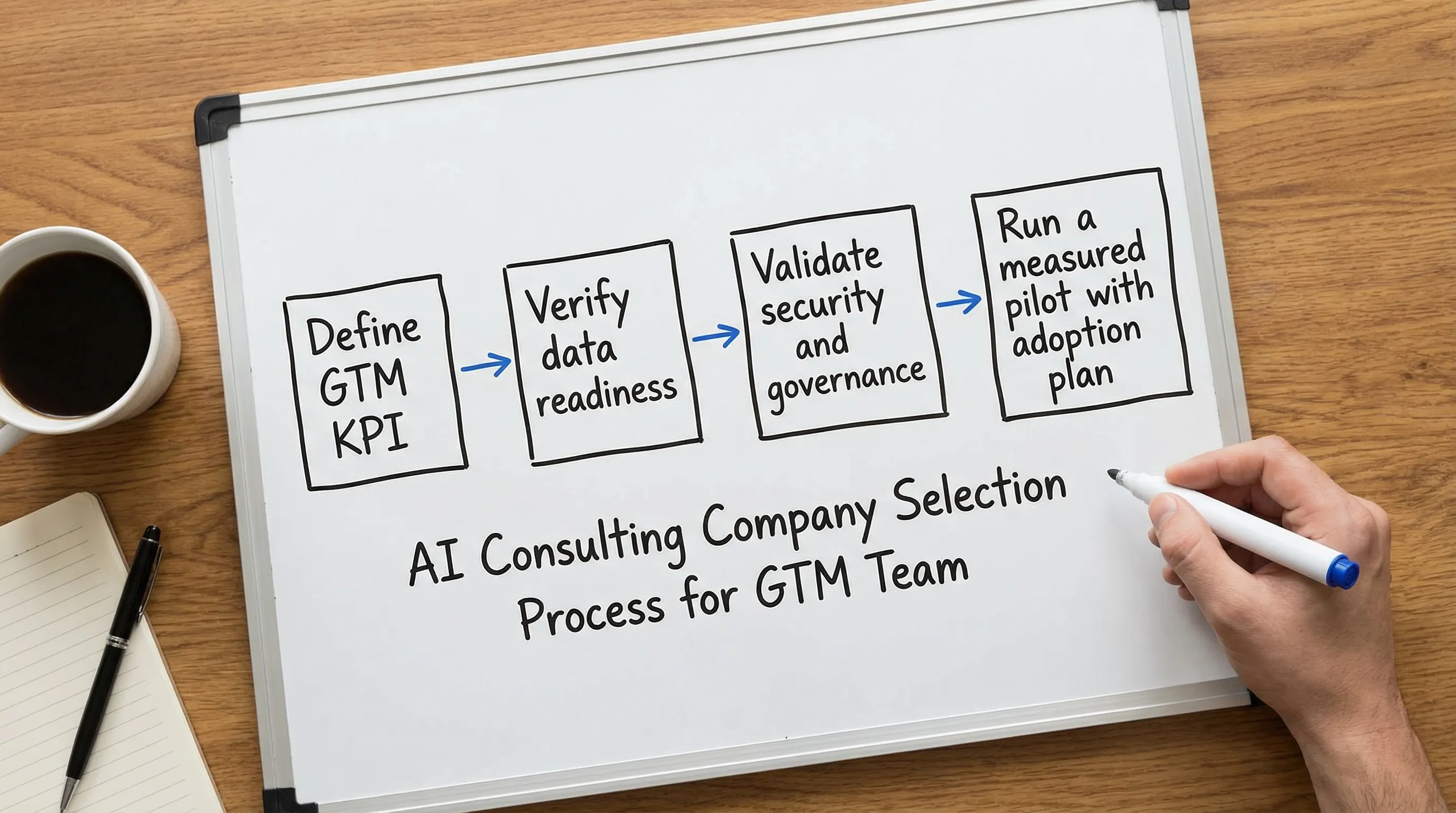
Step 8: Run a pilot designed for learning, not just a demo
A GTM AI pilot should answer four questions:
- Does it work technically? (quality, latency, integration)
- Do people trust it? (rep and manager confidence)
- Does it change behavior? (usage tied to workflow)
- Does it move a KPI? (even a leading indicator)
What “good” pilot scope looks like
- One segment, one region, or one team
- One core workflow (lead routing, call coaching, ticket triage)
- A short timeline (often 4 to 8 weeks) with weekly checkpoints
Document the baseline before you begin, otherwise you will argue about impact later.
Step 9: Prioritize adoption, coaching, and reinforcement (where ROI is won)
Even the best AI system fails if reps and agents do not change how they sell and serve.
High-performing AI consulting companies treat adoption as a first-class workstream:
- Frontline enablement tailored to role (SDR, AE, CSM, support)
- Manager coaching to reinforce behaviors
- QA and feedback loops (what “good” looks like)
- Continuous iteration based on real usage data
A practical option: pair consulting with AI roleplay training
Many GTM improvements require behavior change: better discovery, better objection handling, better de-escalation, better qualification. That is difficult to “implement” with dashboards alone.
This is where a training platform like Scenario IQ can complement consulting work. Scenario IQ provides AI-driven scenario-based roleplay training with personalized simulations, real-time feedback, and progress tracking analytics. If your consulting initiative changes messaging, qualification standards, or service playbooks, roleplay training helps teams practice those changes at scale and build confidence faster.
The key idea is simple: consulting can define and instrument the new standard, training can help people execute it consistently.
A due diligence checklist you can use with any short list
Use this as a structured way to compare AI consulting companies side by side.
| Evaluation area | What to look for | A strong answer sounds like |
|---|---|---|
| GTM domain fluency | Specific examples in sales/service operations | “Here is how we improved stage conversion by changing routing and coaching” |
| Data readiness | Profiling approach, gap plan, assumptions | “We start by auditing these objects and fields, then define what is required for pilot” |
| Evaluation rigor | Offline + online measurement plan | “We will baseline, test, and tie usage to leading indicators before scaling” |
| Integration approach | CRM, support platform, call systems | “We design human review points and log actions for auditability” |
| Security and governance | Policies, controls, and risk posture | “Here is how we handle retention, access, audits, and incident response” |
| Adoption plan | Enablement, manager reinforcement, comms | “We train managers, define rubrics, and measure behavior change weekly” |
| Knowledge transfer | Documentation, handoff, internal capability | “You will own this, so we provide playbooks, training, and clear runbooks” |
Red flags that usually predict disappointment
You do not need perfection, but these patterns tend to correlate with poor outcomes:
- They cannot explain success metrics beyond “usage” or “time saved.”
- They insist on a big-bang rollout without a measured pilot.
- They avoid specifics on data retention, privacy, or governance.
- They overfocus on model sophistication without discussing workflow change.
- They cannot name who will be on your account until after signing.
Making the final decision: pick the partner that reduces uncertainty fastest
When you are choosing between AI consulting companies, the goal is not to find the most impressive pitch. It is to find the team that can:
- Translate GTM goals into measurable interventions
- Prove value quickly with a disciplined pilot
- Deliver safely (security, privacy, governance)
- Drive adoption so the work compounds over time
If you want to de-risk the “people side” of your GTM AI initiative, consider pairing your consulting work with scalable practice and feedback. Tools like Scenario IQ help teams build confidence, handle objections, and improve service performance through AI roleplay simulations and real-time coaching, which is often where the business impact becomes real.