
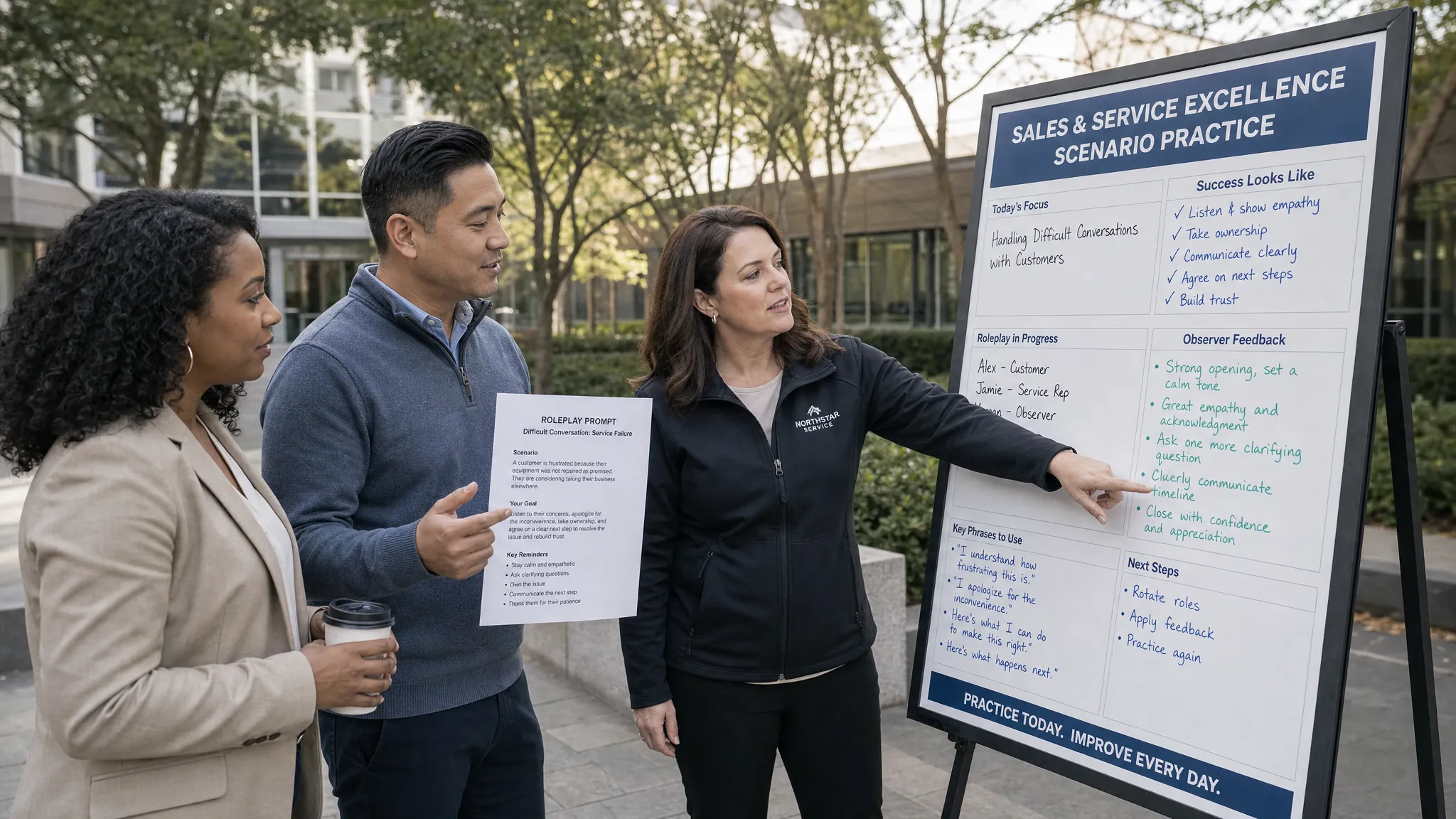
AI is often framed as a productivity shortcut. It can summarize, draft, sort, and automate. Those uses matter, but for sales and service teams, the biggest performance gains often come from a different category: AI capabilities that help people practice the moments that determine outcomes.
A rep may understand the product, know the talk track, and still freeze when a buyer pushes back on price. A support agent may know the policy, but struggle to calm a frustrated customer. A manager may know who completed training, but not which skills are improving. In these gaps between knowledge and execution, AI can create a better practice environment.
Learning science has long emphasized the value of repeated practice, contextual feedback, and transfer to real-world situations. The National Academies’ How People Learn II is a useful foundation for understanding why realistic practice and timely feedback matter. Modern AI makes those principles easier to apply at scale.
Practice Is the Missing Link Between Training and Performance
Traditional training often measures completion. Did the employee attend the session? Did they watch the video? Did they pass the quiz? Those signals are useful, but they do not prove readiness.
Performance depends on whether someone can apply the right behavior under pressure. In sales, that might mean uncovering urgency, handling a competitor comparison, or asking for the next step. In customer service, it might mean de-escalating tension, explaining a policy clearly, or recognizing when to escalate.
AI improves practice because it can make training more interactive, adaptive, and measurable. Instead of waiting for a live customer interaction to reveal a skill gap, teams can rehearse realistic scenarios in a safe environment. Instead of relying only on manager observation, leaders can see patterns across practice attempts. Instead of giving generic advice, AI can offer feedback tied to the learner’s actual response.
That shift changes the role of training. It becomes less about delivering information once and more about building capability over time.
The AI Capabilities That Matter Most
Not every AI feature improves performance. The most valuable capabilities are the ones that help employees rehearse, receive feedback, improve, and transfer skills into real customer conversations.
| AI capability | What it does | Why it improves performance |
|---|---|---|
| AI-powered roleplay simulations | Creates realistic customer, buyer, or stakeholder conversations | Gives teams more repetitions before high-stakes interactions |
| Personalized training scenarios | Adapts practice to role, context, skill level, or common objections | Makes training relevant instead of generic |
| Real-time feedback | Responds during or immediately after practice | Shortens the learning loop and reinforces better behavior |
| Progress tracking analytics | Measures trends across individuals and teams | Helps managers target coaching where it matters most |
| Adaptive guidance | Adjusts difficulty and recommendations based on performance | Keeps learners challenged without overwhelming them |
| Daily actionable tips | Reinforces small improvements between practice sessions | Builds habit formation and consistency |
| Enterprise-grade security | Protects training data, content, and user information | Enables responsible adoption across teams and organizations |
These AI capabilities are most powerful when they work together. Simulation without feedback is just repetition. Feedback without analytics is hard to scale. Analytics without realistic practice can miss the human moments that drive outcomes.
1. AI-Powered Roleplay Simulations Create Safe Repetition
The best performers are rarely great because they read more training material. They usually have more meaningful repetitions. They have handled more objections, heard more customer concerns, and learned how to recover when a conversation turns.
AI roleplay simulations help teams create those repetitions on demand. A salesperson can practice a discovery call with a skeptical CFO. A support agent can rehearse a refund conversation with an upset customer. A team lead can practice giving performance feedback to a direct report.
The value is not just convenience. It is psychological safety. Employees can make mistakes without losing a deal, damaging a customer relationship, or feeling embarrassed in front of peers. That safety encourages experimentation, which is essential for skill development.
For managers, AI roleplay also makes practice more consistent. Instead of each employee getting a different quality of coaching depending on manager availability, everyone can access structured practice scenarios that reinforce the same standards.
2. Personalized Scenarios Make Training Relevant
Generic practice often fails because it does not feel like the learner’s real job. A new business development rep does not need the same scenario as an enterprise account executive. A hospitality service team does not need the same practice as a healthcare support team. A new hire needs a different level of challenge than a senior performer.
Personalized AI training scenarios address that gap. They can reflect different roles, customer types, industries, skill levels, and conversation goals. This matters because relevance increases engagement. When employees recognize the situation, they are more likely to take the practice seriously.
Personalization also helps organizations focus on the moments that matter most. For sales teams, that may include pricing pressure, procurement delays, no-decision risk, competitor displacement, or renewal hesitation. For service teams, it may include policy explanations, emotionally charged customers, complex troubleshooting, or handoffs between teams.
The result is practice that feels less like a classroom exercise and more like preparation for tomorrow’s conversation.
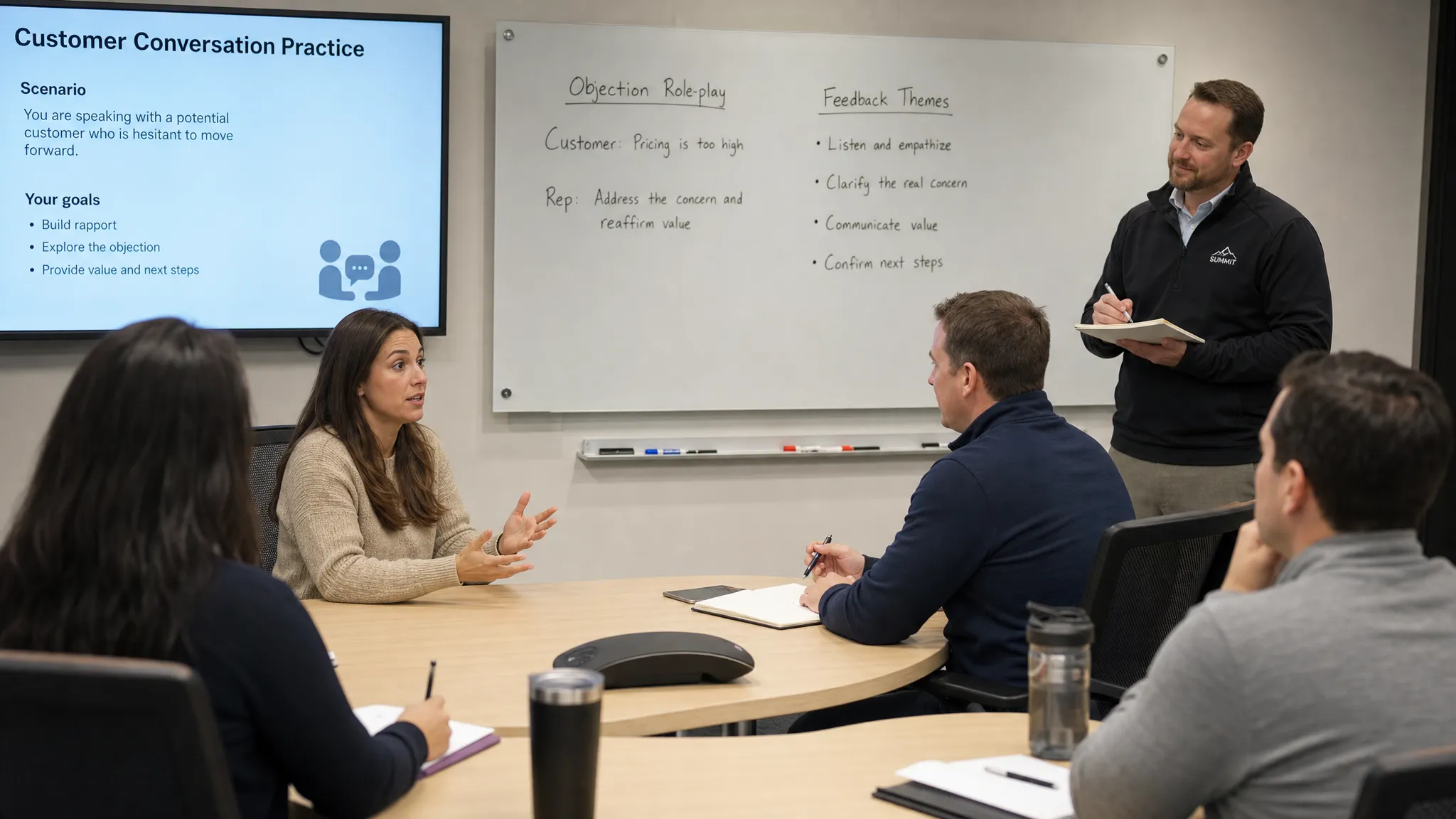
3. Real-Time Feedback Shortens the Learning Loop
Feedback is most useful when it is specific, timely, and actionable. If an employee receives coaching days after a conversation, the details may already be fuzzy. If the feedback is vague, they may not know what to change.
Real-time AI feedback can help learners adjust faster. It can highlight whether they asked a clear discovery question, acknowledged the customer’s concern, explained value before discounting, or missed an opportunity to confirm next steps. In service settings, it can flag tone, clarity, empathy, or resolution structure.
This does not eliminate the need for human coaching. In fact, it can make manager coaching more valuable. When AI handles frequent practice feedback, managers can focus on higher-level judgment, strategy, and nuance.
The best use of real-time feedback is not to overwhelm learners with every possible correction. It is to identify the few changes that would most improve the next attempt. Performance improves when feedback is focused enough to act on immediately.
4. Progress Analytics Turn Practice Into Coaching Intelligence
Many training programs struggle to answer a simple question: are people actually getting better?
Completion data cannot answer that alone. A team may finish every module and still struggle with negotiation, discovery, or de-escalation. Progress tracking analytics give leaders a more useful view of performance development.
For example, analytics can show which scenarios are attempted most often, where learners repeat the same mistakes, which skills improve over time, and which teams need more support. This helps managers coach based on evidence rather than gut feel.
| Practice metric | What it reveals | How leaders can use it |
|---|---|---|
| Scenario completion | Whether people are engaging with practice | Identify adoption gaps and reinforce expectations |
| Reattempt frequency | Whether learners are working to improve | Encourage deliberate practice, not one-time completion |
| Skill trend over time | Whether capability is increasing | Track readiness and coaching impact |
| Common feedback themes | Which behaviors need attention | Build team coaching sessions around shared gaps |
| Difficulty progression | Whether learners are ready for harder situations | Match practice to skill level and role complexity |
| Team-level patterns | Where groups are strong or exposed | Prioritize enablement, coaching, and scenario design |
The goal is not to create surveillance. The goal is to make coaching more precise. When analytics are used constructively, employees can see progress and managers can spend time where it has the highest impact.
5. Adaptive Guidance Keeps Practice Challenging
Training works best when it is neither too easy nor too difficult. If practice is too easy, employees coast. If it is too hard, they disengage. Adaptive AI can help maintain the right level of challenge.
For a new sales rep, the system might start with a straightforward discovery conversation and gradually introduce more difficult objections. For an experienced rep, it might simulate a multi-stakeholder deal with budget risk and a strong incumbent competitor. For a service agent, it might progress from basic troubleshooting to a frustrated customer with incomplete information.
Adaptive guidance is especially useful for diverse teams. In most organizations, skill levels vary widely. A single training path cannot serve everyone equally well. Customizable skill levels and adaptive feedback allow employees to improve from their current baseline, not from an assumed average.
This is where AI can make training feel more like coaching. The experience changes based on how the learner performs.
6. Daily Tips Reinforce Behavior Between Sessions
Performance improvement rarely comes from one big training event. It comes from repetition, reflection, and small adjustments over time.
Daily actionable tips can support that process. A tip might remind a rep to confirm the business impact before presenting pricing. It might remind a service agent to acknowledge emotion before moving into resolution steps. It might prompt a manager to ask one coaching question instead of immediately giving advice.
The point is not to flood employees with content. It is to keep the target behavior visible. Small reminders can help turn training into a habit, especially when they are connected to recent practice performance.
This matters because teams are busy. Sales reps are managing pipeline. Service agents are handling volume. Managers are balancing coaching, reporting, and operations. AI-enabled reinforcement helps keep learning active without requiring long training blocks every time.
7. Security and Governance Build Trust
As organizations adopt AI for training, trust matters. Teams need confidence that practice data, scenario content, and performance insights are handled responsibly.
Enterprise-grade security is not just an IT requirement. It affects adoption. If employees worry that practice mistakes will be misused, they may avoid honest practice. If leaders are unclear on governance, AI initiatives can stall before they scale.
The NIST AI Risk Management Framework offers a helpful reference point for thinking about trustworthy AI, including governance, measurement, and risk management. For training programs, practical governance should clarify what data is collected, who can access it, how insights are used, and how AI feedback fits alongside human judgment.
The healthiest culture treats AI practice data as a tool for development, not punishment. That distinction is critical. Employees improve faster when they believe the system is designed to help them get better.
Where AI Capabilities Create the Most Impact
AI training is especially valuable in roles where performance depends on live communication. These are roles where people must listen, respond, adapt, and make judgment calls in real time.
In sales, AI capabilities can improve discovery, qualification, objection handling, negotiation, value articulation, and closing conversations. Reps can practice before important calls, managers can identify readiness gaps, and enablement teams can reinforce methodology more consistently.
In customer service, AI can help agents practice empathy, policy explanation, escalation decisions, troubleshooting, and difficult customer interactions. This can support faster ramping, more consistent service quality, and better confidence under pressure.
In leadership development, scenario-based practice can help managers rehearse coaching conversations, feedback delivery, conflict resolution, and team communication. These skills are often discussed in theory but under-practiced in realistic settings.
The common thread is conversation quality. AI cannot replace human relationships, but it can help people prepare for them more effectively.
How to Evaluate AI Capabilities for Your Team
Before adopting an AI training platform, leaders should look beyond novelty. The question is not whether the tool uses AI. The question is whether its AI capabilities improve practice in ways that connect to business performance.
Use these criteria to evaluate fit:
- Does the platform support realistic roleplay for the conversations your team actually has?
- Can scenarios be personalized by role, skill level, industry, or performance goal?
- Is feedback timely, specific, and actionable enough to change the next attempt?
- Can managers see progress trends without relying only on completion data?
- Does the system support team-based learning as well as individual practice?
- Are security, data access, and governance clear enough for organizational use?
- Can the platform reinforce learning over time, not just during a one-time training launch?
The strongest AI training programs connect these capabilities to a clear performance model. Define what good looks like, create practice around it, measure improvement, and coach based on the evidence.
A Practical Rollout Plan
AI training works best when it starts with a focused performance problem. Trying to transform every skill at once can dilute impact. A sharper rollout creates faster learning and clearer measurement.
Start by choosing a small set of high-value scenarios. For a sales team, this might be discovery, pricing objections, and next-step commitment. For a service team, it might be de-escalation, policy explanation, and escalation handoff.
Next, define the behaviors that matter. What should a strong response include? What should employees avoid? What signals indicate progress? This gives the AI practice environment and human coaches the same target.
Then launch practice in a regular rhythm. Short, repeated sessions are often more useful than occasional long sessions. Managers should review analytics, identify patterns, and coach around the most common gaps.
Finally, refresh scenarios as the business changes. New products, market shifts, customer expectations, and competitive pressure should all influence practice. AI training should evolve with the conversations your team is having.
Frequently Asked Questions
What AI capabilities matter most for sales and service training? The most important capabilities are realistic roleplay simulations, personalized scenarios, real-time feedback, progress analytics, adaptive guidance, reinforcement tips, and secure data handling. Together, they help teams practice, improve, and measure readiness.
Can AI roleplay replace manager coaching? AI roleplay should not replace manager coaching. It gives employees more opportunities to practice and receive immediate feedback, while managers focus on deeper coaching, judgment, strategy, and accountability.
How does AI improve performance instead of just training completion? AI can measure practice quality, skill progression, feedback themes, and readiness signals. This helps leaders understand whether employees are improving specific behaviors, not just finishing training modules.
Is AI training useful for experienced reps and agents? Yes. Experienced employees often benefit from advanced scenarios, tougher objections, complex customer situations, and adaptive difficulty. AI practice is not only for onboarding, it can support continuous skill development.
What should teams measure when using AI for practice? Teams should track engagement, reattempts, skill improvement, common coaching themes, scenario difficulty, and links to business outcomes such as conversion quality, customer satisfaction, ramp time, or quality assurance trends.
Turn AI Practice Into Measurable Performance
The most useful AI capabilities are not just about automation. They help people rehearse difficult moments, receive better feedback, build confidence, and improve consistently.
Scenario IQ supports AI-driven, scenario-based training with roleplay simulations, personalized practice, real-time feedback, progress tracking analytics, adaptive guidance, daily actionable tips, and team-focused learning. If your team needs more than static training content, it may be time to make practice more realistic and measurable.
Explore how Scenario IQ helps sales and service teams build confidence and perform better at Scenario IQ.