

Call centers run on coaching, but traditional coaching has a scaling problem. QA teams can only sample a fraction of interactions, frontline leaders are stretched thin, and agents often get feedback days (or weeks) after the moment that mattered. The result is predictable: inconsistent experiences, slow ramp times, and coaching that feels subjective.
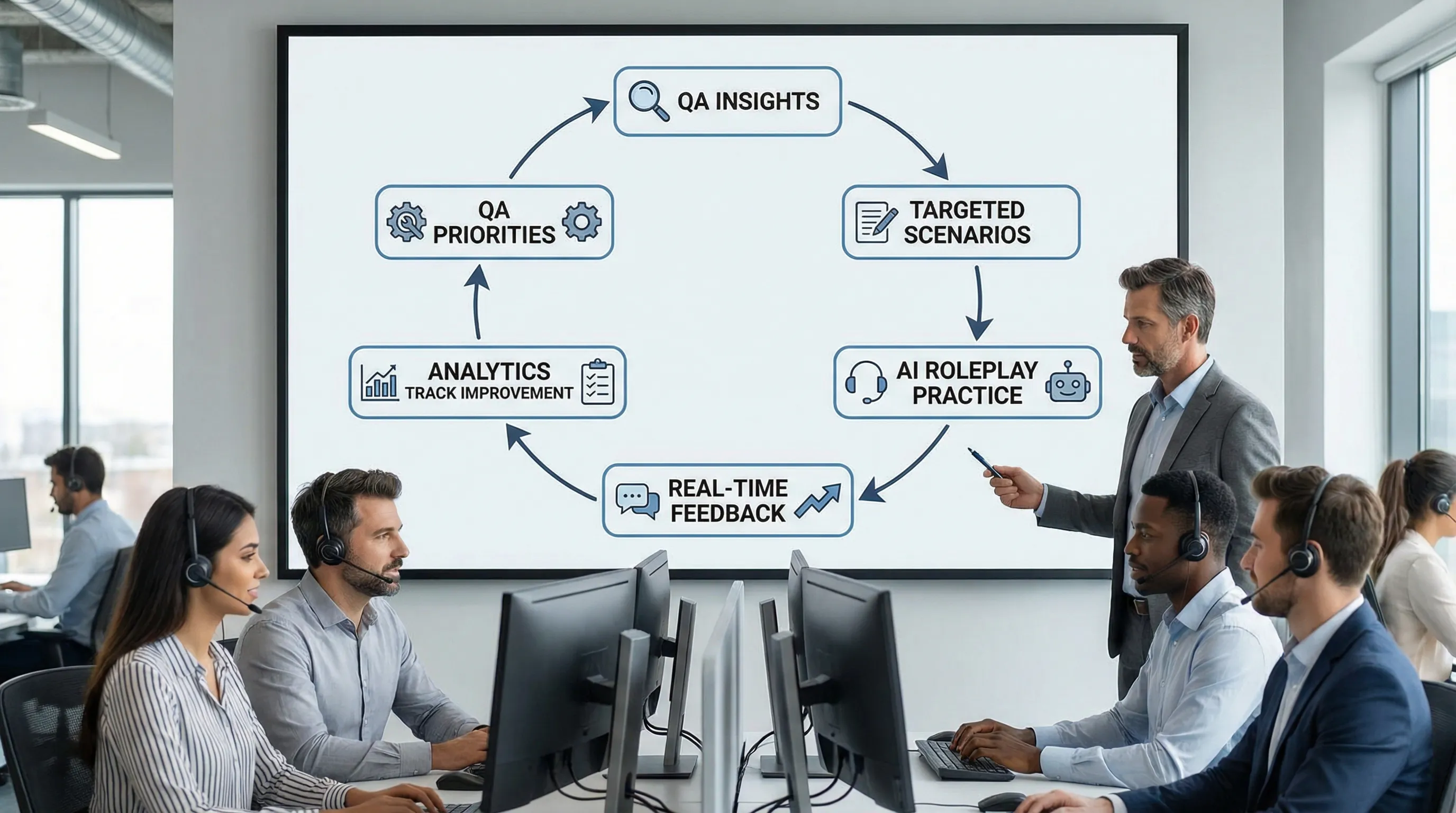
AI call centre coaching changes the equation by turning QA insights into repeatable practice and measurable performance gains. Done well, it combines three things that rarely connect in legacy setups:
- Higher coverage and consistency in QA
- Faster, more personalized training through realistic practice
- Clear performance signals you can act on quickly
This guide breaks down how AI supports QA, training, and coaching workflows in modern contact centers, which metrics typically move, and how to roll it out responsibly.
What “AI call centre coaching” really means (and what it does not)
AI coaching in a call center is not just an AI score or a chatbot telling agents what to say. The most effective programs treat AI as a coaching engine that:
- Detects skill and behavior gaps from QA and performance data.
- Converts those gaps into targeted practice (roleplay simulations and scenario drills).
- Delivers timely feedback that agents can understand and apply.
- Tracks improvement over time, at the individual and team level.
It also is not a replacement for humans. High-performing environments use AI to scale consistency and speed, then have team leads and QA specialists validate priorities, calibrate expectations, and coach with empathy.
The QA upgrade: from sampled calls to consistent standards
The problem with traditional QA sampling
Most QA programs rely on reviewing a small subset of interactions. Even with strong calibration, sampling introduces three issues:
- Low coverage: rare but high-impact failures can slip through.
- Recency bias: what gets coached depends on what got reviewed.
- Inconsistent interpretation: different evaluators can score the same behavior differently.
AI-supported QA can reduce these issues by standardizing how behaviors are detected and flagged, then routing the right coaching actions to the right people.
Where AI helps most in QA workflows
AI is especially useful for coaching when it helps you:
- Spot patterns across many interactions (for example, repeated missed empathy moments, weak discovery, or inconsistent compliance phrasing).
- Identify coaching opportunities tied to the QA rubric (so coaching aligns with how you measure quality).
- Shorten the loop between a mistake and the agent’s next practice session.
The key is alignment: AI outputs should map to your QA definitions and service principles, not create a parallel scoring system no one trusts.
A practical QA-to-coaching loop
A strong model looks like this:
| Step | Traditional approach | AI-enabled coaching approach |
|---|---|---|
| Evaluate interactions | Manual sampling and manual notes | Increased coverage with consistent detection and categorization |
| Decide what to coach | Manager judgment and anecdotes | Pattern-driven priorities tied to QA categories |
| Coach agents | 1:1 sessions, occasional call reviews | 1:1 plus targeted AI roleplay practice |
| Track improvement | Spreadsheet snapshots | Progress tracking analytics and trend visibility |
If your QA team is already overwhelmed, AI coaching can shift QA from “finding problems” to “driving improvements.”
The training shift: practice beats passively “learning”
Contact center training often leans on knowledge bases, shadowing, and onboarding modules. Those are important, but they do not guarantee agents can execute under pressure.
AI coaching is most powerful when it delivers scenario-based practice that mirrors real calls, including tone, pacing, pushback, and ambiguity. Agents build muscle memory for:
- Opening and setting an agenda
- Discovery and diagnosing the real issue
- De-escalation and empathy
- Objection handling (price, policy, time, distrust)
- Confirming resolution and next steps
Why AI roleplay works for call centre coaching
Roleplay has always been one of the fastest ways to improve conversations, but it rarely scales because it requires time from trainers and team leads. AI roleplay simulations help you scale practice without waiting for a manager to be available.
When AI roleplay is done well, it includes:
- Personalised training scenarios that match an agent’s skill gaps
- Adaptive feedback and guidance during or after the simulation
- Real-time feedback that is specific (not generic encouragement)
- Customisable skill levels so you can support both new hires and top performers
This is also where confidence improves. Agents who practice difficult conversations repeatedly tend to hesitate less and recover faster when calls go off-script.
Performance wins: which KPIs AI coaching can improve
“Performance wins” should mean measurable movement in metrics your operation already trusts. While outcomes vary by team, AI call centre coaching typically targets behaviors that influence:
- Quality scores (internal QA evaluations)
- CSAT (customer satisfaction)
- FCR (first contact resolution)
- Escalation rates
- Compliance adherence (when relevant)
- Ramp time for new hires
Be cautious about assuming AI coaching automatically reduces AHT (average handle time). In many environments, coaching improves resolution quality first, and handle time may stabilize or improve later once agents get cleaner at discovery and next steps.
A metrics framework that links coaching to outcomes
To avoid “coaching for coaching’s sake,” connect practice to leading indicators and business outcomes:
| Coaching focus | Leading indicators to track | Outcome metrics it can influence |
|---|---|---|
| Discovery and call control | QA behaviors (questions asked, agenda set), fewer holds/transfers | FCR, AHT, repeat contacts |
| Empathy and de-escalation | QA empathy markers, fewer supervisor assists | CSAT, complaint rate, escalation rate |
| Objection handling | Better compliance with talk tracks, higher confidence ratings | Conversion, save rate, revenue per call (sales) |
| Policy explanations | Fewer compliance flags, fewer contradictory statements | CSAT, rework, refunds, disputes |
The practical win is not just “agents trained.” It is “agents consistently executing the behaviors that move metrics.”
How to implement AI call centre coaching (a rollout playbook)
A successful rollout is more change management than technology. Here is a pragmatic approach that works in many contact centers.
1) Start with a narrow use case that has clear stakes
Pick one high-frequency scenario where performance matters and coaching is currently inconsistent, such as:
- Handling billing disputes
- De-escalating angry callers
- Cancelling or retention conversations
- Booking changes and exceptions
- Upsell or cross-sell moments (if your center does sales)
This keeps the pilot focused and makes results easier to interpret.
2) Define “good” using your QA rubric and best calls
AI coaching needs a definition of success that your org accepts. Ground it in:
- Existing QA forms and score categories
- Your service principles (tone, empathy, clarity)
- A curated set of “great call” examples from your own team
If your QA standards are unclear or constantly shifting, fix that first. AI will scale whatever you define, including ambiguity.
3) Build roleplay scenarios that mirror real friction
The fastest improvements come from scenarios that reflect reality, not ideal customers. Include:
- Interruptions and impatience
- Conflicting information
- “I already tried that” resistance
- Emotion (anger, anxiety, confusion)
- Hard constraints (policy limits, timing, billing rules)
This is where personalised training scenarios and customisable skill levels matter. New hires need structure, experienced agents need edge cases.
4) Set a coaching cadence that fits operations
Keep it lightweight. Many teams succeed with short, frequent practice rather than long sessions:
- 5 to 10 minutes of roleplay practice
- 2 to 4 times per week
- Focused on one skill at a time
Then use team leads for higher-value coaching: patterns, motivation, career development, and escalations.
5) Use analytics to prove impact (and to calibrate)
A good coaching system should provide progress tracking analytics and performance metric dashboards so you can answer:
- Are agents practicing?
- Are scores improving in the targeted skill?
- Are business KPIs shifting in the expected direction?
- Which teams or tenures benefit most?
If analytics and QA disagree, treat it as a calibration opportunity, not a failure. Adjust scenario difficulty, coaching guidance, or QA definitions.
Governance, privacy, and trust: how to deploy responsibly
Contact centers are high-sensitivity environments. Coaching programs touch customer conversations, employee performance, and sometimes regulated topics. Build trust early by addressing governance explicitly.
What to document before scaling
- Purpose limitation: What is AI coaching used for (development), and what is it not used for (punitive surveillance)?
- Access controls: Who can see what (agents, team leads, QA, admins)?
- Retention: How long are practice artifacts and analytics kept?
- Human review: When does a human override AI guidance or conclusions?
If your organization uses an AI risk framework, the NIST AI Risk Management Framework is a widely referenced starting point for thinking about reliability, privacy, and accountability.
The trust principle: coaching should feel helpful
Adoption rises when agents experience AI as:
- Specific feedback they can act on
- A safe place to practice without embarrassment
- A fair system aligned with what they are measured on
A simple tactic that works: pair AI practice with daily actionable tips that reinforce one improvement at a time.
What to look for in an AI coaching platform for call centers
When evaluating tools, focus on whether the platform supports the full coaching loop (not just content delivery).
Key capabilities to prioritize:
- AI-powered roleplay simulations that feel realistic and can be tuned to your scenarios
- Adaptive feedback and guidance that is consistent, explainable, and aligned to your standards
- Team-focused learning so you can run programs by team, skill, or campaign
- Progress tracking analytics to prove training impact
- Enterprise-grade security appropriate for customer service environments
Also ask how quickly you can create or update scenarios. Contact center scripts, policies, and products change constantly, your training needs to keep up.
Where Scenario IQ fits
Scenario IQ is designed around AI-driven, personalised scenario-based training for sales and service teams. For call centers, that typically means:
- Running AI roleplay simulations for the scenarios your agents face every day
- Providing real-time feedback so agents can correct course immediately
- Using progress tracking analytics and dashboards to see improvement across individuals and teams
- Supporting scalable programs with customisable skill levels, daily actionable tips, and team-focused learning
If your goal is to tie QA priorities to targeted practice and measurable performance improvement, that end-to-end loop is the model to aim for.
Frequently Asked Questions
What is AI call centre coaching? AI call centre coaching uses AI to identify skill gaps (often informed by QA), deliver targeted roleplay practice, provide feedback, and track improvement over time.
How is AI coaching different from QA automation? QA automation focuses on evaluating interactions against standards. AI coaching goes further by turning those insights into practice (scenarios, roleplay, feedback) so performance actually improves.
Will AI coaching replace team leads or trainers? No. The best programs use AI to scale practice and consistency, while team leads and trainers focus on calibration, motivation, nuanced coaching, and culture.
What metrics should we track to prove coaching impact? Track a mix of leading indicators (practice completion, targeted QA behaviors) and outcomes (QA score, CSAT, FCR, escalations). Choose metrics tied to the specific scenario you are coaching.
How do we get agents to adopt AI roleplay training? Keep sessions short, make feedback specific, align to QA expectations, and position it as a development tool. Adoption improves when agents feel the system helps them win difficult calls.
Build a coaching engine that scales
If you want AI call centre coaching that connects QA to repeatable practice and measurable performance wins, Scenario IQ is built for scenario-based training with real-time feedback and analytics.
Explore Scenario IQ at Scenario IQ and see how AI roleplay coaching can help your team build confidence, handle objections, and deliver more consistent customer experiences.