

Sales teams are flooded with promises about AI, but most leaders are still asking the same practical questions: What should we automate, what should we never automate, and how do we roll this out without hurting trust, pipeline quality, or brand voice?
This guide turns “AI and sales” from a buzzword into a realistic roadmap you can execute in phases, whether you lead a small SMB team or a global revenue org.
What “AI and sales” means for modern teams (and what it does not)
In 2026, “AI in sales” typically shows up in three places:
- Workflow assistance: drafting emails, summarizing calls, generating follow-ups, finding content, updating CRM fields.
- Decision support: forecasting support, deal-risk signals, next-best action suggestions, territory and account prioritization.
- Skill development: roleplay practice, objection handling, discovery coaching, manager feedback, onboarding acceleration.
What it is not (at least not reliably): a set-and-forget “autopilot” that replaces your reps’ judgment. AI can accelerate execution, but it still depends on clear process, good data, and strong coaching.
A useful mindset is: AI should reduce low-value effort and increase high-quality selling time, while keeping humans accountable for customer truth, pricing, and commitments.
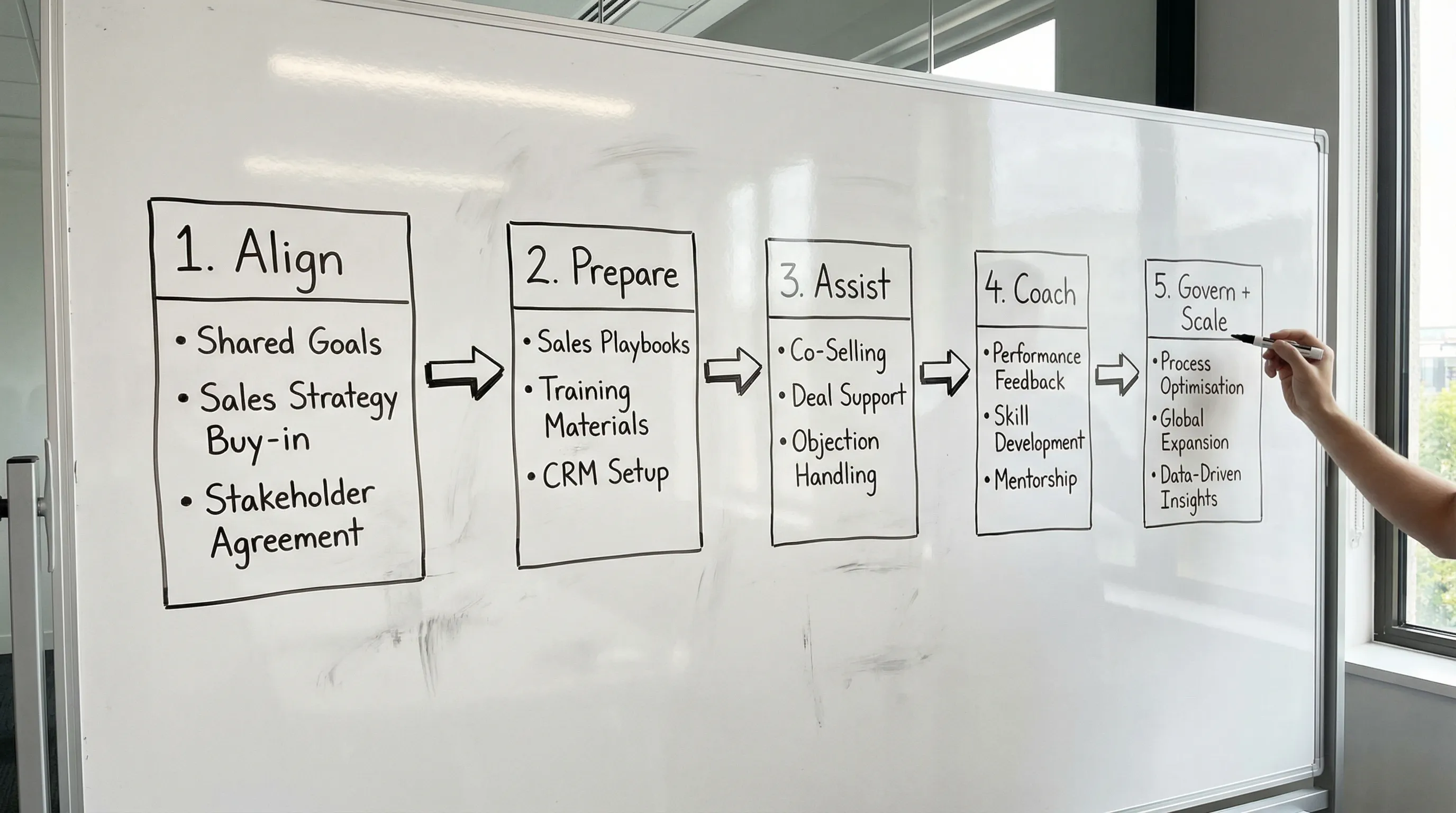
A realistic roadmap for AI and sales (phased, measurable, safe)
Most rollouts fail because teams buy tools before they choose outcomes. Use this phased approach instead.
| Phase | Goal | What you implement | What you measure |
|---|---|---|---|
| 1. Align | Pick the right problems | Use-case shortlist, success metrics, risk guardrails | Baseline conversion rates, ramp time, activity mix |
| 2. Prepare | Make AI “workable” | CRM hygiene, call tagging, content library, permissions | Data completeness, process adherence |
| 3. Assist | Win quick value | Summaries, follow-ups, research, content recommendations | Time saved, CRM update rate, meeting-to-next-step rate |
| 4. Coach | Improve skills at scale | AI roleplay, real-time feedback, scenario practice | Objection handling scores, talk tracks adoption, win rate on targeted segments |
| 5. Govern + Scale | Reduce risk, expand impact | Security review, policy, enablement, continuous tuning | Policy adherence, qualitative rep sentiment, sustained KPI lift |
The rest of this article breaks down how to run each phase with concrete steps.
Phase 1: Align on outcomes, then choose use cases
Start with a one-hour working session (Sales, RevOps, Enablement, and a frontline manager). Your output should be a one-page “AI charter” with:
- Business outcomes: for example, improve win rate in mid-market, reduce ramp time for new SDRs, increase renewal rates, reduce no-show rate.
- In-scope workflows: where AI is allowed to assist.
- Out-of-scope workflows: where humans must decide (discounting, legal commitments, final proposals, sensitive customer info).
- Success metrics: what changes, by how much, and by when.
A practical way to pick your first AI use cases
Choose use cases that are (1) frequent, (2) measurable, and (3) low-regret if the output is imperfect.
Here are strong “first wave” candidates:
- Call and meeting summaries that reduce note-taking and improve handoffs.
- Follow-up drafting that reps review and edit, especially for recap emails and next steps.
- Account research prompts that standardize pre-call prep.
- Content retrieval (finding the right case study or one-pager quickly).
- Training and roleplay to improve discovery, objection handling, and confidence.
Avoid starting with high-risk automation, like fully automated outbound messaging at scale or unsupervised pricing recommendations.
Phase 2: Prepare the foundation (the unglamorous part that determines ROI)
AI reflects the systems you already have. If your CRM is messy and your sales process is inconsistent, AI will amplify that inconsistency.
Focus on three readiness areas.
Data readiness (CRM and conversation data)
You do not need perfect data, but you do need:
- Defined pipeline stages with clear entry and exit criteria.
- Required fields that match reality, not wishful thinking.
- Consistent activity capture (meetings, calls, notes) so AI outputs can be evaluated.
If you use call recording, ensure you have clear rules for consent and retention that match your legal requirements.
For guidance on AI risk management and organizational controls, the NIST AI Risk Management Framework is a practical reference for policies and governance.
Process readiness (what “good” looks like)
Before you ask AI to coach discovery, you need a defined discovery standard, such as:
- Qualification questions that must be answered
- Exit criteria for moving to a proposal
- A standard way to document customer goals, constraints, and buying process
AI can help reinforce a process, but it cannot invent one that your team does not consistently follow.
Enablement readiness (assets and talk tracks)
If reps cannot find the right messaging today, AI-generated messaging will vary wildly. Build a lightweight library:
- Core positioning and differentiation
- Approved talk tracks and objection responses
- Industry-specific examples
- A handful of “gold standard” calls or transcripts
Phase 3: Deploy assistive AI first (help reps, do not replace them)
Assistive AI tends to deliver early value because it saves time without changing customer experience too aggressively.
Where assistive AI usually pays off quickly
After-call workflow: Most teams lose momentum after discovery because follow-up is inconsistent. AI-assisted summaries and next-step emails can improve speed and clarity.
CRM updates: AI can help reps capture key fields faster (pain points, stakeholders, timeline) so managers trust pipeline.
Pre-call prep: Structured prompts can generate a consistent research brief (company context, likely priorities, relevant proof points). Reps still validate.
The quality rule that keeps you safe
Treat AI output as a draft. Make the expectation explicit:
- Reps review for accuracy n- Reps remove assumptions
- Reps match tone and commitments to what was actually said
This reduces brand and compliance risk and improves rep trust.
Phase 4: Use AI for the hardest part of sales, skill building under pressure
Tools that save minutes are helpful. Tools that improve capability can change revenue outcomes.
Sales performance often hinges on moments that are hard to practice in real life:
- Handling price pushback without discounting too early
- Running discovery without interrogating the buyer
- Regaining control when a call goes off-track
- Navigating procurement or security reviews
- Managing renewals and expansion conversations
That is where AI roleplay is a practical, scalable lever.
Why AI roleplay works when training sessions do not
Traditional training tends to be episodic (quarterly workshops, annual kickoff). Real improvement needs repetition, feedback, and progressive difficulty.
AI roleplay can provide:
- Consistent practice without needing another person available
- Personalized scenarios by role, product line, or industry
- Immediate feedback on clarity, structure, empathy, and objection handling
- Progress tracking so managers coach based on patterns, not anecdotes
How Scenario IQ fits this phase
Scenario IQ focuses on AI-driven, personalized scenario-based training for sales and service teams. Instead of hoping reps “remember the slide,” teams can practice realistic conversations and get real-time feedback.
This is particularly useful when you want to operationalize talk tracks and objections across the whole org, including:
- New-hire onboarding (faster confidence and consistency)
- Manager-led coaching (clearer coaching priorities from progress analytics)
- Cross-functional readiness (sales plus customer service, success, and support)
If you are evaluating AI for sales, prioritize tools that are measurable and repeatable, not just impressive in a demo.
Phase 5: Run a pilot you can actually learn from
A common mistake is running a pilot that is too broad. A better pilot is narrow, measurable, and time-boxed.
Design a clean 30 to 45 day pilot
Pick:
- One team (for example, SDRs in one segment, or an AE pod)
- One capability (for example, objection handling for pricing)
- One workflow (for example, after-call recap and next-step email)
- Two to three metrics (one leading, one lagging, one quality)
Here is a practical measurement set.
| Metric type | Example metric | Why it matters |
|---|---|---|
| Leading | Time to send follow-up after meeting | Measures speed and discipline |
| Leading | % of calls with documented next step | Measures process adherence |
| Quality | Manager QA score on recap accuracy | Prevents “fast but wrong” |
| Lagging | Meeting-to-opportunity conversion | Measures pipeline impact |
| Lagging | Win rate on targeted objection deals | Measures skill impact |
Create a feedback loop with frontline managers
Managers are the difference between “AI tool adoption” and “performance change.” Give them a weekly 30-minute review cadence:
- What patterns are showing up?
- Which scenarios need tuning?
- Which reps need extra practice?
- Which talk tracks are working in the field?
Phase 6: Governance, security, and customer trust (do this before you scale)
Scaling AI in sales without governance is how you get inconsistent messaging, privacy risk, and internal backlash.
Create three lightweight artifacts.
1) An AI usage policy for revenue teams
Clarify:
- What customer data is allowed in prompts
- What outputs require human verification
- Where AI cannot be used (pricing commitments, legal terms, sensitive categories)
2) A review process for high-impact content
If AI drafts outreach templates or proposal language, define a review owner (Enablement, Marketing, Legal, or Sales Ops) and a release process.
3) A vendor security checklist
At minimum, confirm how data is handled, who can access it, and how permissions work. If you operate in regulated environments, involve security and legal early.
Scenario IQ notes enterprise-grade security as part of its platform positioning. If security is a deciding factor for your org, validate requirements directly with the vendor during evaluation.
Phase 7: Scale adoption with change management (not just licenses)
AI adoption fails when it feels like extra work. Build habits and incentives.
Practical adoption moves that work
- Bake AI workflows into existing routines (post-call, weekly coaching)
- Make “good examples” visible (gold standard follow-ups, high-scoring roleplays)
- Reward usage that correlates with quality outcomes, not vanity activity
A simple rule: if the new behavior is not reinforced in 1:1s, it will not stick.
Common pitfalls when combining AI and sales
Mistake 1: Measuring “time saved” but not pipeline outcomes
Time saved is only valuable if it becomes more customer-facing selling time and better execution. Tie pilots to conversion rates, cycle time, and quality.
Mistake 2: Letting AI outputs sound generic
If your reps all start emailing the same polished but vague language, buyers notice. Use AI to draft structure, but keep your team’s point of view, proof points, and specifics.
Mistake 3: Ignoring the service and post-sale side
Revenue performance is increasingly tied to retention and expansion. AI roleplay and scenario training can also help customer service and success teams practice de-escalation, renewals, and value conversations.
Mistake 4: Rolling out without manager enablement
Managers need training too, including how to interpret analytics, coach to patterns, and set expectations for human review.
Frequently Asked Questions
Will AI replace sales reps? AI is more likely to reshape sales work than replace it. Teams that win will use AI to reduce admin work and improve skills, while keeping humans accountable for judgment and customer trust.
What is the best place to start with AI and sales? Start with low-risk, high-frequency workflows (call summaries, follow-up drafts, CRM updates) and one measurable skill initiative (like objection handling roleplay).
How do we measure ROI from AI in sales? Combine leading indicators (follow-up speed, next-step documentation, coaching participation) with lagging indicators (conversion rates, cycle time, win rate in targeted segments).
Is AI-generated outreach safe to use? It can be, if reps review outputs, your team uses approved talk tracks, and you have guardrails around sensitive claims, compliance, and customer data.
How can AI improve objection handling? AI can simulate buyer pushback, let reps practice multiple approaches, and give immediate feedback. Over time, analytics can reveal which objections and responses correlate with better outcomes.
What should we include in an AI policy for sales teams? Define what data can be used, which outputs require human verification, where AI is prohibited (pricing, legal commitments), and how approved messaging is maintained.
Build real selling confidence with Scenario IQ
If you want AI to improve outcomes (not just produce drafts), prioritize skill development you can measure.
Scenario IQ provides AI roleplay simulations, personalized scenarios, real-time feedback, and progress analytics to help sales and service teams build confidence and perform under pressure.
Explore how it works at Scenario IQ and evaluate it against your team’s first pilot use case.