

Most sales training fails for a simple reason: it treats practice like a one-time event instead of a system that adapts to each rep’s gaps, confidence level, and real customer reality.
Adaptive learning flips that model. Instead of assigning the same modules and roleplays to everyone, adaptive learning uses performance data to personalize what each person practices next, how difficult it should be, and what coaching feedback they need. The result is better conversations on calls, faster ramp time, and more consistent execution across the team.
What “adaptive learning for sales” really means
Adaptive learning for sales is a training approach where practice content changes based on how a rep performs, not just what they complete.
In a practical sales enablement context, an adaptive system typically does four things well:
- Diagnoses skill gaps continuously (not only at onboarding) using quizzes, call rubrics, roleplay results, and manager input.
- Prescribes targeted practice (scenarios, objections, discovery drills) based on those gaps.
- Adjusts difficulty and pacing as the rep improves, struggles, or changes roles.
- Closes the loop with feedback and analytics so reps, managers, and enablement can see what’s improving and what’s stuck.
That’s the key distinction: adaptive learning is not just personalization by job title. It is personalization driven by demonstrated performance.
Why personalization matters more in sales than in most functions
Sales is a “performance sport.” Knowing the pitch is not the same as executing it under pressure, with a skeptical buyer, in a competitive deal cycle.
A one-size-fits-all program breaks down quickly because:
- Teams are uneven by design. You might have new SDRs, mid-market AEs, enterprise closers, and CSMs all needing different practice.
- Your messaging changes constantly. New products, pricing changes, competitors reposition, and buyer objections evolve.
- Confidence is a hidden variable. Two reps can “know” the same script, but one freezes when pushed, while the other adapts.
Adaptive learning addresses all three by putting reps into the specific conversations they need, as often as they need, at a level that challenges without overwhelming.
Traditional training vs adaptive learning (what changes day to day)
| Area | Traditional sales training | Adaptive learning for sales |
|---|---|---|
| Assignment logic | Same curriculum for all | Practice changes based on performance signals |
| Practice frequency | Periodic workshops | Ongoing, bite-sized sessions built into the week |
| Skill progression | Linear (Module 1, 2, 3) | Non-linear, focused on the rep’s weakest links |
| Coaching | Manager-dependent, inconsistent | More consistent feedback loops and coaching prompts |
| Measurement | Completion rates | Skill improvement trends tied to practice outcomes |
The day-to-day difference is subtle but powerful: instead of “finish the course,” reps experience “get better at this specific moment in the conversation.”
The engine behind adaptive learning: scenarios, signals, and feedback loops
If you want adaptive learning to work at scale, you need a system that connects three elements.
1) Scenarios that reflect real selling conditions
Adaptive learning is only as good as the scenarios it uses. High-value sales scenarios typically map to moments that decide deals, such as:
- First-call discovery that uncovers a measurable problem
- Handling a “we’re already working with X” competitor objection
- Negotiating procurement pushback without discounting by default
- Multi-threading into economic buyers and stakeholders
A good scenario library also varies by industry, segment, and product motion, because the “right” conversation differs in each.
2) Signals that indicate what to practice next
To personalize practice, the system must detect patterns like:
- Weak qualification and lack of next steps
- Over-talking and under-questioning
- Feature dumping instead of value framing
- Struggling with a specific objection category (price, security, switching, timing)
These signals can come from roleplay scoring, structured rubrics, manager observations, and rep self-assessments. The point is not perfection. The point is a reliable enough signal to choose the next best practice.
3) Feedback that is immediate and actionable
Generic feedback (for example, “be more confident”) does not change behavior.
Adaptive learning works when feedback is specific enough to apply on the next rep, such as:
- Which question to ask earlier
- Where to pause and confirm
- How to reframe value in the buyer’s language
- What to do after a buyer says no
This is also where scalability often breaks in traditional programs, because managers cannot consistently deliver high-quality feedback to every rep, every week.
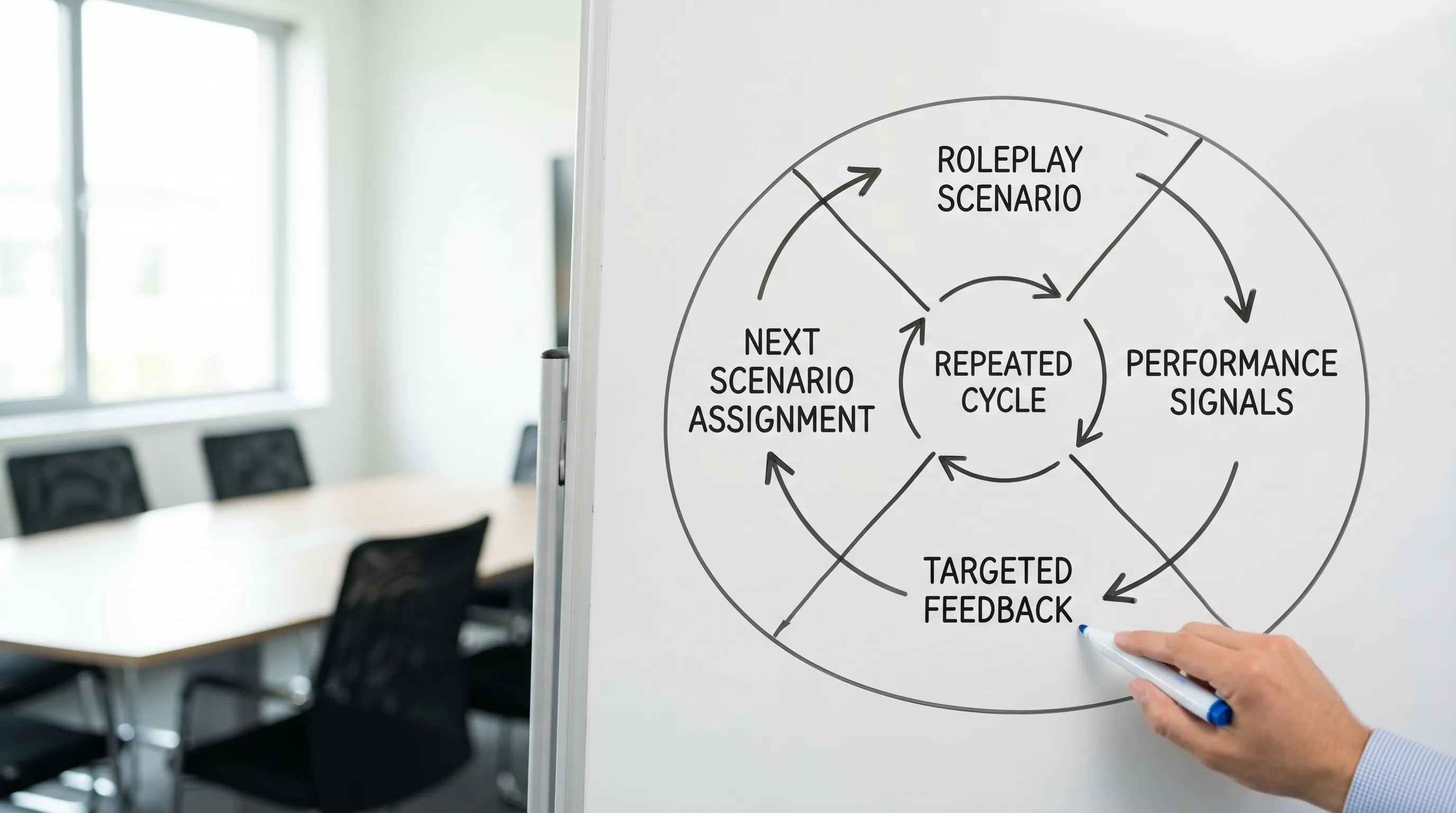
How AI roleplay enables personalization at scale
Personalized practice is not new. What’s new is the ability to deliver it repeatedly without requiring a human coach for every session.
AI roleplay training can help scale adaptive learning by:
- Simulating realistic buyer conversations on demand, so reps can practice when they have time, not only during scheduled sessions.
- Adapting scenarios and difficulty based on how the rep performs, including the type of buyer, objection intensity, and deal context.
- Providing real-time feedback that helps reps correct course immediately, while the conversation is still fresh.
- Tracking progress analytics so enablement and sales leaders can see what skills are improving across the org.
Scenario IQ, for example, is designed around AI-driven, personalized scenario-based training, with real-time feedback, daily actionable tips, and progress tracking analytics that help teams build confidence and consistency. When systems like this are implemented well, reps practice more often because it is accessible, targeted, and directly tied to performance.
A practical implementation plan (without boiling the ocean)
Adaptive learning programs fail when organizations try to model every skill and every scenario on day one. A better approach is to start with a small set of high-leverage behaviors, then expand.
Start with a sales competency map that is actually coachable
Keep the first version focused. Choose 6 to 10 competencies that match your sales motion and are observable in conversation, such as:
- Discovery depth
- Value articulation
- Objection handling
- Next-step control
- Deal qualification
- Executive communication
Then define what “good” looks like in simple language that managers and reps can recognize.
Build a scenario pack tied to your pipeline moments
Instead of writing generic roleplays, design scenarios around:
- The 3 objections that stall most deals
- The top 2 deal stages where opportunities slip
- The first-call and second-call conversations that set the trajectory
You are aiming for relevance, not volume.
Choose a scoring method that reinforces the behaviors you want
A scoring approach can be lightweight, but it must be consistent. Many teams start with a rubric aligned to the competency map, then improve it over time.
What matters is that reps can see the link between:
- The behavior (what they said)
- The impact (how it affected the buyer)
- The correction (what to try next)
Operationalize a weekly practice cadence
Adaptive learning works when practice is frequent enough to drive skill retention. A common starting point is short sessions several times per week.
To keep it sustainable, align it with existing workflows:
- Use roleplays to prep for upcoming calls
- Assign targeted objection drills after pipeline reviews
- Use analytics to shape 1:1 coaching conversations
Measuring whether adaptive learning is working
Completion rates are not the goal. Behavior change is the goal. Revenue impact follows when behavior change is sustained.
Use a mix of leading and lagging indicators.
| Metric type | What to track | Why it matters |
|---|---|---|
| Leading | Roleplay frequency and consistency | Practice volume predicts improvement more than one-off workshops |
| Leading | Skill rubric trends (by competency) | Shows where reps are improving or plateauing |
| Leading | Time-to-proficiency for new hires | Direct signal of ramp efficiency |
| Lagging | Stage conversion rates | Indicates better execution at key moments |
| Lagging | Win rate in target segments | Captures the compounded effect of better conversations |
| Lagging | Discount rate and deal cycle length | Reflects improved value framing and control |
The most useful view is often at the cohort level (new hires, mid-market team, enterprise team) rather than only individual performance.
Common pitfalls (and how to avoid them)
Pitfall: Over-personalizing without standardizing the fundamentals
Adaptive does not mean random. You still need a baseline of “how we sell here,” including messaging, qualification, and talk tracks.
Fix: establish a small set of non-negotiable competencies, then personalize the path to mastering them.
Pitfall: Treating roleplay as “testing” instead of practice
If reps feel they are being judged, practice drops. If they feel they are improving, practice increases.
Fix: position roleplay as a safe environment to build muscle memory, and reserve performance evaluation for clear moments with transparent criteria.
Pitfall: Data without coaching action
Dashboards do not change behavior. Coaching does.
Fix: connect analytics to weekly manager actions, such as choosing one competency to coach per rep per week.
Scenario-based training is bigger than sales (and that’s a good sign)
One useful way to validate your approach is to look at other high-stakes domains where scenario practice is standard. Emergency management, for instance, relies on structured exercises to prepare teams for real-world uncertainty and then document lessons learned.
If you want to see what a mature scenario lifecycle looks like outside of sales, explore a scenario exercise platform like Preppr, which emphasizes designing exercises, running them, and improving based on after-action insights. The principle is the same: realistic practice plus feedback loops drives better performance when it matters.
Where Scenario IQ fits in an adaptive learning approach
If your goal is to personalize practice at scale, you typically need three capabilities working together:
- AI-powered roleplay simulations that reps can run frequently without scheduling overhead
- Personalized training scenarios and adaptive guidance that respond to performance
- Real-time feedback and progress tracking analytics so improvement is visible and coachable
Scenario IQ is positioned around these needs, offering AI-driven roleplay, personalized scenarios, real-time feedback, daily actionable tips, and performance analytics for team-focused learning. For organizations, this creates a practical path to scaling deliberate practice without scaling headcount at the same rate.
Making adaptive learning stick: a simple operating model
Adaptive learning becomes a growth lever when it is embedded in how sales teams work.
Aim for an operating model where:
- Reps practice short, targeted scenarios consistently
- Managers coach one or two behaviors at a time using shared data
- Enablement updates scenarios when products, competitors, or messaging changes
- Leaders track improvement trends and tie them to pipeline health
Personalize practice, keep the fundamentals consistent, and treat training as a continuous system. That’s how you turn adaptive learning for sales into repeatable execution and more closed deals.