
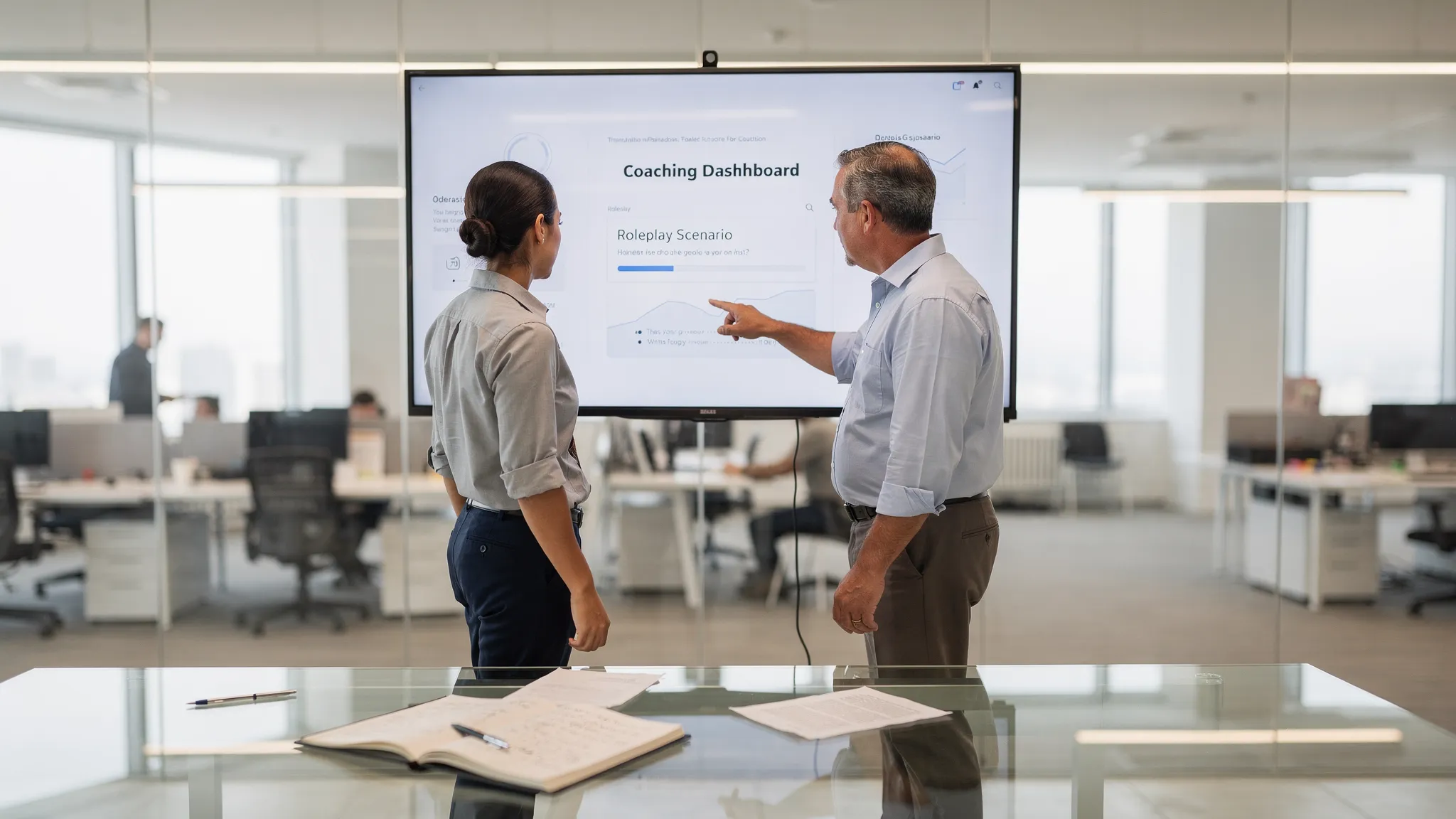
Sales coaching has always had a scaling problem. A great manager can listen to a few calls, diagnose a few skill gaps, and run a few focused coaching sessions each week. But most teams need far more than that. New reps need ramp support. Experienced reps need sharper discovery, negotiation, and objection handling. Frontline managers need visibility into who is improving and who is quietly struggling.
That is where adaptive AI changes the model. Instead of pushing the same training module to every rep, adaptive AI adjusts practice, feedback, and difficulty based on each person’s performance. It can help teams move from occasional coaching to continuous skill development, without asking managers to personally observe every roleplay, call, or customer interaction.
The goal is not to replace sales managers. The goal is to give every rep more high-quality practice and give managers better signals about where their coaching time will have the most impact.
McKinsey’s research on generative AI estimates that the technology could add trillions of dollars in annual economic value, with marketing and sales among the functions positioned for significant impact. For revenue teams, the most practical opportunity is not just automating tasks. It is helping people perform better in the conversations that move pipeline forward.
What adaptive AI means in sales coaching
Adaptive AI uses data from a learner’s actions to adjust what happens next. In sales coaching, that can mean changing the customer persona, objection type, question difficulty, feedback style, or next recommended practice based on how a rep performs.
A static training program might tell every rep to watch the same video on discovery calls. An adaptive coaching system can instead place one rep into a basic discovery roleplay, challenge another with a skeptical CFO, and push a third into a multi-stakeholder negotiation scenario because they have already mastered the fundamentals.
The difference is personalization. The system is not only delivering content. It is responding to performance.
| Coaching approach | How it works | Main limitation | Where adaptive AI helps |
|---|---|---|---|
| Classroom training | Everyone receives the same instruction at the same time | Limited personalization and retention | Reinforces learning with individual practice paths |
| Call reviews | Managers review real customer interactions after they happen | Feedback often arrives too late | Lets reps practice before the stakes are real |
| Peer roleplay | Reps practice with teammates or managers | Quality varies by facilitator and time available | Provides consistent scenarios and feedback |
| LMS modules | Reps complete prebuilt content | Completion does not prove readiness | Connects training activity to observable skills |
| Adaptive AI roleplay | Reps practice dynamic conversations with AI feedback | Requires thoughtful setup and governance | Scales personalized coaching across teams |
For sales leaders, this matters because skill gaps are rarely uniform. One rep may struggle to ask clear discovery questions. Another may rush to discount when challenged on price. Another may know the pitch but fail to tailor it by industry. Adaptive AI helps identify and train those differences at the individual level.
Why personalized sales coaching is hard to scale
Sales managers are often expected to coach, forecast, inspect pipeline, join customer calls, support hiring, report to leadership, and unblock deals. Coaching is critical, but it is also one of the easiest activities to delay when the quarter gets busy.
That creates a gap between enablement intention and rep behavior. Teams may launch strong training programs, but without enough practice and reinforcement, reps often fall back into old habits under pressure. They remember the talk track, but miss the moment. They know the product, but fail to connect it to the buyer’s pain. They understand the objection handling framework, but freeze when a prospect says the competitor is cheaper.
Personalized coaching is hard to scale for three reasons.
First, every rep needs a different path. Ramp-stage reps need structure, repetition, and confidence. Mid-level reps need refinement and scenario variety. Top performers may need advanced negotiation, executive alignment, or enterprise deal strategy practice.
Second, real customer conversations are inconsistent. A manager might observe a great call, but that call may not reveal whether the rep can handle pricing pressure, security concerns, legal delays, or an unhappy customer stakeholder.
Third, feedback is often fragmented. Call recordings, CRM notes, manager observations, and enablement completion data may all live in different places. Even when the information exists, it can be hard to turn it into a clear coaching plan.
Adaptive AI helps by turning practice into a repeatable, measurable loop. Reps can train against realistic scenarios, receive timely feedback, and progress through increasingly challenging situations. Managers can then focus on the patterns that matter most.
How adaptive AI personalizes sales coaching
Adaptive AI for personalized sales coaching works best when it is connected to clear skills, realistic scenarios, and measurable outcomes. The system needs to know what good looks like, then adjust the learning path when a rep shows strength or weakness.
In practice, adaptive coaching can personalize several parts of the learning experience.
- Scenario difficulty: A rep who handles basic objections well can be moved into more complex buyer resistance, while a newer rep can repeat foundational practice until they build confidence.
- Buyer persona: The same product conversation can feel very different with a technical evaluator, economic buyer, procurement lead, or frustrated customer.
- Conversation path: If a rep misses a key discovery question, the AI can create follow-up pressure that reveals the impact of that gap.
- Feedback focus: One rep may need coaching on clarity and structure, while another needs help with empathy, listening, or concise value articulation.
- Practice cadence: Adaptive systems can recommend what to practice next based on recent performance, rather than relying on a fixed training calendar.
This is where AI roleplay becomes especially useful. Traditional roleplay can be awkward, inconsistent, or skipped entirely because managers and reps are busy. AI-powered simulations make practice easier to repeat, easier to measure, and easier to tailor.
The coaching moments where adaptive AI creates value
Adaptive AI is most useful when the conversation is important, repeatable, and skill-dependent. Sales teams do not need artificial practice for every interaction. They need focused rehearsal for moments where better execution changes outcomes.
Discovery calls
Discovery is one of the strongest use cases because it exposes how a rep thinks. Does the rep ask about business impact, or jump straight into features? Do they uncover decision criteria, urgency, stakeholders, and current process? Do they listen and adapt, or follow a script too rigidly?
Adaptive AI can vary buyer openness, industry context, urgency, and complexity. A rep who asks surface-level questions can be coached toward deeper problem exploration. A rep who talks too much can receive feedback on listening and follow-up questions.
Objection handling
Objection handling is not about memorizing clever responses. It is about staying composed, clarifying the concern, and guiding the buyer back to value. Adaptive AI can simulate price objections, timing concerns, competitor comparisons, internal resistance, legal friction, or uncertainty about ROI.
Because reps can practice repeatedly, they build fluency before facing those objections in live deals. This is especially valuable for teams entering new markets, launching new messaging, or selling into more complex buying committees.
Negotiation and closing conversations
Late-stage conversations require precision. Reps need to protect value, understand tradeoffs, align stakeholders, and avoid unnecessary discounting. An adaptive simulation can increase pressure over time, testing whether a rep can respond strategically rather than reactively.
The value here is not just practice. It is pattern recognition. If multiple reps concede too quickly, leadership may need to update negotiation training, pricing guidance, or manager coaching.
Customer service and expansion conversations
Scenario-based coaching is not limited to net-new sales. Service teams, account managers, customer success managers, and renewal teams also face moments where communication quality matters. A customer escalation, renewal risk conversation, or expansion discussion can benefit from the same adaptive practice model.
For organizations that want consistent customer experiences, adaptive AI can help train both confidence and judgment across customer-facing roles.
A scalable coaching loop for revenue teams
The most effective AI coaching programs do not treat adaptive AI as a standalone tool. They use it as part of a coaching operating system. The loop should connect business priorities, roleplay practice, AI feedback, manager insight, and measurable progress.
| Step | What happens | Output for the team |
|---|---|---|
| Define the skill | Leaders identify the conversation or behavior that matters | A focused coaching objective |
| Create the scenario | The team builds realistic buyer or customer situations | Practice that reflects real work |
| Run adaptive roleplay | Reps practice at a suitable difficulty level | Observable performance data |
| Deliver feedback | AI provides real-time guidance and next steps | Faster reinforcement after practice |
| Review analytics | Managers look for individual and team patterns | Better coaching prioritization |
| Repeat and refine | Scenarios evolve as skills improve or markets change | Continuous readiness improvement |
This loop matters because sales readiness is not a one-time event. A rep can be ready for one product, one persona, or one objection and still be unprepared for the next challenge. Adaptive AI keeps coaching aligned with changing buyer expectations, team goals, and rep development.
Metrics that help prove coaching impact
Completion rates alone do not tell you whether reps are ready. A team can finish every training module and still struggle in live conversations. To measure adaptive AI coaching, sales leaders should look at activity, skill quality, manager efficiency, and business indicators together.
| Metric category | Examples to track | Why it matters |
|---|---|---|
| Practice consistency | Roleplays completed, repetitions by skill, practice frequency | Shows whether coaching is becoming a habit |
| Skill indicators | Discovery depth, objection handling quality, clarity, confidence, listening | Measures behavior, not just participation |
| Progress over time | Score changes, skill level movement, repeated weakness reduction | Shows whether reps are improving |
| Manager efficiency | Coaching focus areas, team-level skill gaps, review time saved | Helps managers prioritize human coaching |
| Revenue-adjacent signals | Stage conversion, ramp progress, meeting quality, renewal risk handling | Connects readiness work to business outcomes |
Revenue metrics should be interpreted carefully. Many factors influence win rate, deal size, cycle length, and retention. Adaptive AI coaching should be evaluated as part of a broader performance system that includes sales process, product-market fit, enablement content, manager quality, and pipeline health.
Still, better practice data gives leaders something they often lack: visibility into whether reps can actually execute the behaviors the business expects.
How to implement adaptive AI without overwhelming the team
The best rollout is focused. Trying to automate every coaching need at once creates noise. A stronger approach is to choose a small number of high-impact conversations, define what good looks like, and build from there.
Start with one priority. For example, a B2B sales team might choose discovery for new reps, price objection handling for account executives, or renewal risk conversations for customer success managers. The key is to pick a conversation that is common, important, and coachable.
Next, define the scoring rubric. Reps should know how they will be evaluated. A rubric might include opening structure, question quality, active listening, value connection, objection handling, next-step control, and professionalism. The more specific the standard, the better the feedback.
Then, build realistic scenarios from customer language. The strongest simulations reflect the objections, pressures, goals, and constraints your buyers actually express. Generic practice is better than no practice, but realistic practice is what builds transfer to live conversations.
Manager involvement remains essential. AI can provide real-time feedback and surface patterns, but managers bring context, judgment, and accountability. A useful rhythm is to let reps practice independently, then have managers review analytics and spend coaching time on the highest-value moments.
Finally, keep the experience lightweight. Short, frequent practice sessions are often easier to sustain than long training blocks. Daily actionable tips, targeted simulations, and progress tracking can help make coaching part of the operating rhythm rather than a quarterly event.
What to look for in an adaptive AI sales coaching platform
Not every AI tool is built for coaching. Some tools generate scripts. Others summarize calls. Others answer questions. Those capabilities can be useful, but personalized coaching at scale requires a different set of capabilities.
| Platform capability | Why it matters |
|---|---|
| AI-powered roleplay simulations | Gives reps a safe place to practice realistic conversations |
| Personalized training scenarios | Helps coaching match role, skill level, industry, and use case |
| Real-time feedback | Reinforces learning while the practice moment is still fresh |
| Adaptive feedback and guidance | Adjusts coaching based on how each rep performs |
| Customizable skill levels | Supports onboarding, intermediate development, and advanced practice |
| Progress tracking analytics | Shows managers who is improving and where support is needed |
| Team-focused learning | Helps leaders identify shared gaps across groups |
| Enterprise-grade security | Supports responsible use of training and performance data |
For sales and service leaders, the biggest question is not whether the platform uses AI. It is whether the platform helps people practice the right skills, receive useful feedback, and improve in ways managers can see.
How Scenario IQ supports adaptive coaching at scale
Scenario IQ is designed for AI-driven, personalized scenario-based training across sales, service, and other customer-facing teams. The platform supports AI-powered roleplay simulations, personalized training scenarios, real-time feedback, adaptive guidance, and progress tracking analytics.
For organizations scaling coaching across teams, those capabilities help address a common challenge: managers need more visibility, and reps need more practice than traditional coaching models can provide.
Scenario IQ also supports team-focused learning, customizable skill levels, daily actionable tips, performance metric dashboards, and enterprise-grade security. That combination makes it possible to build a more consistent coaching rhythm while still tailoring development to individual needs.
The practical value is simple. Reps can rehearse difficult conversations before they happen. Managers can spot trends faster. Leaders can move beyond training completion and start measuring readiness signals that are closer to real performance.
Common mistakes to avoid
Adaptive AI can make coaching more scalable, but only when it is implemented with intention. The technology should not become another disconnected enablement tool that reps use once and forget.
One mistake is launching without a clear coaching objective. If the team does not know which skill is being developed, the practice will feel generic. Another mistake is measuring only usage. Activity matters, but the real question is whether reps are improving.
A third mistake is removing managers from the process. AI can create more coaching moments, but human managers still set expectations, interpret context, and reinforce accountability. The strongest programs use AI to multiply coaching capacity, not to eliminate coaching ownership.
Data trust also matters. Teams should be clear about how practice data is used, who can see it, and how it supports development. When reps believe the system exists to help them improve, adoption is easier. When they believe it exists only to monitor them, they are more likely to resist.
The future of sales coaching is adaptive, not generic
Sales teams have invested heavily in content, scripts, playbooks, call recordings, and enablement sessions. Those resources still matter. But they are not enough on their own. Reps need to practice, receive feedback, improve, and repeat.
Adaptive AI gives revenue leaders a way to personalize that loop at scale. It makes coaching more consistent for the team, more relevant for the individual, and more visible for managers. In a market where buyer conversations are increasingly complex, that combination is becoming a competitive advantage.
The teams that benefit most will not be the ones that simply add AI to training. They will be the teams that use adaptive AI to build a stronger coaching system, one that connects practice to readiness and readiness to performance.
Frequently Asked Questions
What is adaptive AI in sales coaching? Adaptive AI in sales coaching is technology that adjusts training scenarios, feedback, and difficulty based on a rep’s performance. Instead of giving every rep the same practice, it personalizes the coaching path around each person’s skill level and development needs.
Can adaptive AI replace sales managers? No. Adaptive AI should support managers, not replace them. It can provide scalable practice, real-time feedback, and performance insights, while managers still provide context, accountability, deal strategy, and human judgment.
Which sales skills are best suited for adaptive AI roleplay? Discovery, objection handling, negotiation, closing, renewal conversations, customer escalations, and new messaging practice are strong use cases. These conversations are repeatable, high impact, and easier to improve through structured practice.
How does adaptive AI help new sales reps ramp faster? Adaptive AI can give new reps a safe place to rehearse common conversations, receive immediate feedback, and repeat scenarios until they build confidence. Managers can also use analytics to see where each rep needs more support during onboarding.
What should teams measure in an AI coaching program? Teams should track practice consistency, skill improvement, feedback themes, manager coaching priorities, and relevant business indicators such as ramp progress or stage conversion. Usage alone is not enough to prove readiness.
Is adaptive AI useful for customer service teams too? Yes. Service and support teams can use scenario-based AI training to practice difficult customer conversations, escalation handling, empathy, clarity, and resolution skills. The same adaptive coaching principles apply beyond sales.
Ready to personalize sales coaching at scale?
If your team is relying on occasional roleplay, generic training, or inconsistent manager feedback, adaptive AI can help make coaching more practical and measurable.
Scenario IQ helps teams build confidence through AI-powered roleplay simulations, personalized training scenarios, real-time feedback, and actionable analytics. Explore how your organization can turn practice into performance with adaptive coaching built for modern sales and service teams.